


Recently, the three major telecom operators unexpectedly announced “New Measures for Replacing or Issuing Replacement SIM Cards and Changing Phone Numbers in 2026.” Among these measures, the requirement to obtain a two-part police report form from a police station in the event of a lost SIM card sparked public outrage over “burdening the police and inconveniencing the public.” Following concerns raised by several legislators and public pressure, the NCC backtracked, stating that the telecom operators had misunderstood the policy and that an alternative solution had been adopted after discussions. However, media reports cited the initial requirement to file a police report for lost SIM cards, and some experts believe this is related to the fact that SIM cards store large amounts of personal data, making them a target for fraud rings if lost.
What are the revised regulations for replacing or reissuing mobile phone SIM cards? Since SIM cards contain a large amount of personal information, wouldn’t losing one be a major concern? Here is an explanation and analysis:
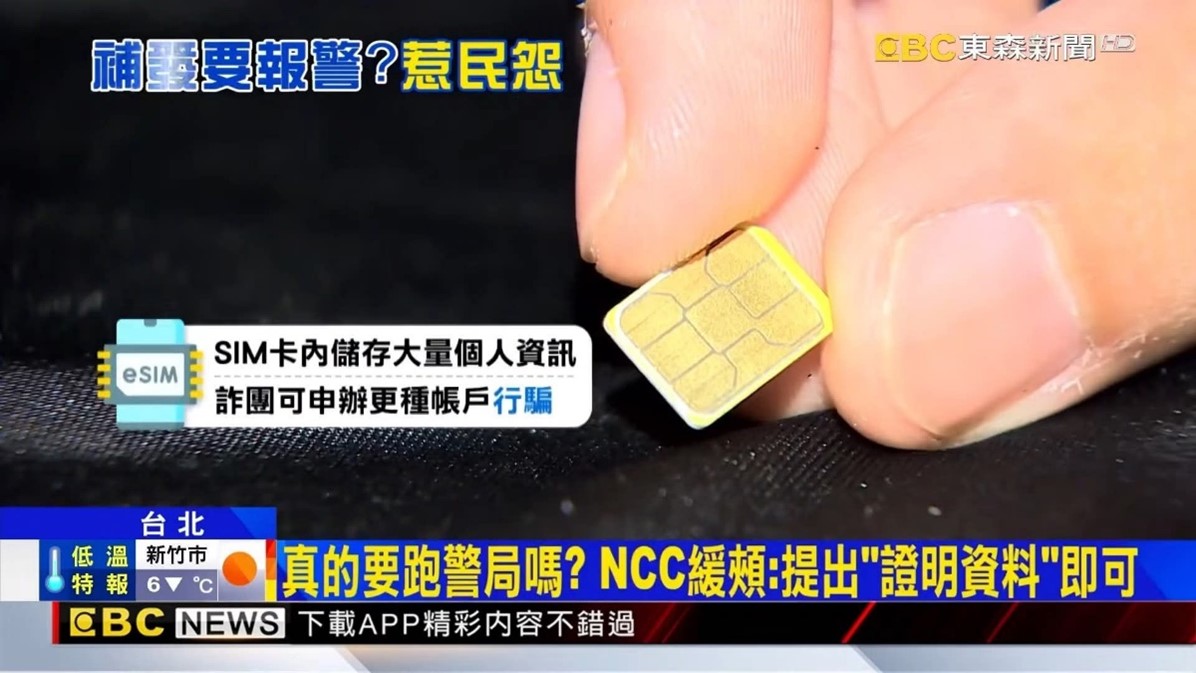
Image source: ETtoday News
1. What are the revised rules for replacing or reissuing SIM cards for mobile phone numbers?
Due to widespread public dissatisfaction over the requirement to report lost SIM cards to the police and obtain a two-part loss report form, the NCC, after consulting with the three major telecom operators, reached a consensus to “impose a limit on the number of times a SIM card can be replaced or reissued and to handle such cases flexibly.” If a SIM card is lost and the user is unable to provide a certificate or a police report from a local police station, they may submit a self-declaration form (affidavit) instead. If a user submits a self-declaration form, they will be subject to the “limit of two SIM card replacements per six-month period.”
Please note: If the applicant is a minor or an elderly person who is about to lose legal capacity and is unable to write a personal statement, a guardian or immediate family member must be present to assist with signing the affidavit and completing the card replacement or renewal process.
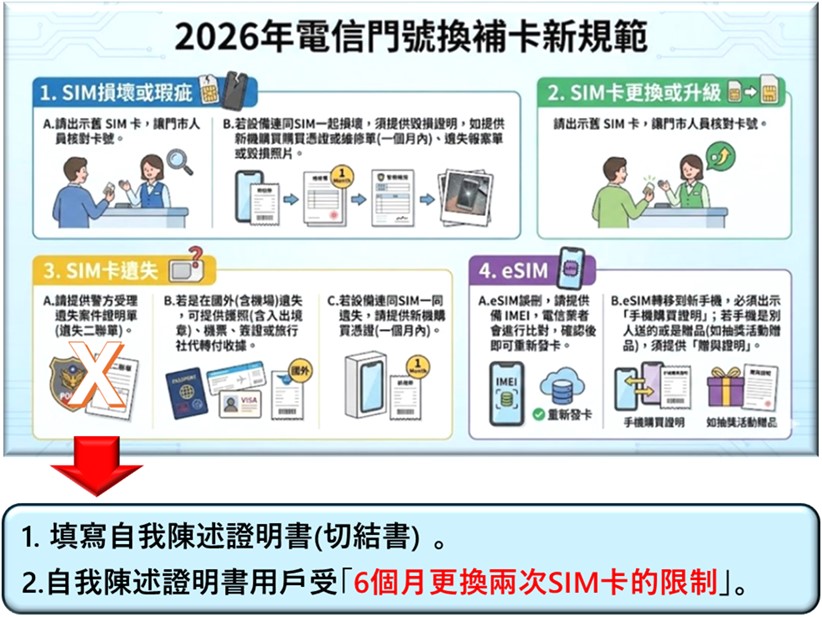
Chunghwa Telecom stated: “Effective December 30, 2025, when processing SIM card replacements or reissuances, as well as phone number changes, in addition to the existing identity verification procedures, our retail staff will ask customers to explain the reason and purpose of their application and provide relevant proof, including: presenting the old SIM card, proof of purchase (such as an invoice) for a recent device replacement; entry/exit records (such as a visa or boarding pass) for SIM cards lost while traveling abroad; or a screenshot of the mobile app prompt (e.g., LINE or Facebook) indicating an inability to register, when requesting a new phone number. If a customer is unable to provide the relevant supporting documentation, the company will review the customer’s recent history of SIM card replacements, number changes, and usage records, and will assist the customer with the process after having them complete the relevant explanatory forms.”
2. SIM cards contain a lot of personal information—would it be a big problem if I lost one?
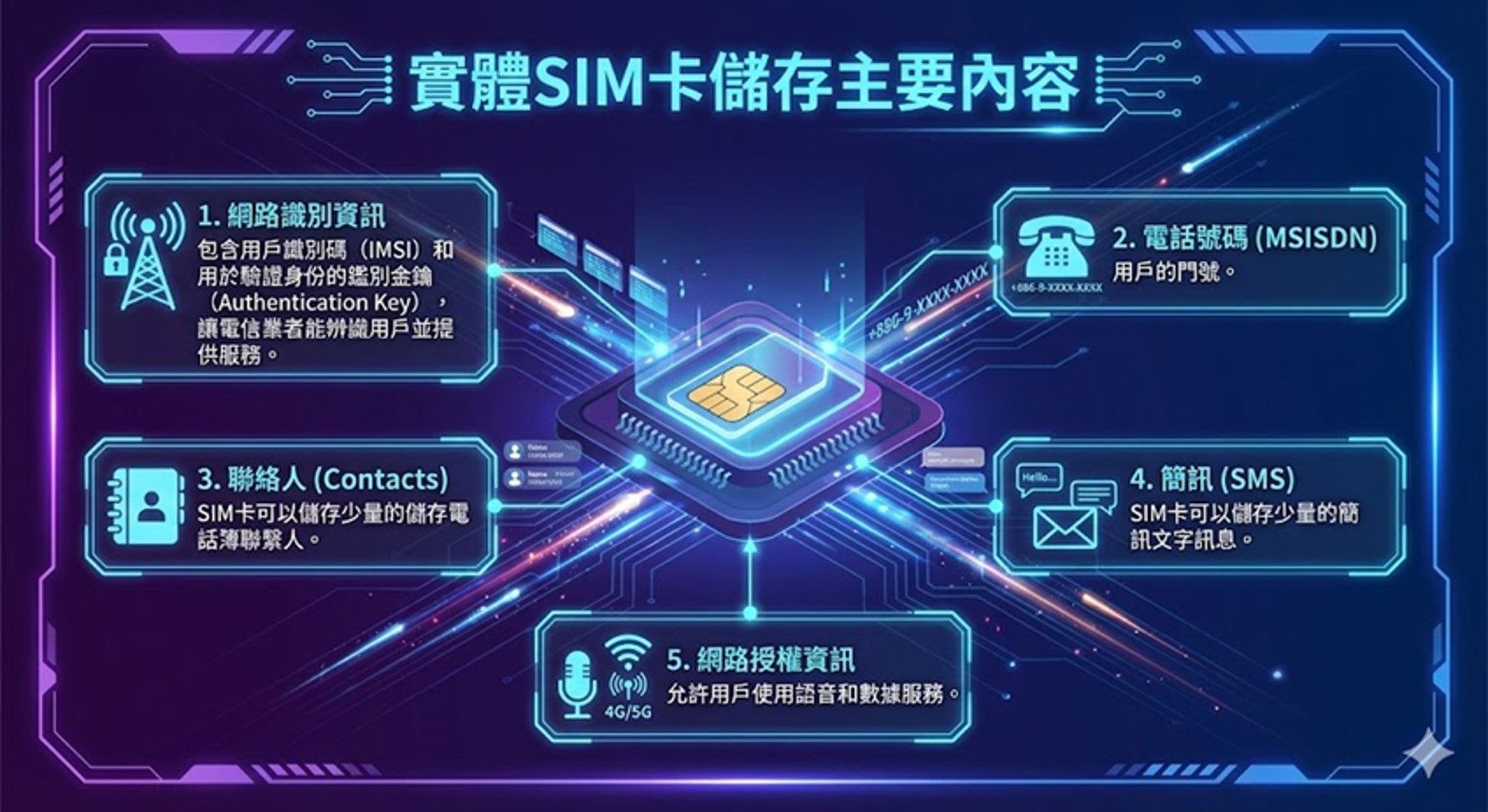
Due to their limited storage capacity, physical SIM cards primarily store network identification information (IMSI and Authentication Key), phone numbers (MSISDN), a limited number of contacts, a small number of text messages (SMS), and network authorization information.
A. Network Identification Information:
It contains the International Mobile Subscriber Identity (IMSI) and an authentication key used to verify identity, enabling telecommunications providers to identify users and provide services.
B. Phone Number (MSISDN):
The user’s cell phone number.
C. A small number of phone book contacts:
A SIM card can store a small number of contacts from your phone book.
D. A small number of text messages (SMS):
A SIM card can store a small number of text messages.
E. Online Licensing Information:
Allows users to use voice and data services.
Mobile phone contacts and text messages are stored by default in the cloud or on the phone,It’s not easy with a SIM cardCredit Card Thieves Steal Personal Information!
Among the data stored on a physical SIM card, network identification information and network authorization information are of no use to fraud rings. Phone numbers, a small number of contacts, and a few text messages can indeed provide some personal information; however, modern smartphones (whether iPhones or Android devices) are factory-set to store address book contacts and text message data either in the cloud or on the device itself (only older feature phones used to store contacts on the SIM card), The information a SIM card can provide to fraud rings is extremely limited, and the risk of personal data leakage resulting from the contents stored on a SIM card after it has been obtained by fraud rings is negligible.
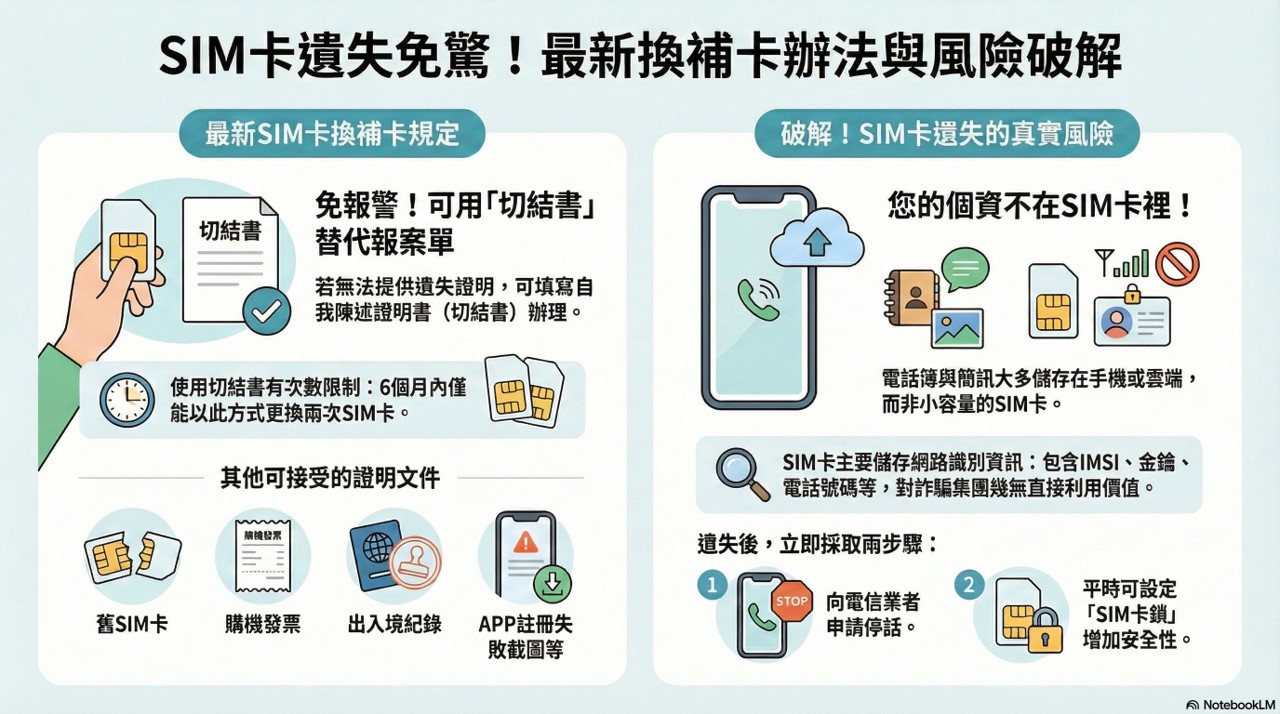
Although fraud rings in mainland China—due to the strict real-name registration system in place there—had for a time resorted to tricking or forcibly seizing SIM cards from children’s smartwatches to carry out scams, these groups primarily exploit the SIM cards they have stolen or seized toCell Phone Number…rather than the SIM card. As long as people report a lost SIM card to their telecom provider immediately to request a temporary service suspension or file a loss report, the SIM card will lose its communication capabilities, making it difficult to use for fraudulent activities!
In other words, the claim that the large amount of personal data stored on SIM cards is easily exploited by fraud rings is essentially alarmist.

Image source: TVBS
If you’re in the habit of storing your phonebook contacts or text message copies on your SIM card, in addition to the “SIM lock” feature provided by Chunghwa Telecom itself, you can also set up a “SIM lock” directly on your phone to prevent unauthorized access and use of your physical SIM card in the event of loss, which could cause unnecessary trouble.
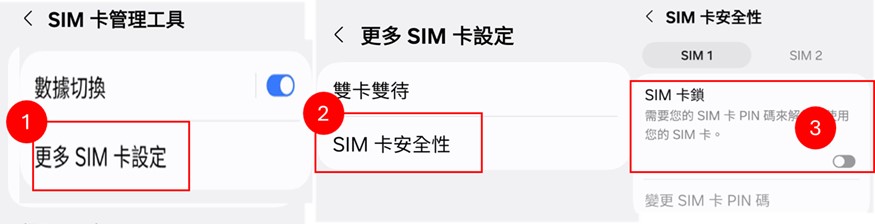
Source: KOCPC Chinese