


Google DeepMind The team officially announced a project called “TranslateGemma“The all-new AI TranslationModel Series—This set is based on Gemma 3 Built on an open-weight architecture, this model redefines the technical standards for edge computing and high-performance translation with its remarkable parameter efficiency: the 12B (12 billion parameters) version outperforms the 27B baseline model. The newly released TranslateGemma series covers three parameter scales—4B, 12B, and 27B—to meet deployment needs across various scenarios, from mobile devices to cloud servers, and is claimed to seamlessly handle 55 major languages, including Chinese.
Google Releases Open-Source Translation Model TranslateGemma
Google In their technical report, the research team noted that TranslateGemma was not built from scratch, but rather utilized a specialized two-stage fine-tuning process to distill the “intuition” and knowledge of Google’s state-of-the-art Gemini model into the open architecture of Gemma 3.
Phase 1: Supervised Fine-Tuning (SFT)
During the initial training phase, researchers fine-tuned the Gemma 3 base model using a highly diverse parallel corpus. This dataset did not rely solely on traditional human-translated texts but instead incorporated a large number of “high-quality synthetic translations” generated by the state-of-the-art Gemini model. This human-machine collaborative data strategy ensures that the model maintains extremely high accuracy and coverage even when processing low-resource languages.
Phase 2: Refining Reinforcement Learning (RL)
To further enhance the “accuracy, fluency, and elegance” of translations, Google has introduced an innovative reinforcement learning phase. Unlike previous approaches that relied solely on a single metric, this training employs an “ensemble of reward models,” integrating advanced evaluation metrics such as MetricX-QE and AutoMQM. These metrics act as rigorous mentors, guiding the model to generate translations that are not only semantically accurate but also contextually appropriate, resulting in natural and fluent sentences.
According to the WMT24++ benchmark results published by Google (evaluated using MetricX), the specially trained TranslateGemma demonstrated impressive performance that exceeded expectations.
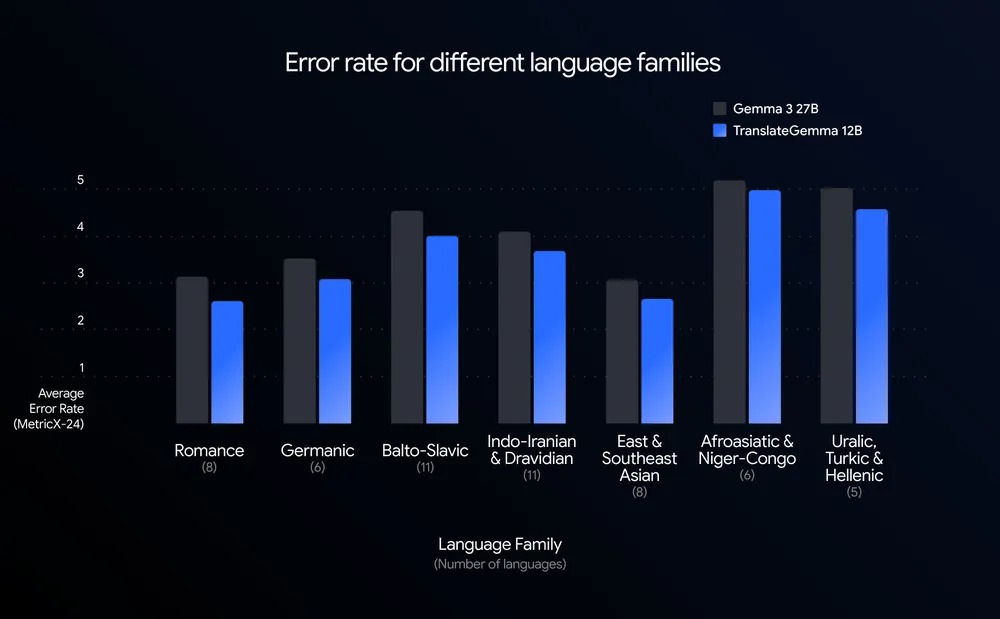
Data shows that,The 12B version of the TranslateGemma model actually outperforms the Gemma 3 27B model—which has more than twice as many parameters—in translation performance. For developers and businesses, this is a breakthrough with significant commercial value. It means that high-fidelity translation quality—which previously required expensive GPU clusters—can now be achieved with less than half the computational resources. Lower parameter requirements directly translate to higher throughput and lower latency, without sacrificing accuracy.
This efficiency advantage also extends to the lightest-weight Version 4B. In testing, the model demonstrated performance on par with the 12B model, making it an ideal choice for mobile devices and edge computing (Edge Deployment). This will enable future smartphones and IoT devices to provide real-time translation services comparable to server-level quality even without an internet connection.
Not only that, but since TranslateGemma is built on the Gemma 3 architecture, it inherently inherits powerful “multimodal” capabilities. This means the model is not just a text translator; it also has the potential to process visual information. According to Google’s tests, although TranslateGemma’s fine-tuning process focused primarily on text translation, it still performed exceptionally well on the Vistra image translation benchmark. The results confirm that improvements in text translation capabilities positively correlate with the model’s ability to “translate text in images.” This feature is undoubtedly a major boon for developers creating travel apps, AR glasses, or real-time road sign translation tools—all without the need for additional fine-tuning for multimodal tasks.
In terms of language support, TranslateGemma has demonstrated great ambition. The model has undergone rigorous training and evaluation and is capable of 55 Major LanguagesIt provides reliable, high-quality translations between these languages, covering widely spoken languages around the world such as Chinese, Spanish, French, and Hindi. Google’s research team also conducted a bold experiment: expanding the scope of training to nearly 500 additional language pairs. These languages often fall under the “long tail” of languages with scarce digital resources. Although Google acknowledges that it does not yet have specific evaluation metrics for this expanded set, it has provided a complete list in its technical report. The strategic significance of this initiative lies in positioning TranslateGemma as a “robust foundation,” encouraging researchers worldwide to use it as a starting point for further fine-tuning and optimization for specific low-resource languages, thereby breaking down language barriers in the digital world.
Flexible Deployment: Three Sizes to Suit a Variety of Scenarios
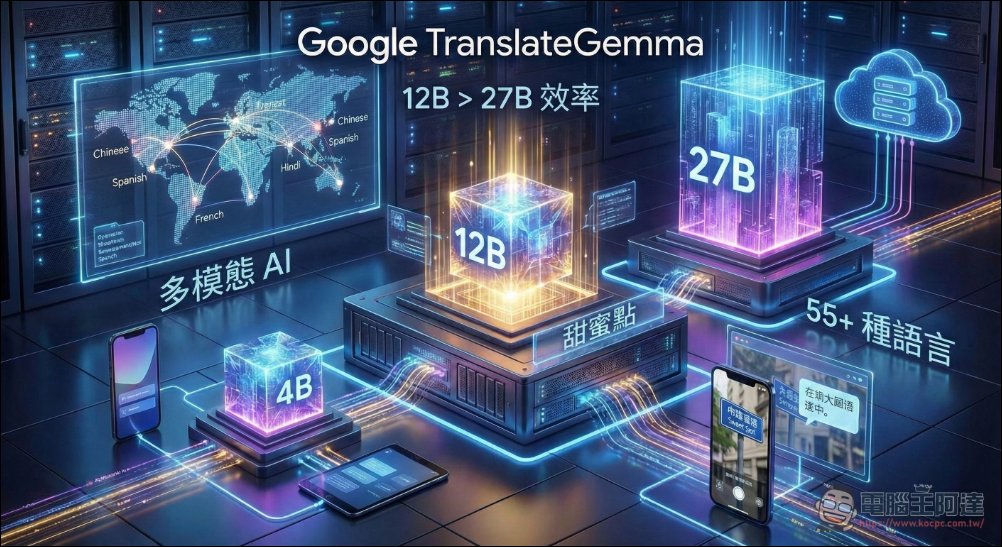
To accommodate a wide range of hardware environments, TranslateGemma offers three different scale options that precisely match varying levels of computing power:
-
4B Model (Mobile Optimization): Designed specifically for mobile devices such as smartphones and tablets, as well as edge computing, with an emphasis on low power consumption and real-time responsiveness.
-
12B Model (Consumer-Grade Powerhouse): This is the “Sweet Spot” model released today, designed specifically to run smoothly on consumer-grade laptops. It allows individual developers and researchers to enjoy research-grade translation performance in a local environment without relying on cloud computing power.
-
27B Model (Ultimate Performance): Built to achieve the highest translation fidelity, it is designed for use in cloud environments and can run on a single H100 GPU or TPU, making it suitable for large-scale batch processing tasks at the enterprise level.
The TranslateGemma translation model recently launched by Google will also have the following impacts on the general public and small and medium-sized businesses:
The Era of “True” Offline Translation Has Arrived (A Win-Win for Privacy and Convenience)
In the past, the “offline translation packages” we used on our phones were often stripped-down versions—with stiff translations, limited vocabularies, and a tendency to crash when encountering complex sentences. To get high-quality translations (such as those from the web version of Google Translate or ChatGPT), you have to connect to the internet and send the data to the cloud.
TranslateGemma’s 4B Model It was created specifically to solve this problem.
-
For General Users: Future travel apps or translation software will be able to provide translations on your phone that are nearly as smooth as those delivered online—even in airplane mode or on the streets of a foreign country without an internet connection.
-
Privacy Dividend: Since all processing is done on the phone (on-device), the text in your chat history, business documents, or personal photos doesn’t need to be uploaded to Google’s or any other company’s servers—which offers tremendous peace of mind for privacy-conscious users.
The translation capabilities of third-party apps will “skyrocket”
In the past, only tech giants like Google, Microsoft, or DeepL could afford to maintain high-quality translation teams and servers. Apps created by small developers—such as specialized novel readers, comic browsers, or travel guides—often had no choice but to integrate expensive APIs or rely on low-quality free translation services.
-
For General Users: Since TranslateGemma is “open-source” and “free,” this means independent developers can easily integrate this powerful translation engine into their apps. You’ll find that in the future, the translation quality of niche reading apps and gaming tools you use may suddenly become just as good as Google Translate—and they’ll usually be free.
The Popularization of “What You See Is What You Get” Visual Translation
TranslateGemma has inherited multimodal capabilities and is particularly adept at processing “text in images.”
-
YesGeneral Users: This technology won’t be limited to Google Lens. In the future, you may see more apps emerge that specialize in specific fields, such as:
-
Manga/Doujinshi Translator: Directly replace the dialogue in the Japanese manga with Traditional Chinese, ensuring the tone remains natural.
-
Shopping Assistance: Just snap a photo of the ingredient list at a drugstore abroad, and the app will accurately translate and explain technical terms—and it’s incredibly fast.
-
Accessibility for Speakers of “Less Commonly Taught Languages” (Breaking Language Hegemony)
Most current translation tools tend to prioritize major languages such as English, Chinese, and Japanese. TranslateGemma places a special emphasis on supporting low-resource languages and allows developers to fine-tune the translations.
-
For General Users: If you need to communicate with people who speak less common languages (such as certain Southeast Asian dialects or African languages), or if you want to learn these languages, more tools optimized for these specific languages will become available in the future, and their accuracy will far exceed that of current general-purpose translation software.
The launch of TranslateGemma marks a new balance between “performance” and “efficiency” in open-source translation models. By making Gemini’s advanced technology accessible to a wider audience, Google has not only lowered the barrier to entry for high-quality translation technology but also provided developers worldwide with powerful tools through support for multimodal capabilities and extensive language coverage. Currently, the entire TranslateGemma series of models has been made available on Kaggle and Hugging Face The platform is available for free download, and developers can also Vertex AI Deploy it in the cloud. As the community begins to explore the potential of this model, we can expect to see a surge of innovative translation applications based on this architecture in the future, further breaking down barriers to human communication.
Source: KOCPC Chinese