


A robotics AI company co-founded by former Mistral researcher Théophile Gervet and Chinese scholar Zhou Xian Genesis AIAfter a year of low-key development, it officially released its first robot foundation model on May 6 GENE-26.5At the same time, they unveiled a realistic robotic hand with human-like dexterity. The achievement caused an immediate sensation in both the robotics academic and industrial communities, being hailed as “the most mind-blowing robot demo so far this year.”
Genesis AI: From Open-Source Physics Engine to Full-Stack Robot Model
Genesis AI is no stranger to many in the open-source robotics community. In late 2024, the team released Genesis, an open-source physics simulation platform. This project, which can “generate a complete physical world from a single sentence,” quickly became the largest open-source robotics project on GitHub. The team then, in July 2025, with a valuation as high as $105 million(approximately NT$ NT$3.41 billionIts seed round financing set a record in Silicon Valley’s embodied AI track, co-led by Eclipse Ventures and Khosla Ventures, with former Google CEO Eric Schmidt and French telecom magnate Xavier Niel also participating in the investment.
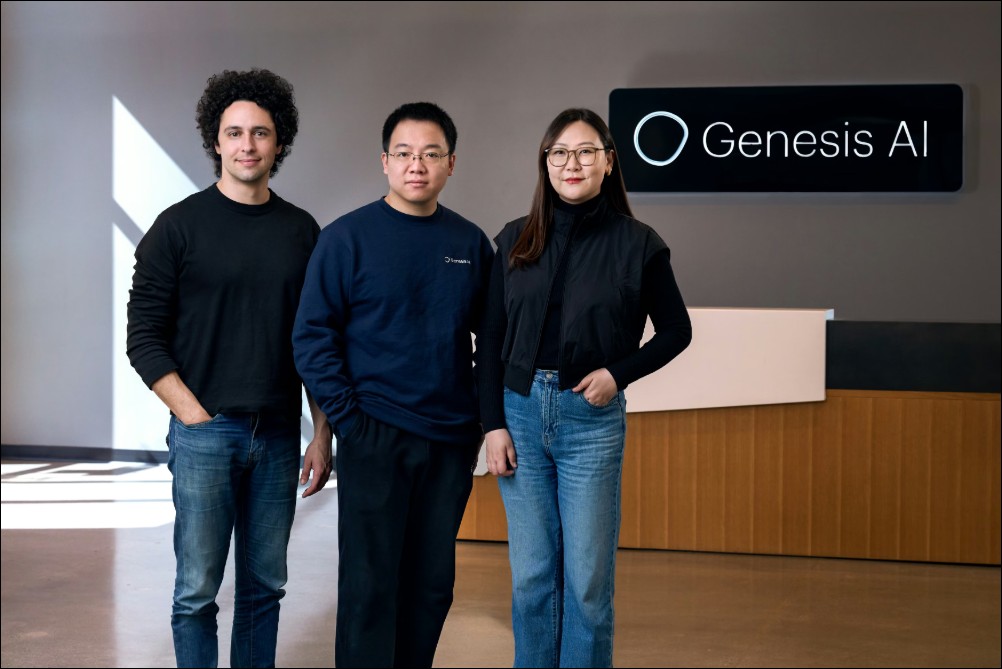
Nearly a year later, Genesis AI has finally delivered its first concrete result. GENE-26.5 is not simply a “robot brain,” but rather a full-stack solution encompassing models, hardware, data, and the control stack.
What can GENE-26.5 do?
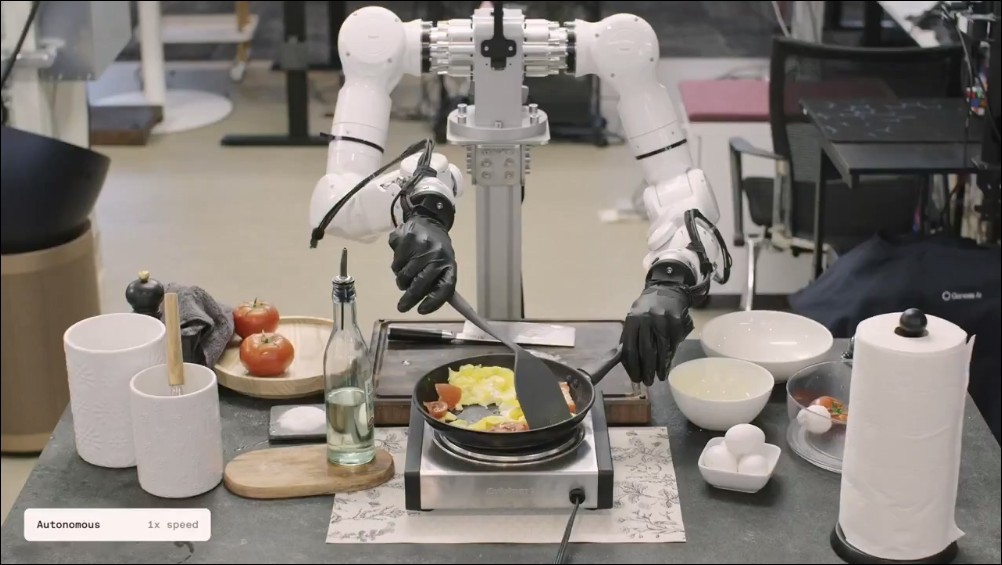
The official demo video shows GENE-26.5 at Long-term sequencing, fine force control, bimanual coordination, and tool use astonishing abilities in this area, and all tasks are 1x speed, the same model A solution designed for independent completion, rather than one specifically trained for a single Demo:
We are back. After one year of quiet building.
Introducing GENE-26.5, our first robotic brain that takes a major step toward human-level capability.
For years, robotics has struggled to learn from the world’s largest and valuable data source: Humans.
Solving it means… pic.twitter.com/ewHNRGuNnH
— Genesis AI (@gs_ai_) May 6, 2026
Cooking Task (approx. 4 minutes, 20+ sub-steps): Robots need to crack eggs with one hand, cut tomatoes, use towels, a salt mill, a whisk, knives, a spatula, and a frying pan, while also performing bimanual coordination—these are extremely challenging tasks for traditional robotic systems.
2/
GENE-26.5 cooks in an unsimplified, real-world setting with more than 20 subtasks. pic.twitter.com/niadsRhyTA
— Genesis AI (@gs_ai_) May 6, 2026
Laboratory Pipetting: In near-commercial deployment scenarios, robots must grasp pipettes, attach tips, transfer liquids, seal test tubes, press centrifuge buttons, and place tubes into the rotor, requiring millimeter-level precision and stable manipulation of small objects.
3/ 在实验室中以毫米级精度操作复杂工具。pic.twitter.com/ppAMfsw8oM
— AI Will (@FinanceYF5) May 7, 2026
Solving the Rubik’s Cube: Genesis claims this is the industry’s first time a general-purpose bimanual robot system has solved a Rubik’s cube, not by relying on specialized mechanical grippers, but by having an external solver generate action commands that the model then executes precisely.
4/ 解魔方一直是机器人操作的长期挑战性基准任务。
该任务要求在魔方自身的几何和运动约束下进行精细控制。
此前的最先进方法仍是 OpenAI 2019 年的单手解法。
这是第一次GENE 实现了双手协作解魔方。pic.twitter.com/o8rBVSZH8w
— AI Will (@FinanceYF5) May 7, 2026
Playing the piano: Robots even took on the notoriously difficult piano piece “Rush E”, which most humans struggle to master.
9/
And plays piano. pic.twitter.com/iIma4YvVQY
— Genesis AI (@gs_ai_) May 6, 2026
Wire Harness Organization: One of the “holy grail” tasks in the automotive industry involves handling soft objects like cables and adhesive tapes, requiring bimanual coordination and highly precise force control.
8/
Does wire harnessing. pic.twitter.com/cRhPxhw8v0
— Genesis AI (@gs_ai_) May 6, 2026
Key Breakthrough: Full-Stack Self-Development + Humanoid Hands
Unlike other teams focused on training a single “robot brain,” Genesis AI chose a more difficult path:Full-stack self-developedFundamentally address the long-standing data, hardware, and control coordination challenges in robot dexterous manipulation. In terms of hardware, Genesis AI showcased a brand-new 1:1 Lifelike Humanoid Robot HandIts structure is closer to the human hand than traditional industrial mechanical grippers, allowing human movements to be mapped more directly onto robots.
In terms of data collection, the team developed Non-invasive wireless sensing gloveTrainers simply wear gloves and a head-mounted camera to repeatedly demonstrate everyday tasks, and the system records motion, force, and tactile data in full. This is then combined with vast amounts of online videos to train the model. This end-to-end training system significantly reduces data acquisition costs.
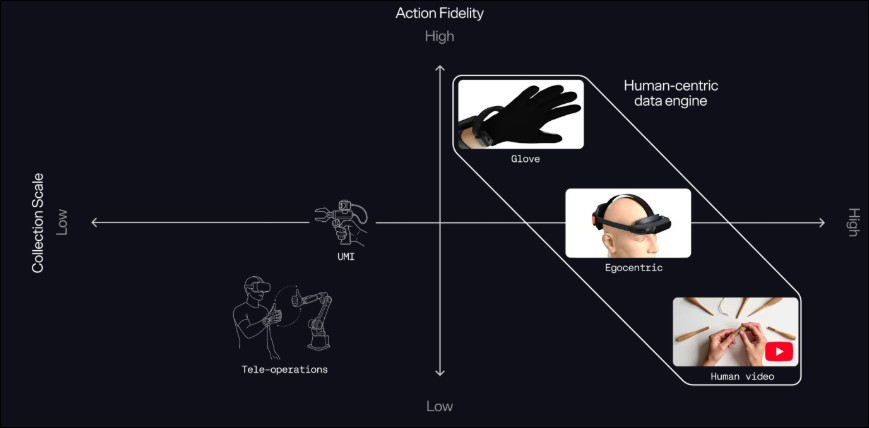
In terms of model architecture, GENE-26.5 employs a Transformer architecture, integrating visual, linguistic, and tactile multimodal information to generate precise motion control commands. Zhou Xian stated at the product launch event:GENE-26.5 enables robots to quickly learn new skills like humans, through observation and language commands.」
Speed and precision are the core highlights of this model update. According to official data, when tracking a 15 cm diameter circular trajectory, Genesis’s self-developed control middleware reduced the average tracking error from approximately 20 millimeters dropped to about 2 millimetersend-to-end latency from approximately 80 milliseconds Reduced to the lowest 3 millisecondsSuch performance is already close to the fluidity of human operation.
Commercialization prospects
Although Genesis AI has not yet announced a specific commercialization timeline, the company has stated that GENE-26.5 can be used to power various robotic hardware, including equipment from other manufacturers. Currently, in-depth discussions are underway with potential customers in France, Germany, and Italy.
From an open-source physics engine at the end of 2024, to a record-breaking seed round in 2025, and now the debut of GENE-26.5, Genesis AI has charted a path distinctly different from most robotics startups. If the team can maintain the same level of execution in the upcoming mass production and deployment phase, then the “robotics endgame” may truly be just beginning.
Source: KOCPC Chinese