


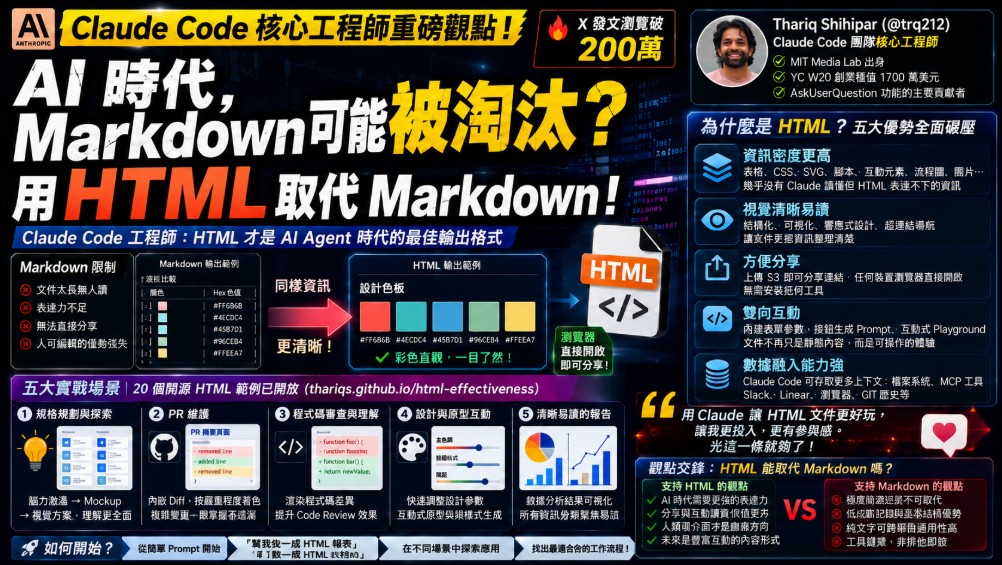
Could the Markdown file format, currently the mainstream in the AI industry, become obsolete? Anthropic Claude Code team core engineer Thariq Shihipar (@trq212) posted an article titled” on X on May 9Using Claude Code: The Unreasonable Effectiveness of HTMLThe article garnered over 2 million views within just a few hours, sparking a heated discussion in the tech community about “what format should be used for output in the AI Agent era.” In the article, Thariq boldly argues that HTML should replace Markdown as the primary output format when collaborating with AI.
Thariq Shihipar is not your typical engineer. He’s a core member of Anthropic’s Claude Code team, and nearly every major Claude Code feature gets announced first by him on X. Before joining Anthropic, his resume was already impressive: MIT Media Lab graduate, founded a game company that raised $17 million in Y Combinator’s W20 batch. His reason for joining Anthropic is quite interesting—in his own words, it’s “AI psychosis.” He’s convinced that Claude Code is the future of software development. Boris Cherny, the father of Claude Code, has a hiring standard of “ex-founder, high agency” (someone who’s started a company and has strong execution skills). Thariq fits both criteria perfectly.

After joining the Claude Code team, he took responsibility for three areas: engineering, content, and user feedback. His most notable contribution was the AskUserQuestion feature—which enables Claude to proactively ask questions when information is insufficient, rather than making wild guesses. In March of this year, he wrote a long article about how Claude Code uses Skills internally, revealing that Anthropic has hundreds of active Skills running—far more than outsiders had imagined.
Claude Code’s Core Engineer Calls for Ditching Markdown in Favor of HTML
Thariq acknowledged that Markdown was once a great tool—simple, lightweight, cross-platform, and ideal for version control. Claude could even create decent charts using ASCII art within Markdown. However, as AI Agent capabilities have advanced rapidly, the limitations of Markdown have become increasingly apparent:
Document is too long, no one reads it“Markdown files over 100 lines? I basically won’t read them, let alone get the rest of the team to read them.” Thariq said bluntly.
Insufficient information presentation skills: When Claude Code wants to display a design color palette, it can only produce dull gray boxes made of ASCII characters in Markdown—the hex color codes are accurate, but visually they’re impossible to distinguish. When the same information is output as HTML instead, it becomes clear, distinguishable color blocks that are immediately obvious.
Sharing is a hassle Markdown files cannot be rendered directly in browsers and can only be sent as attachments. When you upload HTML files to S3 and share the link, anyone can open them directly on any device.
The biggest advantage is disappearing: Markdown’s biggest advantage was that it was “easy for humans to edit,” but as AI gets stronger, users increasingly edit these files manually less and less, letting AI do the modifications instead. This advantage has essentially become obsolete.
Why HTML?
Thariq argues the advantages of HTML from five perspectives:
Information density HTML can carry far more information than Markdown. Beyond basic headings and formatting, HTML can also express: tabular data (table), styling information (CSS), illustrations (SVG), code snippets (script tags), interactive elements (JavaScript), workflow diagrams, spatial data (absolute positioning + canvas), as well as images. Thariq even said: “There’s almost no information that Claude can read but HTML cannot express.”
Visual clarity and readability Claude can organize HTML document structure for easier navigation using tab grouping, illustrations, and hyperlink navigation, and can even implement responsive design.
Feel free to share. Upload an HTML file to get a shareable link. No installation needed — colleagues can view it directly in their browser.
Two-way interaction This is one of HTML’s killer features – you can add sliders to documents to adjust design parameters, add buttons to copy your adjustments as a Prompt to paste back into Claude Code, and even turn documents into an interactive Playground.
Data ingestion capability The main reason to choose Claude Code (instead of Claude.ai or Claude Design) for generating HTML is that it can handle significantly more context — the file system, MCP tools like Slack and Linear, the browser, Git history, and more.
Practical Use Cases: 5 Scenarios with 20 Open Source Examples
Thariq open-sourced all 20 HTML files that he and his team created using Claude Code on GitHub Pages (thariqs.github.io/html-effectivenessDivided into nine major categories by purpose, the following are the five core scenarios:
Specification Planning and Exploration Instead of writing a simple Markdown proposal, generate a complete set of HTML files: first have Claude Code brainstorm different options, then develop detailed mockups, and finally create an implementation plan. This way, when the Agent reads in these HTML files, its contextual understanding of the requirements will be much more comprehensive.
PR Summary Instead of telling Claude to “summarize this PR in Markdown,” tell it to “generate a self-contained HTML PR guide with inline annotations highlighting important diff regions, color-coded by severity, plus a manual verification checklist at the bottom.” This gives reviewers a focused review interface instead of a wall of bullet points.
Code Review and Understanding: Use HTML to render code diffs, improving code review effectiveness.
Design and prototype interactionHTML can quickly sketch out designs, showcase layouts and interactive effects, and even add sliders for adjusting parameters.
Generate clear, easy-to-read reportsConvert complex analysis results into a navigable HTML report.
Point/Counterpoint: Can HTML Really Replace Markdown?
Of course, this isn’t unanimous support. Some developers point out that Markdown still has irreplaceable advantages for lightweight note-taking, Git version control diff comparisons, and plain text portability. There’s also the view that this is more of a “tool selection” issue: use HTML when outputting content for human readers, continue using Markdown for line-by-line maintained specification documents—each has its own suitable use cases. Notably, just a few months ago, Cloudflare launched a “Markdown for Agents” feature that converts HTML web content at the source into Markdown format more suitable for AI crawlers, demonstrating that even within the same wave of AI agents, Markdown and HTML each have their own irreplaceable positions.
How do I get started?
Thariq suggests not rushing to create an “always respond in HTML” Skill. The key is understanding what you want this Artifact to do and how you plan to use it. Start with simple prompts: “Help me create an HTML file” or “Create an HTML artifact,” and gradually explore usage across different scenarios. As you accumulate experience, you’ll naturally find the workflow that works best for you.
Source: KOCPC Chinese