


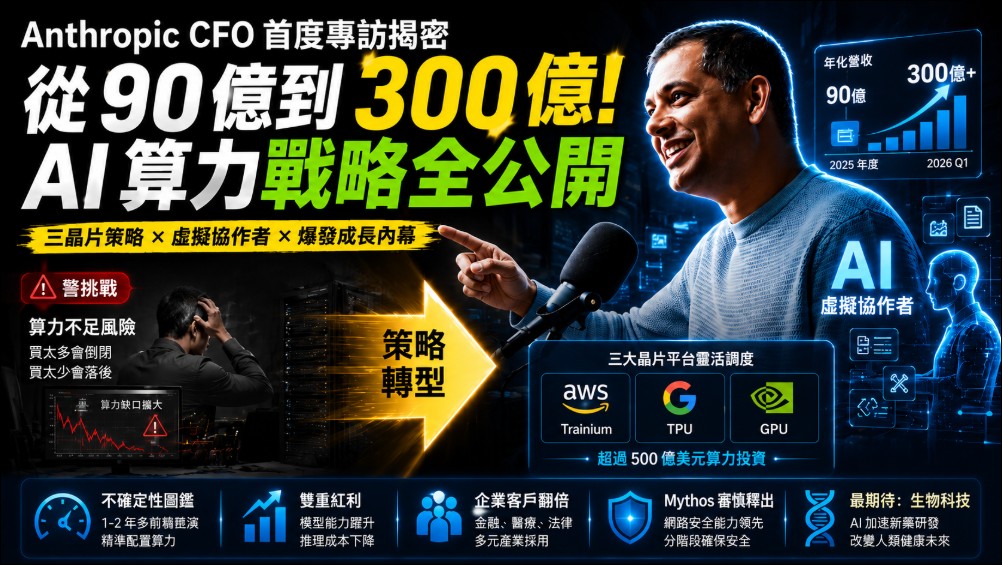
Anthropic CFO Krishna Rao recently made his debut on a podcast, appearing on Patrick O’Shaughnessy’s “Invest Like the Best” to offer a rare glimpse into the inner workings of this AI leader. From the company’s annual multi-billion-dollar compute allocation and its three-pronged chip strategy, to how company culture impacts talent retention—the 76-minute deep dive represents the first opportunity for outsiders to understand Anthropic from a CFO’s perspective, tracing its remarkable growth trajectory from $9 billion in annualized revenue just a year ago to over $30 billion projected this year. This was also Krishna Rao’s first public interview since joining Anthropic two years ago. Previously, outside knowledge of Anthropic’s financials and operations had been limited, making this interview an unprecedented inside look.
“Cone of Uncertainty” for Compute Allocation
At the start of the interview, Rao pointed out the fundamental importance of compute for Anthropic: “Compute is the lifeblood of our business, the canvas for everything.” He stated directly that compute procurement is one of the most difficult and impactful decisions within the company: buy too much and you go bankrupt, buy too little and you can’t serve customers or stay at the frontier.
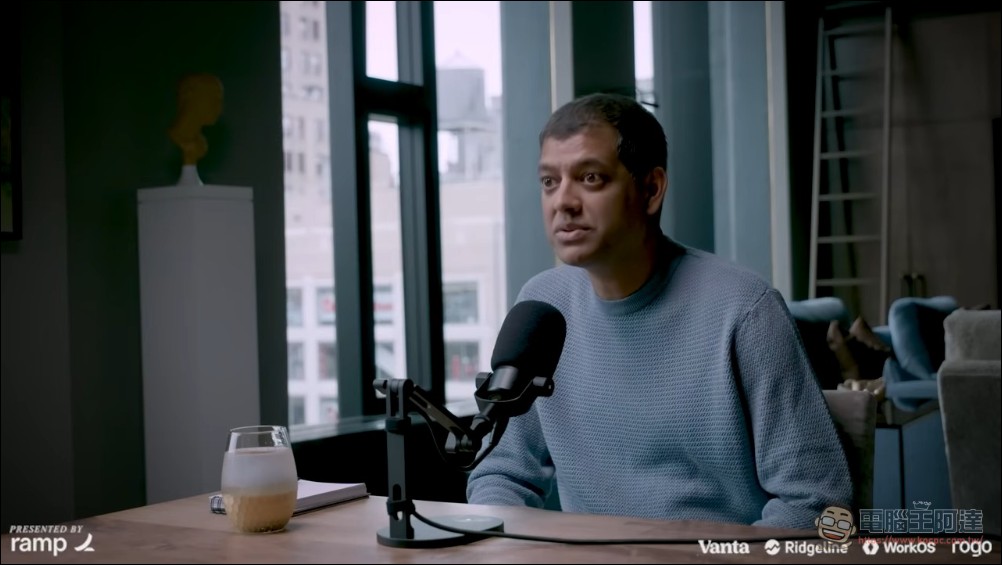
Rao introduced a core concept: the “Cone of Uncertainty.” Since Anthropic’s business is growing exponentially, minor fluctuations in monthly or weekly growth rates, compounded over time, lead to vastly different outcomes. Therefore, the company must consider multiple scenarios simultaneously, projecting backward over a 1 to 2 year timeframe to ensure sufficient compute capacity regardless of where they land on the cone.
He revealed that even today, he still spends 30% to 40% of his time on computing-related matters.
Flexible scheduling of three chip platforms
In the interview, Rao revealed one of Anthropic’s most distinctive technical strategies: simultaneously using three major chip platforms—Amazon’s Trainium, Google’s TPU, and NVIDIA’s GPUs. Anthropic views these three chips as “interchangeable resources,” dynamically allocating them based on the characteristics of different workloads.
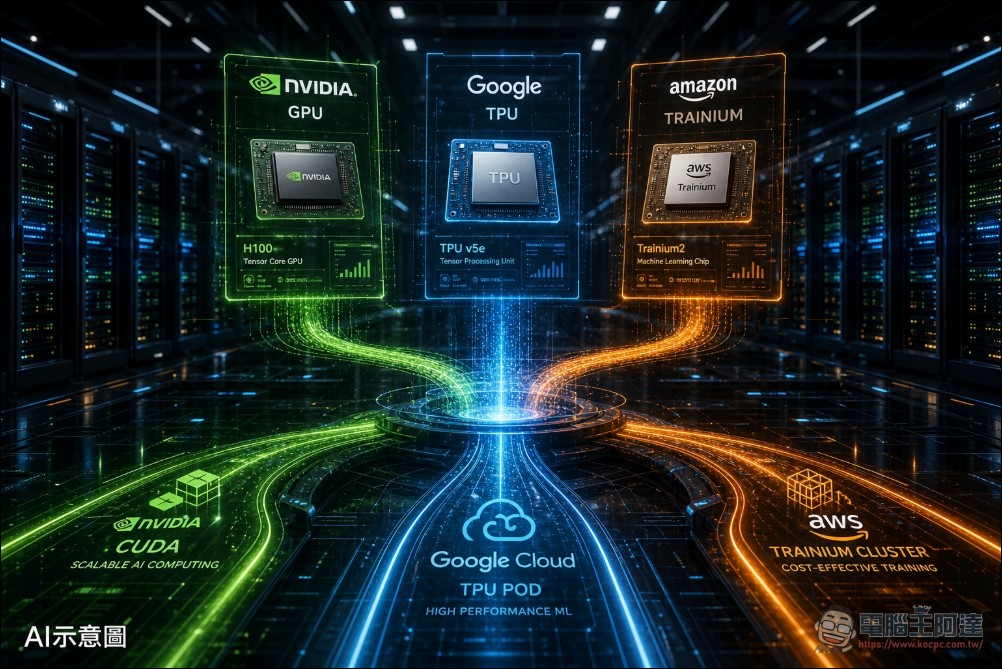
He pointed out that this flexible allocation capability wasn’t achieved overnight—it took years of investment to build. As early as the third-generation TPU era, Anthropic was already using non-NVIDIA solutions at scale. At the time, people widely questioned, “Everyone uses GPUs, so why don’t you?” But looking back now, this multi-chip strategy has made Anthropic “the most efficient compute user among frontier labs.”
To achieve this flexibility, Anthropic even developed its own compiler, customizing at the chip level to maximize ROI for each chip internally. According to SemiAnalysis, Anthropic has committed over $50 billion in cumulative compute investments across three major chip suppliers.
The tri-chip strategy is Anthropic’s key weapon against NVIDIA’s dominance. While OpenAI and most competitors are heavily dependent on NVIDIA GPUs, Anthropic is diversifying risk through AWS Trainium and Google TPUs, while also gaining greater bargaining power in price negotiations.
Three buckets of compute power allocation
Rao further broke down Anthropic’s internal compute allocation logic, which can be roughly divided into three aspects: model training and R&D, internal employee usage, and customer service. He emphasized that the company’s culture is highly collaborative, and compute allocation is not a zero-sum game, but rather determined through open discussion and ROI evaluation.
One key principle is that there is a “non-negotiable floor” for the computing power allocated to model development—Anthropic will not cut R&D compute even if it means customer service takes a hit. The company believes the returns on frontier intelligence are exceptionally high, especially in the enterprise market.
The “R&D compute floor” reflects Anthropic’s long-term thinking: short-term revenue matters, but maintaining technological leadership is the key to survival. Rao noted that if all the compute used by internal employees were redirected to serve customers, it could generate an additional several billion dollars in revenue, but the company chose to sacrifice short-term interests for long-term competitiveness.
The dual dividend of model efficiency
When it comes to compute efficiency, Rao used a vivid analogy: most people think upgrading to a more powerful model is like switching from an RV to a sports car—performance increases but fuel efficiency worsens. But in Anthropic’s experience, going from Opus 4 to 4.5, 4.6, and then to 4.7, each model iteration not only brought significant leaps in capability but also improved reasoning efficiency simultaneously, sometimes even being several times faster than the previous generation.
This means Anthropic can simultaneously enjoy the dual benefits of enhanced capabilities and reduced costs. More efficient models not only make it cheaper for customers to use, but also make internal reinforcement learning (RL) training more cost-effective, since RL is essentially large-scale inference combined with reward functions.
This explains why Anthropic can maintain relatively healthy gross margins while revenue has surged. Each new model release isn’t just a leap in capability, but also a decrease in unit cost.
The astonishing leap from 9 billion to 30 billion
In the interview, Rao confirmed Anthropic’s explosive growth data: annualized revenue of approximately $9 billion (approximately NT$292.5 billion) at the end of 2025, which exceeded $30 billion (approximately NT$975 billion) by the end of Q1 2026—a more than threefold increase in just over three months.

He attributes this growth to a combination of several factors: multidimensional advances in model intelligence, not just traditional IQ score improvements, but also significant improvements in long-horizon task execution, tool use, computer use, and agentic task performance. Each new generation of models unlocks a larger total addressable market (TAM), and when enterprise customers discover new use cases, they dramatically increase usage.
According to PYMNTS, Anthropic’s enterprise client count doubled during this growth wave, spanning diverse industries including financial services, healthcare, and legal.
$30 Billion Annualized Revenue Comparison: AWS took 13 years to reach this milestone. Anthropic achieved $30 billion in roughly 5 years from its founding, underscoring an unprecedented growth pace in AI industry history.
Vision for Virtual Collaborators
Rao described Anthropic’s ultimate product vision: the “virtual collaborator.” This isn’t a simple chatbot, but an AI agent with organizational context, access to proprietary tools, memory capabilities, the ability to learn from mistakes, and the capacity to handle complete projects over extended time horizons.
He cited Claude Code as the best practice case for this vision: Anthropic has already started using an entire fleet of agents to handle different tasks simultaneously, so product development is no longer a three-month project cycle but shipping every day. Everyone has become a manager managing agents.
The Prudent Release of the Mythos Model
Rao also discussed the Mythos model, which has recently drawn significant attention. He noted that Mythos is an extremely powerful general-purpose model across many dimensions, but its capabilities in the cybersecurity domain are particularly outstanding—where the previous model found 22 security vulnerabilities in an open-source codebase, Mythos found 250.
This marks the first time Anthropic has decided not to release a model through conventional means. The company chose a phased release strategy, first providing access to small-scale, specific groups, focusing on defensive applications, and accumulating safe deployment experience in the process. According to the NYT, Anthropic estimates that other organizations will also release models with similar capabilities within 18 months.
Mythos’s phased release can be seen as a practical demonstration of Anthropic’s responsible AI philosophy. Compared to OpenAI and Google’s “ship now, patch later” approach, Anthropic has chosen a more cautious path, but this comes with business trade-offs.
Company Culture and Talent Attraction
Rao devoted considerable space to discussing Anthropic’s distinctive company culture. All seven co-founders remain with the company to this day, as do the vast majority of the first 20 to 30 employees. When competitors like Meta tried to poach talent with astronomical salaries, Anthropic “only lost two people, while other labs lost dozens”—an impressive statistic.
He attributes this to the culture interview system, where candidates won’t be hired even with perfect technical scores if they don’t meet cultural standards. The company culture emphasizes collaboration, humility, and intellectual honesty. CEO Dario Amodei holds all-hands meetings every two weeks where any question can be asked, creating a highly transparent environment.
In the AI talent war, Anthropic is using culture rather than salary to retain people, and this strategy seems to be working in the short term. But as competition intensifies, whether such an advantage can be sustained is worth watching.
The Most Exciting Future: Biotechnology
When asked what excites Rao most, his answer isn’t more powerful models or more computing power, but biotechnology and healthcare. He paints a picture of a world where when you’re diagnosed with a currently incurable disease, AI can accelerate finding a treatment within your lifetime so you won’t die from that disease.

He believes AI holds tremendous potential in drug discovery. The complexity of molecules and how tiny changes can have outsized effects on outcomes make it an ideal setting for AI to shine. When lab throughput increases tenfold or even a hundredfold, humans will be able to discover new drugs at an unprecedented pace.
This podcast episode is really great, and it also has CC translated Chinese subtitles, so I recommend everyone check it out:
Conclusion
This interview marks not only Krishna Rao’s personal debut but also Anthropic’s most comprehensive public disclosure of its internal operations to date. From compute allocation to chip strategy, from product vision to talent philosophy, it paints a picture of a company defining AI’s future and how it maintains direction amid unprecedented growth. And the story Rao shared at the end—about his brother sacrificing his own choices so he could attend a good university—perhaps also explains why a CFO would stay at such a company.
Source: KOCPC Chinese