


There’s an old saying in the blockchain world: “Not your keys, not your coins.” But if the private key still exists and you simply forgot the password, does that still count as your coins? A netizen going by the handle “cprkrn” bought 5 bitcoins back in 2015 when the price was still relatively affordable—at the time worth only around NT$40,000. Today, those assets have ballooned to nearly $400,000, yet he hasn’t been able to access them for years because he changed his password while stoned out of his mind. In his quest to cash out these bitcoins, he tried everything from traditional brute-force methods to professional data recovery services, all to no avail. In the end, he managed to retrieve his private key by feeding his entire old college laptop into Anthropic’s AI model Claude, which sifted through mountains of chaotic backup files to locate the “correct wallet.”

The story went viral after being posted on X, but here’s the thing: Claude didn’t “crack” Bitcoin’s SHA-256 encryption — what it did was something most engineers would do when faced with a jumble of chaotic backup files, but never imagined could be applied this way: piecing together scattered clues into a complete puzzle-solving narrative.
HOLY FUCKING SHIT OMG CLAUDE JUST CRACKED THIS SHIT, THANK YOU @AnthropicAI THANK YOU @DarioAmodei NAMING MY KID AFTER YOU 😍https://t.co/gObNirRDpS https://t.co/ByTdIM4d20 pic.twitter.com/xB5LUJb6Pe
— 🍜 (@cprkrn) May 13, 2026
Why did I forget my password? Turns out it was because I got scammed.
In 2015, when Bitcoin was still hovering around $250, cprkrn met a LocalBitcoins seller online and, using a coffee meetup as an introduction, bought these 5 Bitcoin at Starbucks. In those days, most people’s understanding of Bitcoin was still停留在 the “online game currency” stage—no one expected it to break through $126,000 a decade later. cprkrn stored his wallet on the Blockchain (Blockchain.com) platform and went on with his life.
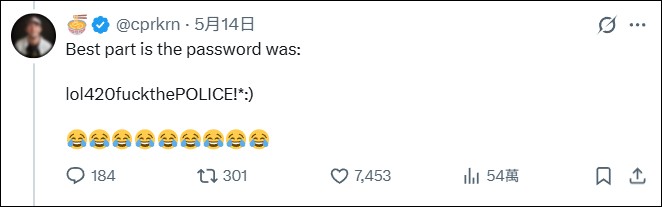
According to cprkrn’s later recounting on X, the tragedy unfolded one night in 2015 when, after smoking weed, he got the urge to change his wallet password. The marijuana didn’t just mess with his judgment—it completely wiped his password memory. He could only remember the “two components” of the new password (lol, 420), but the third one just wouldn’t come back to him. And that final “element” later turned out to be a profanity mocking police, along with a few symbols, making up the final password: “lol420fuckthePOLICE!*:)」。
A grueling 11 years of repeated unlock failures
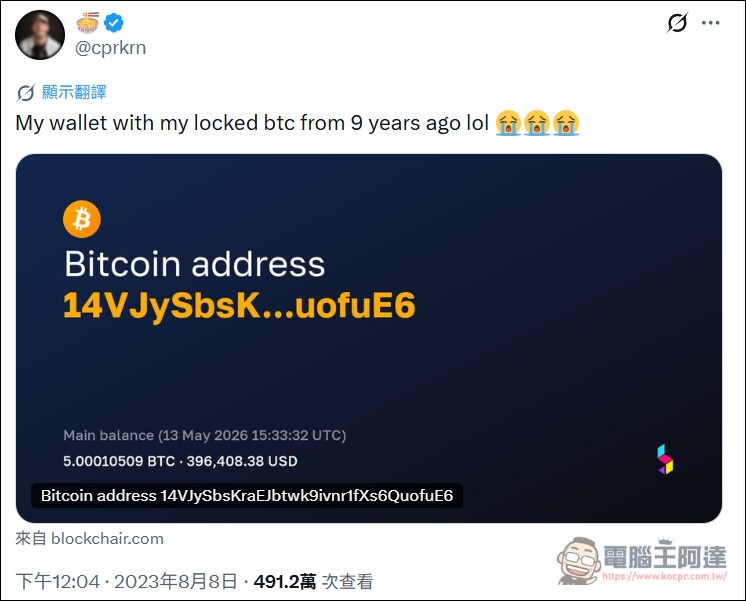
Eleven years is more than enough time for Bitcoin holders to create wealth legends. Five bitcoins grew from $1,250 to over $400,000, a gain of more than 300 times. Yet throughout this period, cprkrn could only watch his assets multiply while being unable to access a single dollar. It’s not as though he hadn’t tried to help himself:
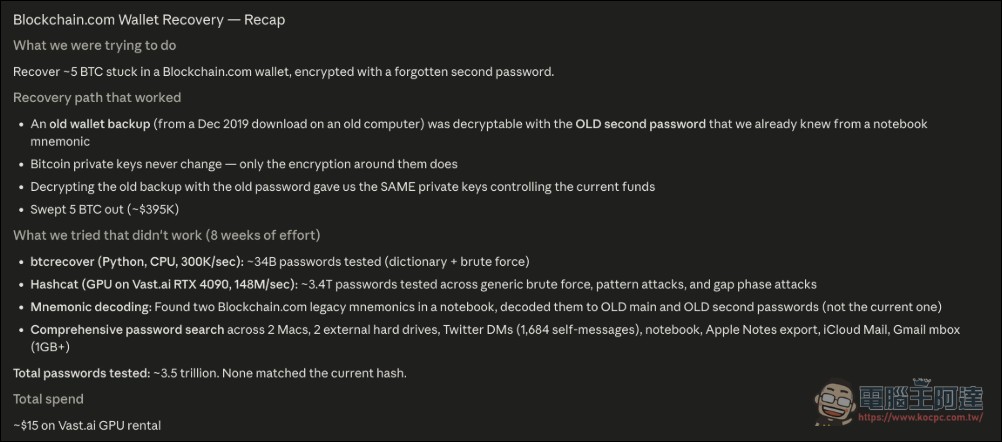
- Traditional brute-force attackUsing the open-source tool btcrecover on rented GPU computing power, I ran through over 3.5 trillion password combinations at a cost of only about $15, but still came up empty.
- Professional Data Recovery Services:Tried to get help from the industry, but came back empty-handed
- Physical Search:Once drove back to my parents’ house and rifled through every box and cabinet looking for my old college notebooks.
- Mnemonic Adventure:Miraculously found the original seed phrase a few weeks before the breakthrough, but when I tried to use it, it couldn’t unlock the current wallet file.
The “mnemonic phrase not matching the wallet” deadlock had also driven him to post desperately on X seeking help back in 2023, but at the time all he got was mockery from other netizens.
A game changer: dumping all my laptop data into Claude
cprkrn later stated that he uploaded all the contents of his college laptop—including various backup files, documents, code snippets, notes…—all at once to Anthropic’s Claude AI. Over eight weeks, Claude scanned and analyzed file by file, and finally found a key file that most people would have overlooked: a file with timestamp December 2019 Old wallet backup
The significance of this discovery is that Bitcoin private keys, once generated, theoretically never change. Over the years, cprkrn had been trying to use the mnemonic phrase to unlock “the current wallet file,” but his password was actually set at some earlier point in time, and the wallet structure had never been updated since. In other words, the key that could actually decrypt with the mnemonic phrase exists in that old 2019 backup, not in the current wallet he had been desperately trying to crack.
When Claude located the correct backup file and confirmed it matched the mnemonic phrase found earlier, the miracle happened: the private key was successfully decrypted and converted to WIF format, allowing the assets to finally be transferred. cprkrn immediately moved all 5 bitcoins to a new wallet address. At the Bitcoin price at the time (approximately $79,000 per coin), the total value came to about NT$12.7 million.
Claude is just solving puzzles, not actually cracking anything.
Bitcoin’s use of elliptic curve cryptography (ECDSA) and the SHA-256 hash algorithm means that, theoretically, a 256-bit keyspace makes it impossible to crack through brute force using all computing resources in the world within a reasonable timeframe (unless quantum computers are eventually realized and can operate stably). In this incident, Claude did not at all touch upon the underlying cryptographic security assumptions of Bitcoin.
What does Claude actually do
In this incident, Claude’s actual contributions are threefold:
First, file identification and semantic analysis: In a hard drive full of various code, images, documents, and compressed files, can Claude understand which files are “wallet-related,” which are wallet backups, and which are irrelevant game saves?
Second, logical fallacy detection: While auditing btcrecover’s source code, Claude discovered a logical error where the concatenation order of the shared secret key and user password was reversed, which explains why the tool still fails to decrypt even when the password combination is theoretically correct.
Third, timeline correlation: Claude compared the timestamp of the recovered mnemonic phrase with that of the 2019 backup file, establishing the correct decryption path.
These three tasks combined fully demonstrate AI’s unique value in information synthesis and code auditing—far more accurately than the label “brute-force password cracking.”
Conclusion
cprkrn’s lost-and-found Bitcoin is both an extreme case of luck and a compelling demonstration of contemporary AI capabilities. The core technological breakthrough isn’t cryptography, but “understanding hidden correlations in unstructured data.” Bitcoin’s cryptographic walls didn’t crumble, but human data management discipline has always been the weakest link in the security chain. For most cryptocurrency holders, the moral of this story is simple:Do a proper job of organizing your mnemonics and wallet backups into categories. Don’t rely on just one password, one file, or one point in time. This case has already provided an exciting answer to what role AI could play in similar scenarios in the future.
Source: KOCPC Chinese