


MiniMax, the Chinese AI company used by many OpenClaw and Hermes users, officially unveiled its latest flagship model, MiniMax M3, on June 1st. It claims to be the first open-weights model to integrate three cutting-edge capabilities—top-tier coding and agent capabilities, million-level token context, and native multimodal—into a single model.
MiniMax M3 Delivers Three Key Features: Coding, Million-Token Context, and Multimodal
MiniMax announced on their official X account that M3 is the first open-weight model to simultaneously achieve frontier-level performance in both coding and agentic capabilities. Its benchmark results are quite impressive: SWE-Bench Pro at 59.0%, Terminal Bench 2.1 at 66.0%, SWE-fficiency at 34.8%, KernelBench Hard at 28.8%, and MCP Atlas at 74.2%. Additionally, on the autonomous web search benchmark BrowseComp, M3 scored 83.5, surpassing Anthropic Opus 4’s 79.3, demonstrating excellent autonomous browsing and information retrieval capabilities.
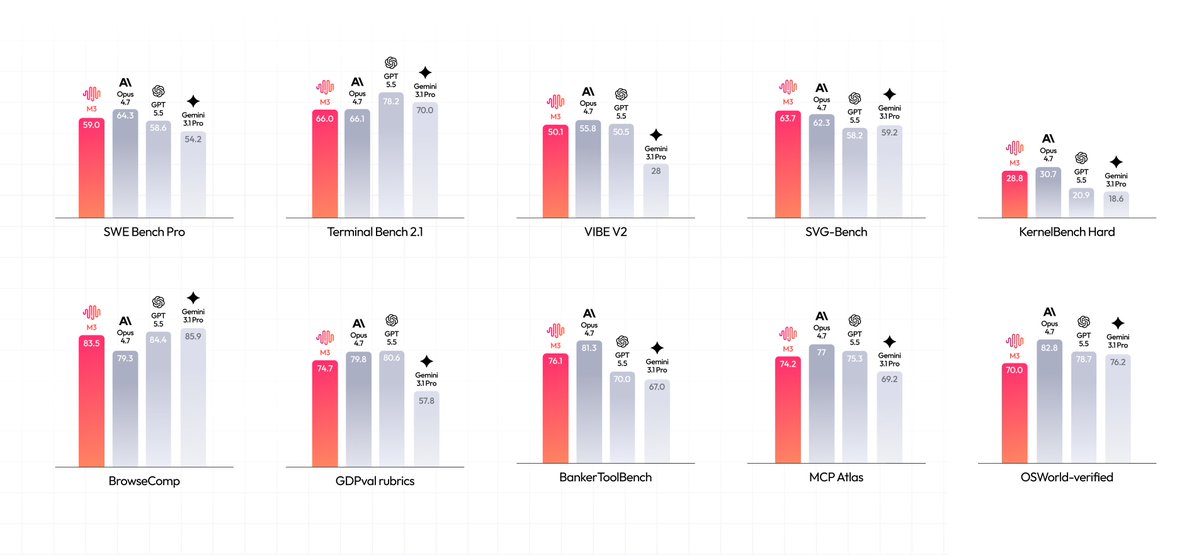
Additionally, in the SWE-Bench Pro software development benchmark, M3’s score of 59% surpasses OpenAI GPT-5.5 and Google Gemini 3.1 Pro, second only to Anthropic Opus 4.7.
MiniMax Sparse Attention: The Key Technology for Million-Token Contexts
M3’s core technological breakthrough is a brand-new attention mechanism: MiniMax Sparse Attention (MSA). Under the traditional full attention mechanism, computational cost grows quadratically with input length. MSA uses a block filtering mechanism to perform full computation only on relevant key-value blocks, reducing KV cache computation to one-twentieth of traditional methods. This enables M3 to process ultra-long input sequences at reasonable computational cost.
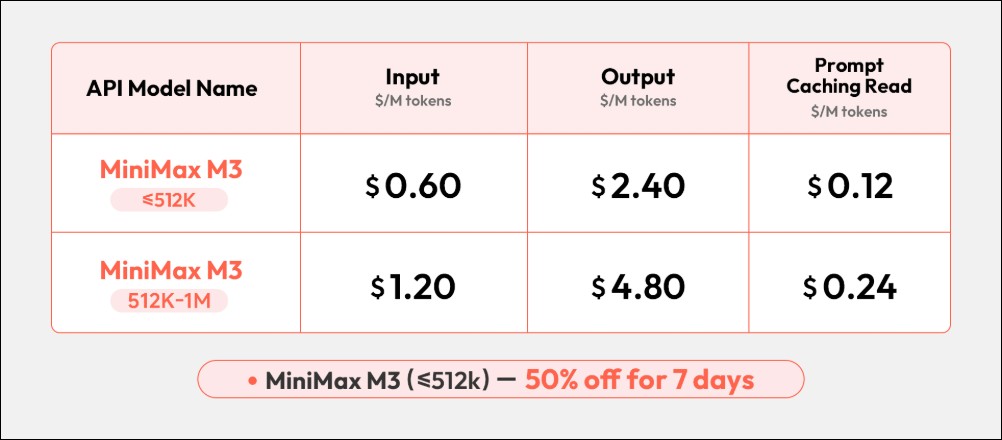
Thanks to MSA technology, the M3 API supports a maximum context window of 1 million tokens, with a minimum guaranteed 512K tokens. This represents a 5x improvement over the previous generation M2.7’s 200K tokens and surpasses the context length of most comparable models. This expansive context window is well-suited for long code projects, extended agent tasks, and long video comprehension, giving M3 a significant advantage when handling complex tasks requiring prolonged continuous reasoning. MiniMax states that the 1M context is infrastructure built for long-term agent tasks, long-range code development, and long video understanding.
In terms of inference cost, MSA’s sparse attention mechanism reduces KV cache computation to one-twentieth of traditional full attention. This not only enables M3 to process longer and more complex input sequences, but also significantly reduces computational costs and response latency, providing a substantial advantage for developers who need to process large amounts of tokens.
Native Multimodal: From-Scratch Training Strategy
Unlike most models that add visual capabilities only in later stages, M3 adopts mixed-modality data (interleaved data) from the pretraining phase, training text and images interwoven within the same sequence. The MiniMax team redesigned the data pipeline, scaling the training data to approximately 100 trillion tokens, achieving deep alignment between text and visual semantic spaces. Officials emphasize that multimodality is M3’s native core capability, not a superficial add-on feature. This means M3 demonstrates the same level of performance in understanding visual information such as charts, flowcharts, and screenshots as it does with text.
Autonomous Agent Benchmark: Replicating an ICLR Paper in 12 Hours, 9.4x CUDA Speedup
MiniMax showcased three autonomous agent real-world tests, highlighting M3’s capability in long-duration task execution:
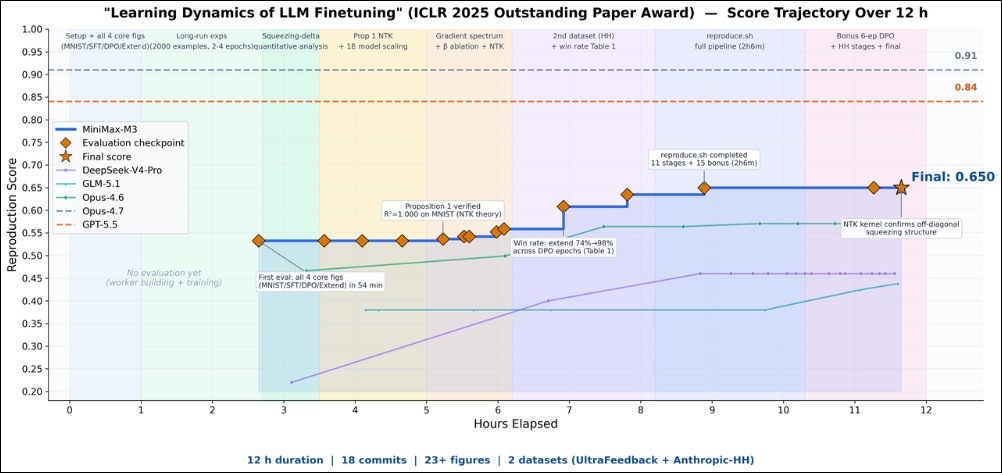
In the first test, the team asked M3 to independently reproduce an ICLR 2025 Outstanding Paper: “Learning Dynamics of LLM Finetuning.” M3 ran continuously for nearly 12 hours, autonomously generating 18 commits and 23 experimental figures, successfully reproducing the paper’s core experimental results. Throughout the process, its multimodal capability enabled it to understand the figures and equations in the paper, long context allowed the paper, code, and experiment logs to be processed within a single window, and its coding and agent capabilities drove the long-duration execution.
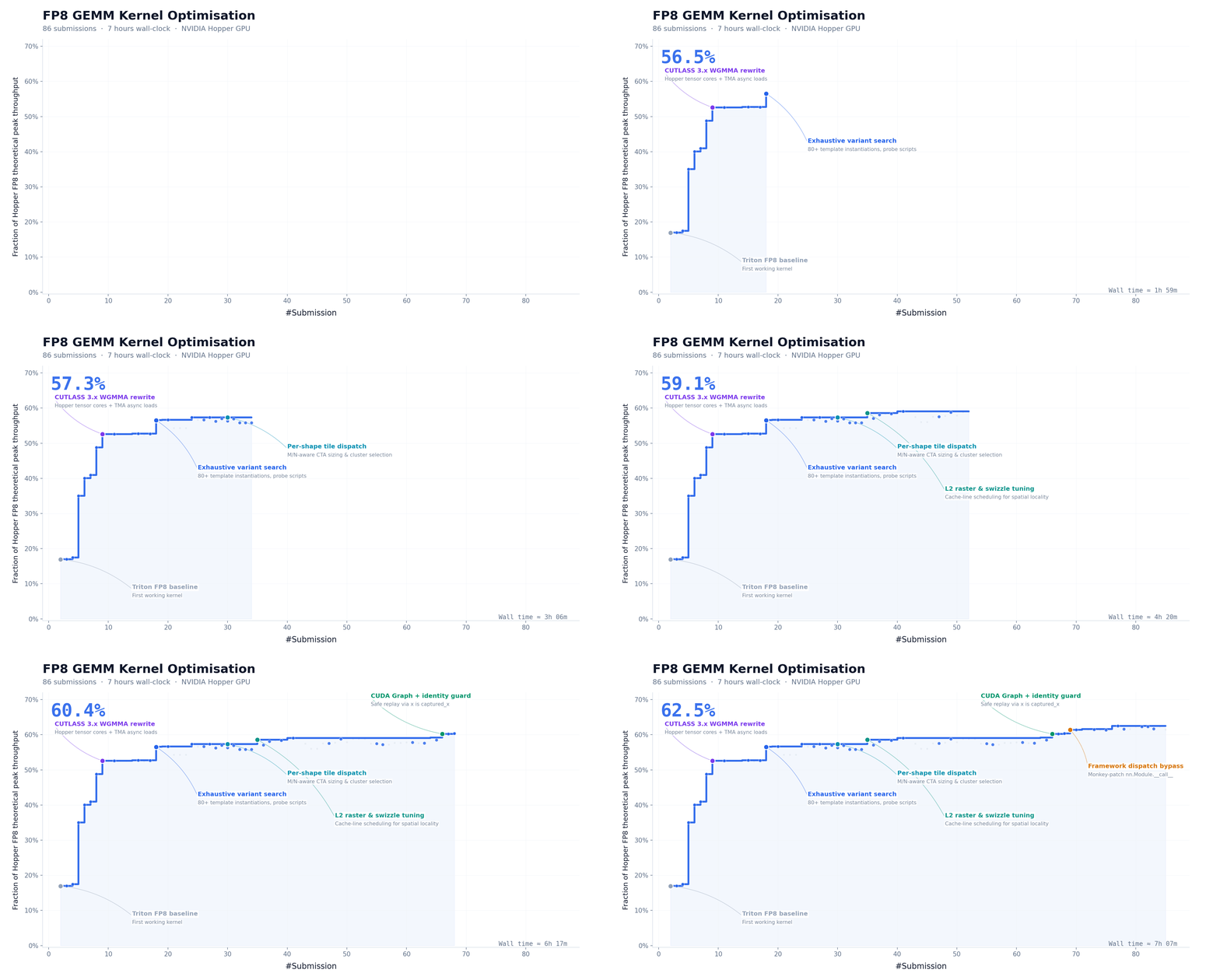
The second test is CUDA kernel optimization. The team tasked M3 with optimizing an FP8 GEMM operation kernel on NVIDIA Hopper GPUs, initially providing only a task description and a non-functional Triton skeleton. After approximately 24 hours, 147 iterations, and 1,959 tool calls, M3 pushed peak hardware utilization from 7.6% all the way up to 71.3%, achieving a 9.4x speedup, all without human intervention.
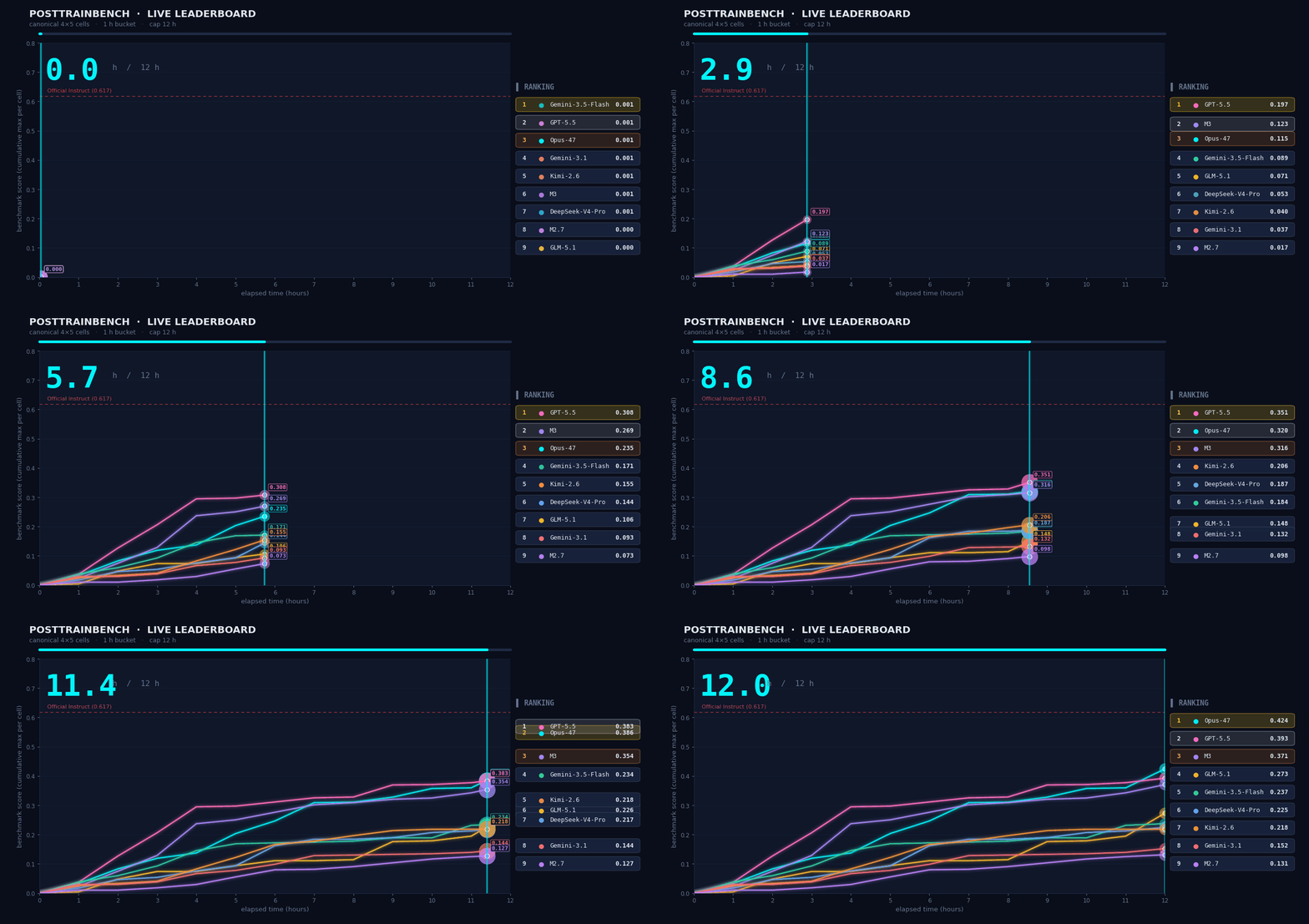
In the third test, PostTrainBench, M3 was required to independently complete the entire process of data synthesis, training, evaluation, and iteration for four base models within 12 hours, with no human intervention allowed. M3 ultimately scored 37.1 points, ranking third, behind only Opus 4.7 (42.4) and GPT-5.5 (39.3), significantly outperforming all other models tested.
Open Source Weights and Developer Ecosystem
M3 is released in an open-weight format. Developers can use it directly through the MiniMax API and Token Plan, or experience it directly on the MiniMax Code desktop client. The official claim states that M3 performs exceptionally well in tool framework compatibility, and currently supports multiple mainstream AI coding tools including Claude Code, Roo Code, Kilo Code, Cline, Codex CLI, OpenCode, and Cursor. Developers can freely choose their familiar development environment.
Summary
MiniMax M3 arrives as an open-weight model, achieving frontier-level performance across three dimensions: coding agent capabilities, million-token context windows, and native multimodality. Whether it’s the 59% SWE-Bench Pro score, autonomously completing a 12-hour paper reproduction task, or 9.4x CUDA kernel acceleration, all demonstrate MiniMax’s solid technical prowess in AI foundation models. For developers requiring long-duration autonomous task execution, M3 offers a competitive open-source option and adds new variables to the AI model competitive landscape in the second half of 2026. As the gap between open-source and closed-source models continues to narrow, M3’s emergence marks a significant milestone in the development of open AI.
Source: KOCPC Chinese