


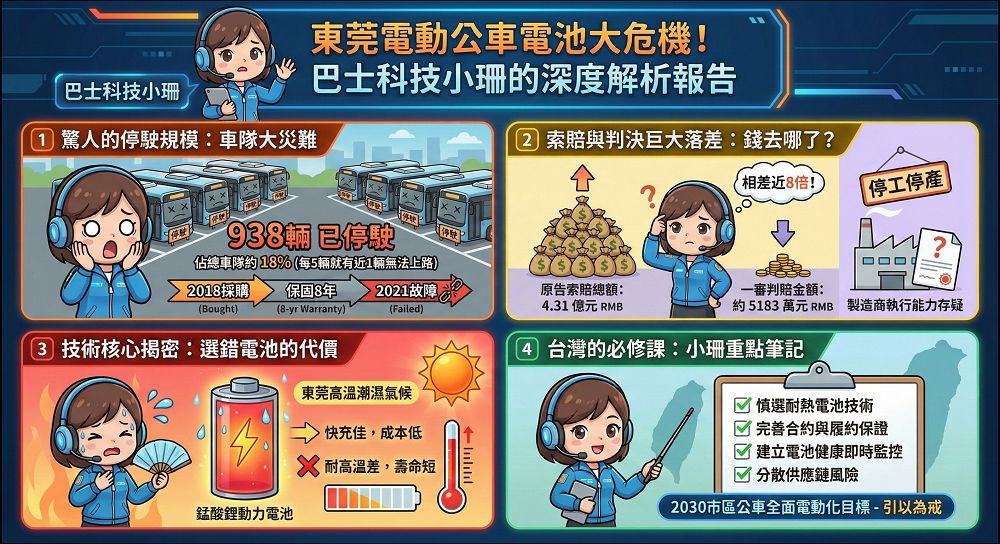
Recently, the largest bus company in Dongguan took the vehicle manufacturer to court, claiming compensation as high as 431 million yuan (approximately NT$1.94 billion). The first-instance verdict only awarded compensation of about 51.83 million yuan. The huge life span gap has triggered in-depth reflections in the industry on the quality of electric bus batteries and the responsibility of the industry. In October 2018, Dongguan Bus Co., Ltd. and its wholly-owned subsidiary Dongguan Citybus Transportation Co., Ltd. purchased 250 and 422 pure electric buses respectively from Dongguan AVIC Hongyuan Automobile Co., Ltd. through public bidding, for a total of 672 buses. These vehicles are all equipped with lithium manganese oxide power batteries produced by Weihong Power Systems (Huzhou) Co., Ltd., and the warranty period stipulated in the contract is 8 years. However, since October 2021, only about three years since delivery, these vehicles have successively experienced power battery failures or abnormal attenuation, and their cruising range has dropped sharply, eventually leading to widespread outage of the vehicles.
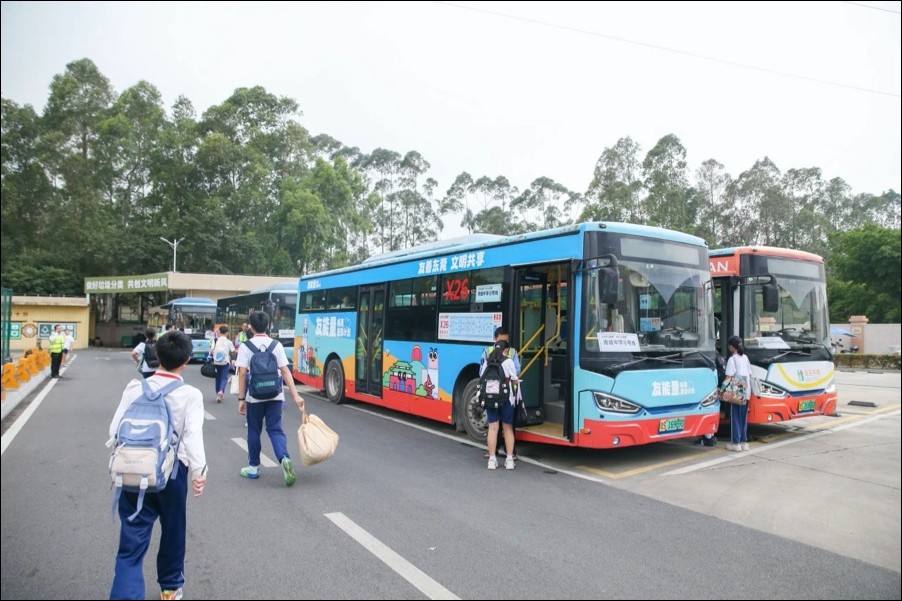
The scale is staggering: 938 buses are out of service, accounting for nearly 20% of the fleet
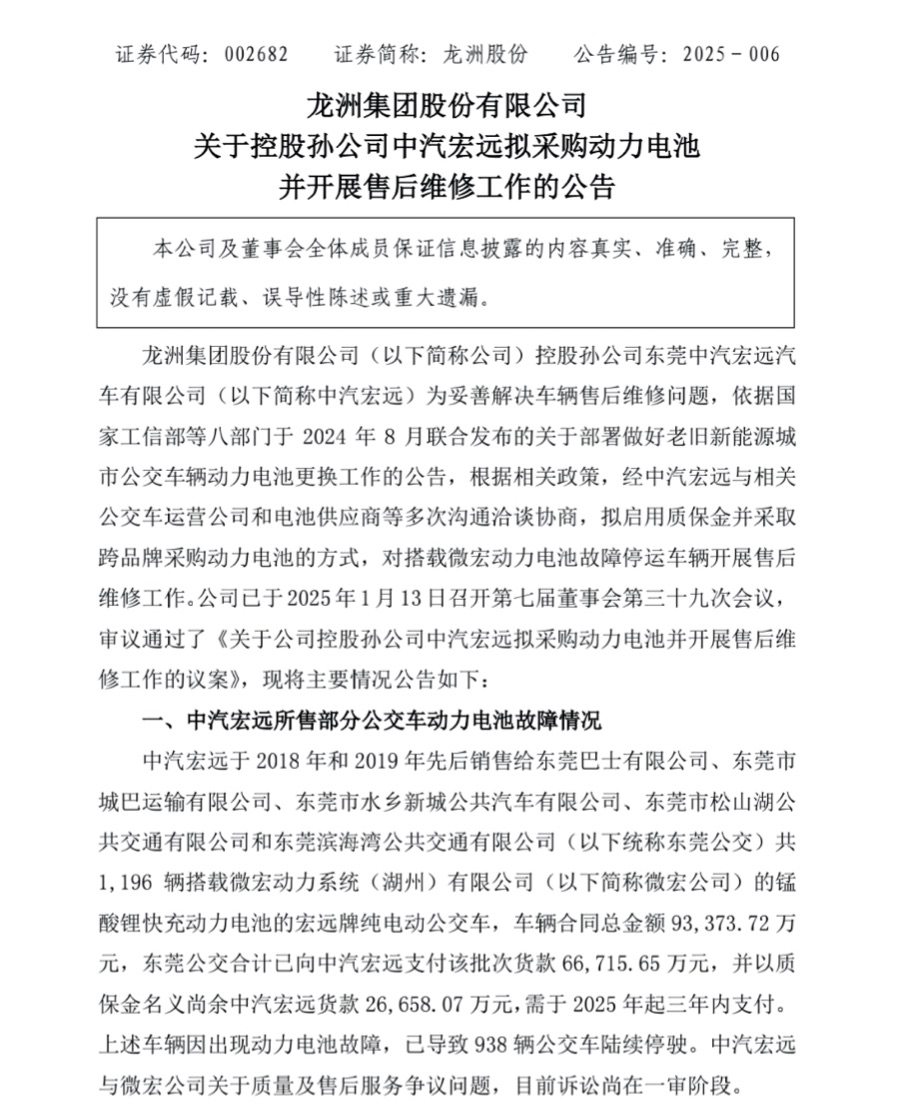
The extent of the problem extends far beyond the 672 vehicles initially exposed. according to21 Economic Network’s in-depth report, between 2018 and 2019, China Automobile Hongyuan sold a total of 1,196 pure electric buses equipped with Micromacro lithium manganate fast-charging batteries to 5 bus companies in Dongguan, of which 938 buses have been suspended. As of the end of June 2024, Dongguan Bus has 339 routes and 5,311 operating vehicles. The 938 out-of-service vehicles account for about 18% of the entire fleet, which is equivalent to nearly one out of every five buses being unable to go on the road due to battery problems.
Legal Attack and Defense: Claim 431 million, only 51.83 million awarded
Faced with huge losses, Dongguan Bus and Dongguan Citybus filed lawsuits respectively. In the first case, Dongguan Bus sued China Automotive Hongyuan, claiming RMB 205 million, and in the second case, Dongguan Citybus sued, claiming RMB 226 million, totaling RMB 431 million. In addition, Dongguan Marina Bay Bus also filed a separate lawsuit claiming RMB 123 million for its 166 problem vehicles.
The first-instance judgment of the Dongguan First People’s Court: The court ordered China Automobile Hongyuan to compensate a total of 51.83495 million yuan for outage losses and must continue to perform its warranty obligations. The nearly 8-fold gap between claims and awards reflects several key issues:
- Strict loss determination standards: The court may only recognize the part supported by direct evidence, and be more conservative in determining indirect damages such as loss of operating profits.
- Shared responsibility: The chain of responsibility for battery failure involves both the vehicle manufacturer (China Automotive Hongyuan) and the battery supplier (Micro Power)
- The legal framework is not yet mature: Damage compensation standards for large-scale quality disputes involving new energy vehicles are still being explored.
However, China Automotive Hongyuan has stopped production since January 2024. Even if the judgment requires it to continue to perform its warranty obligations, its actual execution ability is questionable.
Technical concerns about lithium manganese oxide batteries
Compared with the current mainstream lithium iron phosphate (LFP) and ternary lithium batteries (NCM/NCA), although lithium manganate batteries are low in cost and have good fast charging performance, cycle life and high temperature stability have always been known shortcomings. Lithium manganate cathode material is prone to manganese ion dissolution during the charge and discharge process, resulting in accelerated capacity fading.
Dongguan is located in southern China, and the hot and humid climate conditions in summer may further aggravate the decay rate. Large-scale failures occurred after only about three years of use, far from reaching the 8-year warranty period, showing obvious flaws in battery selection and quality control.
Taiwan’s lesson
Taiwan’s Ministry of Transportation has set a goal of fully electrifying urban buses by 2030. This case provides important lessons:
- Battery technology selection is crucial: Taiwan’s climate is also hot and humid, so battery heat resistance must be taken into consideration
- Contract terms need to be improved: Suppliers should be required to provide performance bonds or insurance mechanisms
- Establish real-time monitoring of battery health: Detect abnormalities in the early stages of decay and intervene early
- Supply chain risk diversification: Avoid systemic risks caused by single supplier mistakes
Conclusion
As many as 938 buses broke down and were parked at stations, unable to go on duty. This affected not only the financial statements of transportation companies, but also the daily lives of tens of thousands of citizens in a city. To promote green transportation, we cannot only look at policy schedules and subsidy figures, but also need to do a solid job in technical verification, quality control and risk prevention. China’s case is a lesson for all public transportation companies that are transitioning to electric vehicles (or is it that the battery quality of some second- and third-tier manufacturers in China is really bad?).
Source: KOCPC Chinese