


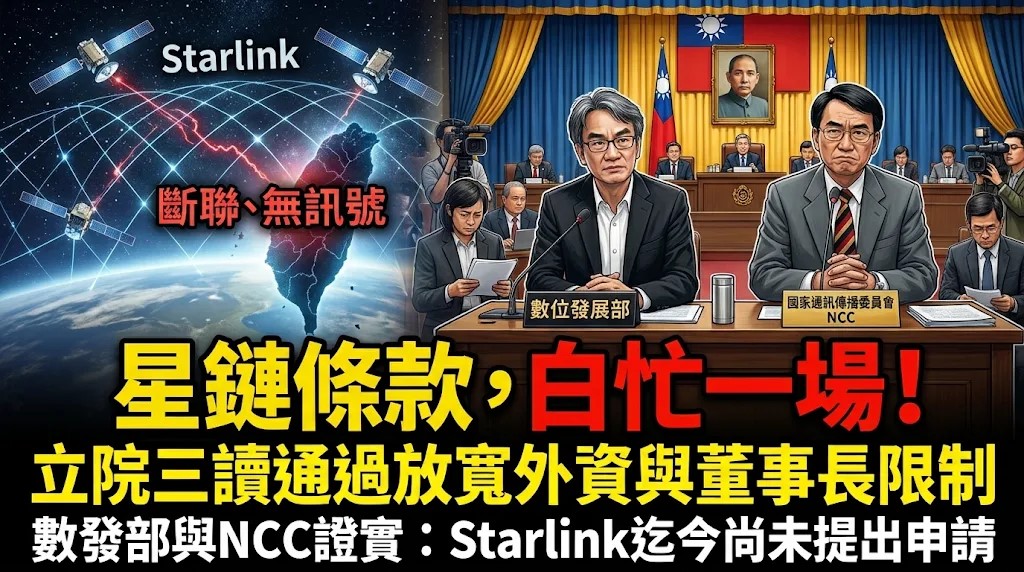
Although Taiwan’s Legislative Yuan has passed the third reading of partial amendments to the Telecommunications Management Act that relax restrictions on foreign investment and the chairperson (commonly known as the Starlink clause) to attract Startlink’s international satellite services to operate in Taiwan, the Ministry of Digital Affairs and the NCC confirmed during questioning at the Legislative Yuan that Starlink has not yet applied to date—was revising the “Starlink clause” all for nothing!?
Why is Starlink unwilling to come to Taiwan? What should Taiwan do about its direct-to-device (D2D) satellite service for mobile phones? Here is an analysis:
1. Why is Starlink (星鏈) unwilling to come to Taiwan?
To attract Starlink, the global leader in low-Earth-orbit satellites, to establish operations in Taiwan, Taiwan’s Legislative Yuan in August passed the third reading of amendments to Articles 36 and 95 of the Telecommunications Management Act. After approval by the competent authority, the amendments relax restrictions on public telecommunications networks applying to establish and use telecommunications resources—specifically, the requirements that the chairperson be of Republic of China nationality and the limits on foreign shareholding ratios (commonly known as the Starlink clause).
Minister of Digital Affairs Lin Yijing said recently (2026/11/9) while taking questions at the Legislative Yuan: “Starlink has consistently shown little interest in the Taiwan market. At first it said Taiwan’s 4G and 5G coverage already exceeds 99.9%, so there is no business opportunity. Later, when the Ministry of Digital Affairs sent emails asking about its willingness, it did not reply either. It is [relatively unfriendly] to Taiwan.” NCC Chief Secretary Wen Chun-yu also confirmed that Starlink has not yet submitted an application.
In response to the continued indifference of global low-Earth-orbit satellite leader Starlink toward entering the Taiwan market, Deputy Minister Yeh Ning of the Ministry of Digital Affairs has traveled to Australia to inspect the operations of another international satellite internet provider, Amazon Leo. In the future, it may be incorporated into communications backup plans for remote areas and other locations.
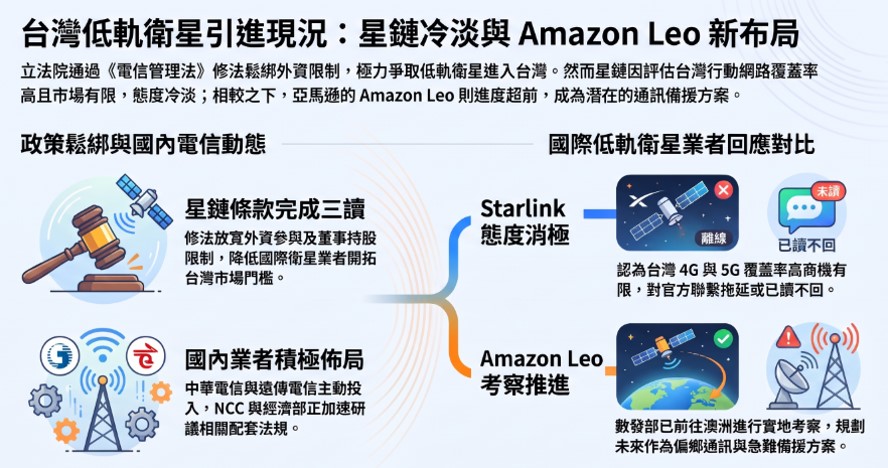
Starlink currently provides legal or commercial services in more than 160 to 170 countries and regions worldwide, covering North America, most European countries, South America, New Zealand, Australia, many African countries, and several Southeast Asian countries. Starlink has not prioritized metropolitan countries and regions with high mobile network coverage because it considers the business opportunity too low, and it cannot be introduced in mainland China, North Korea, Afghanistan, or Syria. Starlink is unwilling to come to Taiwan. In addition to the low business opportunity, Tesla electric vehicles still have a huge market in China, which makes Musk wary of offending China, and Starlink’s global insistence on 100% sole ownership are both difficult obstacles to its landing in Taiwan.
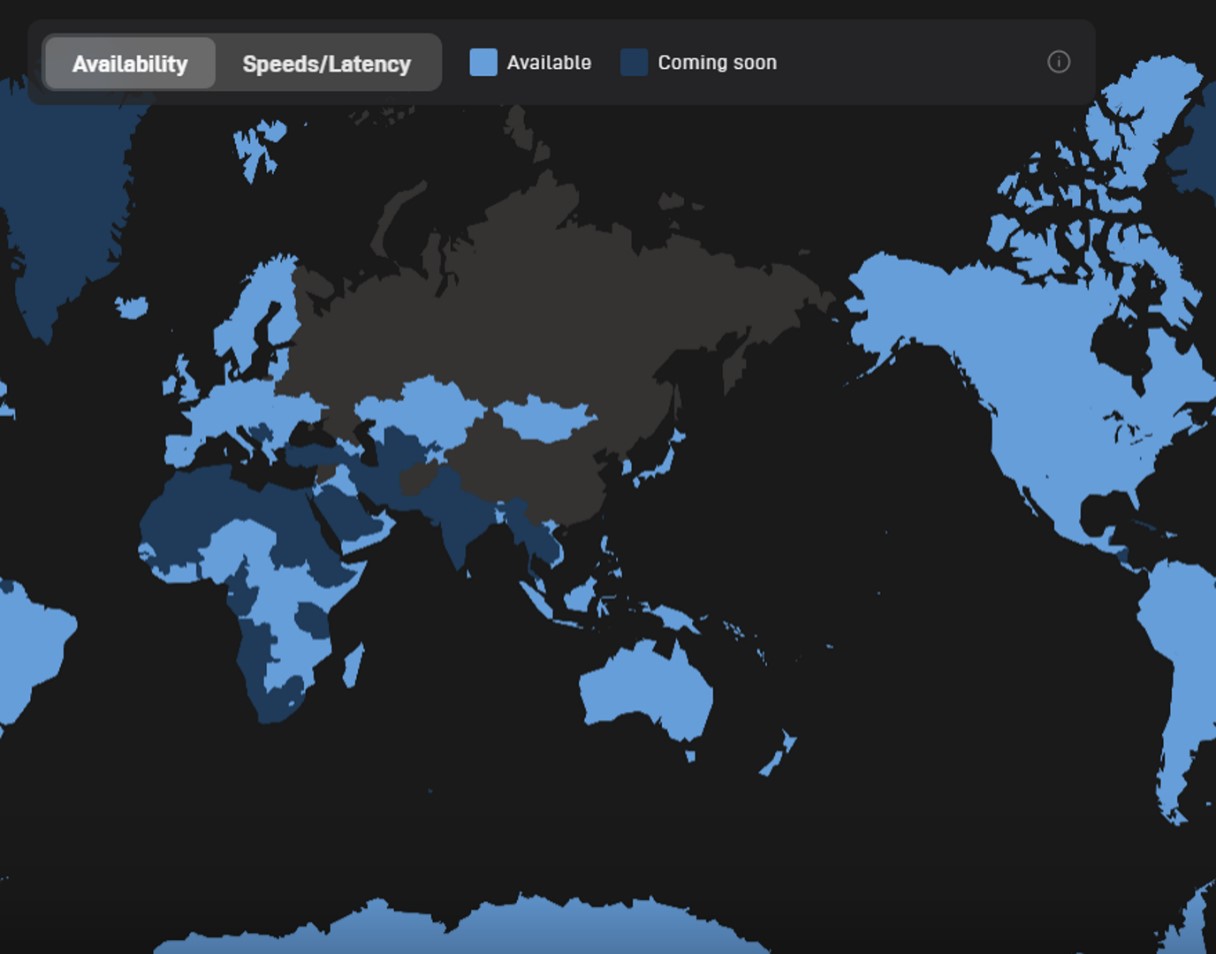
Image source: Starlink service coverage map lookup page
2. What should be done about Taiwan’s direct-to-device (D2D) satellite service for mobile phones?
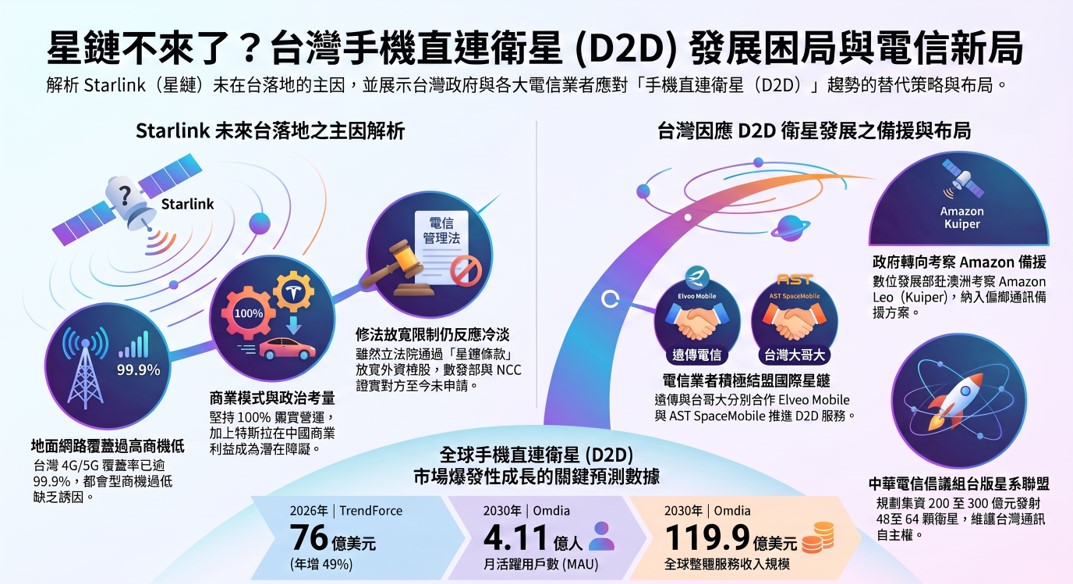
“Direct to Device” (D2D; Direct to Cell; D2C) is a technology that allows ordinary commercially available 4G/5G smartphones to connect directly to low Earth orbit satellites without special hardware, firmware modifications, or special software, providing SMS, voice, and data services. 3GPP is expected to complete unified 6G standards in 2029, and direct-to-device satellite connectivity will be one of the core battlegrounds for 6G commercialization in 2030. According to estimates by research firm TrendForce, the global direct-to-device satellite market will reach USD 7.6 billion in 2026, up about 49% from the previous year; international research firm Omdia forecasts that by 2030, global monthly active users (MAU) of direct-to-device satellite services will reach 411 million, with total service revenue projected to reach USD 11.99 billion.
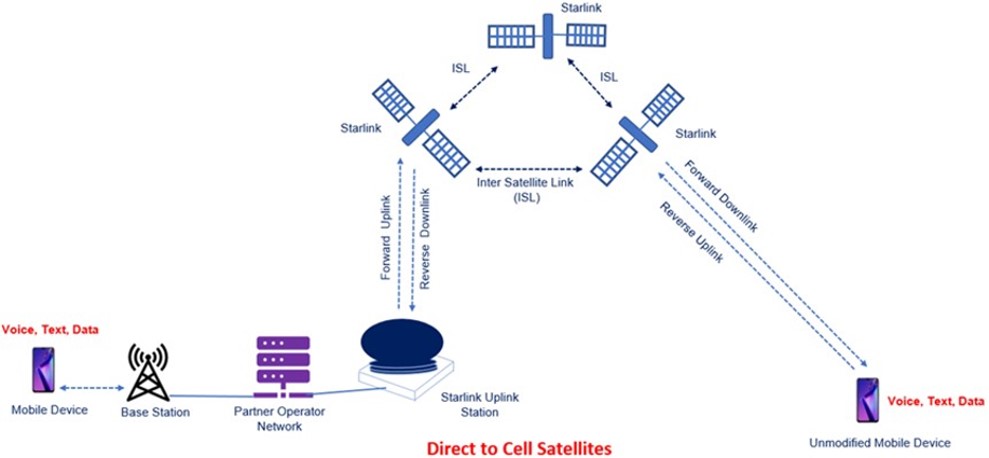
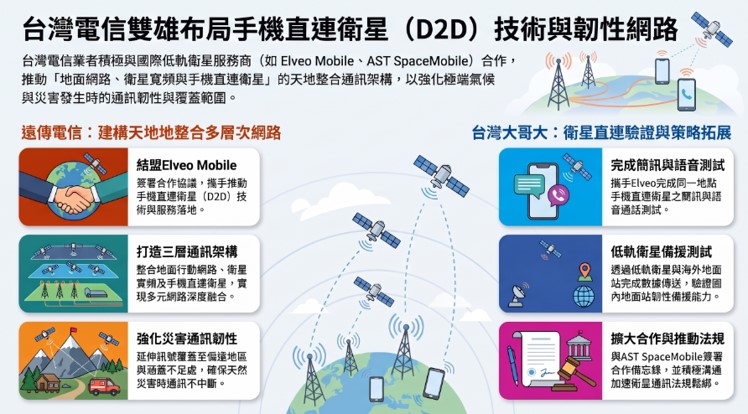
Regarding direct-to-cell satellite services, Far EasTone Telecommunications is not only actively negotiating cooperation with Amazon Kuiper but also signed a cooperation agreement this month (2026/11) with global satellite communications service provider Elveo Mobile to jointly advance direct-to-cell satellite technology. Taiwan Mobile also mentioned its past collaboration experience and test results with this satellite operator (formerly Lynk Global); in addition to signing a memorandum of understanding with another company, AST SpaceMobile, it also welcomes domestic industry peers to jointly advance related satellite services.
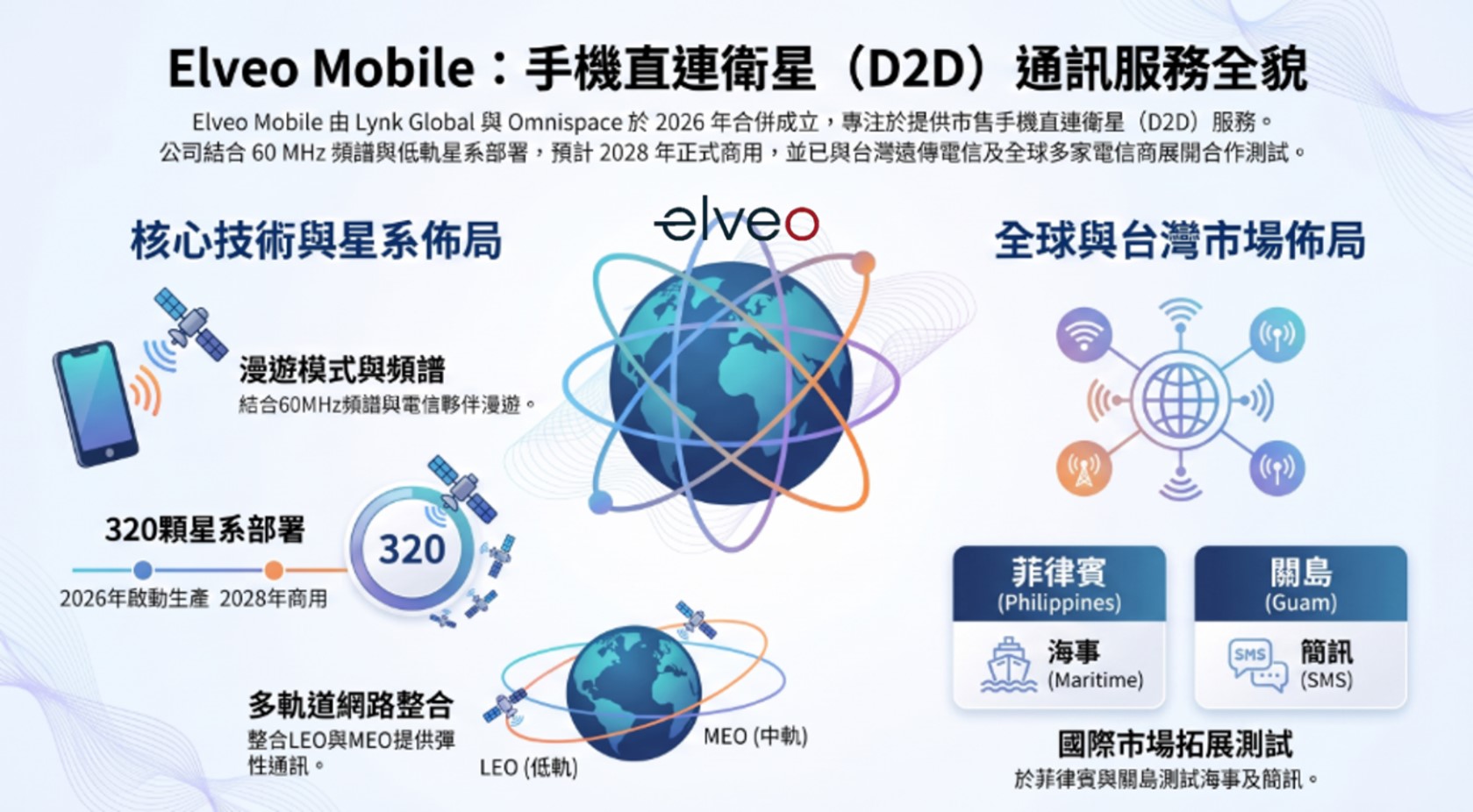
Elveo Mobile is a global direct-to-satellite communications service provider formed through the merger of Lynk Global and Omnispace in 2026. Its core business is enabling ordinary commercially available, unmodified mobile phones to maintain basic communications and internet connectivity directly via satellite when terrestrial mobile network coverage is insufficient or disrupted.
As for Chunghwa Telecom, its current satellite deployment focuses mainly on private enterprise networks, government digital resilience, and rural coverage. Apart from stating its intention to seek exclusive agency rights to bring Starlink satellite services to Taiwan, it has not yet announced a partner for direct-to-handset satellite services.
Since the Ministry of Digital Affairs has listed Amazon Leo as a backup partner for low-Earth-orbit satellite services, it is worth watching whether Far EasTone Telecommunications, which holds the same 28MHz frequency band as Amazon Leo, will be willing to loosen its grip and let Chunghwa Telecom get a piece of the pie.
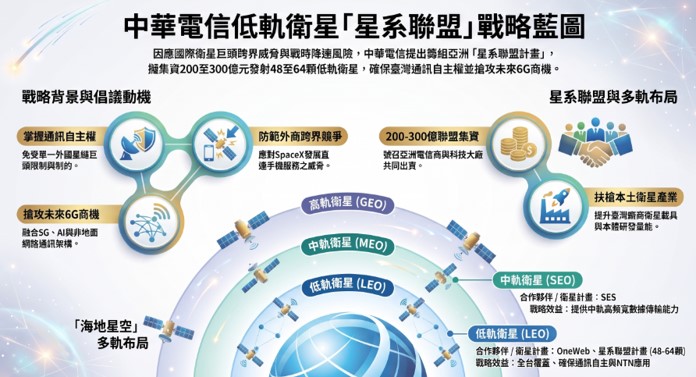
On the other hand, the chairman of Chunghwa Telecom recently publicly proposed forming a low-Earth-orbit satellite “Constellation Alliance Project” with Asian telecom partners and major technology companies, jointly raising NT$20–30 billion to launch 48 or 64 low-Earth-orbit satellites covering all of Taiwan, in order to ensure Taiwan’s communications autonomy and capture greater global business opportunities in future 6G.
Taiwan’s mobile network availability exceeds 99%, and satellite signals cannot be received indoors, where accidents are most likely to occur. Apart from a few high-mountain valleys or offshore waters, demand for “D2D direct-to-cell satellite” services is not strong. Whether Starlink services can be permitted to enter Taiwan does not have much impact on the general public in Taiwan, and Taiwan currently has no urgent need for them.
However, D2D direct-to-device satellite connectivity is a representative application of 6G and NTN, capable of strengthening communications in remote areas, disaster response, and emergency rescue. It is imperative for Taiwan to cooperate with other internationally renowned low Earth orbit satellite service companies or advocate the formation of a low Earth orbit satellite “constellation alliance plan.”
As for whether Taiwan will cooperate with Starlink, that can only be left to chance. Although this disappoints many Musk fans, a forcibly picked fruit will never be sweet.
Source: KOCPC Chinese