


Due to US regulatory factors, major Chinese AI companies have always faced restrictions when trying to buy NVIDIA GPUs, and with pressure from Chinese authorities, many Chinese AI startups have also begun trying to use domestically produced Chinese GPUs for model training. Recently, a series of leaks from the Chinese workplace social platform Maimai in late November brought the stability issues of DeepSeek using Huawei Ascend chips to train large models into the open. TheseMaimai discussionIt is said that DeepSeek’s Ascend clusters frequently drop offline in the middle of training, pushing DeepSeek’s frontline engineers to the brink of collapse.

NetEase’s November 24ReportAlso relaying this wave of Maimai leaks: a cluster running several thousand cards in parallel ran nonstop for 10 days, when in the middle of the night a large batch of chips suddenly went offline, followed by network lag and training interruption. Engineers had to crawl out of bed to troubleshoot and roll progress back to a checkpoint from several hours earlier; each disconnection and rollback burned electricity and several million RMB (about more than NT$10 million) in compute costs. The report also noted: the test environment, communications architecture, and software versions were not disclosed; the outside world has no way to verify whether the figures are true; neither Huawei nor DeepSeek has publicly responded.
Leak: Thousands of Ascend cards tested; comment section says “high failure rate.”
A poster from Guangdong wrote that DeepSeek has reportedly been tested on thousands of Ascend cards, but training the next-generation flagship model requires more than 10,000 cards running continuously for weeks. The post used a gaming analogy: a teammate going AFK may cost you a star, but in AI training, a faulty chip burns through millions of dollars in compute; the closing line was, “What’s scary isn’t that domestic chips are a bit slower, but that everyone else’s new models have already been released while you’re still checking which batch of chips went offline last night.”
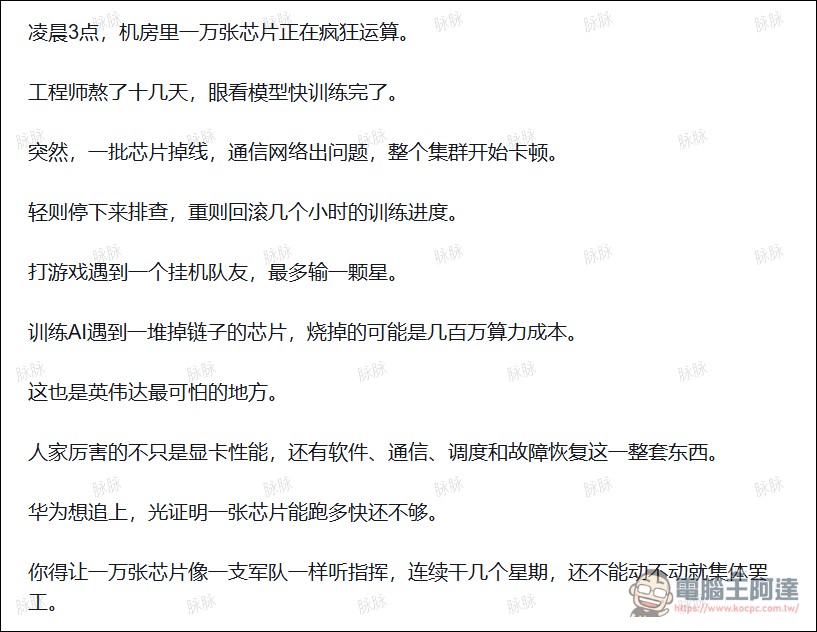
In the comment section of the same screenshot, a user tagged as a Lenovo employee wrote, “This is Huawei; it’s normal for it to hang,” while another user tagged as a Zhongqingbao employee said bluntly, “Honestly, the failure rate of Ascend GPUs is quite high.” These comments are personal statements by community users and are not backed by any test data.
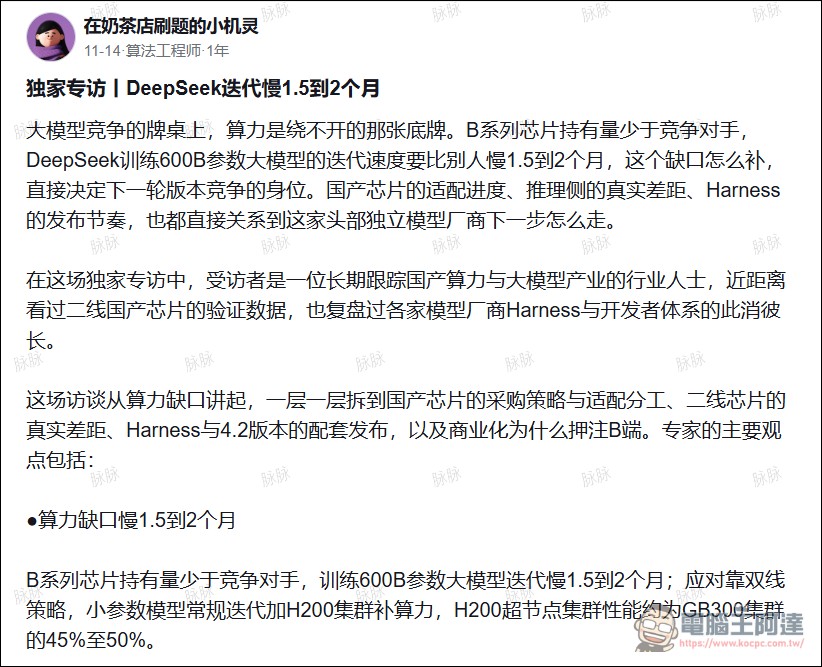
The second screenshot is from a November 14 article titled “Exclusive Interview | DeepSeek’s Iteration Is 1.5 to 2 Months BehindA compilation post. The post claims that DeepSeek has fewer NVIDIA B-series GPUs than its main competitors and that its progress in training a 600B (600 billion parameter) model lags 1.5 to 2 months behind rivals. Due to insufficient compute, it has adopted a dual-track strategy: routine iteration of smaller models while using H200 supernode clusters to supplement compute, with the measured speed of H200 supernode clusters at about 45% to 50% of GB300 clusters.
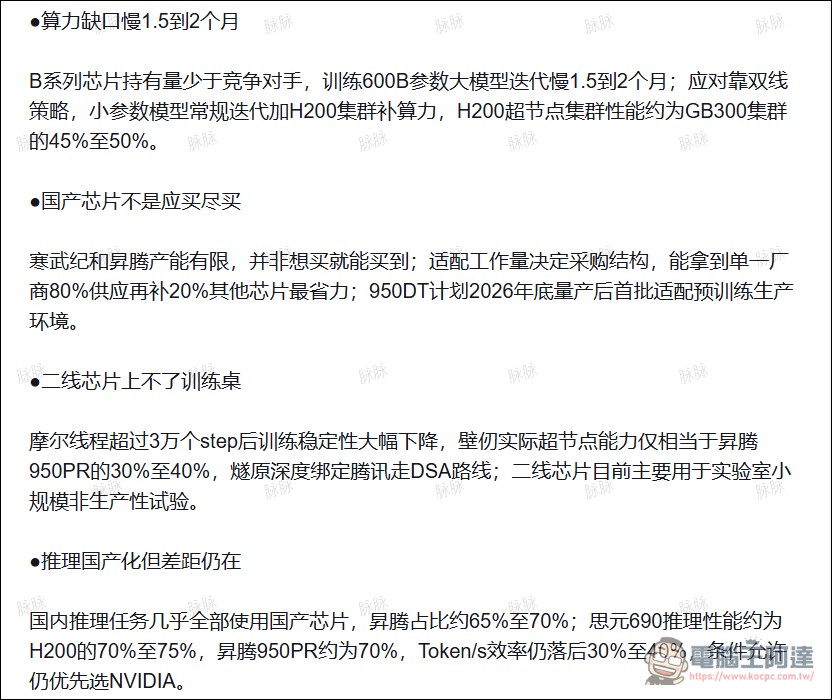
This interview post also ranks several domestic chips: Cambricon and Huawei Ascend have limited capacity and cannot be purchased on demand; Moore Threads’ cluster training stability drops sharply after more than 30,000 steps; Biren’s actual supernode capability is about 30% to 40% of Ascend 950PR; Enflame is deeply tied to Tencent’s DSA route. On the inference side, it is already domestic chip territory: Ascend accounts for 65% to 70% of domestic inference; Siyuan 690’s inference performance is about 70% to 75% of H200; Ascend 950PR is about 70% of H200, with token efficiency lagging by 30% to 40%. Huawei’s next-generation 950DT is scheduled for mass production by the end of 2026. These are likewise industry claims leaked from Maimai, with no public test data.
This wave of leaks did not come out of nowhere. In August, the UK’s Financial Times reported that after R1’s success, DeepSeek shifted R2 training to Huawei’s Ascend platform on Chinese advice, encountering problems such as unstable performance, slow chip interconnect, and limitations in Huawei’s CANN software toolchain; Huawei stationed engineers at DeepSeek’s data center, but a fully successful training run was still not completed, and training was ultimately switched back to NVIDIA accelerators, with Ascend reserved for inference, while R2 was delayed from its originally scheduled May. DeepSeek’s R1 training cluster at the time was 50,000 Hopper-series cards (30,000 HGX H20, 10,000 H800, and 10,000 H100), supplied by affiliated investor High-Flyer Quant.
Positive news on the other side is on the same timeline. In June, the Shenzhen municipal government, throughSouth China Morning PostIt was announced that a research team including Huawei (with members from the Shenzhen Huanqu Research Institute, Harbin Institute of Technology, Shenzhen, and the Shenzhen Research Institute of Big Data) completed full-parameter post-training of DeepSeek V4-Pro (1.6 trillion parameters) using at least 1,000 Ascend 910C chips. The 910C is Huawei’s current flagship AI accelerator; earlier DeepSeek tests showed its inference performance at about 60% of NVIDIA H100. A July 22 arXiv technical report added efficiency figures: the model FLOPs utilization (MFU) for this round of post-training was 34.22%, 2.93 times faster than the open-source baseline recipe; but the report covers only post-training. Liu Zhiyuan of Tsinghua University told MIT Technology Review that the main pre-training compute for V4-Pro may still be NVIDIA hardware. “Post-training” is the tuning stage after pre-training; V4-Pro’s pre-training corpus exceeds 32 trillion tokens. Being able to complete post-training on Ascend is a real achievement, but it does not mean Chinese domestic GPUs can pre-train frontier models from scratch.
Reliability Is the Real Moat: The Extreme Tug-of-War Beyond Peak Compute
A leak on Maimai and existing reports point to the same engineering problem: large-model pretraining is an extreme endurance contest in which tens of thousands of cards are lashed together and run at high load for weeks on end, and a few-minute benchmark tells you nothing. If any link—the interconnect network, drivers, or per-card yield—is a weak point, a 10,000-card cluster cannot hold up even for 3 weeks, and no matter how high the peak compute on the slides, it cannot be brought into play. DeepSeek is “paying tuition with its own R&D progress and real money for the reliability of domestic hardware,” while local chipmakers are learning the lesson of failure recovery in ultra-large-scale clusters through repeated crashes, disconnects, and rollbacks.

Post author Fateev wrote that Huawei’s peak FLOPS look good on slides, but if 10,000 cards cannot stay alive for three consecutive weeks, those numbers are meaningless; NVIDIA’s strength lies in the stability of its entire stack across software, networking, scheduling, and failure recovery. It should be noted that as of now, neither Huawei nor DeepSeek has responded to this wave of leaks, and the figures in the leak—600B progress, 45% to 50%, 30,000 steps, 30% to 40%, etc.—also lack any verifiable raw test data. What can be confirmed is that Jensen Huang probably still does not need to worry too much; at present, Huawei still cannot fully replace NVIDIA in training.
Source: KOCPC Chinese