


People who need to use open-source models but don’t want to—or can’t—use Chinese open-source models are in luck! AI startup Thinking Machines Lab launched the open-weight model Inkling 2 Mini on November 20, making “run a frontier-level model on your laptop” its main selling point. The model has only 26.4B total parameters and activates 3.4B per token, yet it beats competitors several times larger on multiple agentic coding and tool-use benchmarks, relying on a not-so-new architectural idea: running the middle-layer loop three times. In less than 48 hours after release, it had already made LM Studio’s 17,000-download chart.
The “anti-parameter-stacking” route from the former OpenAI CTO
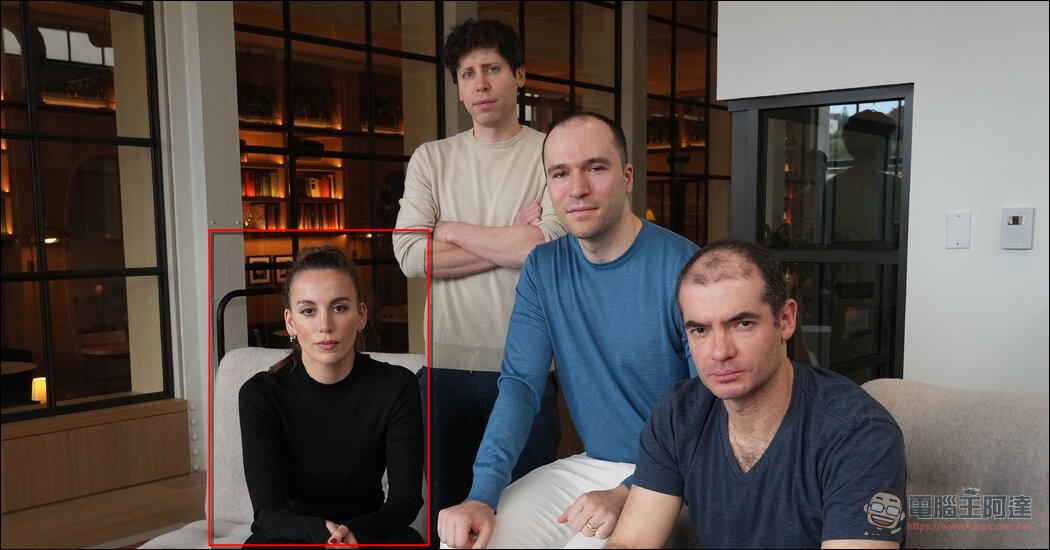
Thinking Machines Lab was co-founded in February 2025 by former OpenAI CTO Mira Murati (one of the members who pushed Altman out that year). Its co-founders include OpenAI senior researchers John Schulman, Barrett Zoph, Lilian Weng, and others, and the team has about 30 people. Within five months of its founding, the company raised a $2 billion seed round at a $12 billion valuation (about NT$63 billion), one of the largest seed rounds in Silicon Valley history; in September this year, reports also said Accel was in talks to lead a new $1 billion round, with a valuation of up to $40 billion (about NT$1.26 trillion).
In its product line, the lab first launched the model fine-tuning platform Tinker in 2025, then on July 15, 2026 released Inkling, its first open-weight model trained from scratch—a 975B-parameter MoE model under the Apache 2.0 license; two weeks later, it launched the 276B-parameter Inkling-Small, which maintains near-comparable performance at a quarter of the size. Inkling 2 Mini continues the same “predictive scaling ladder” training recipe, with two main changes: pruning two-thirds of the experts during training and introducing inter-layer loops.
Inkling 2 Mini loop architecture: 24 layers running as 48 layers
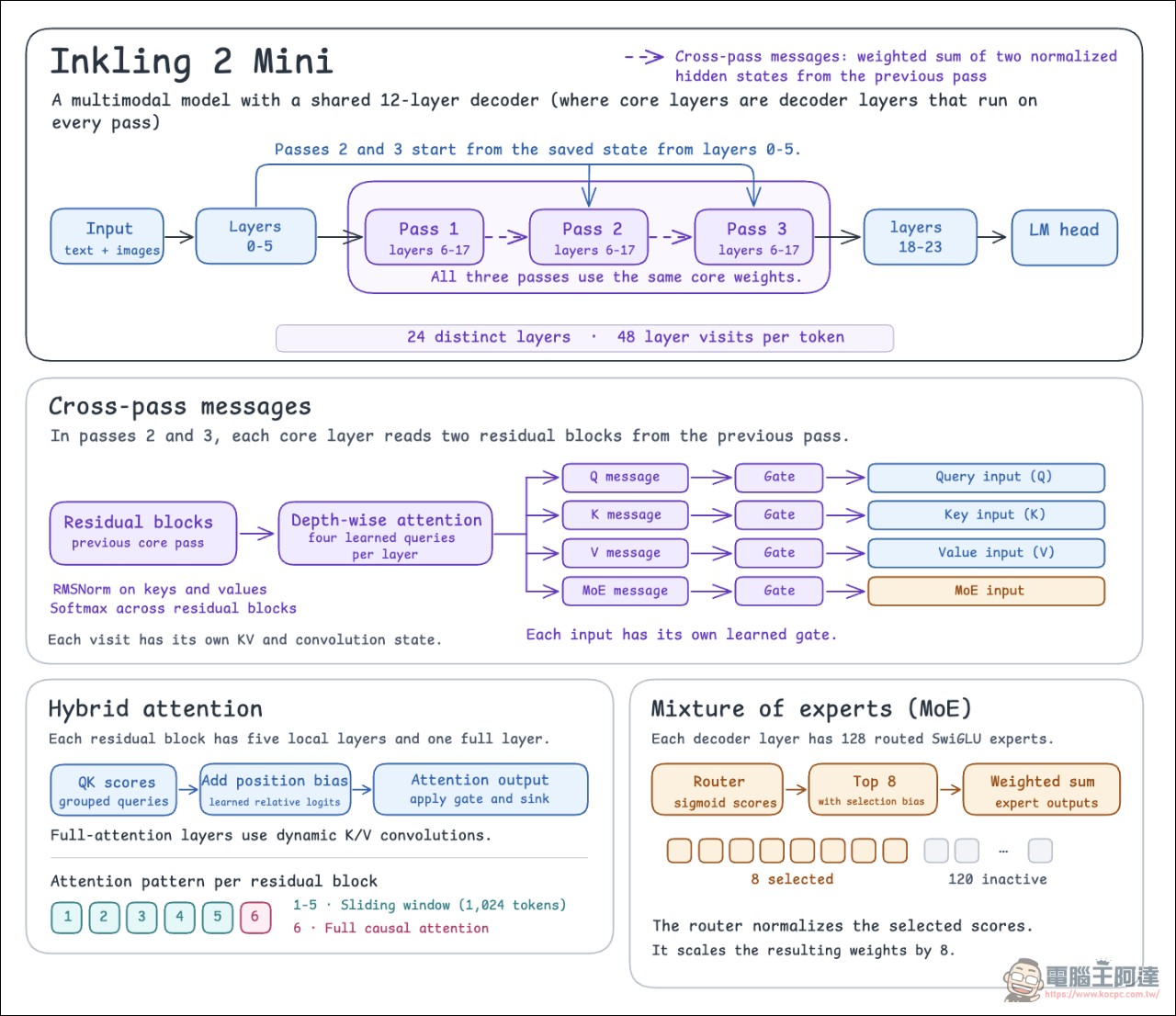
Inkling 2 Mini is a 24-layer MoE model divided into four six-layer blocks. The first and last blocks each run once, while the middle two blocks run three times with shared weights, meaning each token goes through 48 layer operations. The actual active parameter count goes from 3.4B to an equivalent 5.4B, with no change in storage size. The model moves the process of “think it through before writing it down” inside the weights, so it does not have to output all its thinking as text like a typical reasoning model.
To let information flow across three iterations, Thinking Machines introduces attention residuals: each iteration starts from the output of the first block, then reads the “message” left by the intermediate layers in the previous round, with a learned gate deciding how much of the current input to forget and how much of the previous round’s message to add.[1] The company’s empirical testing found that looping the middle 12 layers outperformed looping the last 12 layers on 27 of 28 evaluations; a non-looped baseline model was 7.5% cheaper to train, but at inference it required 140% more compute to match the looped version’s loss on 512K-token agent trajectories.
Another key is the numerical format. Of Inkling 2 Mini’s 24 layers, 20 are trained natively in 4-bit NVFP4 throughout, from pretraining to RL, and the last 4 use 8-bit MXFP8. It ships directly at training precision, skipping the conversion loss of the usual “quantize after training” approach. The entire set of weights takes up about 20GB, so a Mac with 32GB of memory or a single desktop GPU can run it offline. Thinking Machines researchers demonstrated that on a 48GB M5 Pro MacBook Pro in airplane mode, the model could build a playable flight simulator within minutes.
Benchmark scores: matches Qwen3.8-27B and leads its class in agentic coding.
On the Intelligence Index v5 from independent organization Artificial Analysis, Inkling 2 Mini scored 20.1, tying with Alibaba’s 27-billion-parameter dense model Qwen3.8-27B, while using only 5.4B equivalent parameters per token. In the official 48-benchmark comparison against four competitors—Gemma 4 31B, Muse Glimmer, Qwen3.8-27B, and Nemotron 3.5 Super VL—Inkling 2 Mini leads in 32 of them.
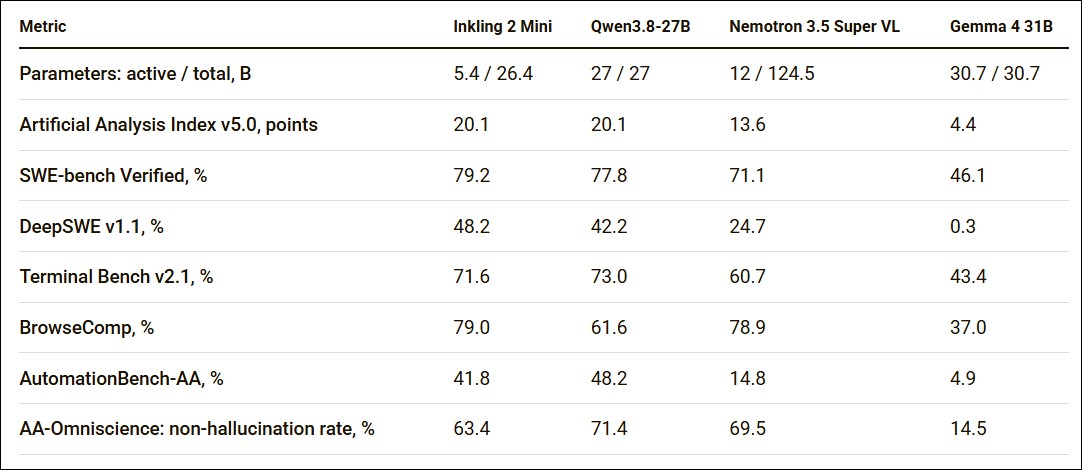
Agentic coding is its strongest area: DeepSWE v1.1 scored 48.2% (Qwen3.8-27B 42.2%), SWE-bench Pro v2 Hard 77.9%, and SWE-bench Verified 79.2%, all the best results among open models under 100B. Search and long documents are equally outstanding: BrowseComp 79.0% vs. Qwen’s 61.6%, LongBench v2 66.9% vs. 52.3%, and document understanding OmniDocBench v1.6 92.8%.
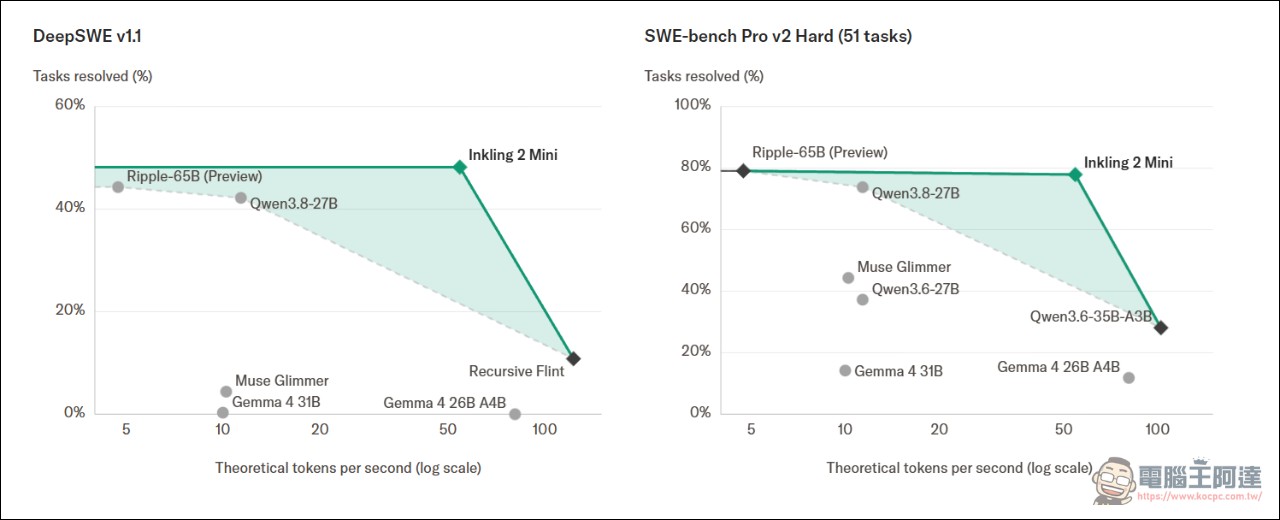
On efficiency, Stanford’s Hazy Research Lab and Scaling Intelligence Lab obtained early testing access and measured “intelligence per joule” on NVIDIA DGX Spark. Inkling 2 Mini scored 0.703, far ahead of Qwen3.6-35B-A3B’s 0.430 and Gemma-4-26B-A4B’s 0.159. On cost, the only current provider on OpenRouter, Prime Intellect, quotes $0.10 per million input tokens and $0.40 per million output tokens (about NT$3.2 and NT$12.6), and Neurohive estimates that an agent work session with 2M input plus 100K output costs about $0.10 (about NT$3.2), almost half that of Qwen3.8-27B.
Shortcomings: knowledge, multi-turn dialogue, and surveillance concerns
Loops can increase depth of thought, but they cannot let the weights hold more facts; the amount of knowledge depends roughly on the total number of parameters. On the AA-Omniscience factuality score, Inkling 2 Mini is -8.6 with a 63.4% non-hallucination rate, trailing Qwen3.8-27B’s -6.4 and 71.4%. The official release also acknowledges that it is not a top-tier small model for multi-turn dialogue and multi-constraint instructions: MultiChallenge 50.0% and ComplexConstraints v1.1 33.4%, losing to Qwen on both, while on the reasoning-heavy CritPt v2 and HLE-Diamond it also trails larger models.
The loop architecture also raises a safety question: if the model does more “unwritten thinking” internally, will the outside world’s ability to monitor it by reading its chain of thought (CoT) decline? Thinking Machines also released the variable-loop research version TML-d24-varloop-research. In tests, the reasoning length at 5 loops was only half that at 1 loop (1,661 vs. 3,703 tokens on average), but readability remained unchanged. In CoT manipulation tests, the model was almost unable to deliberately rewrite its own chain of thought (highest compliance rate 0.1%), and the LinuxArena monitoring evaluation found no clear correlation between the number of loops and evasion of monitoring. The company also provided the model to interpretability research organizations such as Goodfire and NDIF, actively inviting the community to study the internal computations of loop models.
Community reactions: excitement in local circles, along with doubts about “hype.”
The official Hugging Face blog gave it high praise, saying that in vibe tests it is at least comparable to Qwen3.8-27B, and day-one support for transformers, llama.cpp, and MLX went live; Unsloth subsequently released a 16.6GB 4-bit quantized version.Reddit r/LocalLLaMA Testers report that on the RTX Pro 6000, single-concurrency throughput is about 200 token/s and 4-concurrency aggregate throughput is about 550 token/s, already slightly faster than 27B-class competitors; some also prefer that it uses less memory than Qwen-family models, and “in blind tests you can’t tell the difference.”
The opposing voices are equally clear. A criticism video cited in the same thread alleges hype around U.S. models and double standards in evaluating Chinese and U.S. models; the community counters that the claim lacks evidence. A tester pointed out that llama.cpp’s early implementation had bugs affecting quality, dense uncompressed attention noticeably slows generation speed in long contexts, the model occasionally gets stuck in repetitive debugging loops, and non-English outputs such as Chinese are sometimes truncated. LM Studio’s model page also warns that running this loop architecture well requires setting output and agent turn limits, sandboxing the coding agent, and confirming before destructive actions.
In terms of significance, Inkling 2 Mini shows that powerful open-source models that can run on consumer devices are not limited to Chinese models. Its arrival gives organizations that prohibit the use of Chinese open-source models another option; as for how capable it is, everyone will have to test and use it themselves.
Inkling-2-Mini – Hugging Face
Source: KOCPC Chinese