


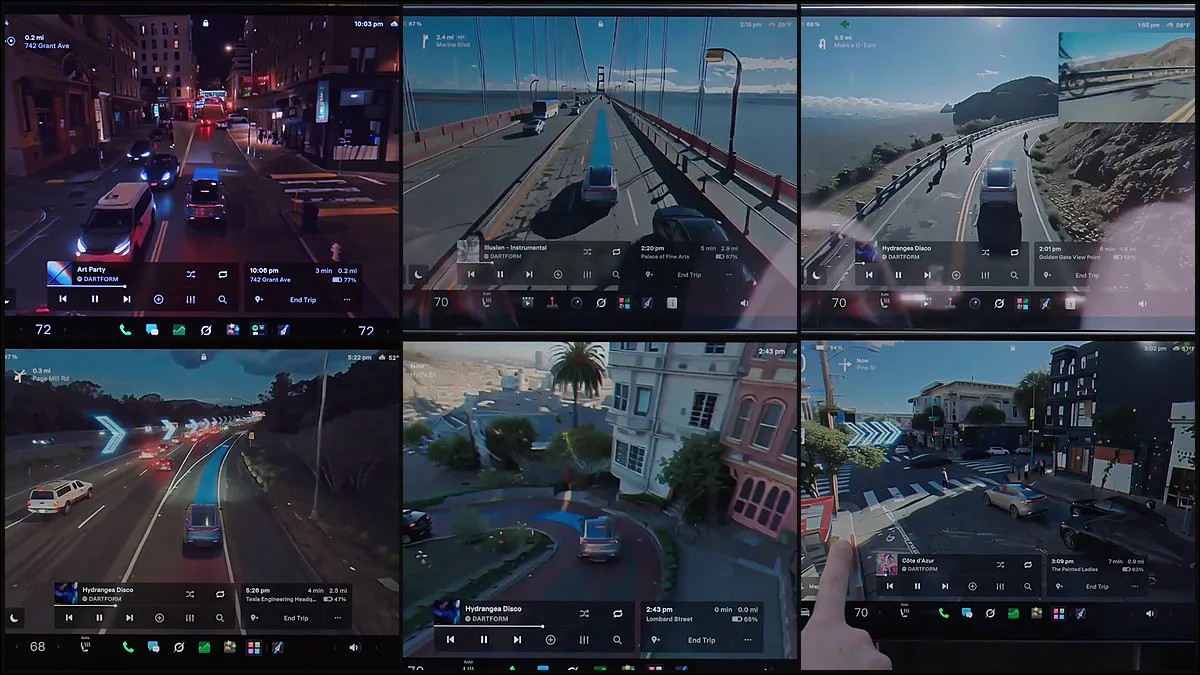
Tesla began rolling out FSD v15 on November 21 U.S. time, which is the early hours of November 22 Taiwan time. Tesla’s official account simultaneously released a 46-second promotional video, featuring a new driving visualization interface called Tesla Reality View. The street view on the center display has changed from the wireframe color blocks of the past to real-time imagery that looks close to real photos. On X, Musk described this version as a “banger release” and also said the new visuals “look like GTA.”
FSD v15 now starting to roll out – upgrading every part of the end-to-end driving network Safety 25x better handling of safety critical cases Tesla Reality View Adds a live visualization of the drive that lets you see & control what FSD is planning to do Navigation for start & end of the trip now learns end-to-end from fleet route preferences. Later v15 releases will expand this to the entire route. You also should notice better detection of signs, animals, debris, potholes and standing water, plus more natural speed handling in school zones and inclement weather. Lastly, FSD can now slow for speed cameras & Bike Rack Mode lets you enable FSD w/ bike racks or similar hitch accessories
— Tesla (@Tesla) November 21, 2026
Beyond the screen, the official release notes list 12 updates covering the vision encoder, navigation, parking, driver monitoring, road surface detection, speed control, and two new modes, and claim a 25-fold improvement in the “critical intervention rate.” The first to receive the update are Early Access Program owners, with version v15.0.1 and in-car software 2026.38.6.11; US owners have been uploading test-drive videos. This article also compiles the official notes, first owners’ real-world tests, and media fact-checks, and adds the latest progress on the Taiwan review. We also made a detailed analysis video, welcome to check it out:
Reality View: The driving model is also responsible for drawing.
According to the official release notes, Reality View is a “real-time generative driving visualization” that continuously streams footage from a virtual camera at an arbitrary position above the vehicle, allowing the driver to see and control FSD’s planning.[3]The so-called virtual camera refers to the image viewing angle. No camera is installed on the roof; the image source is still the vehicle’s existing cameras, and a model reconstructs the surrounding scene to generate the image.
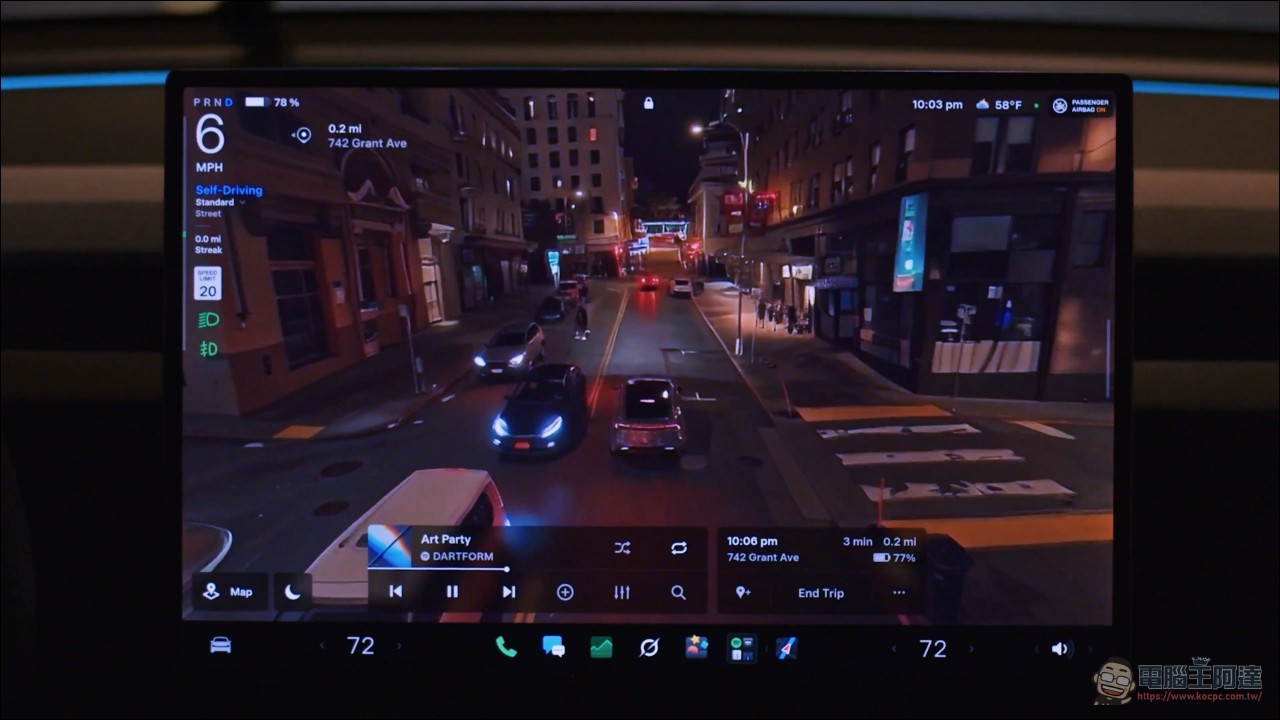
Tesla AI software vice president Ashok Elluswamy explained on X that the same end-to-end driving model is also responsible for rendering the view around the vehicle: an arrow floating in the sky indicates where FSD intends to turn, and a pin marker indicates the parking spot it intends to park in.
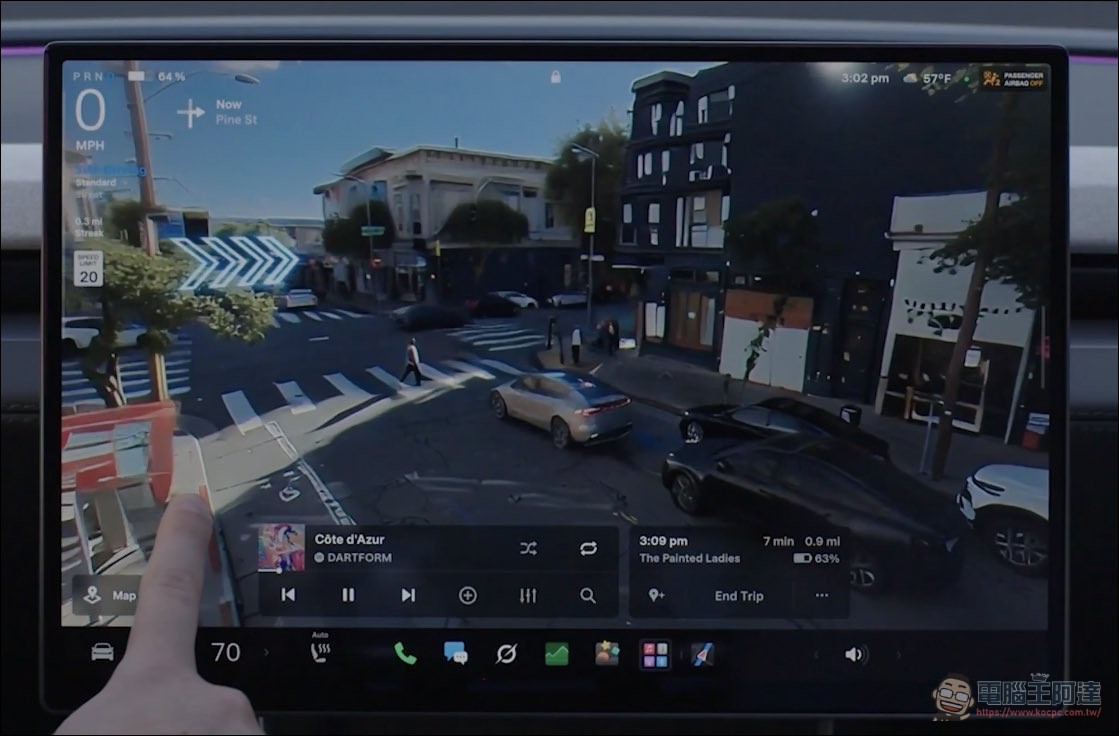
He also reposted a comparison image of the old 2020 wireframe screen and the new version, noting that the new screen on the right uses less computation than the old screen on the left. Musk added that this is real-time AI video generation, does not use a game engine, and uses only half of a single AI4 TRIP accelerator.
The crazier thing is that the right side uses less compute than what the left used to take. Extreme compute efficiency optimization.
— Ashok Elluswamy (@aelluswamy) November 21, 2026
How much “half an accelerator” is can be estimated from hardware teardown data. The HW4 teardown compiled by Notebookcheck shows that the AI4 computer has two SoCs, each containing 3 TRIP neural network cores. If what Musk calls “one accelerator” is one core, Reality View occupies only half of all 6 cores, that is, one-twelfth.
For the interface, Reality View offers four layouts: full-screen visualization, full-screen map, left-right split, and quiet mode. Navigation turns are displayed directly on the screen, and the turn signal alert sound has been made quieter, fading out after a few beeps. Musk also said on X that tapping any point on the Reality View screen will make the car drive there.
A item-by-item look at the 12 release notes
Announced by the Tesla Super Intelligence account.Release NotesPlus the two new modes added in the official announcement, summarized as follows:
- Vision encoder upgradeFSD, Robotaxi, and the Optimus humanoid robot share the same upgraded vision encoder, trained on millions of online videos; officials say the critical intervention rate improved 25-fold.
- Tesla Augmented RealityUsing a single end-to-end visualization to replace the multiple model signals previously output separately lowers total computation.
- Navigation: Changed to an end-to-end model to learn the fleet’s route preferences; this version is used only for the departure and arrival legs of the trip, and only the later v15 version expands it to the full route.
- ParkingChoose a parking location based on your personal parking history; the map will list multiple parking options for your destination.
- Driver monitoring: The in-car camera can still determine the driver’s line of sight when they are wearing a hat or sunglasses, and monitoring is more relaxed in faster driving modes.
- Detect: Improve recognition of road signs, small animals, road debris, and chains.
- Road surfaceImprove pothole and road surface detail detection, and avoid deeper standing water.
- Vehicle speedAdjust vehicle speed according to driving mode, school zones, speed limits, and adverse weather.
- AutoshiftAutomatic gear shifting now uses FSD’s gear prediction.
- Tesla Reality ViewNew real-time generative driving visualization and four layouts.
- Speed camera ahead—slow down.When passing a speed camera, FSD will slow down; press the accelerator or raise the speed profile to cancel it. If you cancel twice at the same location, the vehicle will remember and no longer slow down there; you can remove it under Controls > Service > Manage Saved Locations.
- Bicycle rack modeWhen a bike rack or similar hitch accessory is installed, FSD can still be enabled; the vehicle will pull over near the destination and will not reverse, and Autopark, Summon, and reverse warnings will be disabled.
The full promotional video on the official X also shows a “human gesture recognition” scene that was not listed in the release notes, depicting a traffic director making gestures at an intersection.
First owners put it to the test: stunning visuals, but controls still fall short.
Sawyer Merritt, who has long tracked Tesla, demonstrated in a test-drive video that even with FSD off and the driver driving manually, Reality View still appears. However, he also pointed out several drawbacks, including occasional touch-control lag, the inability to zoom the view in this version, the wipers not being rendered on screen, and the lettering on a farther Best Buy sign being a blurry mess. The first owners have yet to reproduce what Musk described as “tap where you want to go and it drives there.” With FSD enabled, Merritt tapped a parking spot on the screen and got no response, nor could he specify nose-in or reverse parking; only after switching back to manual driving could he tap a parking spot through Autopark and reverse into it. He also found that FSD still parks in accessible parking spaces.
As for everyday driving, Merritt said that compared with v14, he doesn’t feel much difference for now, and also said that when using v14 he rarely took over due to critical situations. In the first batch of videos, they have not yet encountered potholes or flooded road sections that could be tested.
25 times and 9 times: only multiples, no baseline
The official promo video opens with “25x safer,” while the release notes phrase it as “a 25x improvement in the critical intervention rate,” meaning fewer critical situations requiring the driver to take over. The same promo video has another title card reading “9x safer than humans.” The two numbers are compared against different things: 25x is compared with FSD’s own previous version, while 9x is compared with human drivers, and Tesla disclosed neither the original baseline nor the measurement method. Based on data estimates, v14 has about one critical intervention every 2,000-plus miles; if improved 25x, that would be about once every 50,000 miles (about 80,000 km), equivalent to circling the Earth twice.
Who can get it: Tesla has not announced a list of models.
Tesla did not specify which models would receive v15 first. Tesla previously told investors that the AI4 (HW4) computer is sufficient to run v15, while HW3 vehicles were not mentioned at all. Merritt observed several early-access owners in the U.S. and Canada; the first wave appears to have only reached Model Y vehicles with a front bumper camera, while Model 3 and some HW4 Model Y vehicles have not yet received it; AI DRIVR’s own earlier HW4 Model Y has also not received it, and he believes it is more likely just the order of the phased rollout.
On the timing of the wide rollout, Musk said on X that FSD v15 will be widely released next month. A user asked whether it would launch together with the 2026 holiday update, and Musk replied “Yeah.” The holiday update is usually rolled out in December.
Taiwan progress: The review is still at the supplementary documents stage.
On June 16, 2026, Tesla Taiwan announced that it had submitted FSD (Supervised) application documents to the Vehicle Safety Certification Center, and the one-time purchase option also ceased being sold at 11:59 p.m. on June 30. According to the process announced by VSCC, Tesla Taiwan must submit a “Declaration of Suitability for the Domestic Road Environment and Related Safety Verification Test Reports”; testing can begin only after the road test plan has been reviewed and submitted to the Ministry of Transportation and Communications for approval; after testing is completed, a safety verification report must be submitted; and vehicle owners can use it only after approval and obtaining a type safety certification certificate.
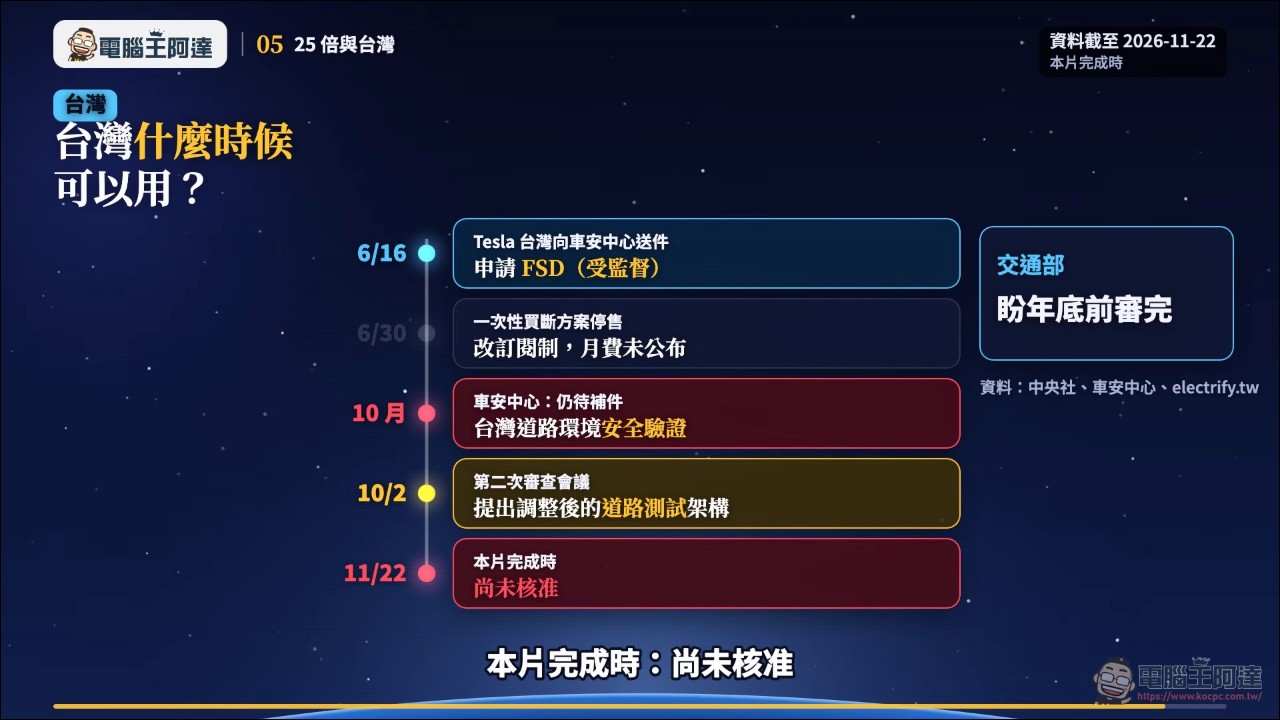
October 1, electric vehicle specialist media electrify.tw Quote the Vehicle Safety Center’s response.The case “still has many materials pending reply, confirmation, and supplementary submission from Tesla Taiwan,” and the details have not been made public. Tesla Taiwan stated on October 2 that it had proposed a road testing plan framework at the second technical review meeting; the test route covers urban to rural areas and incorporates Taiwan’s unique mixed traffic of cars and motorcycles and local traffic rules, and it will subsequently provide supplementary explanations in response to review comments.
Chao Chin-wei, a senior specialist in the Ministry of Transportation and Communications’ Department of Public Transportation and Supervision, said the ministry hopes to complete the relevant review by the end of the year, but actual progress will still depend on Tesla’s preparations and test results, and it does not guarantee that FSD will be allowed by year-end. As of November 22, when this article was completed, Taiwan had not yet approved FSD (Supervised) for road use, and the monthly fee had not been announced.
Conclusion
The most noticeable change in FSD v15 is Reality View. The same driving model draws the surrounding environment for the owner to see, and arrows and pins make it easier to anticipate what the vehicle will do next; the detection and vehicle-speed improvements listed in the release notes also target issues FSD has long been criticized for. However, Tesla’s officially claimed 25x and 9x figures have no basis, driver monitoring is actually relaxed in highway mode, and no owner has yet reproduced “tap where you want to go and it drives you there.” The official name of this version is still FSD (Supervised), and the driver must still pay attention to the road at all times and be ready to take over at any moment. Tesla and regulators have not yet given a timeline for which models will receive the large-scale rollout first in December, whether HW3 owners will get it, or when Taiwan’s review will move to road testing. The hope is that owners in Taiwan will be able to use it next year.
Source: KOCPC Chinese