


Microsoft recently officially launched a new security mechanism called “Windows Baseline Security” through the Windows Insider Program, and it is expected to be fully rolled out in 2027. This new feature consolidates various complex protection settings at the system level into a single “yes/no” test result, allowing third-party applications to quickly determine whether a device is in a secure state; once a computer fails this baseline test, developers can warn users, restrict some features, or even directly block the application from running.
Microsoft has introduced a new Windows 11 “Baseline Protection” mechanism; turning off memory integrity may result in apps having restricted functionality.
The first wave of “Windows Baseline Protection” will focus on eight key security safeguards. In addition to the well-known security processor (TPM), Secure Boot, virtualization-based security (VBS), and Memory Integrity, it also mandates that systems use signed and Windows-certified drivers, and includes mechanisms to guard against kernel debuggers and block drivers with known high-risk vulnerabilities.
This mechanism scans the above settings synchronously every time Windows starts, and if any one of them is disabled, the computer must be restarted for the change to take effect. For application read permissions, in addition to providing the most basic yes/no pass signal, the system also allows developers to request a list of specific missing protections or a hardware-level verification token that is harder to forge. Microsoft emphasizes that this is currently only a preliminary version, and that as cybersecurity threats evolve, the detection standards will continue to be raised.
Gamers bear the brunt as Adobe and Blizzard are the first to partner.
This new feature is the first concrete result of the plan Microsoft announced in February this year to “enhance Windows security by default.” Notably, in the past, many PC gamers habitually manually disabled the “Memory Integrity” feature in pursuit of maximum game frame rates; in the future, under the new rules, such PCs will fail the baseline test and must re-enable the protection to return to normal.
Currently, Microsoft has partnered with several major software companies across gaming, productivity, and education to begin early testing:
- Adobe notes that this security signal can help teams identify pirated software and potential malware more accurately and quickly.
- Blizzard Entertainment (Battle.net) said the mechanism helps raise the bar for anti-cheat and security while minimizing disruption to regular players’ gameplay.
- 1Password, Raycast, and the online exam monitoring tool Schoolyear are also on the first wave of partners list.
However, none of the companies mentioned above have so far indicated that they will directly block computers that fail to meet the requirements, and Microsoft has clearly stated that the final authority to decide how to handle them will be left entirely to each developer.
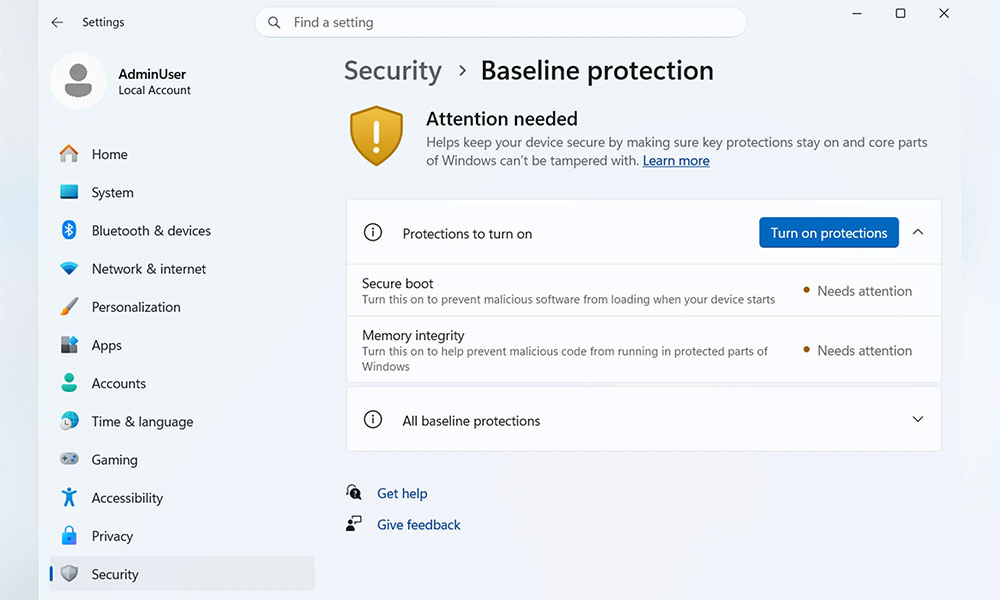
To avoid discouraging ordinary users with cumbersome security settings, Microsoft added an intuitive detection dashboard to the “Settings >> Security” page in Windows 11. When the system detects protection gaps, users only need to click a single button to automatically complete all protections that can be enabled from the operating system side before restarting; if they encounter items such as Secure Boot or TPM that require entering the motherboard BIOS/firmware to adjust, Windows also provides step-by-step guided instructions to help users complete the setup smoothly.
Source: KOCPC Chinese