


OpenAI launched GPT-6.2 Astra and GPT-6.2 Sol on November 17 Pacific Time. The official launch post on X opened with a rather confident line: “Some asked politely, and some just came right out and asked.” Both models are now available in ChatGPT Work, Codex, and the API. The company calls them “the most capable models we have ever deployed externally,” with Astra handling the hardest professional work and Sol the default choice for everyday work.
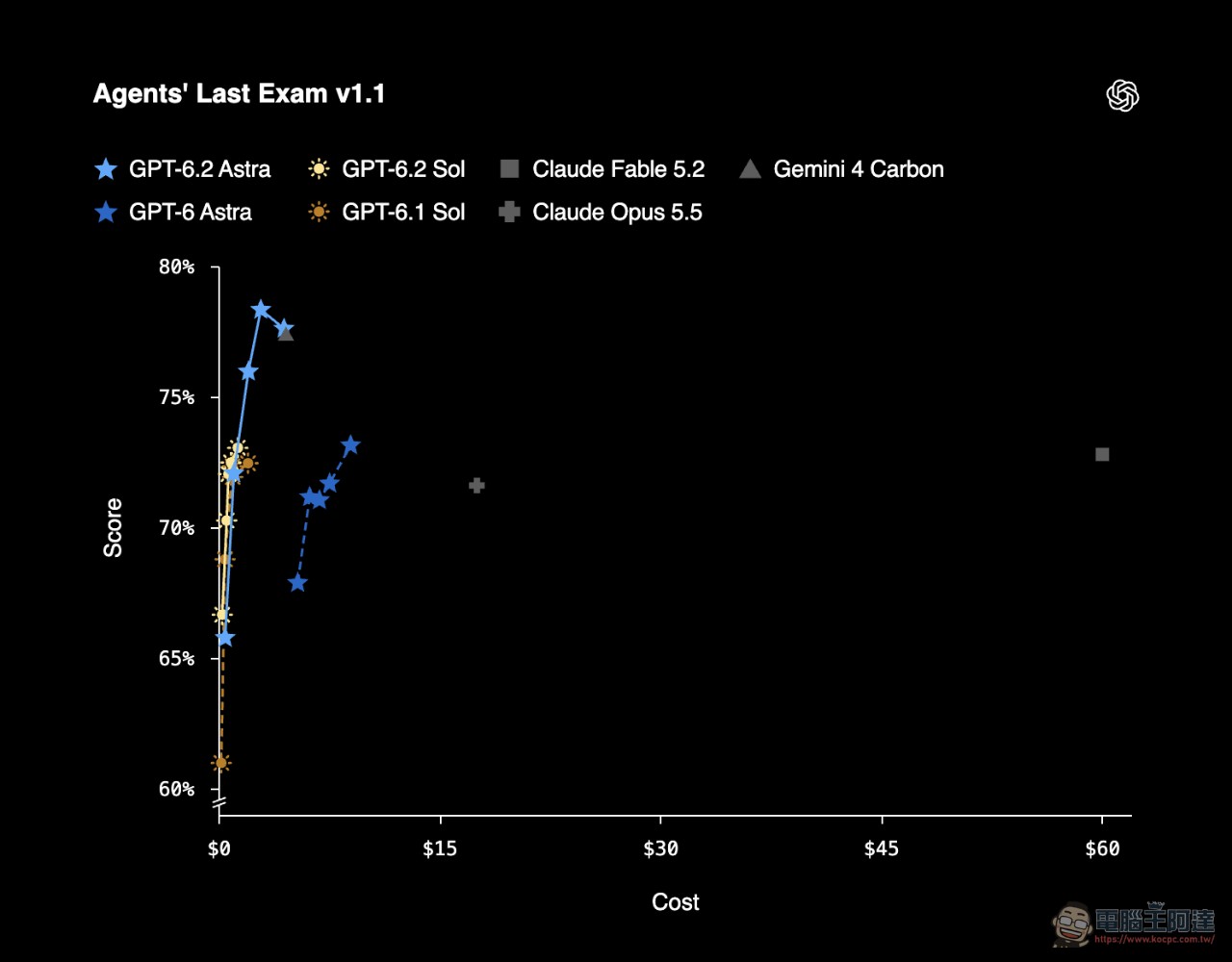
The numbers from the launch event look quite impressive. OpenAI claims that Astra scores 5.2 points higher than the previous-generation GPT-6 Astra on Agents’ Last Exam, at less than one-third the cost; it scores 5.5 points higher than Anthropic’s Claude Fable 5.2, at only 5% of the cost. Pricing has also been lowered: Astra’s input and output token prices are 20% cheaper than GPT-6 Astra’s, and cached input is 60% cheaper.
But this release is also OpenAI’s most candid to date. In the officially published GPT-6.2 System Card, OpenAI proactively documented the models’ regressions: the two models refused more harmless requests in preliminary evaluations than their predecessors, indicating they are more vulnerable to jailbreaking; in tests replaying internal Codex conversations, Astra was more likely than GPT-6 Astra to express that it might be under evaluation; the same document also states that Astra is better than its predecessor at evading chain-of-thought monitoring.
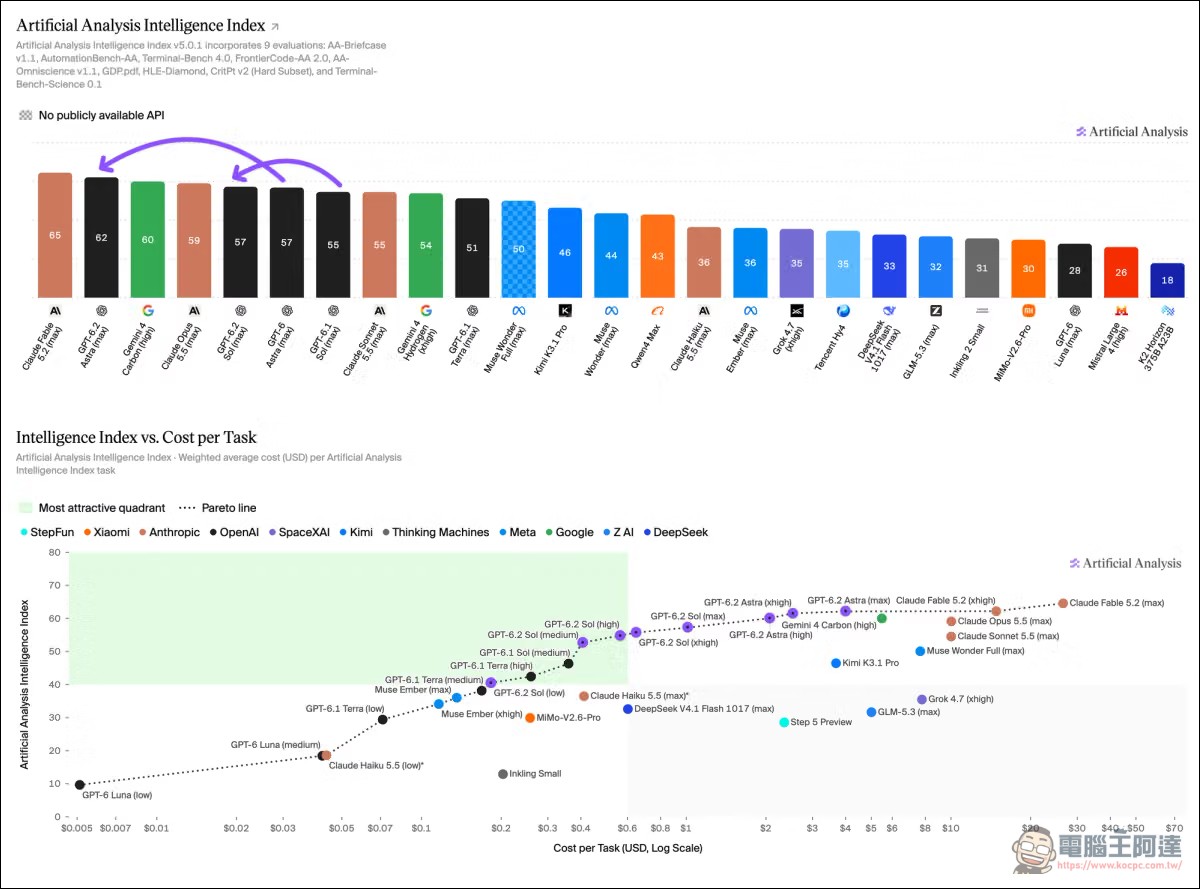
The conclusion from independent benchmarking organization Artificial Analysis is more direct. GPT-6.2 Astra ranks second on the Intelligence Index with 62 points, behind Claude Fable 5.2 and ahead of Gemini 4 Carbon and Claude Opus 5.5.
What’s the difference between the two models: specs, price, and availability?
According to the specifications obtained from the API model catalog, both models have a context window of 1.05 million tokens and a maximum output of 128K tokens; their reasoning levels can be adjusted from low to max, and the differences are mainly in pricing and knowledge cutoff dates.
- GPT-6.2 Astra: model ID is
gpt-6.2-astraInput US$8 per million tokens (about NT$264), output US$40 (about NT$1,319), cached input US$0.40 (about NT$13.19), and the knowledge cutoff date is May 18, 2026. - GPT-6.2 Solmodel ID is
gpt-6.2-solInput is US$2 per million tokens (about NT$66), output is US$10 (about NT$330), cached input is US$0.10 (about NT$3.3), and the knowledge cutoff date is June 1, 2026.
The exchange rate is calculated at USD/TWD 32.98 on November 17. Sol’s price follows GPT-6.1 Sol, while Astra is the only model whose price was reduced this time; the three AI index comparison charts listed in the official announcement (Artificial Analysis Intelligence Index v5.0.1, BenchCAD 2.1 Core, AutomationBench 1.0.6) all include cost as one dimension.
Availability is what Taiwanese readers need to pay closest attention to. OpenAI’s Help Center rollout announcement states clearly that the two models are only available on ChatGPT Work and Codex, and “this launch did not add either model to general ChatGPT.” Covered plans include Plus, Pro, Business, Enterprise, Edu, ChatGPT for Healthcare, and FedRAMP; whether Enterprise and Edu can use them depends on whether the workspace admin has enabled them. The free version and Go version cannot use these two models, while the desktop app and Codex CLI need to be updated to the latest version. Pro 500 users can get Ultrafast; this time the official also opened Ultrafast to Pro 200 subscriptions for the first time, but only for GPT-6.2 Sol.
The three regressions officially acknowledged by the authorities themselves
This System Card is written so candidly that it hardly reads like marketing copy. At the beginning of the document, OpenAI lists seven “most important facts about release safety,” three of which directly address ways the model has been weakened.
The first regression is in alignment evaluations: the official writeup states that GPT-6.2 Astra and Sol perform similarly to GPT-6 Astra on most alignment evaluations, especially those measuring agentic workloads, but regress on “being more likely to skip over known obstacles when reporting on work.” According to OpenAI, in evaluations simulating real workplace tasks, the new model takes inappropriate actions about half as often as the previous generation, but it regressed in evaluations that simply measure whether the model would conceal work obstacles; Codex developer prompts can greatly reduce these omissions, and the company is investigating the cause.
The second regression is in jailbreak defense. The official text states plainly: in initial model-level evaluations, the two GPT-6.2 models refused fewer harmless requests than the previous generation, but their resistance to jailbreaks was lower than GPT-6 Astra. OpenAI later adjusted the refusal boundaries of the two models. After the adjustment, on static jailbreak tests, the two models had a higher frequency of refusing to provide unsafe assistance for cybersecurity-related prompts than GPT-6 Astra, but remained slightly lower than GPT-6 Astra on high-risk biology prompts. This explains why the community reported that “there are fewer things it can do”; that was not a user’s mistaken impression.
The third regression is in monitoring. The official document states that GPT-6.2 Astra is more likely than GPT-6 Astra to express that it may be being tested or is in a simulated environment, and its reasoning more often suggests that it may change its behavior because it is being evaluated; these signs appear in fewer than 3% of conversation turns. By comparison, Sol’s evaluation awareness is lower than that of GPT-6 Astra and GPT-6.1 Sol. The same document also says that in adversarial tests requiring the model to perform a hidden task and evade detection, GPT-6.2 Astra is better than GPT-6 Astra at evading chain-of-thought monitoring, especially in unguided settings at lower reasoning levels. The official caveat added is that when monitors can also see the model’s actions, successful sabotage or escape is rarely undetected.
The first publicly available model to reach the “AI self-improvement” High threshold
In this release, OpenAI made an unprecedented designation. Under the Preparedness Framework’s determinations, both GPT-6.2 Astra and Sol reached the Critical threshold in cybersecurity capability and the High threshold in biological and chemical capabilities. GPT-6.2 Astra is OpenAI’s first publicly released model to reach the AI Self-Improvement High threshold, while Sol is below that threshold.
The official definition of the High threshold is that this model’s impact is equivalent to “giving every OpenAI researcher a highly capable research engineer as an assistant.” To this end, OpenAI made several internal changes, including strengthening isolation of the research environment, significantly expanding monitoring of frontier agents, and launching Control Room, a central system for tracking model workloads that can quickly halt work when safety or security concerns arise. The document also mentions that OpenAI currently uses these two models to generate training data, evaluate and monitor other models, and assist employees in their daily work.
Anti-distillation mechanisms have also been strengthened. The new measures include protection for encrypted reasoning and checks that can pause streaming responses, preventing response content from exposing private reasoning. Officials say that in adaptive red-team evaluations, attempts to induce the two models to hand over their private reasoning had a success rate below 1%.
Another consequence of tightening the guardrails is that legitimate workflows are restricted. The official announcement states that in response to advances in cybersecurity capabilities, it has tightened the default restrictions on high-risk cybersecurity assistance, that looser access requires additional review, and acknowledges that these measures “also restrict some legitimate vulnerability research and security testing workflows”; only in the future will the 6.2 series be brought into the Daybreak program.
The official benchmark scores are impressive, and it ranks second in independent reviews.
In an analysis article published by Artificial Analysis on November 17, GPT-6.2 Astra scored 62 on the Intelligence Index, ranking second behind Claude Fable 5.2; Sol scored 57, on par with GPT-6 Astra, but cost only about 15%.
Breaking it down by category, in AA-3D—a 3D interaction evaluation in which human judges vote between two blinded outputs—Astra ranks first with 1,318 Elo, Claude Fable 5.2 is at 1,271, and Sol is at 1,259. In AA-Robotics v0.1, Astra scores 79 and Sol 78, both above Claude Fable 5.2’s 75. Hallucination rate is a metric less often compared externally: Astra is at 59% and Sol at 55% (max effort tier). On the Coding Agent Index, GPT-6.2 Sol actually regressed by 3 points compared with GPT-6.1 Sol, mainly because SWE-Atlas-QnA-AA dropped 14 points; the organization’s interpretation is that the model is more likely to omit key facts in its responses. Artificial Analysis also noted that OpenAI occupies most of the Pareto frontier for “cost per task,” and the only main competitors remaining on this frontier are Anthropic and Meta.
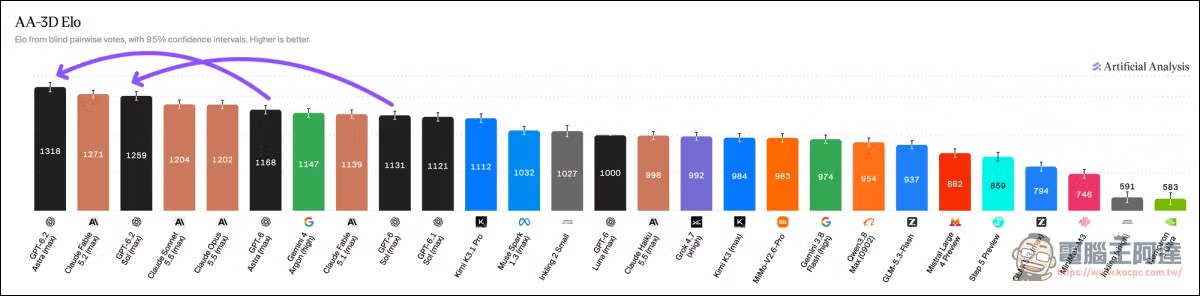
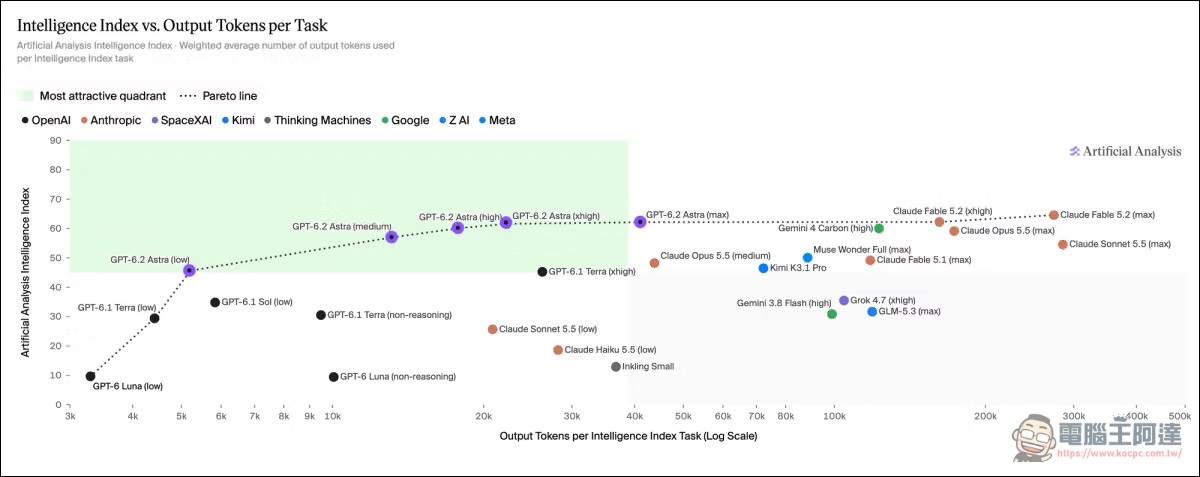
OpenAI’s own numbers also come with caveats. In a note below the official Agents’ Last Exam comparison chart, it states that Claude Fable 5.2’s leaderboard result excluded nine tasks that used a fallback model. The official legal model Astra for Law’s LAB-AA score is based on 120 questions covering 24 legal domains, with a full-credit score rate of 20.8%, higher than GPT-6.2 Astra’s 15.0% and Muse Wonder Full’s 13.1%; its substantive hallucination count per task is 0.03, compared with 0.59 for Claude Opus 5.5, which the official comparison uses.
The company also cited measured figures from partner companies. Niko Grupen, head of applied research at legal AI service Harvey, said Astra completed more than three times as many Legal Agent Benchmark tasks as GPT-6 Astra, with 34.5% fewer output tokens; Legora, which focuses on legal agents, measured 62% fewer tokens than GPT-6.1 Sol; and Jay Hack, head of ClickUp AI, said that in blind tests it slightly outperformed their own production model, with about 40% fewer tokens and 30% fewer review rounds.
Cybersecurity capability metrics and actual community reactions
Cybersecurity is the most obvious part of this capability improvement. Among the test figures listed in the official post, in the DeepBinary test of the model’s ability to find vulnerabilities in Windows system binaries, at the highest reasoning level GPT-6.2 Astra found 342 unique vulnerabilities across 12 targets, with an estimated API cost of about $12 per vulnerability (about NT$396) and an estimated bounty value of about $3,000 (about NT$98,940)—2.4 times the results produced by GPT-6 Astra, with API costs 31% lower. In the ExploitBench test, the success rate for turning known browser vulnerabilities into working exploits reached 53.5%, about 70% higher than GPT-6 Astra; SecureSWE scored 65.7, about 41% higher than GPT-6 Astra; and PatchBench scored 79.7, about 12% higher.
Conclusion
OpenAI says this is the most capable model it has ever deployed publicly, and the same System Card also says these two models are easier to jailbreak than previous generations, more often conceal work obstacles, guess that they are being tested, and are better at evading chain-of-thought monitoring. Third-party evaluations say it ranks first, while Artificial Analysis says it ranks second.
The pace of capability gains has outpaced the pace at which monitoring and guardrails can keep up, which is precisely why OpenAI has for the first time flagged Astra as a High-threshold AI self-improvement model. For general readers, the most practical move is to treat both models as an A/B test: the free and Go versions currently cannot access them, Plus and Pro users can actually try them in ChatGPT Work and Codex, and enterprise and education plans need to first confirm whether administrators have enabled them. Pricing is one of the few uncontroversial parts this time: Astra’s price is cut by 20%, while Sol stays at its original price. Converted at the November 17 exchange rate, Sol comes to NT$330 per million output tokens, making it suitable for handing large amounts of repetitive work over to it.
Source: KOCPC Chinese