


Today, a shocking news circulated on the Internet: “Lao Gao and Xiao Mo”, the top creators in the Chinese-speaking YouTube region, were fined a whopping 415.69 million yuan (approximately NT$1.8 billion) by the tax authorities in Dalian, China. According to information from “Asia Finance”, the Dalian Municipal Taxation Bureau determined that Lao Gao had illegally made US$5.7735 million through the YouTube platform, and calculated a huge fine based on this. However, as more information is revealed and netizens examine relevant documents in depth, doubts have arisen, putting a question mark on the truth of the entire incident.
5年前,老高与小茉,教人如何赚钱;5年后,因为一笔4.1亿税务罚单,老高与小茉面临分手。老高本名高全,大连人;小茉真名不详,内蒙古人。老高在2004年因工作移居日本,两人在2009年在日本结婚,2021年移居新加坡生活至今。传闻大连税务认定,老高在YouTube违法获利577.35万美元,因此要罚41569.20万元… pic.twitter.com/ypZQz4HKW4
— 亚洲金融 Asia Finance (@AsiaFinance) February 21, 2026
According to the InternetPublic information, Lao Gao was born in Dalian, Liaoning Province, China in 1981. He graduated from Dalian University of Technology and worked as an IT consultant in the financial industry. In 2004, he moved to Japan, where he met Xiao Mo, a Chinese student from Inner Mongolia. The two got married in 2009 and jointly run the YouTube channel “Mr & Mrs Gao”. The channel tells topics such as urban legends, world anecdotes, mysticism and unsolved cases in the form of relaxed and humorous couples’ conversations, and is deeply loved by Chinese-speaking audiences around the world. As of February 2026, the number of channel subscriptions has reached 6.72 million, with a total of more than 2.3 billion views, making him an iconic creator in the Chinese YouTube industry.

It is reported on the Internet that “Lao Gao and Xiao Mo” were fined 410 million yuan by China’s Dalian tax agency “Ocean Fishing”
In 2021, Lao Gao and Xiao Mo moved to Singapore from Japan. The outside world generally believes that this move is related to tax planning: Singapore’s top personal income tax rate is only 22%, far lower than Japan’s 45%. The rumor this time is because when Lao Gao and Xiao Mo returned to China to visit relatives, they were detained by the Dalian tax authorities as soon as they entered the country. They must pay the fine before March 31 this year before they can leave the country. The amount is as high as 410 million yuan.
尘埃落定,老高与小茉。 pic.twitter.com/CsZR7P6rX3
— 刘正博士 (@mokoocn) February 21, 2026
Authenticity of fines sparks heated debate
Although news of the fine spread, many netizens raised questions, pointing out that the circulated fines may be suspected of forgery. The main doubts include:
- Wrong ID number: Some netizens found after comparison that the ID number on the ticket did not match Lao Gao’s actual information.
- Citing failed bills: The bill mentioned in the ticket has not actually been passed, which is extremely rare in formal government documents.
- The ticket format is wrong: Some netizens posted the administrative penalty ruling of Dalian City, which is obviously different from the format exposed on the Internet.
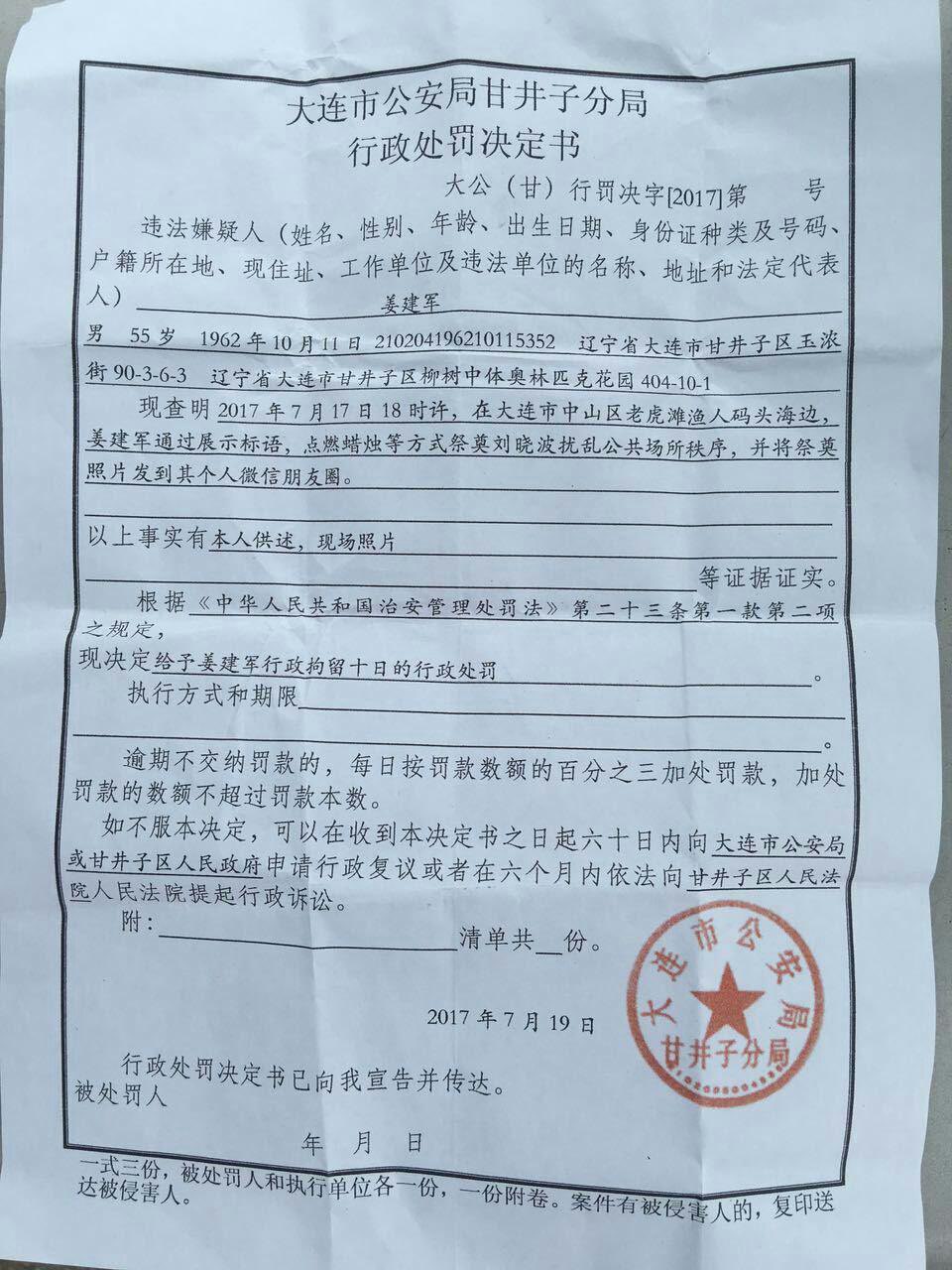
These doubts have led some observers to believe that the so-called “410 million fine” may be forged documents or malicious rumors. However, some people point out that even if there are doubts about the fine itself, it does not mean that Lao Gao and Xiao Mo have no potential tax problems at all.
Background Analysis: The “Distant Ocean Fishing” Phenomenon and China’s Tax Inspection
To understand the deeper significance of this incident, it must be viewed within the context of China’s “distant ocean fishing” law enforcement phenomenon in recent years.
“Ocean fishing” is a term used on the Internet in China to describe the behavior of some local government and public security agencies that are motivated by profit and violate laws and regulations to arrest, seize, and freeze personnel and assets of foreign companies in other places. This approach is called “profit-driven law enforcement” in official discourse, and has intensified in recent years due to local financial constraints. According to the New York Timesreport, local governments across China are facing pressure from increasing debt and reduced tax revenues, and land transfer revenue has dropped by nearly one-third from the peak in 2021. In order to fill budget gaps, law enforcement agencies often “fish” companies outside their jurisdictions with fabricated or exaggerated accusations.
The key reason for “distant ocean fishing” is that local governments are short of money. A Shanghai lawyer isAnalyze articlesZhong bluntly said: “In the past, when real estate was booming, there was less offshore fishing. The local government ran out of money and the land could not be sold. The tax department had worked very hard, but in the end we had to rely on guns.” Against this background, China’s tax authorities are indeed increasing their intensity in auditing overseas internet celebrities and creators. Especially for creators who earn high advertising shares through platforms such as YouTube (especially Lao Gao, who should be the highest-paid creator among Chinese), the Chinese tax authorities may believe that their income should be declared and taxed within China.
Similar cases: Lessons from the Internet celebrity tax evasion incident
The case of Chinese Internet celebrities being investigated for tax evasion is actually not a special case. At the end of 2021, Wei Ya, a well-known Chinese Internet celebrity anchor, was found to have evaded taxes of RMB 643 million by the Hangzhou Municipal Tax Inspection Department for concealing, converting income, and falsely declaring income. In the end, she paid a total of RMB 1.341 billion in back taxes and fines. In addition, Chinese Internet celebrity “Peng Shiliu” was also fined 4.15 million yuan for tax evasion. These cases show that China’s tax authorities have become increasingly strict on the income supervision of online creators, and income generated by both domestic and overseas platforms may be included in the scope of audit.

Channel suspension: The dog’s condition became the main reason for the suspension
Because their pet dog “Li Qi” was suffering from lymphoma, doctors revealed the reason why the situation was not optimistic. Lao Gao and Xiao Mo’s channels announced in October 2025 that they would suspend updates indefinitely. Lao Gao once issued an announcement through YouTube saying: “All videos on the channel will be suspended and the resumption time has not been determined.” However, in recent days, they have begun to quietly resume updates. However, neither of the two people showed their faces in the video, and Xiao Mo’s voice was not heard.

The timing of the channel suspension and the emergence of rumors about tax fines triggered various associations on the Internet. However, there is currently no conclusive evidence showing a direct link between the two.
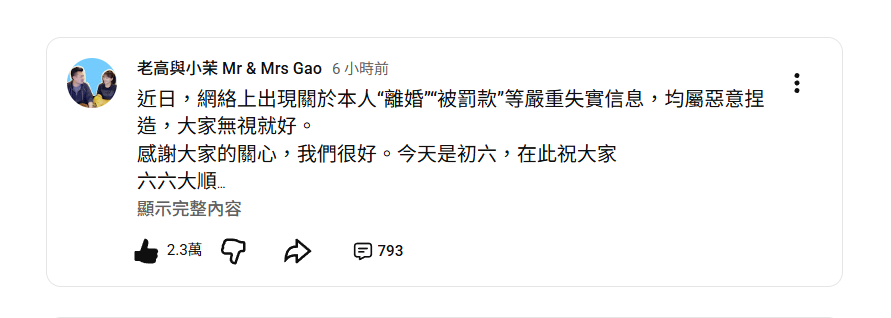
Update: Lao Gao himself has publicly stated on YouTube earlier that this news is purely a rumor, which is consistent with our report.
Conclusion
The incident of Lao Gao and Xiao Mo being fined 410 million yuan by Dalian tax is still in the “rumor” stage, and the authenticity of the relevant fines has not been officially confirmed. Whatever the ultimate truth, this incident highlights several issues worthy of attention:
First, tax compliance challenges faced by multinational creators are increasingly complex. As tax authorities in various countries tighten supervision of the digital economy, creators must be more cautious in reporting cross-border income. Secondly, the phenomenon of “distant ocean fishing” reflects China’s local financial difficulties and law enforcement chaos, which not only affects the confidence of private enterprises, but may also have a chilling effect on overseas Chinese creators.
Finally, in the era of information explosion, the public should remain rational in the face of various “news” circulating on the Internet, wait for Lao Gao’s official response, and avoid becoming the disseminator of false information.
Source: KOCPC Chinese