


The U.S. Supreme Court recently ruled against U.S. President Trump (Donald Trump) promoted “reciprocal tariff(Reciprocal Tariffs)” made a historic ruling. The court ruled that the Trump administration’s use of emergency powers to impose tariffs on imported goods without explicit authorization from Congress was “illegal and ultra vires.” The ruling not only dealt a serious setback to current trade policy, but also left tech giants Apple Be the biggest beneficiary: According to preliminary estimates, Apple is expected to recover up to US$3.3 billion (approximately NT$107 billion) oftariffloss.
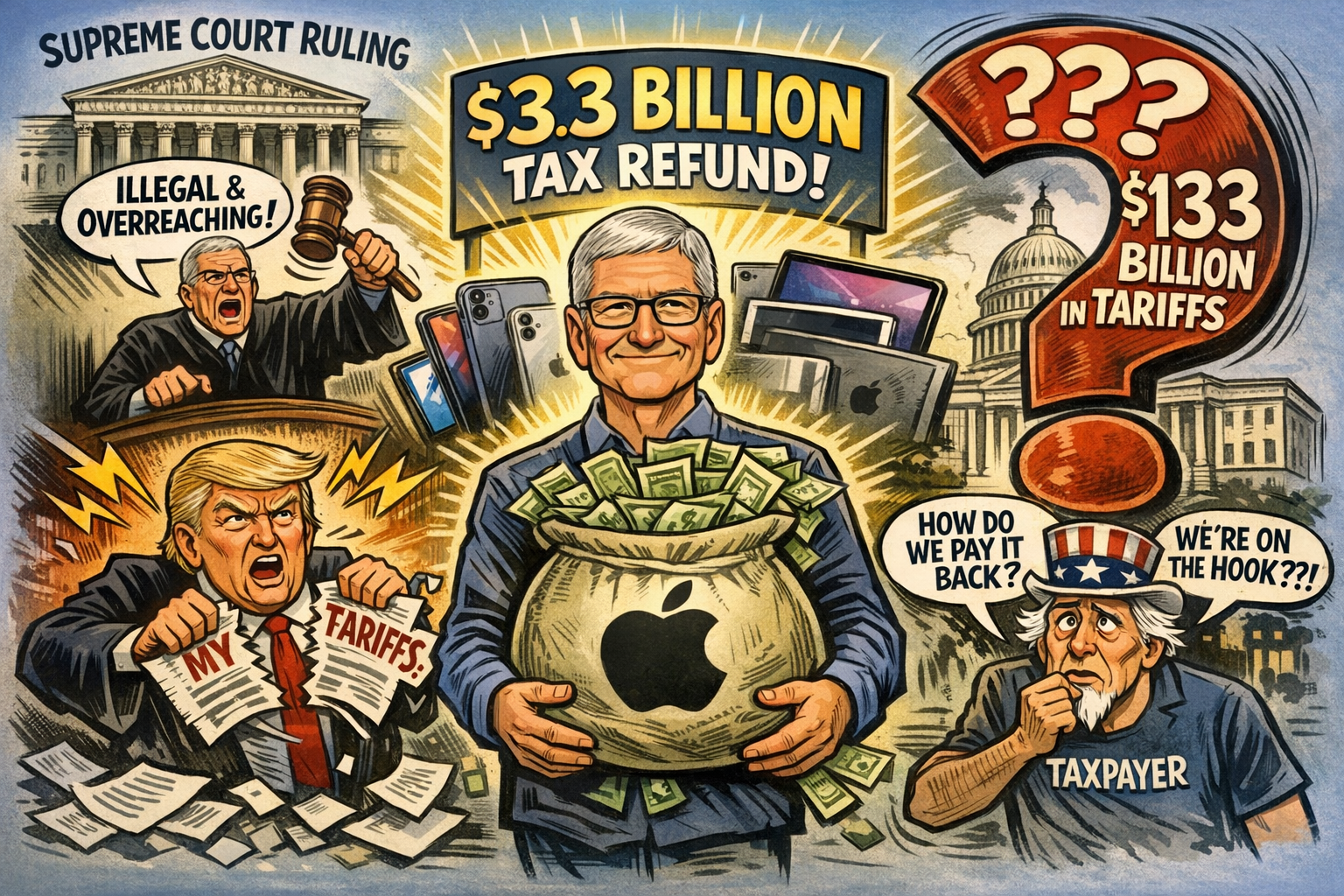
The U.S. Supreme Court rules that Trump’s “reciprocal tariffs” are illegal! Apple expected to receive $3.3 billion in tax refunds
At the heart of the legal battle is whether the Trump administration has abused executive orders to interfere with international trade.
- Basis for ruling: The Supreme Court ruled that the International Emergency Economic Powers Act (IEEPA) cited by the Trump administration was insufficient to support its indefinite, country-specific reciprocal taxation. The court held that taxation power belongs to Congress, and administrative agencies are not allowed to create their own taxes in the absence of a legal framework.
- Apple’s losses: Under this tariff policy, Apple paid huge additional taxes on imported iPhones, iPads, Macs and other products. CNBCanalyzeIt pointed out that the $3.3 billion paid by Apple should be considered “unjust enrichment” and must be returned.
- legal breakthrough: This ruling is a “decisive financial victory” for Apple, which will not only improve its cash flow, but also likely boost its financial performance in 2026.
The big unresolved “$133 billion” question mark
Although the ruling clarifies that tariffs are illegal, the question arises:What about the $133 billion in tariffs already imposed?
- Difficulty of tax refund: The ruling does not automatically trigger a full tax refund. Government lawyers argue that some of the money has already found its way into state coffers and been consumed, and that a forced return could lead to a collapse of the budget.
- Program trap: pointed out that although the court has blocked future collections, it still retains a certain amount of legal interpretation space for “retrospective refunds”, and companies may need to file lawsuits on a case-by-case basis to get the money back.
- industrial chain reaction: In addition to Apple, hardware manufacturers such as Dell and HP that rely heavily on overseas OEMs are also preparing to follow up and demand the return of illegal tariffs.
- Variables in U.S.-China Relations: The ruling may reduce the U.S.’s leverage in future trade negotiations with China, but it also buys technology supply chains breathing room.
This ruling is a strong correction of “administrative abuse” in a country governed by the rule of law. For Apple, although $3.3 billion is huge, what is more important is the “predictability of regulations.” However, as Fortune magazine notes, the $133 billion chargeback dispute has only just begun. Is this verdict delayed justice? Or is it the beginning of another government fiscal disaster? As Trump publicly announced after the verdict that he would immediately impose 15% tariffs on all countries (including those that have completed negotiations) (it was 10% at the beginning, he really just screamed as he pleased), it feels like this tariff farce will not end in a short time.
Source: KOCPC Chinese