


Whoscall, the world’s leading call identification and fraud prevention application, today released the “2025 Annual Fraud Prevention Report”, revealing the latest trends in fraud activities in Taiwan. The report shows that with the joint efforts of the government, telecom operators and private enterprises, the number of fraudulent calls and messages identified in Taiwan will decrease by 37% in 2025 compared with the previous year, ranking first in Asia. However, with the development of technology, fraud techniques continue to evolve, and new threats such as malicious links and phishing websites are rapidly emerging, and the public still needs to remain highly vigilant.

Whoscall releases 2025 fraud prevention report, Taiwan’s fraud identification volume decreases by 37% year-on-year
The number of fraud detections dropped significantly by 37%, making Taiwan the best in Asia
According to statistics from Whoscall, the total number of fraudulent calls and messages flagged and blocked by Taiwanese users through the Whoscall app in 2025 dropped significantly by 37% compared to 2024. This data not only reflects Taiwan’s remarkable achievements in anti-fraud work, but also makes Taiwan the country with the most significant reduction in fraud in Asia.
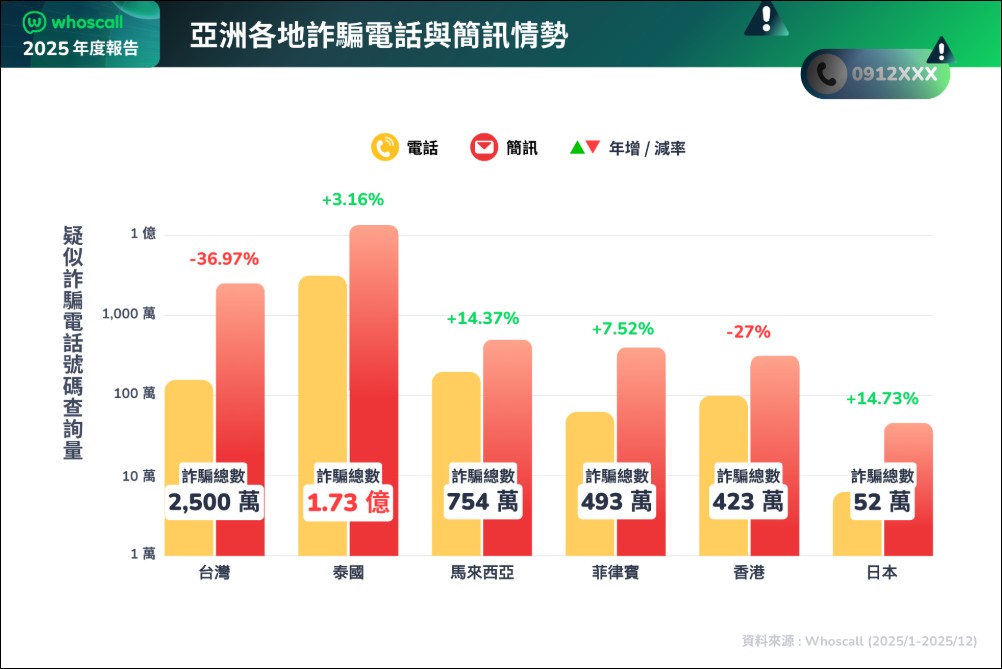
Industry analysts pointed out that the reasons for Taiwan’s outstanding anti-fraud results include:
- The government takes active actions: The 165 anti-fraud hotline of the Police Department of the Ministry of the Interior continues to strengthen publicity and establishes a rapid reporting mechanism with telecommunications operators.
- Telecom operators cooperate: Telecom companies such as Chunghwa Telecom, Taiwan Telecom, and Far EasTone proactively intercept suspicious calls and send warning text messages.
- Raising public awareness: After years of anti-fraud education, Taiwanese people have become significantly more alert to suspicious calls.
- Popularization of technological tools: The widespread use of anti-fraud applications such as Whoscall provides real-time identification and interception functions.
More than 60% of links are malicious, and malware and phishing websites are the two major threats.
Although the number of traditional scam calls is declining, the Whoscall report also warns that new types of online threats are growing rapidly. Among the malicious links encountered by Taiwanese users in 2025, the following two categories combined will account for more than 60%:
- Malware downloads (35.7%): Inducing users to click on links to automatically download malicious applications such as Trojans and spyware to steal personal information or control devices.
- Phishing websites (30.5%): Fake websites disguised as banks, e-commerce platforms, or government agencies to trick users into entering sensitive information such as account passwords, credit card information, etc.
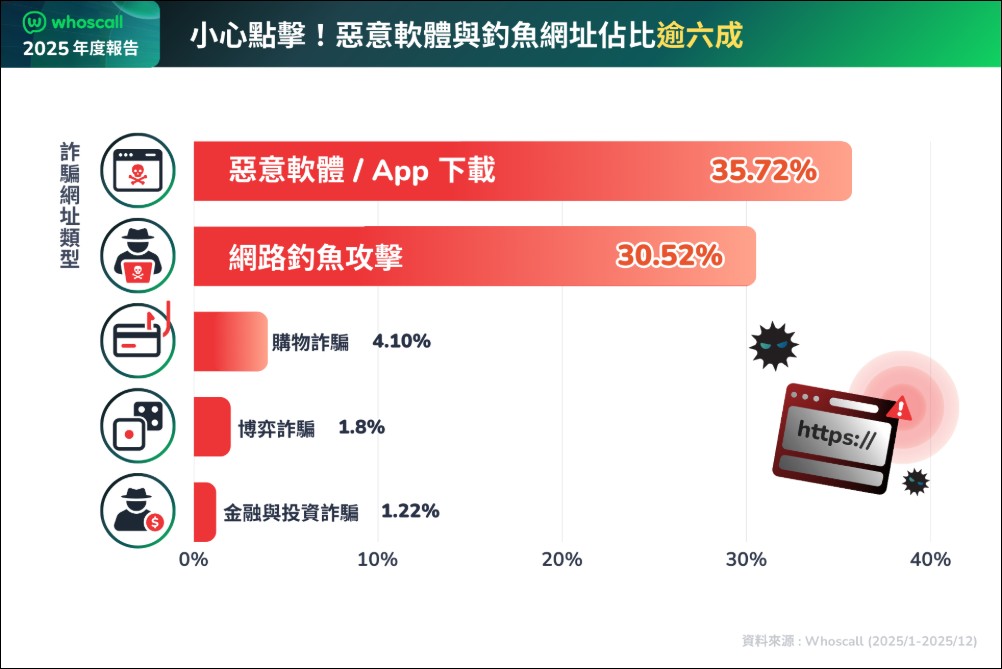
The Whoscall security team emphasized that such malicious links are usually spread through text messages, social media or emails. Since the URL is disguised, ordinary users have difficulty identifying the authenticity and are extremely easy to be deceived.
Text message fraud: Loan fraud accounts for nearly 80%
Among the types of text message fraud, “loan fraud” overwhelmingly ranks first, accounting for nearly half of all text message fraud cases.80%. This type of fraud usually attracts scammers with words such as “low interest rates,” “quick disbursement,” and “no need to pay taxes.”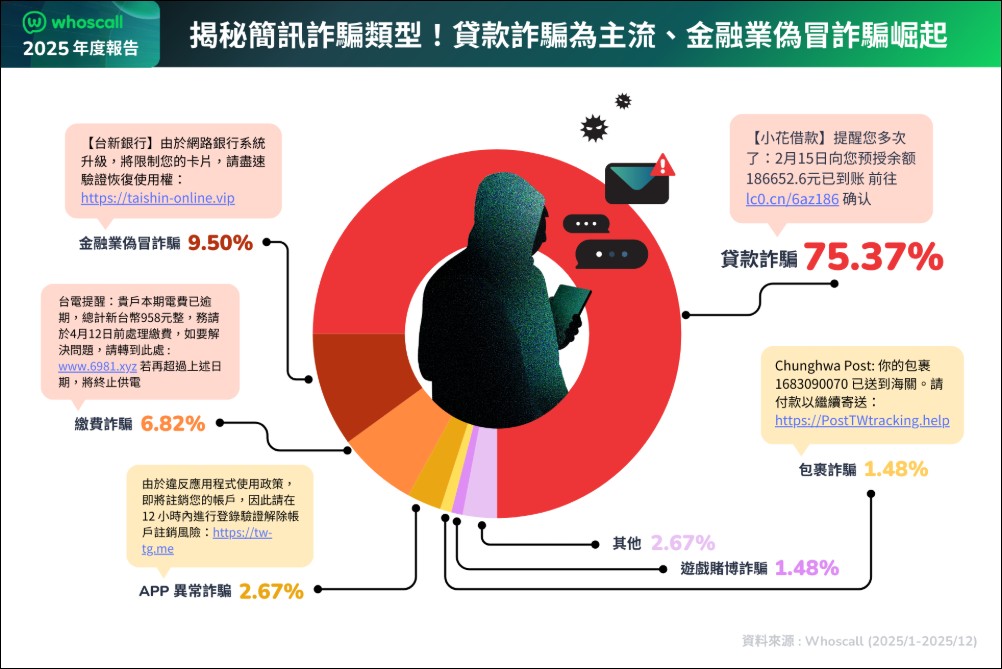 Victims who are in urgent need of funds then require payment of deposits, handling fees and other fees, and eventually run away with the money. Typical loan scam text messages include:
- “[XX Bank] Congratulations on getting a cash advance of 500,000 yuan, with an annual interest rate of only 2%. Click here to apply now”
- “[XX Credit] No joint charges, same-day wire transfer, if you need funds urgently, please contact 09XX-XXX-XXX”
- “[Government Subsidy] Eligible people can apply for low-interest loans. Please click on the link for details.”
The police remind that regular bank loans will never be actively promoted through text messages, nor will they require any payment in advance. People who receive such text messages should delete them immediately and do not click on the links or call the number provided.
Harassment calls: Private financial lending topped the list, reaching 14.59 million calls
In addition to scam calls, Whoscall also released statistics on harassing calls in Taiwan in 2025. Among all types of harassing calls, “private financial lending” accounts for as much as1,459 WantongRanked first in terms of number, approximately as many as regular bank loan marketing calls3.5 times。
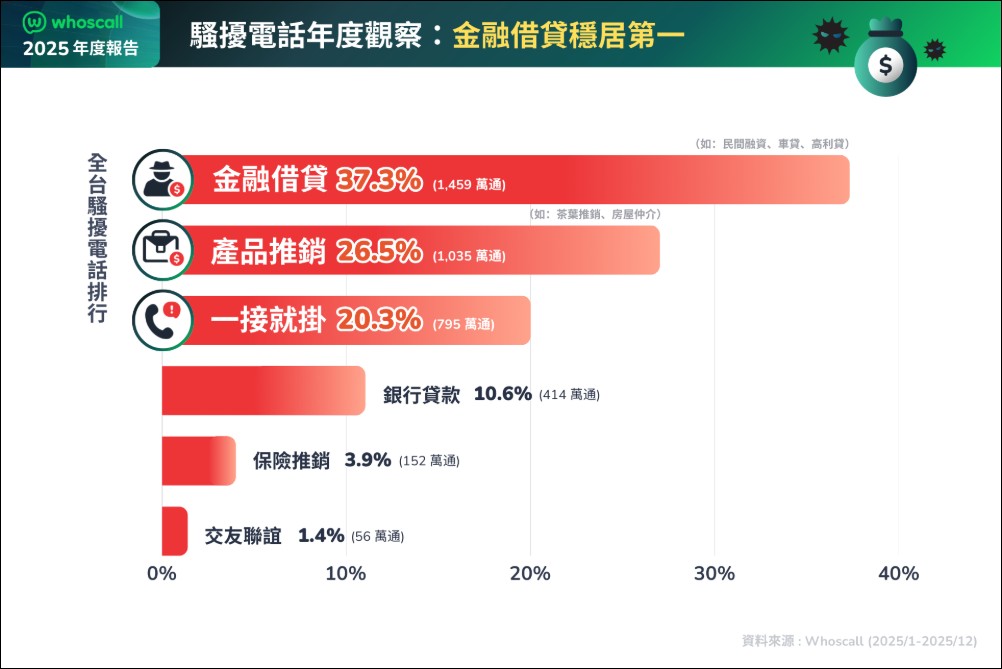
Characteristics of this type of private lending phone call include:
- Frequent calls, possibly multiple calls in a day
- The numbers are mostly mobile phones or hidden numbers
- Strong words, even coercive
- Claims “no credit check” and “same day funding”
Consumer protection groups point out that some private lenders operate on the edge of the law and even engage in loan sharking and violent debt collection. If people have financial needs, they should give priority to formal financial institutions to avoid falling into the trap of private lending.
“Hang up as soon as you answer the call” nearly 8 million phone calls are made every year
Another noteworthy statistic in the Whoscall report is the “answer-and-hang-up” type of discovery calls. The characteristic of this type of call is that it rings once and then hangs up immediately, inducing people to call back. In 2025, the total number of pathfinding calls received by Taiwanese users will be close to8 million Wantong。
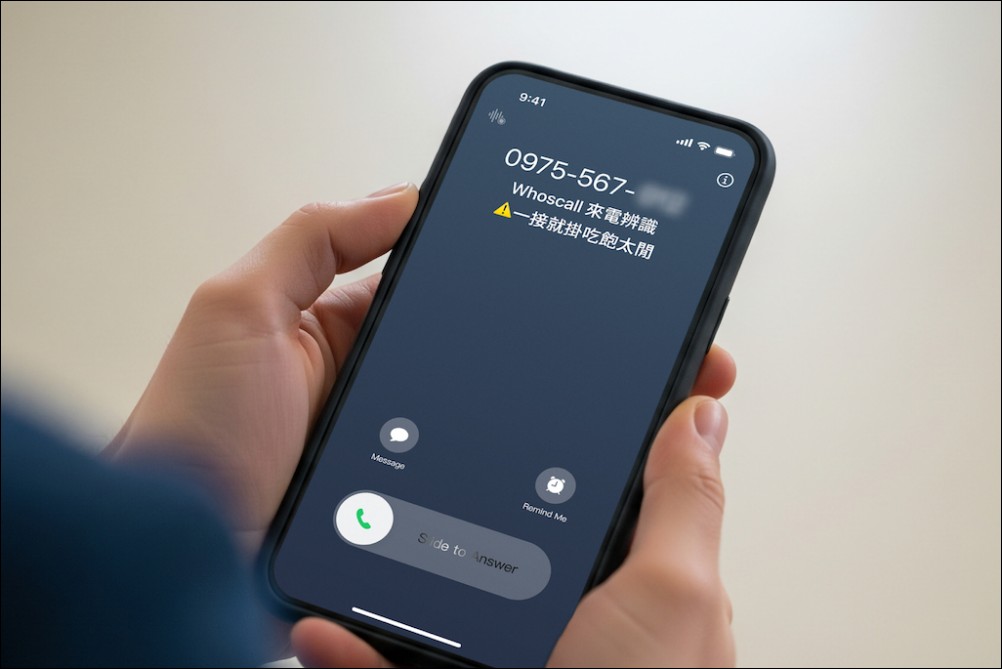
The purpose behind a discovery call may include:
- Confirm number validity: Once a callback is made, it means that the number is being used and will subsequently be put on a target list and resold to other fraud groups.
- High cost pay phone scam: After calling back, you may be transferred to a high-cost pay phone, resulting in huge phone bills.
- Voice fishing: After calling back, you will hear the recorded voice, which will induce you to perform further operations and be deceived.
Anti-fraud experts suggest that if the public sees a missed call from an unknown number and only rings once, it is best not to call back. If you are worried that the call is important, you can first check the number attributes through applications such as Whoscall, or directly wait for the other party to call again.
Fraud prevention trend forecast for 2026
In the face of ever-evolving fraud techniques, the Whoscall security team makes the following predictions about fraud prevention trends in 2026:
- The rise of AI fraud: Scam groups may use AI technology to simulate the voices of relatives and friends to conduct voice fraud, or use deepfake technology to create fake videos.
- Cross-border fraud increases: With the opening of international borders, cross-border telecommunications fraud cases may increase significantly, making investigation more difficult.
- Virtual currency scams: Fraud cases in the name of investing in virtual currencies will continue to grow, especially targeting older people who are unfamiliar with cryptocurrencies.
- social media scams: Frauds conducted through social platforms such as Facebook, LINE, and Instagram will become more rampant, especially fake online photos and fake investment groups.
Three steps for nationwide anti-fraud
Whoscall calls on the public to follow the “Three Steps to Anti-Fraud” to protect the safety of their property:
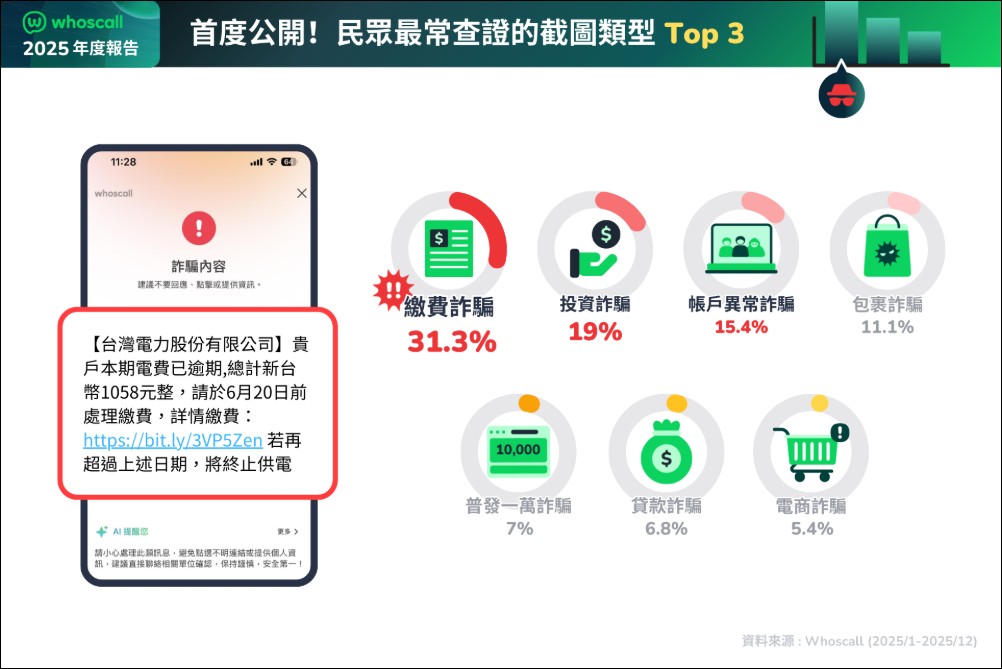
- Install protective tools: Install call identification applications such as Whoscall to instantly intercept scam and harassing calls, and use screenshots of unknown links to check whether they are scams.
- be alert: Be suspicious of unknown calls, text messages, and links, and do not trust, click, or call back.
- timely notification: If you encounter any suspicious situation, immediately call the 165 anti-fraud hotline for consultation or report, and inform your family and friends to avoid being deceived.
Whoscall stated that it will continue to update the blacklist database in the future, and use AI technology to improve identification accuracy, and work with governments, enterprises and the public to create a safer communication environment.
Source: KOCPC Chinese