


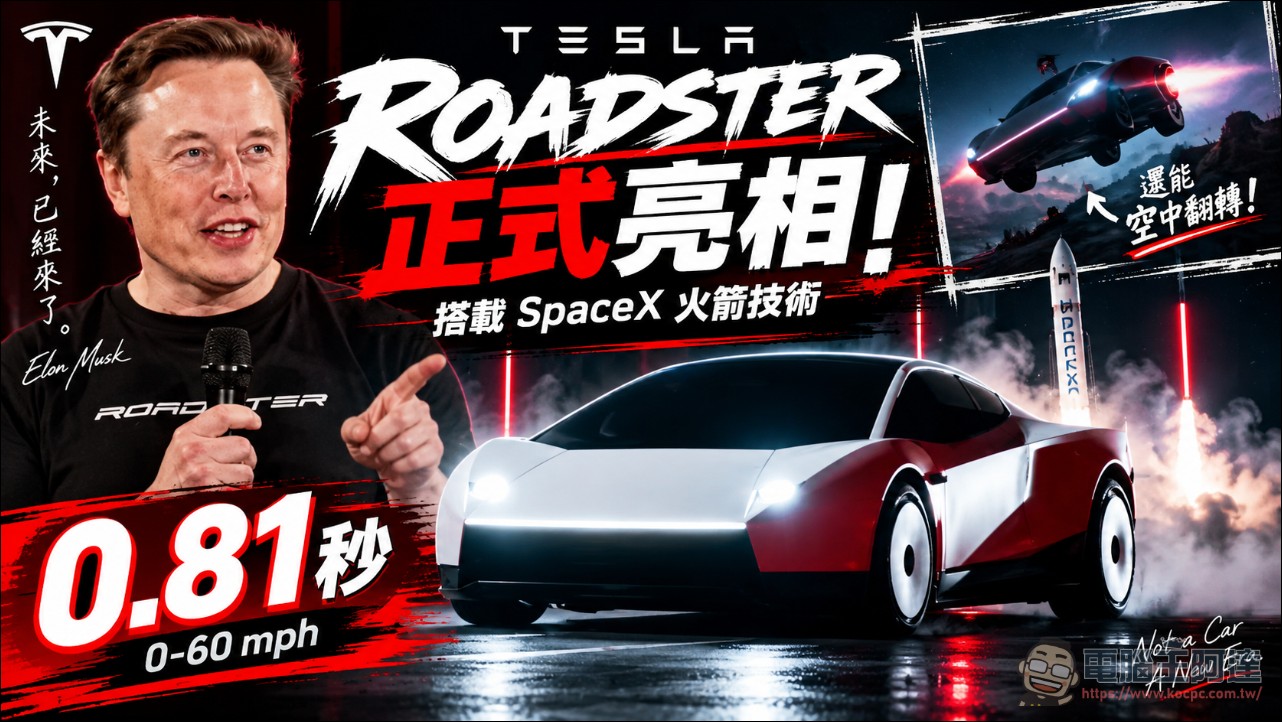
After nearly a decade of delays, Tesla’s new Roadster is finally going on sale—and it actually flew for all the on-site audience to see. On the evening of October 15, Pacific Time, Tesla held a launch event lasting less than 30 minutes at SpaceX’s McGregor rocket test site outside Waco, Texas, bringing the second-generation Roadster—first unveiled in 2017 and delayed until now—back to the forefront.
Opening: Watching cars at a rocket test site
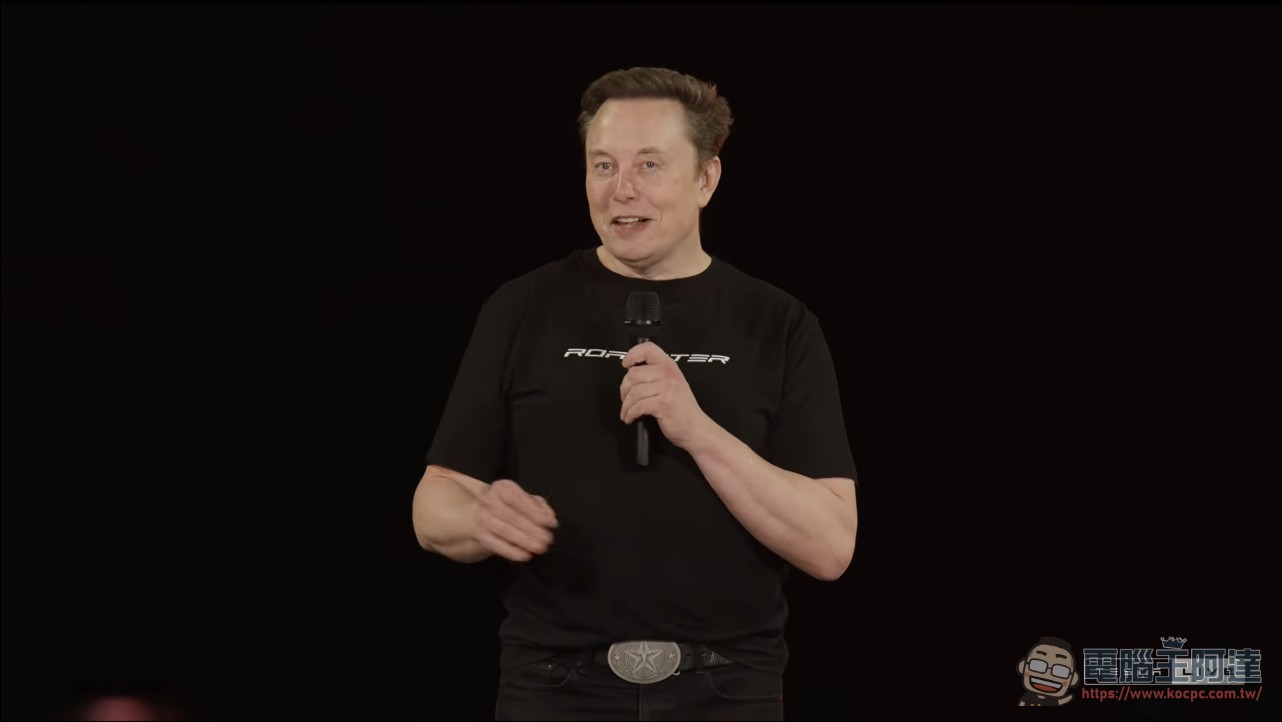
The event was held at SpaceX’s rocket testing and R&D center in McGregor. Franz opened by noting the site is 4,000 acres, and a warm-up Raptor static fire took place not far away. Musk stressed that everyone was there in person to “prove that this isn’t AI or synthetic imagery” (To prove that it’s not AI or SI), because what followed was “something you’ve never seen in any movie.” He defined the new Roadster as the result of a partnership between “the world’s strongest car company and the world’s strongest rocket company.” Musk also brought out a quote from old friend and PayPal co-founder Peter Thiel to joke that the future promised everyone flying cars but delivered only 140-character tweets—“not anymore.”
First demonstration segment: inverted driving, mid-air flip (⏱️ 08:15-09:14)
The stage for the first stunt was a curved ramp several stories high. After the Roadster drove up the ramp, it climbed vertically while hanging upside down, held by the suction from fans under the car. At the top, cold gas thrusters flipped the car upright, let it hover briefly, and then it landed, kicking up a cloud of white smoke. The live audience gasped, with someone shouting, “Oh my God, the car just flew!” Musk calmly said, “Yeah, it worked,” and admitted that before the demonstration he had only dared to say it “should work” (It’ll probably work).
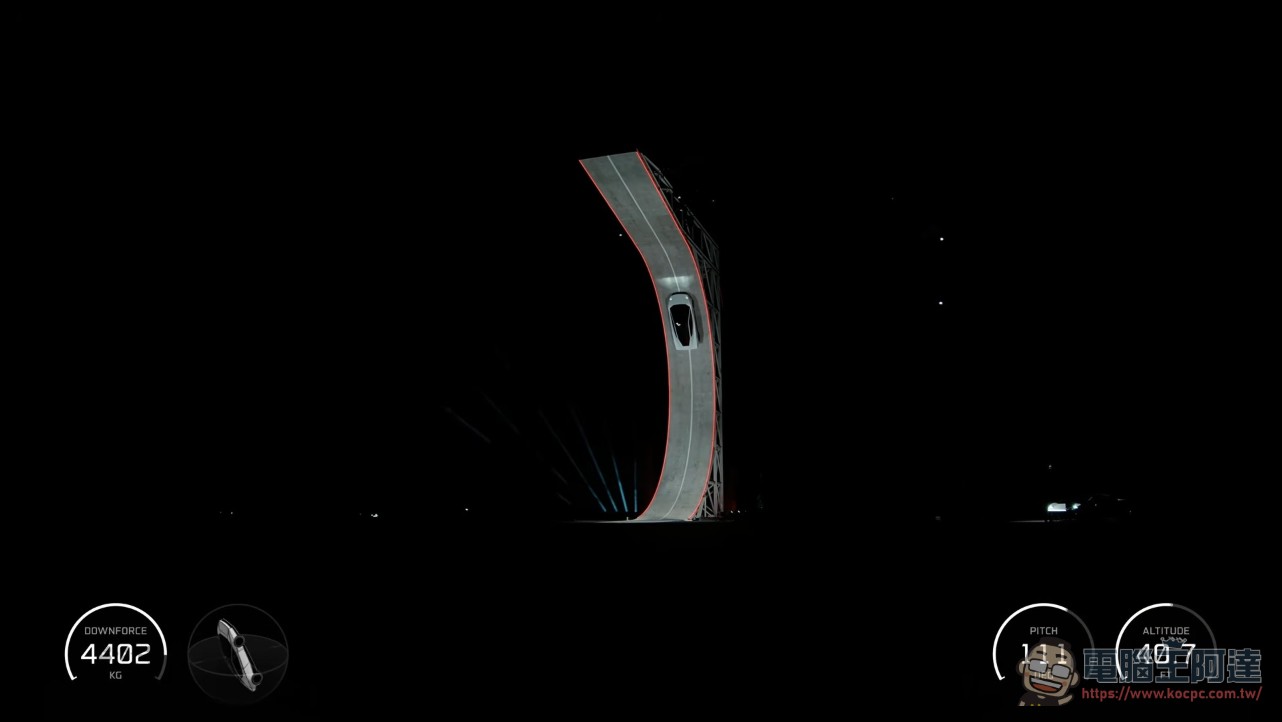
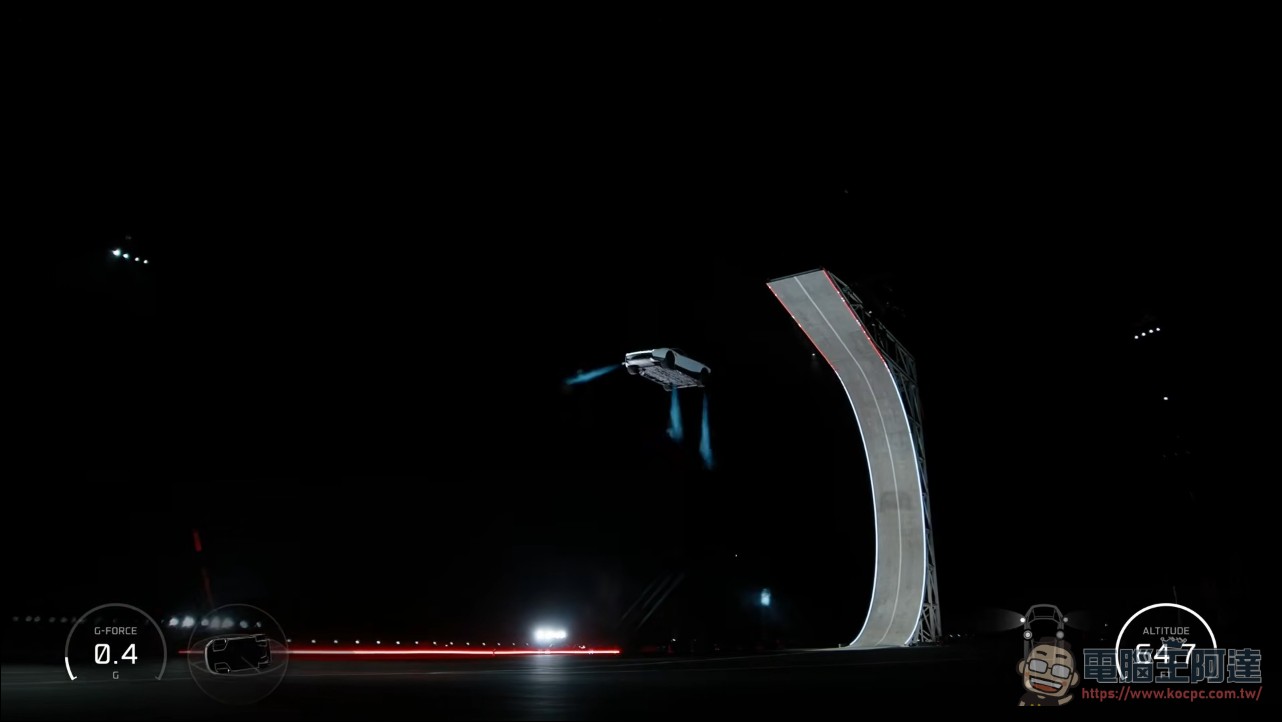
This demo simultaneously validates two systems: the fan’s ground-suction downforce is enough to counteract gravity, and the thruster’s thrust is enough to flip the vehicle. Tesla has integrated two completely different physical mechanisms into the same production-architecture car; the engineering integration is the real point of this performance.
Second demo: kickflip over the entire car series.
The second part was even bolder: the Roadster took off directly, jumping over a lineup of Tesla models, including Model 3, Model Y, Cybertruck, Cybercab, and even the Semi semi-truck, completing a 360-degree flip in the air before landing. Lars Moravy said on stage, “Tony Hawk would definitely be proud. We call it a kickflip.” It’s the name of a classic skateboarding flip trick, and even Tesla’s own fleet was used as a ramp. Musk added that the car “can basically fly like a rocket, can roll, and can do crazy gymnastic moves,” but he also admitted, “I’m not sure it’s legal in all regions.”
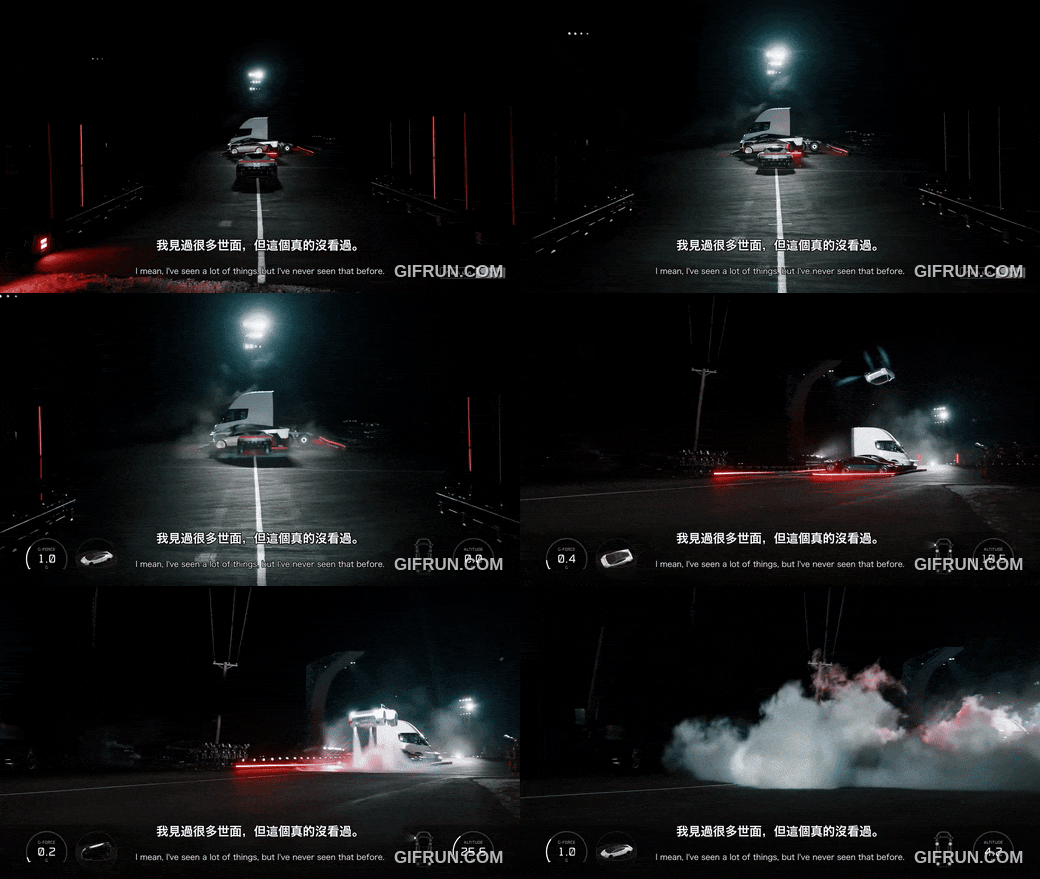
The shot of it jumping over the Semi was the highlight of the entire event and also doubled as a family-portrait marketing moment. Musk’s statements ranged from “this will be a real car that can be driven on the road” to “not sure whether it’s legal in all areas,” suggesting that the regulatory status of the flight and propulsion features is still up in the air.
How It’s Done: Vacuum Fan + SpaceX Cold Gas Thruster
During the onstage technical explanation segment, Tesla laid out two systems. The first is an underbody fan ground-suction system that can generate up to 2 G of downforce. Musk described it as being able to “suck the chrome right off a trailer’s bumper”; compared with the roughly 1.26 G grip limit of the tires themselves, this system lets the Roadster’s cornering ability break through the ceiling of tires alone. At the rear is a variable-angle-of-attack wing that deploys at low speed to increase grip and retracts at high speed to reduce drag. Officially, it offers two aerodynamic modes: high downforce and low drag.
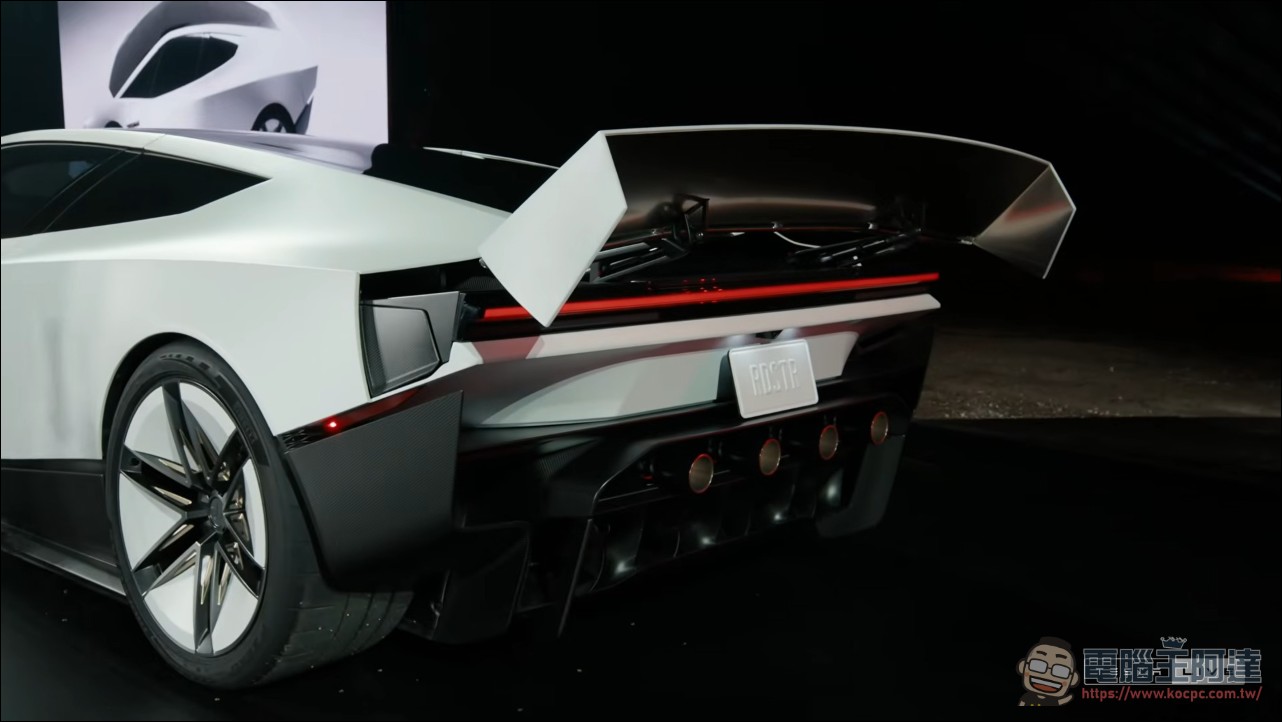
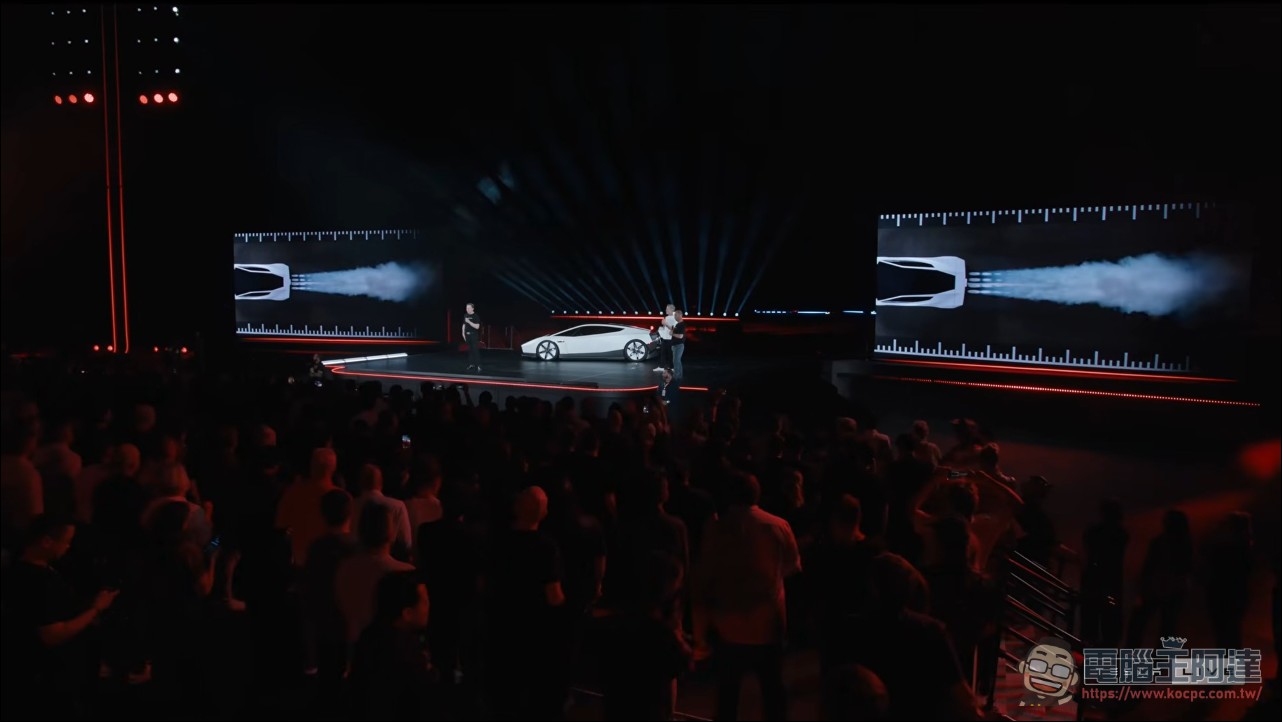
The second set is a cold gas thruster directly descended from SpaceX: two carbon-fiber-wrapped high-pressure vessels with a total capacity of 600 liters, carrying about 250 kilograms of compressed air, feeding 10 nozzles. The exhaust velocity exceeds the speed of sound, and Mach rings were visible in person. Maximum thrust is about 80 kilonewtons, equivalent to just over 8 tons. The car can refill its own tanks, so no special propellant is needed. Musk said plainly on stage: “It’s just air.”
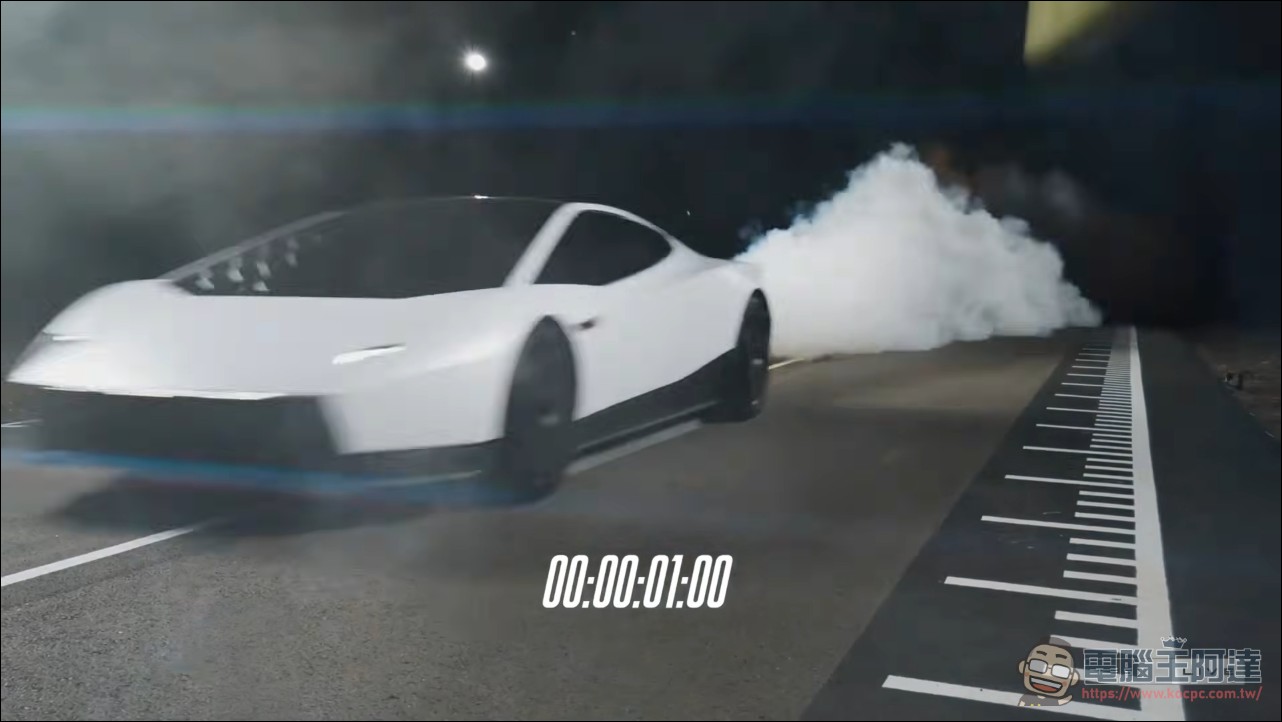
The power core is a new-generation battery and drive unit, with total output reaching 1 MW. The official claim is that it has “one-third more power than the Model S Plaid, while the vehicle weighs only half as much.” The cockpit follows an aircraft-style approach: two seats, seats integrated directly into the chassis, a steer-by-wire yoke for steering, and fully drive-by-wire brakes and throttle. Musk said that driving this car in the snow, “you can steer with the throttle,” and also showcased a steering design inspired by the SR-71 reconnaissance aircraft.
The choice of cold gas thrusters is very pragmatic: compressed air is not a hazardous chemical, and it can even self-replenish, eliminating the “propellant acquisition” problem outright. The biggest hurdle is integrating the high-pressure vessel and nozzle; this is SpaceX’s forte, and carbon-fiber-wound pressure vessels are a direct hand-me-down from rocket technology.
Field-tested 0-60: 0.81 seconds.
The acceleration test was conducted live on site. At one point, the screen inside the car displayed an absurd figure of 0.17 seconds; the people onstage immediately explained that it was a display malfunction—17 was stuck on the screen and wouldn’t clear. The final measured result was 0 to 60 mph in 0.81 seconds. Musk said the production version will be even faster, provided they “don’t fling the driver’s retinas out.” Asked what it felt like to sit in the car, the answer from the stage was “like free fall, but faster than free fall,” and Musk added a textbook-physics conclusion: F=ma—17,000 pounds of thrust and a 1,700-kilogram car, and that’s how you get that acceleration.
In terms of top speed, the Roadster has already been measured at over 230 mph (about 370 km/h). Musk’s goal is half the speed of sound, around 383 mph (about 616 km/h): “I think it needs to break at least half the speed of sound, Mach 0.5, maybe a little higher.” Someone on stage replied, “Challenge accepted.”
The key to the 0.81 seconds isn’t just horsepower; it’s the fan downforce that lets the tires hold acceleration above 1 G, with thrusters making up the stretch that exceeds the tires’ limits. The minor display failure actually lends credibility to the result—a detail that only shows up in real-world, on-site testing.
Three versions, a deposit, and mass production in 2028
The new Roadster carries over the 2017 name, but its styling is completely redesigned: a low, flat wedge shape, a full-width rear light bar, an exposed diffuser, and an aerospace-inspired color called Ano White. Tesla’s official website lists three versions:
- Performance (Road Version): Two-seater with active aerodynamics and a ground-effect system, 0–60 mph in under 1.6 seconds, targeting over 300 miles of range.
- Thrust (Track Edition)Fitted with a rear-mounted cold gas acceleration thruster, 0-60 mph within 0.9 seconds; limit one per customer; officially listed as limited supply.
- Rocket (Rocket Edition)The only complete flight system of its kind, with all 10 nozzles, single-seat, invitation-only, 0-60 mph in under 0.59 seconds. Only this version can fly.
The order page is already there. tesla.com/roadster Now live: The Performance version requires a $50,000 deposit (about NT$1.63 million), while the Thrust version requires $250,000 upfront (about NT$8.13 million). Both are refundable deposits, but Tesla has yet to announce official pricing for any version. When asked about delivery timing, Musk’s answer was “mass production in 2028,” then he added two sentences himself: “Really,” “I’m not lying to you.”
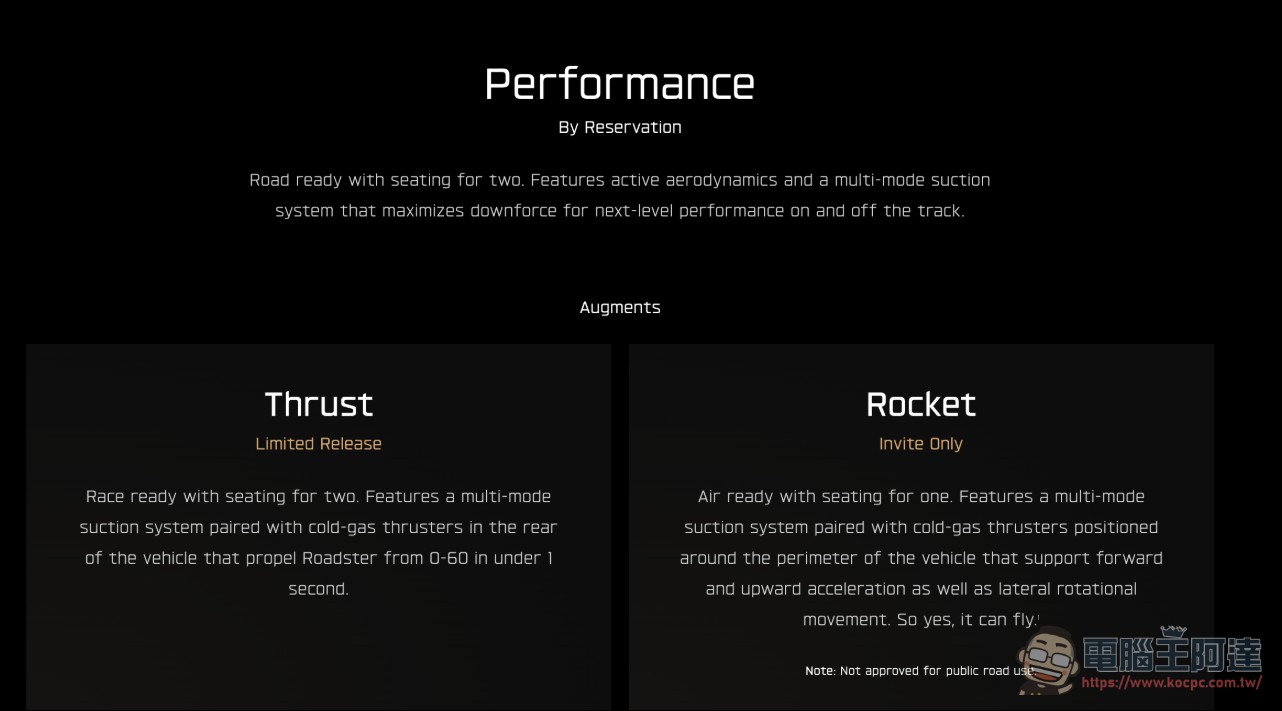
The flying version is limited to an invitation-only single-seat configuration, which amounts to treating flight as a display piece and technology showcase; only the ground-hugging and acceleration versions are open for preorder. The $250,000 deposit threshold is higher than the full price of most supercars, and it is collected upfront even though the price has not yet been set.
We also provided a translation of the entire launch event. Those interested can take a look:
Conclusion
At the end of the launch event, Musk described the new Roadster as “the world’s first truly great flying car and, at the same time, the last truly great driver’s car.” He also teased that he would next attempt the feat Evel Knievel failed to achieve when he tried to jump the Snake River Canyon, leaving it with: “Where we’re going, we don’t need tires.” From driving upside down up walls to kickflipping over a Semi, Tesla proved tonight where the ceiling of technology lies; as for whether it can actually be delivered in 2028 and whether the flight function can legally hit the road, the answers aren’t in the stunt arena, but in the regulations and production lines of the next two years.
Source: KOCPC Chinese