


For some time now, Meta has consistently lagged behind rivals such as OpenAI, Anthropic, and Google in the race for top AI models. After launching Muse Spark in April of this year and playing catch-up ever since, Meta has finally unveiled its most powerful Muse Wonder series: two versions, “Muse Wonder” and the more powerful “Muse Wonder Full.”
The Muse Wonder series isn’t about chat—it’s about AI agents that can actually get things done for you, including new models that remember what matters to you across conversations, switch approaches and keep going when they hit a roadblock, and have significantly improved coding capabilities as well.
In benchmark scores, it also outperforms Anthropic’s Claude Fable 5.1 and OpenAI’s GPT-6 Astra across multiple results.

Meta unveils its most powerful AI model, Muse Wonder! Featuring AI agents, long-term memory, and coding, it beats Claude and GPT-6 on multiple benchmarks.
Meta recently announced the launch on the official Meta AI Research blog. Muse Wonder Series, including two models, Muse Wonder and Muse Wonder Full, which are officially positioned as frontier models for “personal and professional AI agents” and are also Meta’s most capable models to date.
As for specifications, according to the official model card, the Muse Wonder series can take text, images, video, and audio as input, while its output is text; its context window during inference is 1 million tokens.
Muse Wonder is the standard version, available to developers for paid integration via the Meta Model API; Muse Wonder Full is a more capable full version, currently available only to Muse Code subscribers, with no API offered.
From the benchmark scores, the gap between the two is considerable; in Meta’s official comparison table, most of the first-place categories go to the Full version.
The table below is a comparison table published by Meta. The competitors include OpenAI’s GPT-6 Astra, Anthropic’s Claude Fable 5.1, and Claude Opus 5.5. All models were tested at the highest reasoning effort (max). The full results are as follows, with bold indicating the highest score in each category:
| Test item | Muse Wonder Full | Muse Wonder | Claude Fable 5.1 | GPT-6 Astra | Claude Opus 5.5 |
|---|---|---|---|---|---|
| Individual and Professional Agents | |||||
| Personal Superintelligence Index (Personal and Knowledge Work Composite Index) | 59.1 | 54.3 | 49.9 | 54.5 | 55.2 |
| Harvey LAB-AA (Legal Representation) | 13.1 | 10.0 | 6.4 | 8.6 | 4.2 |
| Vals Finance Agent V2 (Financial Analysis Research) | 59.1 | 56.6 | 58.9 | 53.5 | 58.6 |
| HealthBench Pro (Open-ended Health Questions) | 62.3 | 60.5 | 62.1 | 65.3 | 65.6 |
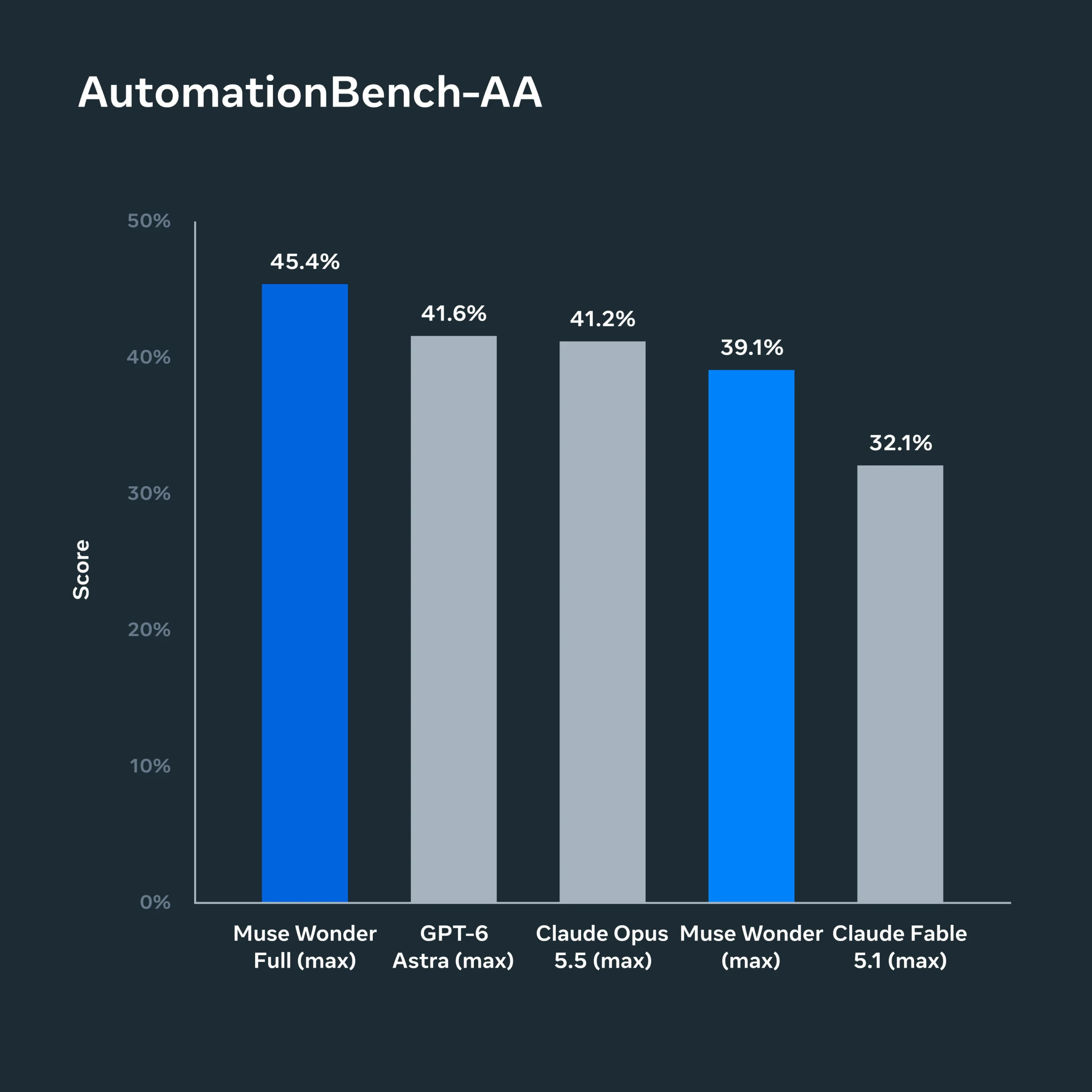
| AutomationBench-AA (End-to-End Business Process) | 45.4 | 39.1 | 32.1 | 41.6 | 41.2 |
| GDP.pdf (Professional Work) | 33.2 | 30.8 | 27.6 | 34.2 | 30.6 |
| JobBench (Professional Tool Use) | 75.3 | 70.5 | 73.1 | 66.1 | 75.4 |
| OSWorld V2.1 (computer operation, partial/binary) | 78.4/39.4 | 72.6/34.3 | 80.7/43.1 | 75.8/34.3 | 81.8/- |
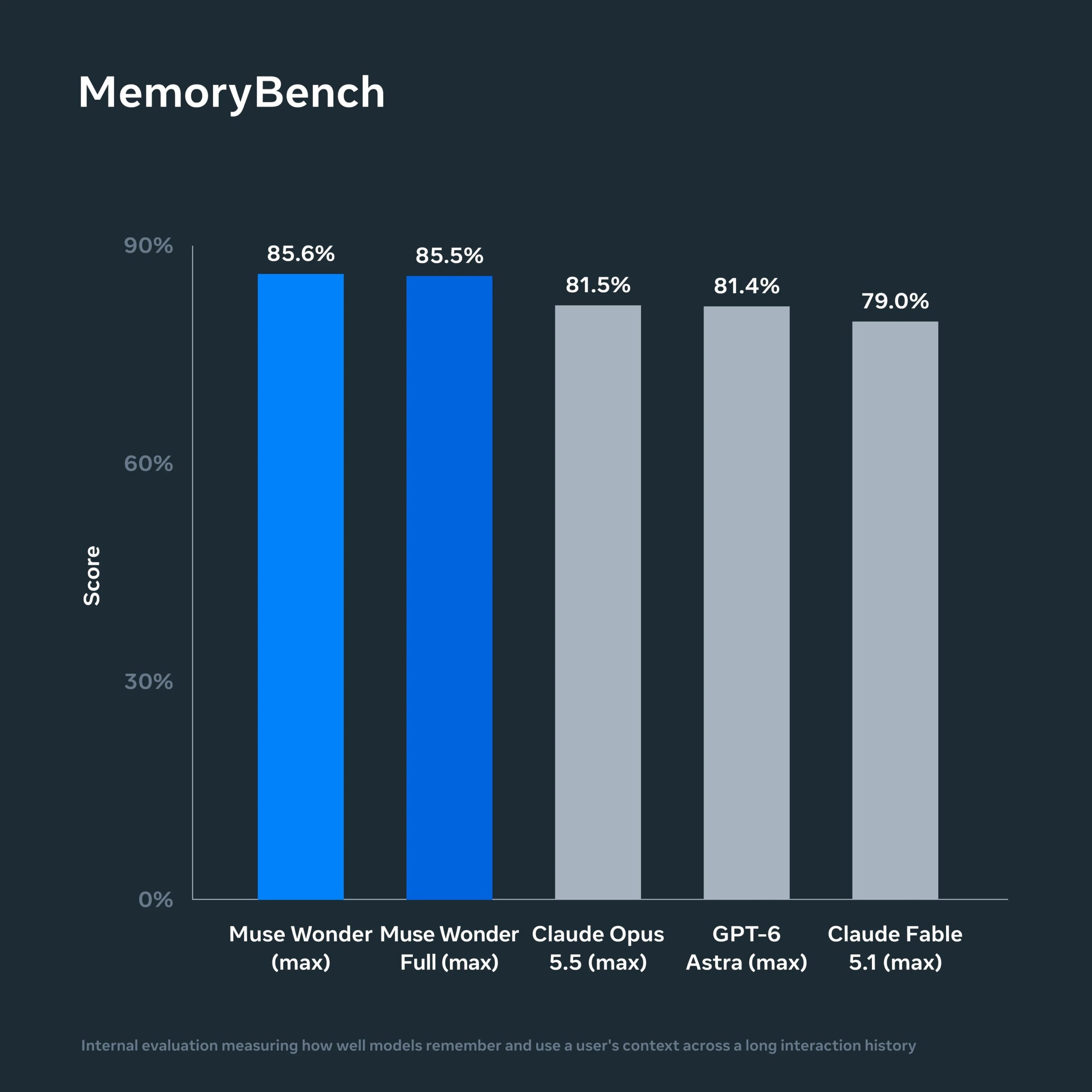
| MemoryBench (memory context) | 85.5 | 85.6 | 79.0 | 81.4 | 81.5 |
| Software development | |||||
| Terminal-Bench 4.0-AA (Terminal Agent Development) | 57.1 | 52.0 | 52.0 | 59.1 | 59.6 |
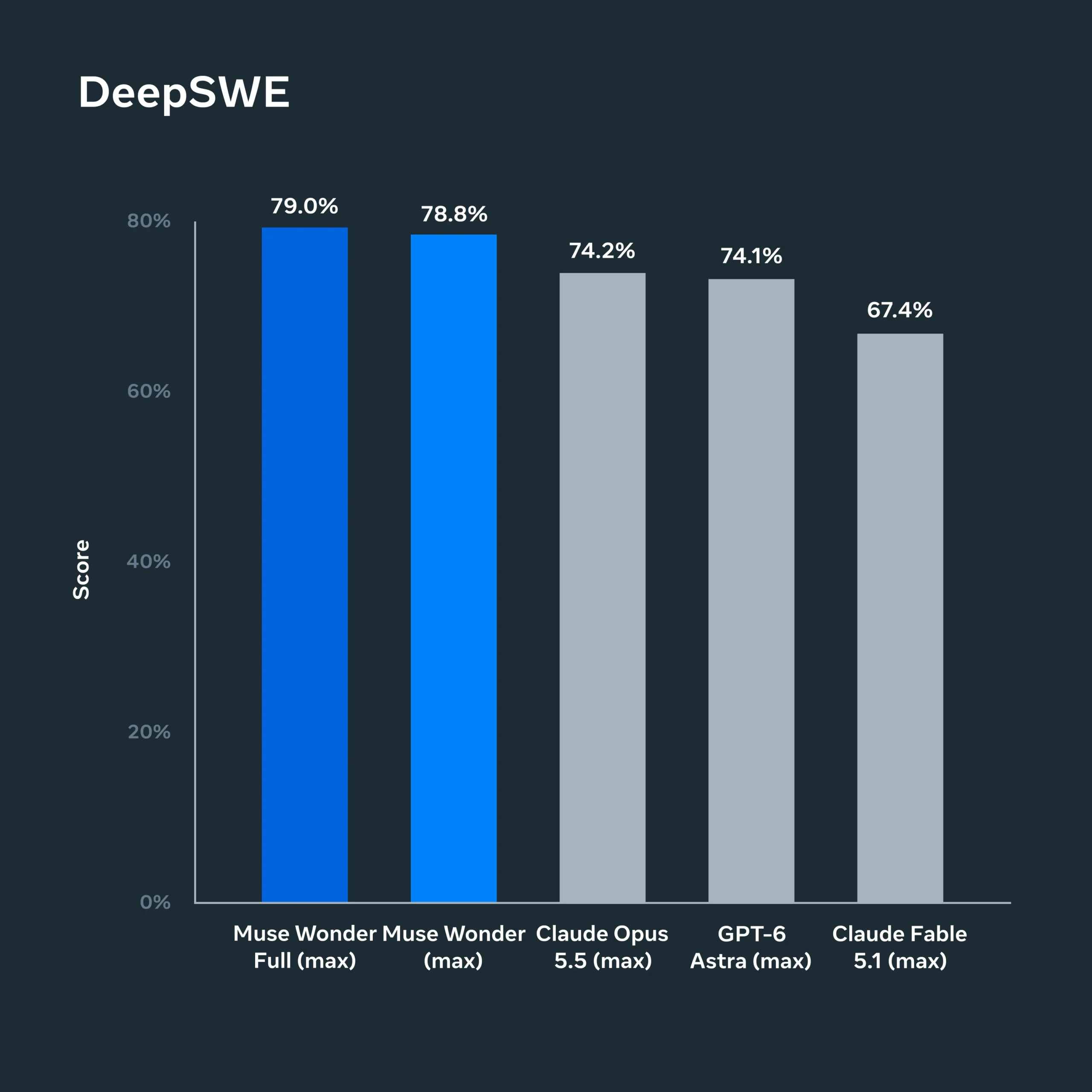
| DeepSWE 1.1 (Long-Horizon Software Development) | 79.0 | 78.8 | 67.4 | 74.1 | 74.2 |
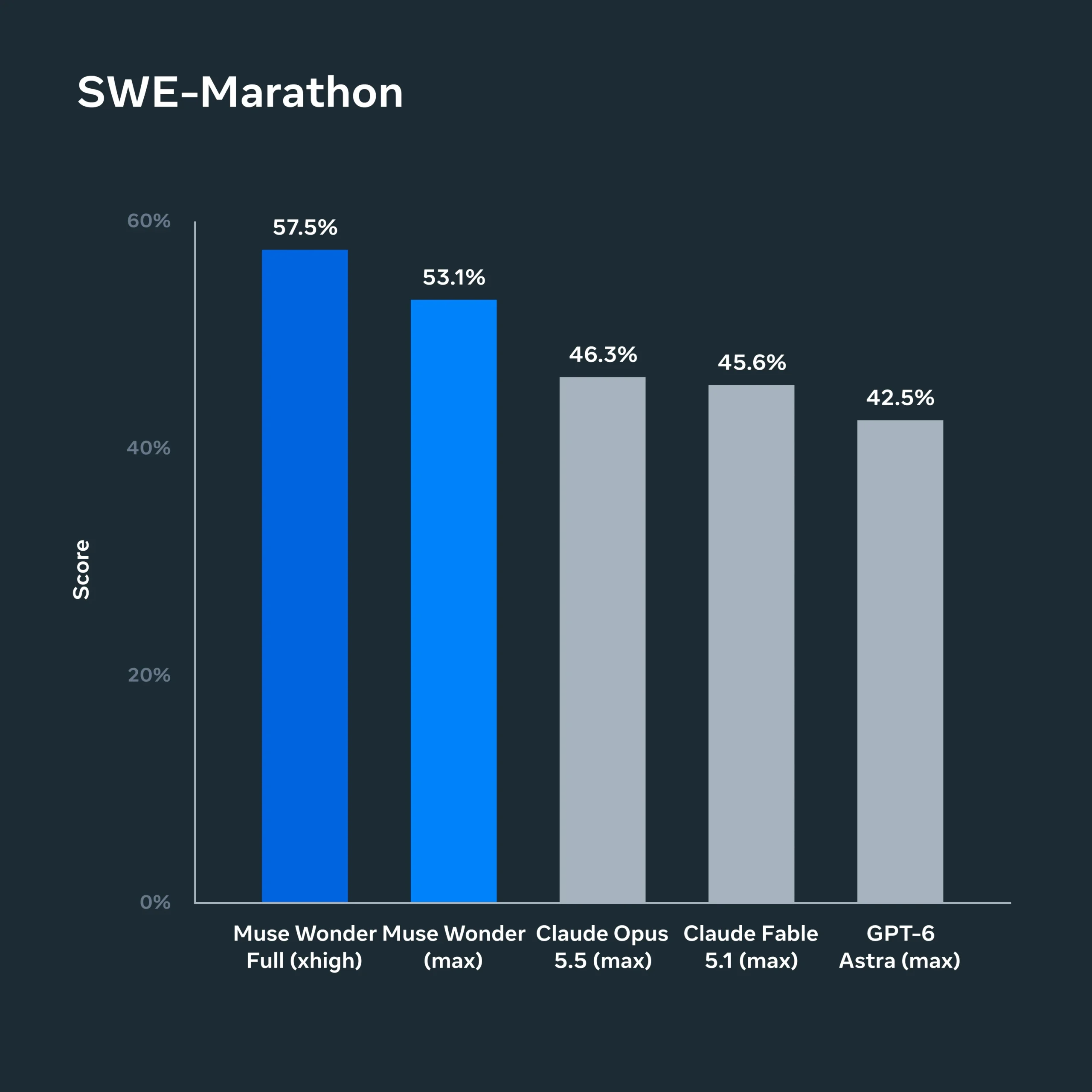
| SWE-Marathon (Ultra-Long-Horizon Software Engineering) | 57.5(xhigh) | 53.1 | 45.6 | 42.5 | 46.3 |
| ProgramBench (Programming from Scratch) | 59.0 | 50.0 | 55.5 | 52.5 | 70.5 |
| Comprehensive | |||||
| Artificial Analysis Index | 56 | 52 | 53 | 53 | 58 |
Software development was the most impressive part this time.
In the long-horizon software development benchmark DeepSWE 1.1, Muse Wonder Full scored 79.0%, Claude Opus 5.5 scored 74.2%, and GPT-6 Astra scored 74.1%, while three months earlier Muse Spark 1.1 scored only 53.3%, meaning Meta improved by more than 25% on this benchmark in one leap:
In the more endurance-testing SWE-Marathon, Muse Wonder Full scored 57.5%, Claude Opus 5.5 got 46.3%, Claude Fable 5.1 got 45.6%, and GPT-6 Astra only got 42.5%, a lead of more than 10%. The standard version Muse Wonder also scored 78.8% and 53.1% in these two, respectively, again beating all opponents:
Memory is also one of Meta’s main selling points this time. In Meta’s in-house MemoryBench test, the standard version of Muse Wonder scored 85.6%, actually a little higher than the Full version’s 85.5%; both clearly lead Claude Opus 5.5 at 81.5%, GPT-6 Astra at 81.4%, and Claude Fable 5.1 at 79.0%:
In AI agent-related tests, the Full version also took several first places.
For example, on AutomationBench-AA for end-to-end business process automation, Muse Wonder Full scored 45.4%, GPT-6 Astra 41.6%, and Claude Opus 5.5 41.2%:
Of course, Meta Wonder doesn’t win in every category either. In this table, Claude Opus 5.5 still maintains a lead in several of them.
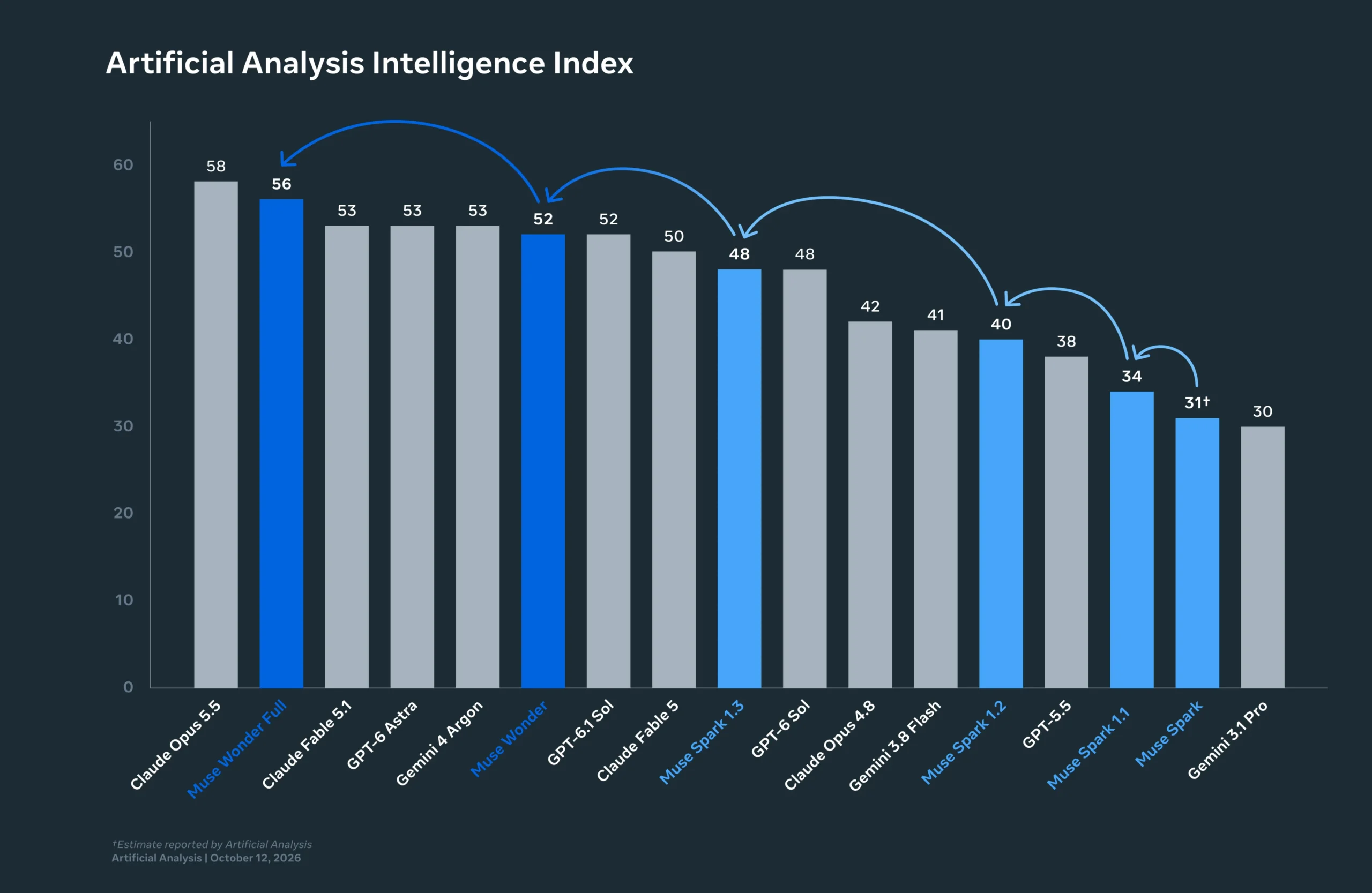
Meta also provides the comprehensive intelligence index rankings from third-party benchmarking organization Artificial Analysis.
In September, Muse Spark 1.3’s 48 points had already tied GPT-6 Sol. And this time, the standard version of Muse Wonder scored 52, not only matching GPT-6.1 Sol, but the Full version also took second with 56, surpassing Claude Fable 5.1, GPT-6 Astra, and Google’s Gemini 4 Argon (all 53), losing only to Claude Opus 5.5’s 58:
The Muse Wonder series is now available through Meta Model API and Muse Code. Muse Wonder Full is only available to Muse Code subscribers.
Meta also said that Muse Wonder will soon introduce the personal AI agent service Muse, available first to subscribers, and later it will also be used for Muse’s Artifact generation and other features that require higher intelligence.
Source: KOCPC Chinese