


In recent years, more and more people have been choosing to buy Macs with large amounts of memory to run AI models locally, hoping to save on monthly API fees from OpenAI, Anthropic, and other companies. However, considering current Mac prices, electricity costs, and the usage costs of different AI models, local AI may not save you as much money as you think.
Recently, a free online calculator called “Sunk Cost” has appeared online that can help you calculate the answer. Take a Mac Studio priced at NT$119,900 in Taiwan as an example: under specific AI models and usage conditions, it would actually take 46.7 years to break even. In addition to calculating the break-even time, it can also compare AI model capabilities and generation speeds, and tell you which models can run on your own computer.
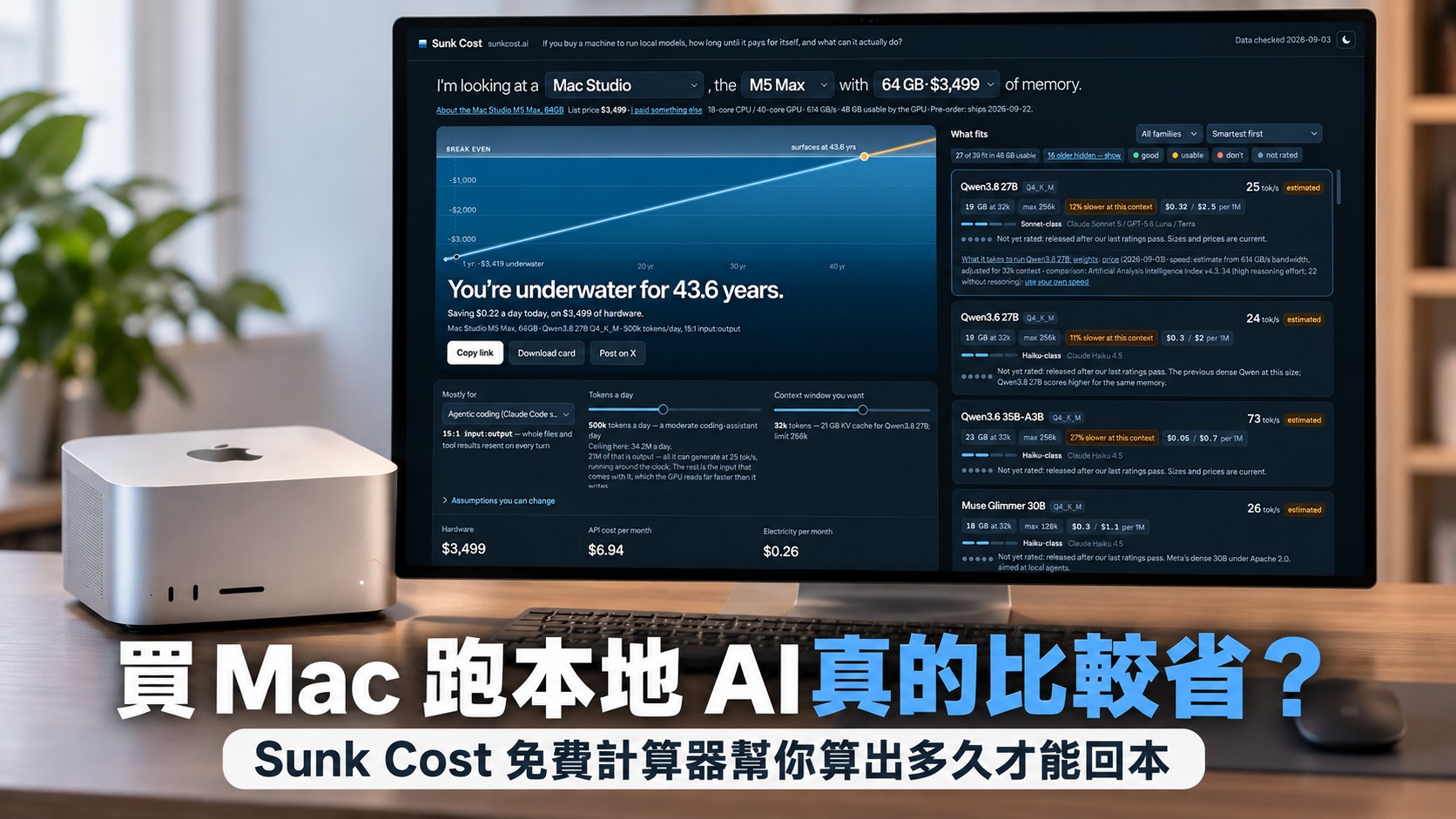
Sunk Cost free calculator: calculate how long it takes to break even with one click.
Sunk Cost is a free online calculator whose core logic compares two ways of using AI. One is to spend money on hardware, run open-source AI models on your own computer, and then only pay for electricity; the other is not to buy hardware, but directly use a cloud API to call the same model and pay as you go.
The calculator factors in the hardware price, daily electricity costs, and API costs at the same usage, then plots a break-even curve that tells you how many years it will take for the saved API costs to recoup what you paid for the machine.
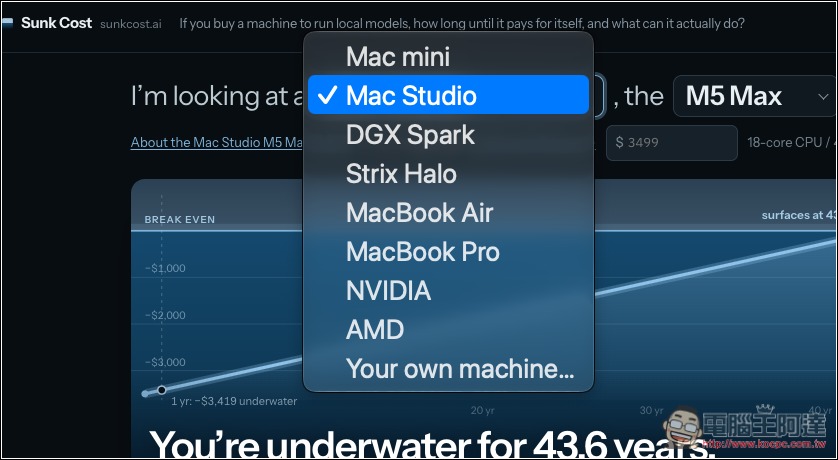
The hardware options aren’t limited to the Mac lineup; they also include small machines focused on local AI, such as NVIDIA DGX Spark and AMD Strix Halo, as well as NVIDIA and AMD graphics cards, and you can even manually enter specs like memory, power consumption, and memory bandwidth.
The models are primarily open-source models, including families such as Qwen, Llama, Gemma, Mistral, DeepSeek, gpt-oss, GLM, Nemotron, and MiniMax. API prices reference the pricing for the same model on OpenRouter, and the website indicates that the data was last checked on September 3, 2026.
The Sunk Cost homepage defaults to the Mac Studio M5 Max 64GB version just announced in August, priced at $3,499 in the U.S. The model is Alibaba’s Qwen 3.8 27B using the Q4_K_M quantized version, taking up about 19GB of memory. The use case is set to “Agentic coding,” a style of use like Claude Code where an AI agent reads files and edits code on its own, consuming 500,000 tokens per day. The final calculation is 43.6 years to break even:
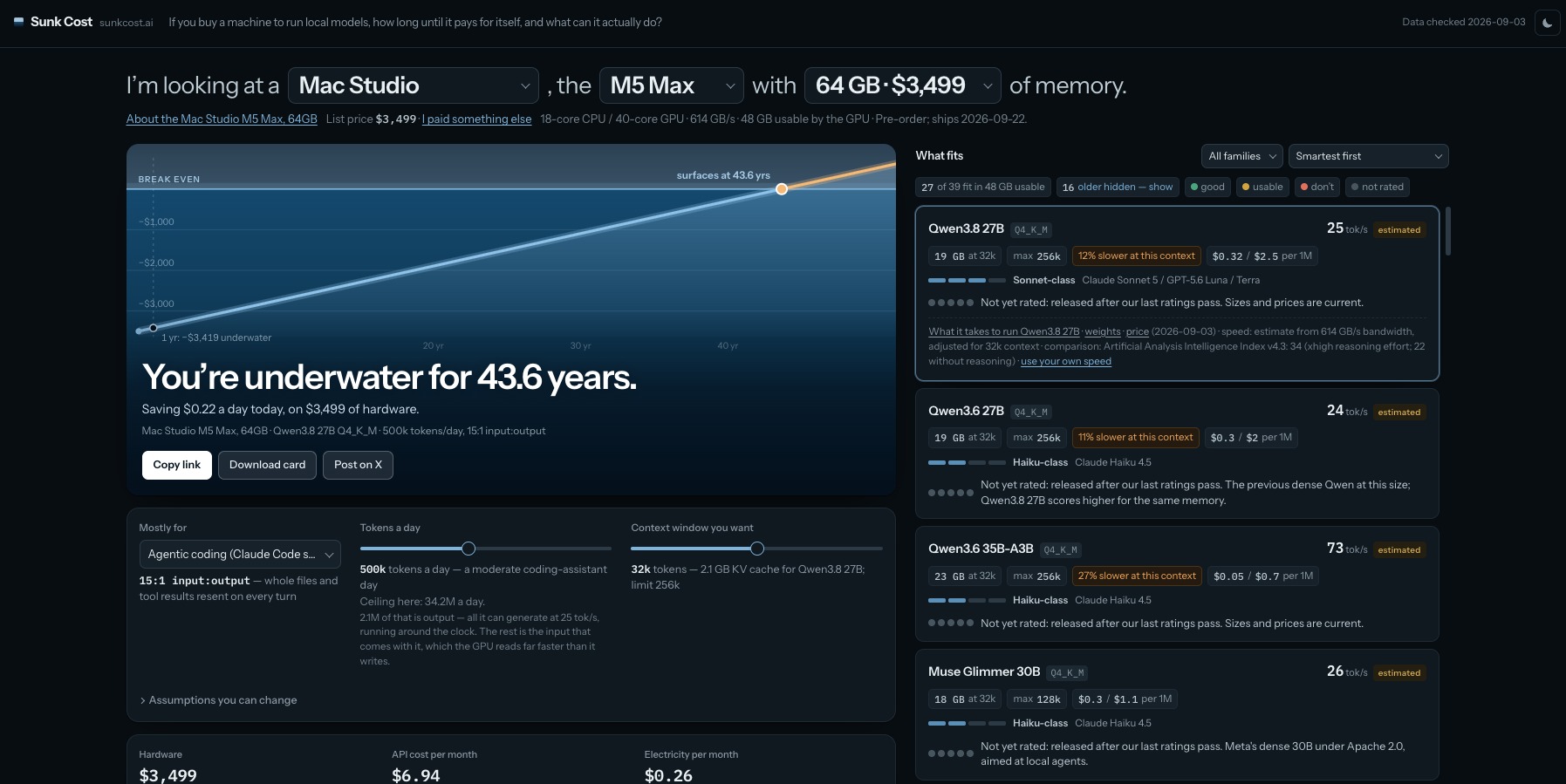
On Apple’s official Taiwan website, this model is priced at NT$119,900 (M5 Max 18-core CPU, 40-core GPU, 64GB unified memory, 512GB SSD), which turns out to be a bit more expensive than in the U.S. I used “I paid something else” to change the price to the U.S. dollar amount converted from the Taiwan price, left all other conditions unchanged, and ran it again. The results are summarized below (assuming an exchange rate of about 32 New Taiwan dollars to 1 U.S. dollar):
| Item | Numerical value |
|---|---|
| Mac Studio purchase cost | NT$119,900 (M5 Max, 64GB, price on Apple’s official website in Taiwan) |
| AI model | Qwen3.8 27B (Q4_K_M quantization) |
| Daily usage | 500,000 tokens (input:output = 15:1) |
| Cloud API monthly cost | Approximately NT$222 (US$6.94, OpenRouter quote) |
| Monthly electricity bill for local AI | About NT$8 (US$0.26; US$0.17 per kWh, 145W at full load) |
| Monthly savings | Approximately NT$214 (US$6.68) |
| Payback period | About 46.7 years (43.6 years at the U.S. price of $3,499) |
The math is simple: if you use an API, you pay about NT$222 per month, but if you switch to running it on your own Mac, it only costs about NT$8 in electricity, so you save about NT$214 per month. Based on the purchase price of NT$119,900, 119,900 ÷ 214 ÷ 12, it takes about 46.7 years to break even.
Of course, the payback period is so long not only because Macs are more expensive, but also because the models being compared are relatively cheap.
On OpenRouter, Qwen3.8 27B costs just US$0.32 (about NT$10) per million input tokens and US$2.50 (about NT$80) for output. Plus, in agentic coding scenarios, input far exceeds output (only 1 out of every 16 tokens is AI-generated), and most usage falls at the cheapest input rate, costing only a little over NT$200 a month.
If you switch to a model with a higher API price and scale up usage, the payback period will be different. However, I checked, and currently, with Mac Studio using the vast majority of open-source models, it almost always takes over 50 years.
The usage is also very simple: after entering Sunk Cost, just select the device you want to purchase:
Then select specifications:
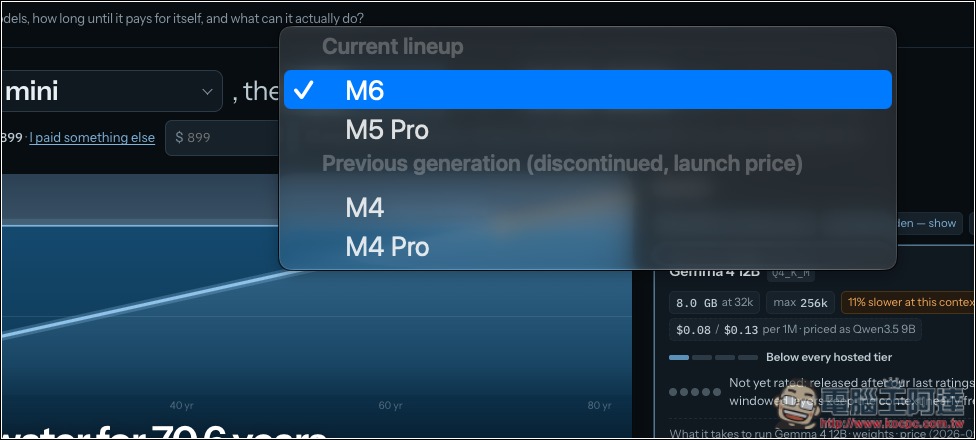
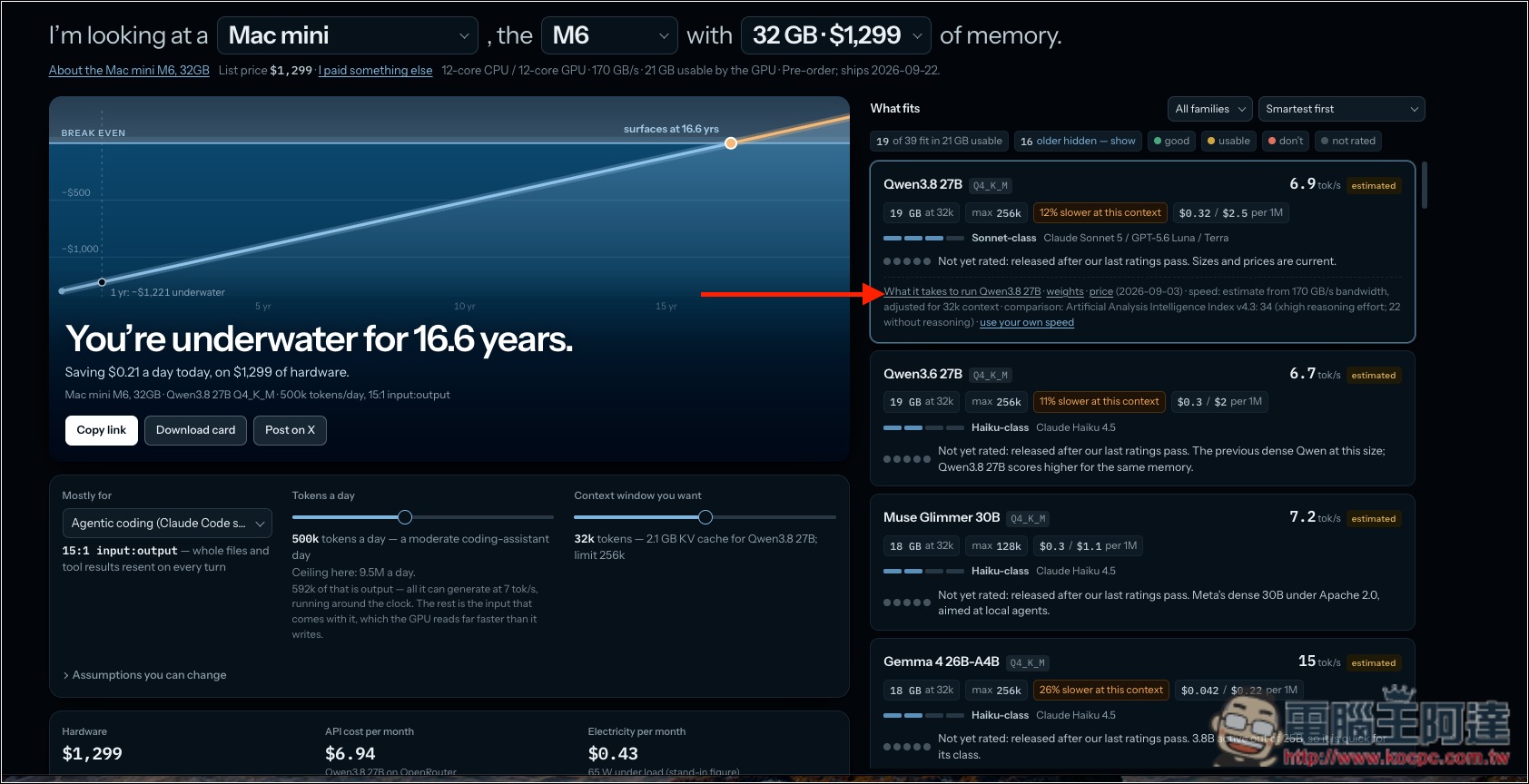
Next is selecting a model. In the “What fits” list on the right, click the model you plan to run. Each model card shows how much memory it needs at a 32k context, the estimated number of tokens it can generate per second, and the cloud API input/output price per 1 million tokens. For the default Qwen3.8 27B, it needs 19GB of memory; on the M6 Mac mini 32GB I selected, the estimate is only 6.9 tok/s:
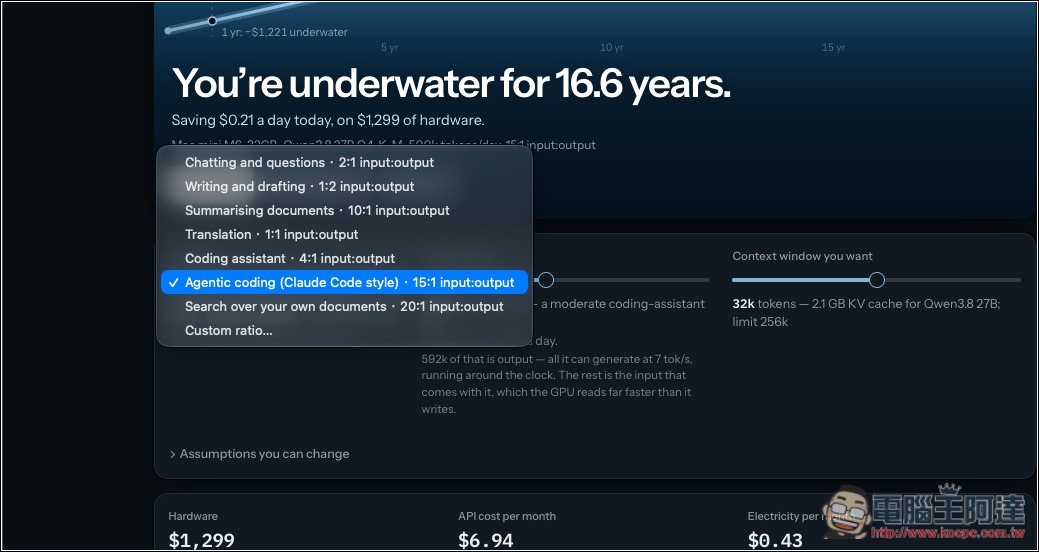
Next, set how you’d use it. In the “How you’d use it” section, under “Mostly for” you can choose the main purpose. Options include chat Q&A, writing, document summarization, translation, coding assistant, Agentic coding (agentic use cases like Claude Code), and searching your own documents. Each use case corresponds to a different input:output ratio.
Finally, adjust the calculation assumptions. Under “Assumptions you can change,” change the electricity rate. The default is the U.S. average of $0.17 per kWh (about NT$5.4); you can convert your own per-kWh electricity rate to USD and enter it. If you’ve already benchmarked the speed at which your Mac runs this model, you can also enter the actual tok/s to replace the website’s estimate:
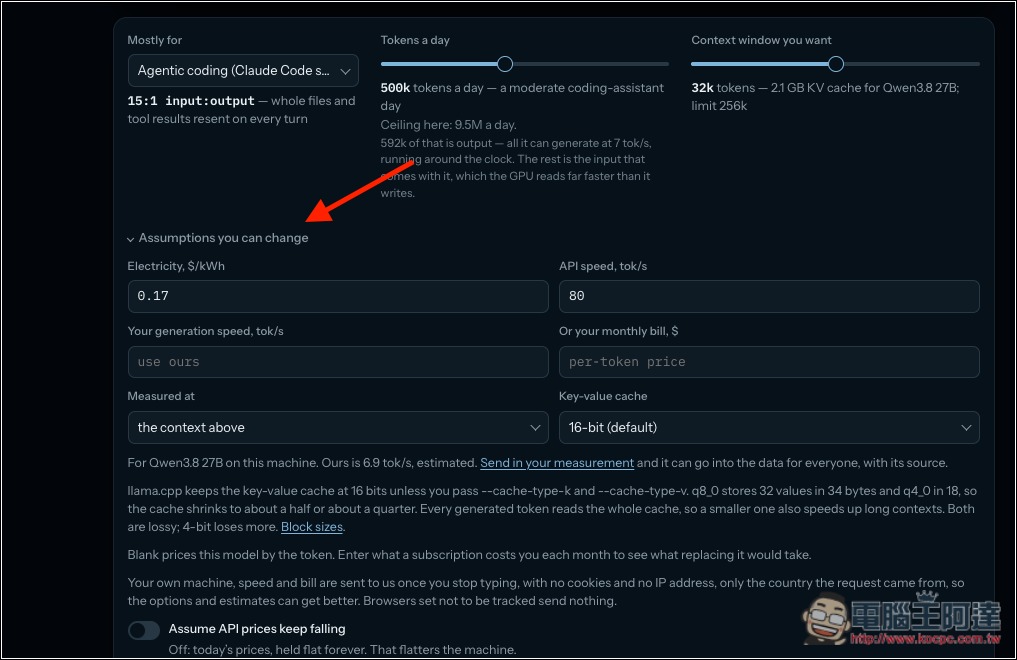
The most important thing here is the “Assume API prices keep falling” option. Once you check it, you can set API prices to fall by 20%, 30%, 40%, or 60% per year. Over the past few years, API prices have kept falling, so this option can have a very large impact on the results. In addition, “Compare against a subscription instead” lets you compare against a monthly subscription instead—for example, enter the $20 you pay each month for ChatGPT or Claude.
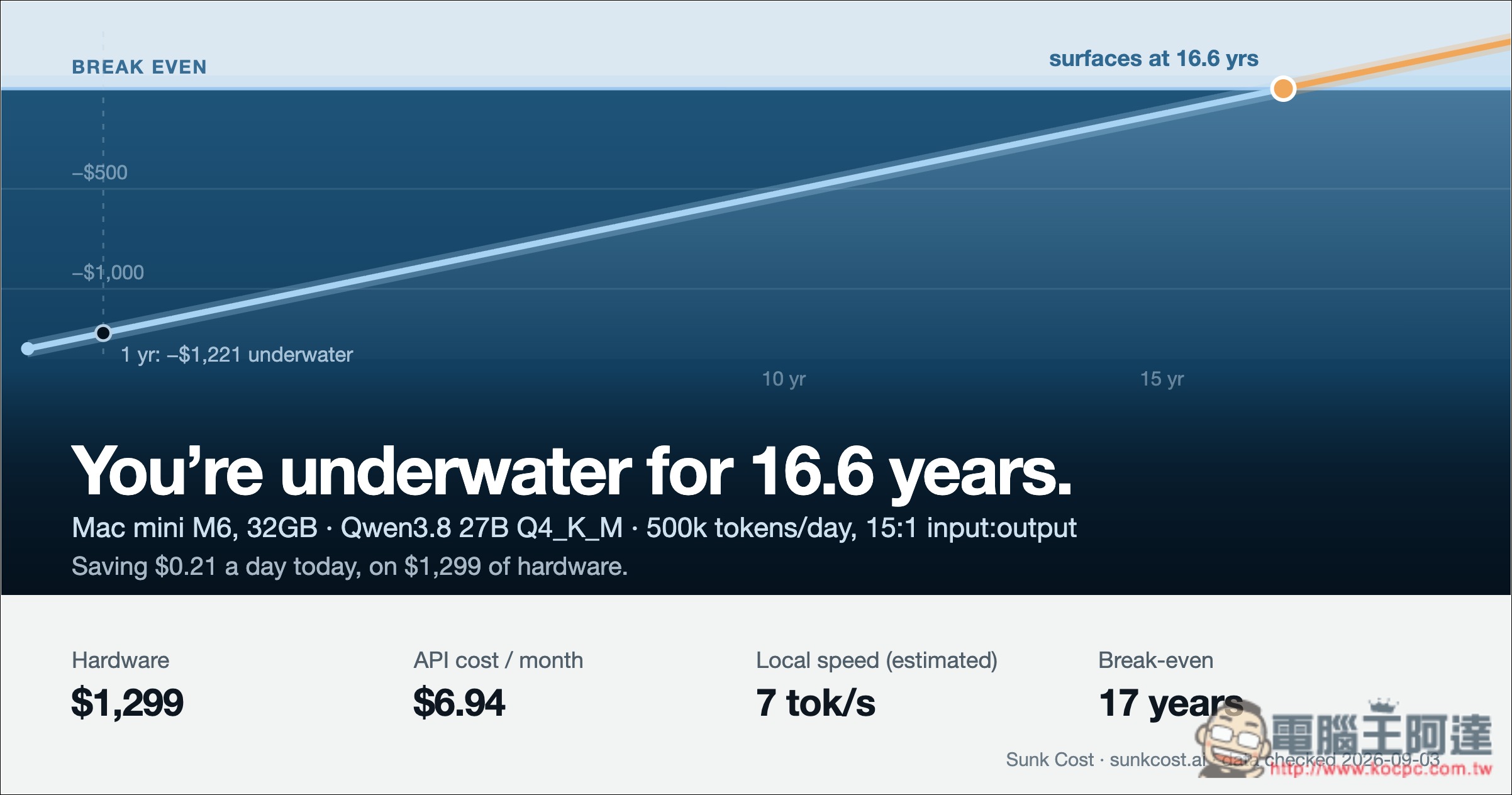
Once completed, the results will appear above. “The break-even” will plot a break-even curve, showing how many years it takes to surface:
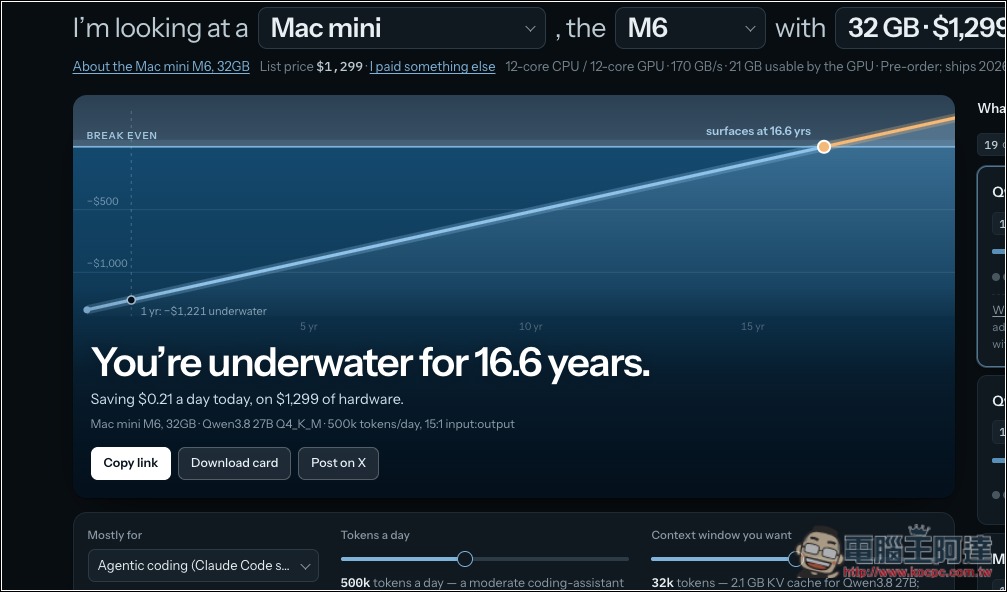
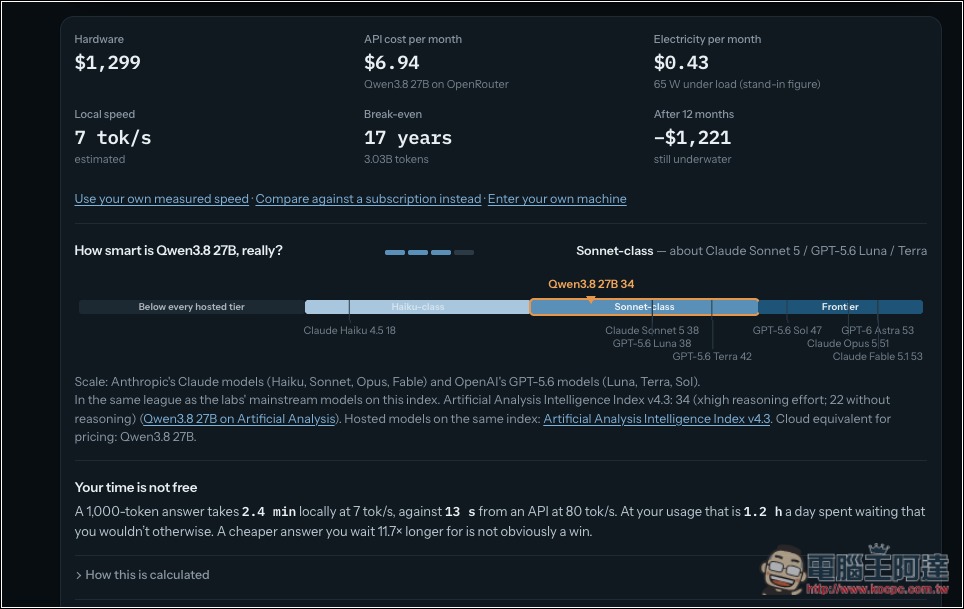
The row of figures below will summarize the hardware price, monthly API cost, local monthly electricity cost, local speed, payback time, and how much money you’d still be short after 12 months:
Click Download card to get a result card like this:
40 to 50 years sounds scary, but it actually doesn’t take that long, because hardware has resale value, especially Macs. Even after a few years, they can still fetch a good price, and the computer can be used for other things too.
In addition, the advantages of local AI are not limited to saving money; the website also lists several points, including:
- Prompts and files never leave your computer.
- No one can modify, rate-limit, or take down the model you’re using.
- You can decide the safety limits yourself and fine-tune them on your own.
- The machine can also be used to play games, render graphics, and compile programs.
For people who need to handle confidential company code, customer data, or use AI in an offline environment, these may matter more than how much money can be saved.
Source: KOCPC Chinese