


The South Korean government has rolled out the world’s first special universal welfare policy over the past couple of days: unlimited free AI use. The Ministry of Science and ICT (MSIT) announced on August 28 that it selected three consortia, each led by SK Telecom, Kakao, and KT, from six applicants to jointly operate a nationwide free AI service called “AI for All.” The project aims to give approximately 51 million citizens free access to generative AI with no token limit. Agreements will be signed in September, beta testing will begin in October, and the service will go live by the end of the year. The government will first provide the three consortia with a total of 512 Nvidia B200 GPUs this year, leased as an online Kubernetes cluster, and starting in 2027, operating costs will be covered by the national budget.
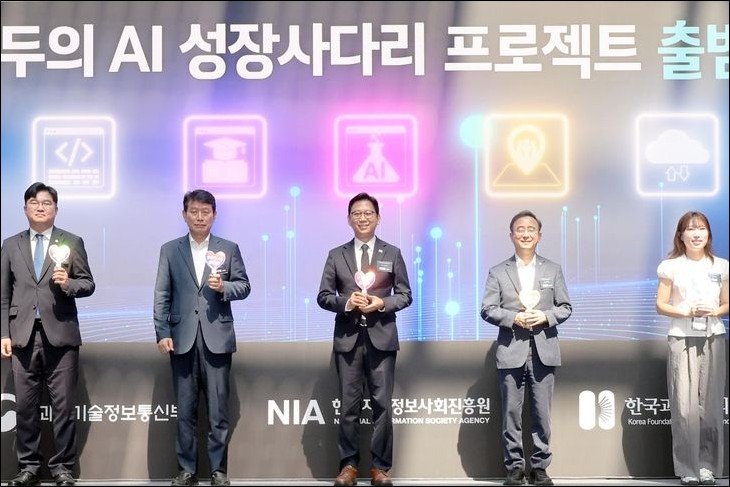
South Korea launches “AI for All” — free unlimited AI services for all citizens!
South Korea currently has approximately 23 million generative AI users, but most are still using overseas products such as ChatGPT, Gemini, and Claude. AI for All’s “free and unlimited” is not entirely without conditions: operators may implement traffic management based on usage behavior (speed throttling, limiting concurrent connections, blocking abnormal automated requests), but cannot differentiate users by purpose such as work, study, or creation. General-purpose chatbots and public AI Agents must be completely free, while enterprise proprietary Agents may be priced at the operator’s discretion. Starting in 2027, each alliance must submit a “one person, one AI Agent” evolution roadmap, with the goal of enabling Agents to handle actions such as reservations and payments on behalf of users.
Among the three major alliances selected this time, the SK Telecom alliance, with its self-developed 688B-parameter A.X K2 Centered on large language models, integrated with Upstage’s Solar Open 2, Motif Technologies’ Motif 3, and LG AI Research’s K-EXAONE 2.0; the service will be provided through three channels—app, phone, and SMS—and will integrate Government24 and PASS identity verification, allowing users to directly apply for 83 types of official documents.

KT Alliance with Mi:dm K Pro 2.5 As the main model, paired with Solar Pro 4 and Motif 3, the entry is deployed on the Daum portal, app, and partner platforms such as Danawa, Musinsa, and Zigbang, and integrates with KT’s telecommunications network and IPTV.
The Kakao alliance uses the KakaoTalk messaging app as its primary gateway, integrating Kakao’s self-developed Kanana with LG AI Research’s EXAONE and K-EXAONE 2.0. It plans to launch an AI Lite version for phone calls in partnership with LG U+ by the end of the year, and establish a dedicated Agent marketplace where external companies can develop, test, and distribute proprietary AI agents.
The model allocation rules are quite strict: at least 50% of service output tokens must be generated by Korean sovereign foundation models (independently pre-trained foundation models), and at least another 30% must come from domestic models developed by entities other than the operator. These two metrics are calculated separately along the axes of “model type” and “developer” respectively, and the official FAQ explicitly states that they cannot be combined and interpreted as “80% domestic, 20% foreign.” Foreign models are only permitted within the scope of “minimal necessity,” and API costs must not be subsidized by government funds or project budgets.
Related controversies
The focus of the controversy falls on Motif Technologies. This time, the unsuccessful Motif 3 scored 47 on the Artificial Analysis Intelligence Index (AAII), the highest among the four competing Korean models (Upstage 37, SK Telecom 35, LG AI Research 31), yet it was eliminated in the second-stage review of the “Sovereign Foundation Model” project on August 18. Motif formally filed an objection with MSIT on August 27, demanding the disclosure of detailed scores and evaluation criteria. The government’s second-stage scoring structure is: benchmark 40 points, expert evaluation 35 points, and user evaluation 25 points. Motif scored 11.9 out of a possible 25 points in the AAII sub-item (the four-team average was 9.48), but SK Telecom took first place in both the NIA domestic benchmark and professional user evaluation, while LG AI Research ranked first in both expert evaluation and general public evaluation. Motif’s 16-point AAII gap narrowed to about 4 points in the 25-point benchmark sub-item, and the company questioned whether the scoring formula failed to reflect the true gap.
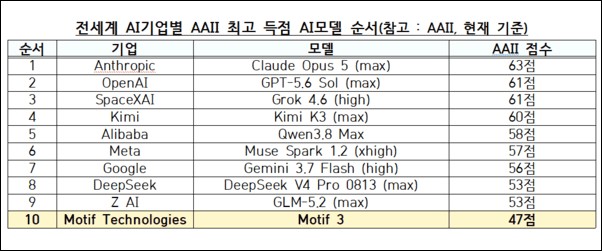
The scoring criteria for this project reveal the logic behind the Korean government’s selection of winning bidders: service reach and user acquisition carry the most weight at 50 points, while model quality, stability, and safety together account for only 30 points. This also explains why the final winners were companies with telecommunications networks, portal sites, and super app entry points, rather than the teams with the highest model benchmark scores (the winning bidders didn’t even make the top ten).
Despite being excluded from the “national team,” Motif 3 still entered both SKT’s and KT’s model pools as a supplementary model for the alliance. Naver was another major absentee: as Korea’s largest portal and mobile platform, Naver has its own self-developed HyperCLOVA X model, but ultimately decided not to participate in AI for All, citing the tight project timeline and the requirement to use other companies’ models, which made the return on investment too low—especially since Naver already offers free AI services on its own platform. Naver was also eliminated during the first-stage review of the sovereign model project in January over data independence issues, and market concerns about its AI competitiveness remain unresolved.
Summary
The outcome of this round of selection is, at its core, a battle for entry points. Model companies handle the backend supply, while front-end reach is controlled by the giants of telecom, portals, and super apps. The 512 B200 units are starting capital, not a guarantee of the finish line—honestly, that number is a bit too small. The real test is whether the budget can hold up in 2027, whether user retention can be established, and whether Korea’s own domestic models can outperform overseas products under real traffic. For Korea’s AI industry chain, this is the first time generative AI is being pushed to the entire population with the positioning of “public infrastructure.” Success or failure will directly determine how resources are allocated for subsequent sovereign model projects. As for Taiwan, although our TSMC can produce the most advanced GPU chips with over 70% market share, when it comes to giving the public free access to AI or truly owning a fully independent domestic large model—most of what we have now are just fine-tuned open-source models—there’s still a long way to go.
Source: KOCPC Chinese