


When it comes to AI platforms, most people probably immediately think of NVIDIA’s CUDA ecosystem, but AMD actually has its own AI platform called ROCm. In April 2016, AMD released ROCm 1.0, an open-source GPU computing platform centered around a C++ compiler and the HIP GPU programming language, targeting the high-performance computing market. On August 26, 2026, AMD released ROCm 10.0, jumping directly from version 7.x to 10, a major release built on the all-new construction system TheRock, and also the first time ROCm includes a native AI developer experience.
AMD officially releases ROCm 10, ROCm.AI ushers in a new era of Agentic AI development
The core highlights of ROCm 10 are ROCm.AIA set of AI-native development toolchains composed of three tools: ROCm CLI, AMD Skills, and Hyperloom. Previous ROCm versions mainly provided low-level math libraries and framework support, leaving developers to handle installation, verification, deployment, and optimization steps on their own. The goal of ROCm.AI is to integrate these steps into an end-to-end workflow, allowing AI Agents to participate directly in the development process.
ROCm CLI: One command for AI workloads
ROCm CLI is the first piece of ROCm.AI. It’s a command-line tool that ships as a single binary, with no need to pre-install Python, Rust, or ROCm, and it works on Linux and Windows (x86_64).rocm serve <model> You can directly start model inference on PyTorch,rocm examine Can diagnose environment and driver issues. For environments without network connectivity, the CLI supports downloading all dependencies as a self-contained offline package.
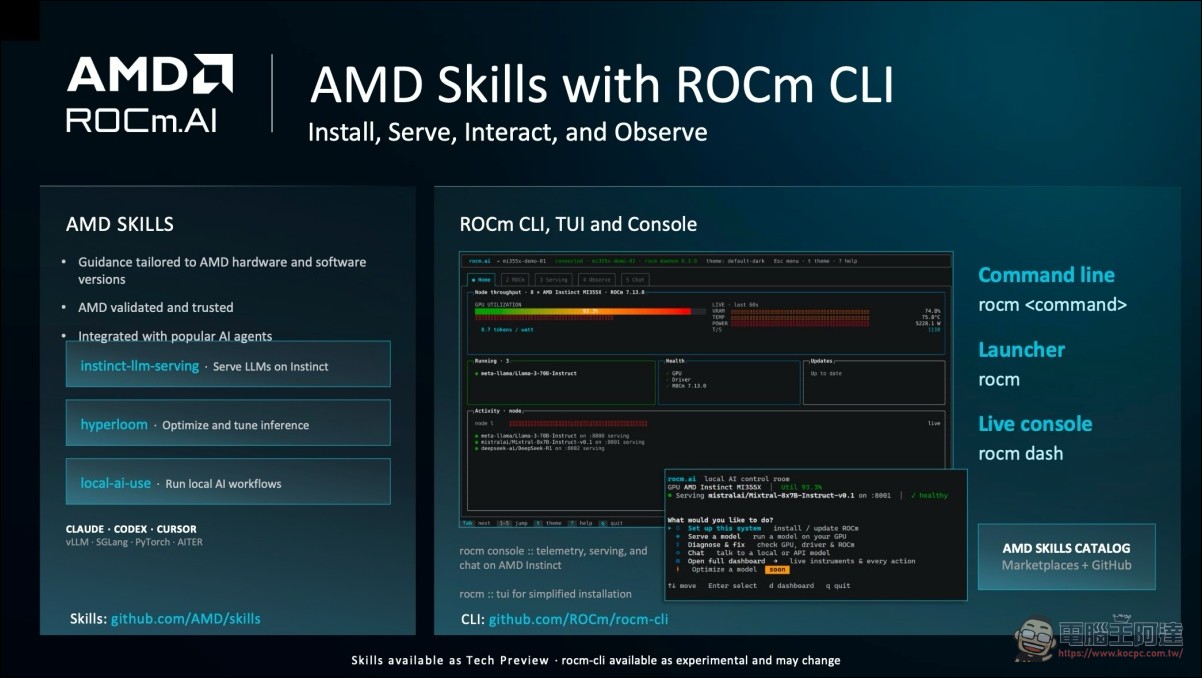
Currently, the ROCm CLI is in technical preview, and the API and behavior may change. It includes built-in inference engine adapters for Lemonade and vLLM, aiming to make the path from installation to running models as simple as possible.
AMD Skills: Helping AI Assistants Understand AMD Hardware
AMD Skills is the second piece of ROCm.AI. It packages AMD’s validated ROCm knowledge into a standardized Agent Skills format, feeding it directly to the AI coding assistants developers already use, including Claude, Cursor, OpenAI Codex, and Gemini CLI. The official skills catalog is on GitHub’s amd/skills The warehouse uses a federated architecture, compatible with these tools’ existing skill catalog structures.
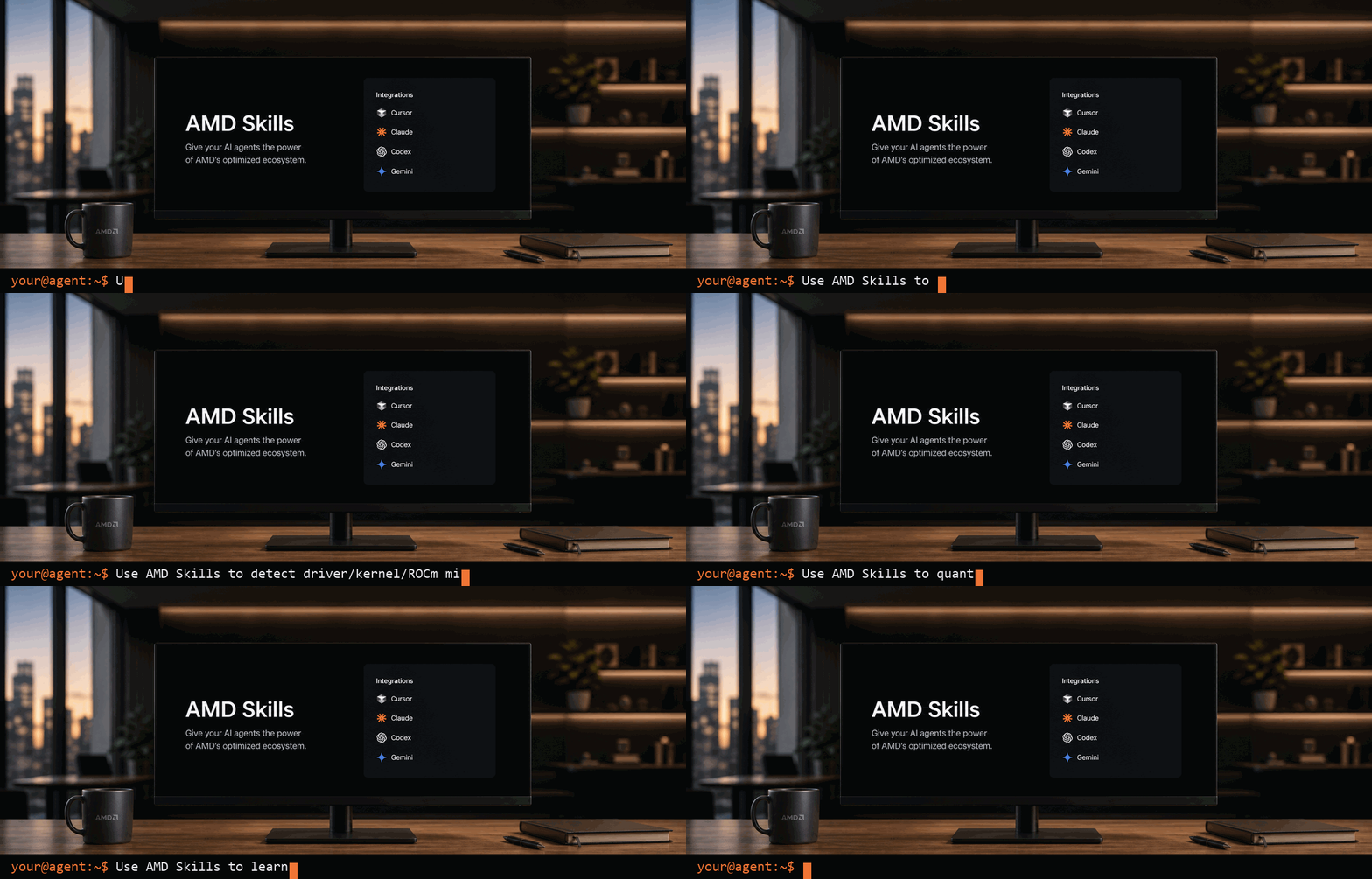
Skills cover both the GPU and CPU tracks. On the GPU side, rocm-doctor(environment diagnostics that drive the CLI) and serving-llms-on-instinct(Setting up vLLM endpoints on MI300X/MI325X/MI350X/MI355X); on the CPU side, it extends to EPYC processors via ZenDNN and zentorch, providing serving-llms-on-epyc and quantize-for-zentorch And other skills. Whether the target is an Instinct GPU or an EPYC CPU, an AI assistant with AMD Skills installed can automatically select the corresponding skill.
Hyperloom: Fully Automated Reasoning Optimization Agent
Hyperloom is the most aggressive component of the ROCm.AI trilogy. It is an open-source autonomous agent system that automates end-to-end inference workload optimization, covering performance analysis, bottleneck identification, solution planning, code modification, and correctness verification—all without any manual engineer intervention. AMD states that Hyperloom can compress what previously took weeks of manual optimization work into just a few hours.
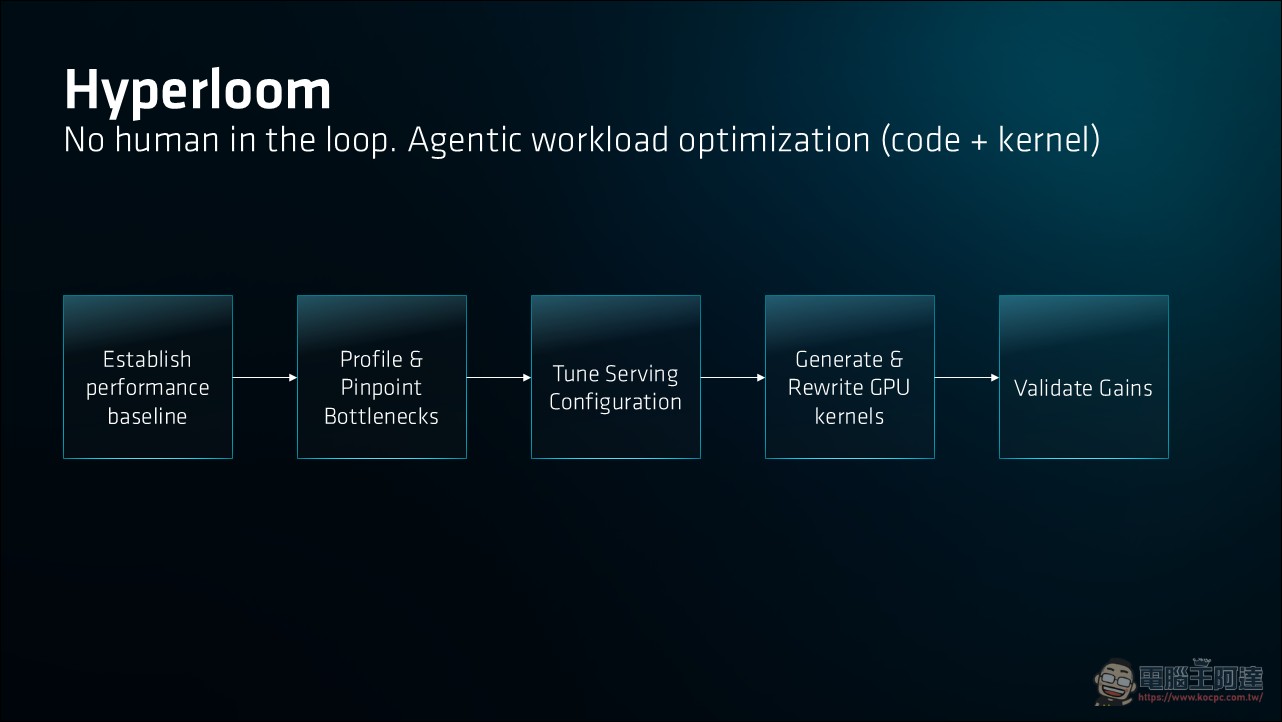
Hyperloom’s architecture consists of five components: TraceLens handles automatic bottleneck identification, Magpie manages core evaluation and benchmarking, IntelliKit provides conversational performance analysis tools, GEAK is a multi-agent core optimizer that works across Triton/HIP/CK/FlyDSL/TileLang backends, and Arbor continuously self-evolves through a tree-based cognitive layer to explore more optimization space. The entire workflow follows an “analyze → plan → optimize → validate” loop that can iterate repeatedly until performance targets are achieved.
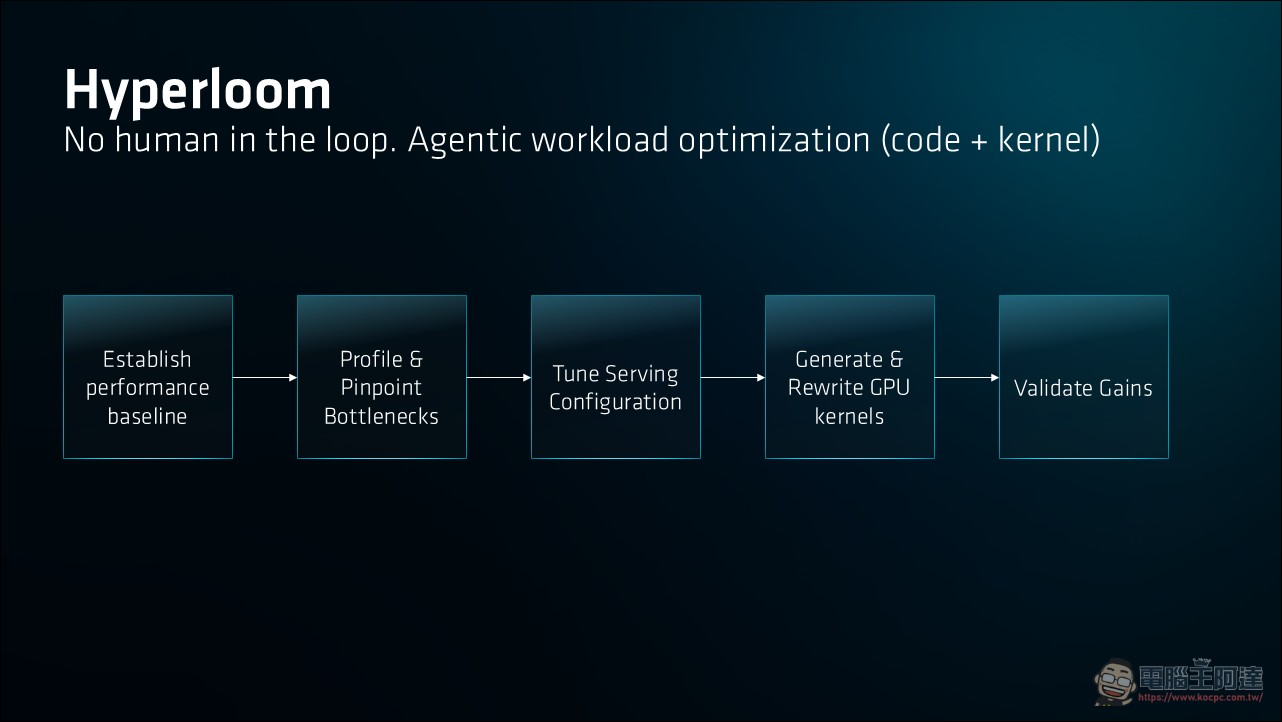
Hyperloom currently supports MI300X, MI325X, and MI355X, via pip Install and it’s ready to use. Developers only need to specify the model and settings, and tell the Agent “use Hyperloom to optimize a model” to launch an optimization session.
TheRock build system takes over completely
Another structural change in ROCm 10 is the full adoption of the TheRock build system. TheRock is an automated open-source build and release system that first entered production in ROCm 7.14. In ROCm 10, all underlying libraries, framework wheels, and tools are produced from the same pipeline, undergoing full-stack staged validation before release.
This brings several practical changes: the installation directory is from /opt/rocm-7.2/ Change to /opt/rocm/core-10.0, uniformly add to the kit names amdrocm- prefix (e.g. amdrocm-blas、amdrocm-rcclThe previously scattered packages were consolidated, with hipBLAS and rocBLAS merged into a single package, and similarly for hipSPARSE and rocSPARSE. At the same time, AMD integrated GPU software distribution into the redesigned repo.amd.comROCm suite, amdgpu drivers, and public GPU tools are unified into the same repository.
Framework Support and Hardware Expansion
ROCm 10.0 updated its AI framework support lineup: PyTorch 2.13.0, JAX 0.11.0, vLLM 0.27.0, SGLang 0.5.15, TensorFlow 2.21, MIGraphX 2.17, and ONNX Runtime 1.27.0. On the hardware side, support for the Radeon RX 9050 (including the 4GB version) was added, and virtualization support has been expanded to multiple Passthrough and SR-IOV configurations for the MI355X, MI350X, MI325X, MI300X, and MI210.
On the consumer side, ROCm 10 adds Unsloth support on the Ryzen AI MAX platform, enabling developers to perform LoRA and QLoRA fine-tuning of large language models locally. By leveraging the large unified memory of Ryzen AI MAX, model training can be completed without relying on cloud infrastructure. This is particularly appealing to teams that require data privacy or offline development. ComfyUI also receives performance tuning for popular image generation models such as Wan2.2, FLUX.2 KLEIN, Stable Diffusion 3.5 Medium, Stable Diffusion 2.1, and Stable Diffusion XL Base. AMD also provides recommendations for attention algorithms and backends, allowing users to get the best out-of-the-box performance on Radeon and Ryzen platforms.
Major upgrade to the communications library
RCCL (ROCm Collective Communications Library) received its largest single investment ever in this release. The upstream NCCL merge advanced from 2.28.3 to 2.30.4, adding support for symmetric memory, a GPU-initiated network transfer (GIN) device API, a one-sided host API, and a new Pythonic API. Large-scale launch improvements reduced launch overhead across hundreds of GPUs, while fault tolerance enhancements boosted stability for long-running tasks.
rocSHMEM continues to narrow the API gap with NVIDIA NVSHMEM 3.6.5, adding host AMO and context APIs.reduce_on_stream Variants, wave-level collective operation, and team_split_2d and other functions.
Developer Tools and Windows Unification
ROCm Compute Profiler’s Roofline analysis extends to the GFX11xx (RDNA 3) architecture, bringing performance ceiling analysis to Radeon hardware for the first time. ROCm Optiq 1.0 has entered official release, serving as a unified visualization analysis environment that combines system-level timeline exploration with core-level performance analysis.
On the Windows side, the HIP SDK has been officially retired and replaced by the ROCm Core SDK. Windows and Linux now share the same SDK definition and release cadence, no longer going their separate ways. ROCm 10 is distributed on Windows as a tarball, with a native installer expected to arrive later in 2026.
Conclusion
The version number jump of ROCm 10 carries real meaning. With TheRock taking full control, ROCm’s long-standing “scattered here and there” software distribution problems have been resolved. The ROCm.AI trio (CLI, Skills, Hyperloom) transforms ROCm from a platform that “hands you tools to assemble yourself” into a development environment where “Agents can participate directly.” For developers still on the fence about the AMD GPU ecosystem, ROCm 10 lowers not just the technical barrier, but the psychological one as well. ROCm 10 will continue releasing follow-up versions at a cadence of roughly every six weeks, and AMD has also teased that a native installer for Windows will arrive later in 2026.
Source: KOCPC Chinese