


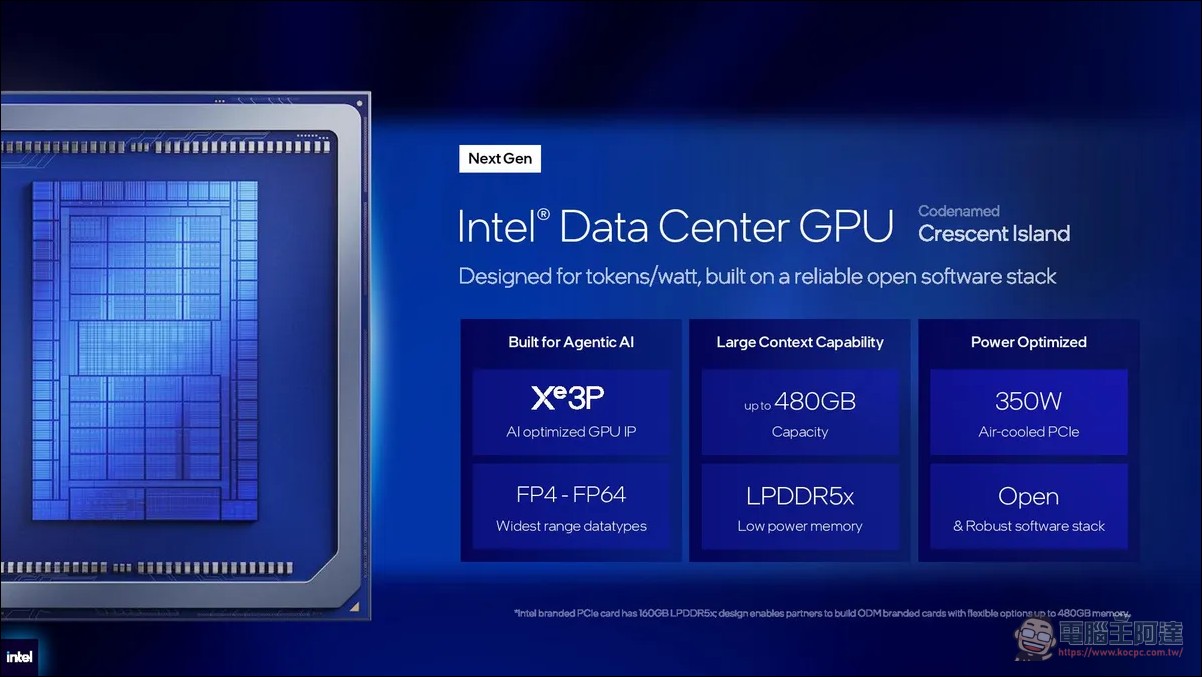
Intel previously unveiled a data center GPU that takes an unconventional approach at Computex 2026, with the product codename Crescent Island. This chip abandons HBM (High Bandwidth Memory), which is a must-have for current AI accelerators, and instead adopts LPDDR5X as its memory solution. At the recent Hot Chips 2026 conference, Intel further detailed the architecture specs: 32 Xe cores, 256 XMX engines, and memory configurations starting at 160GB on the reference design, with ODM partners able to scale up to 480GB.
Why not use HBM?
Intel’s choice is actually quite pragmatic. It’s no secret that current HBM semiconductor capacity is almost entirely consumed by high-end GPU products like NVIDIA and TPU. SK Hynix holds roughly 57% of HBM market revenue, and together with Samsung, the two suppliers’ capacity is already fully allocated. SK Hynix has publicly stated it cannot fulfill all customer orders, and Samsung’s memory division head has warned that “significant shortages” will persist beyond 2027.
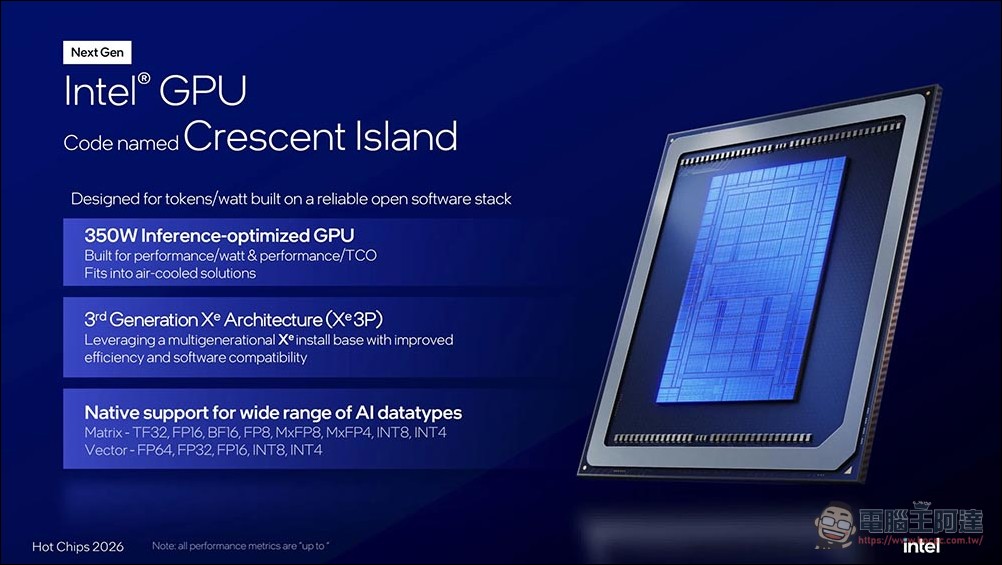
For an accelerator card that requires hundreds of GB of HBM, this supply tightness is a structural capacity ceiling. Intel’s answer is to skip HBM altogether and switch to LPDDR5X, the same memory standard that has been mass-produced for years in phones and laptops, with dozens of factories making it at once, ensuring ample supply. Crescent Island uses Intel’s Xe3P architecture (a performance-enhanced version of Xe3, sharing the same lineage as the Panther Lake laptop processor) and is positioned as a data center accelerator purely for inference.
Capacity vs. Bandwidth: A Design Trade-off
Using LPDDR5X instead of HBM comes with the most immediate cost: bandwidth. In the standard 160GB configuration, Crescent Island delivers roughly 684 GB/s of memory bandwidth, about one-seventh of NVIDIA’s H200 (HBM3e). On paper, that gap is indeed substantial. But Intel’s argument is that inference scenarios are bottlenecked not by bandwidth but by capacity. For example, a 200-billion-parameter model stored in FP8 needs roughly 200GB of memory. On a single 480GB Crescent Island, that model can be loaded entirely without quantization or splitting across cards. In contrast, the NVIDIA H200 has only 141GB of HBM3e, and the B200 has about 192GB—if the model doesn’t fit, it has to be split across multiple cards for distributed deployment, bringing with it the overhead of cross-GPU communication.
Intel’s target is agentic AI inference—workloads such as multi-step reasoning chains, long-context document analysis, and continuous code generation. These scenarios are difficult to parallelize across multiple cards, and when a single card can hold the entire model, deployment and management become far simpler. Intel CEO Lip-Bu Tan emphasized in his Computex keynote that Crescent Island is a chip designed specifically for “agentic AI.”
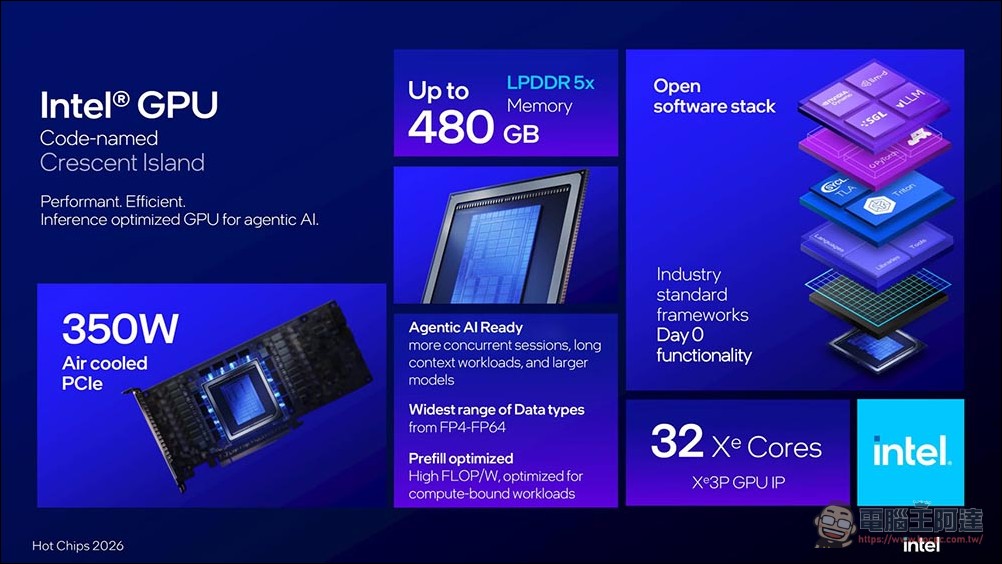
The actual impact of memory bandwidth depends on the configuration. The 684 GB/s bandwidth of the public-edition 160GB version comes from a 640-bit bus paired with LPDDR5X-10667 modules. If an ODM expands the memory to 480GB, the bus may need to be widened to 1280-bit, in which case bandwidth could increase to around 1.5 TB/s, narrowing the gap with HBM accelerators.
Using small-batch inference as an example: when each batch only carries one or two prompts, the compute units spend most of their time waiting for data to arrive from memory, making bandwidth the bottleneck. In this case, the seven-fold gap between Crescent Island and HBM accelerators would directly show up in output speed. But when the inference chain grows longer and context accumulates to tens of thousands of tokens, the time consumed by computation itself gradually dominates latency, and bandwidth’s impact becomes less pronounced. Intel’s argument is built on the latter scenario: agentic AI naturally has long inference chains, so bandwidth’s marginal utility diminishes, and capacity is what really determines which models can run.
350W air-cooled card, lower deployment barrier
Crescent Island is a standard PCIe add-in card with 350W power consumption that can operate in traditional 4U or 5U server chassis without liquid cooling. NVIDIA’s latest Blackwell series accelerators draw between 700W and 1000W and require custom liquid cooling infrastructure. For enterprises without liquid-cooled data centers, Crescent Island can be plugged directly into existing racks, significantly lowering the deployment barrier.
A 480GB card running at 350W means a fully loaded eight-card system draws about 2,800W total, still within standard rack power supply limits. Looking at the hardware configuration, Intel’s target customers are clear: enterprise users who can’t get on NVIDIA’s supply list and need large-capacity inference solutions. Intel’s Arc Pro B70 workstation-grade inference card has already proven this approach viable, and Crescent Island scales the same strategy up to data center level.
Eight Crescent Island modules fill a 4U server, with total memory capacity up to 3.84TB (based on the 480GB version), enough to load a full 700-billion-parameter model. Compared to the NVIDIA DGX B200’s 1.4TB total HBM3e capacity, Crescent Island has a clear advantage in memory capacity. Of course, the bandwidth gap will limit per-card output speed for large-batch inference, but for scenarios where model completeness matters most, capacity is what counts.
Software ecosystem and shipping schedule
Intel is pairing Crescent Island with the oneAPI software stack. oneAPI is far less widely adopted than NVIDIA’s CUDA or AMD’s ROCm, but for teams already developing within Intel’s ecosystem, the migration cost is relatively manageable. Intel has not released any compute performance data—no TFLOPS, no TOPS, and no inference benchmarks. For now, the entire pitch rests on memory capacity and deployment flexibility.
Sample delivery is scheduled for the second half of 2026. Given the pace of information releases—from the Computex reveal in June to the core specifications only being filled in at Hot Chips in August—Intel has been quite cautious with details on this product. Until third-party independent benchmark data comes out, Crescent Island’s actual inference performance remains an open question. Still, the strategy of using a single-card 480GB capacity to counter the HBM supply ceiling at least carves out a market position no one else is occupying.
From an industry perspective, the greater significance of Crescent Island lies in breaking the established notion that AI accelerators must use HBM. If the LPDDR5X approach proves viable in inference scenarios, more vendors may follow this path in the future, especially chip design companies excluded from the HBM supply chain. Intel is betting that memory capacity matters more than bandwidth, and the odds of that bet paying off are increasing as model parameter counts continue to grow. After sampling in the second half of 2026, real-world test results will provide the answer.
Source: KOCPC Chinese