


An article on PTT, a well-known forum in Taiwan, asked “should I contact a credit reporting agency to collect evidence?” which sparked a lot of discussion. There are many negative impressions of credit reporting agencies in the comments. Some netizens bluntly said that “there are many ghosts and monsters” and “be careful of being paid by both parties.” Others suggested that they simply collect evidence by themselves or purchase surveillance equipment. This type of discussion quickly attracted attention and once again brought the long-standing question “Are credit bureaus reliable?” back to the public’s attention.

PTT hotly discusses “Are credit bureaus really reliable?” Detectives reveal 3 dark sides, a must-read before looking for a credit bureau
In fact, credit bureaus do play a role in investigations of romantic disputes, marital problems or business risks. However, due to the long-term phenomenon of uneven quality within the credit reporting industry, many people have developed a strong sense of distrust in online discussions.
Taiwan Detective AssociationChairman Xie Zhibo pointed out that the doubts on the Internet were not groundless. Some unscrupulous operators had indeed taken advantage of the information gap to make profits, causing damage to the overall industry image. Therefore, before entrusting any investigation services, understanding industry risks and basic judgment principles is the first step to protect one’s own rights and interests.
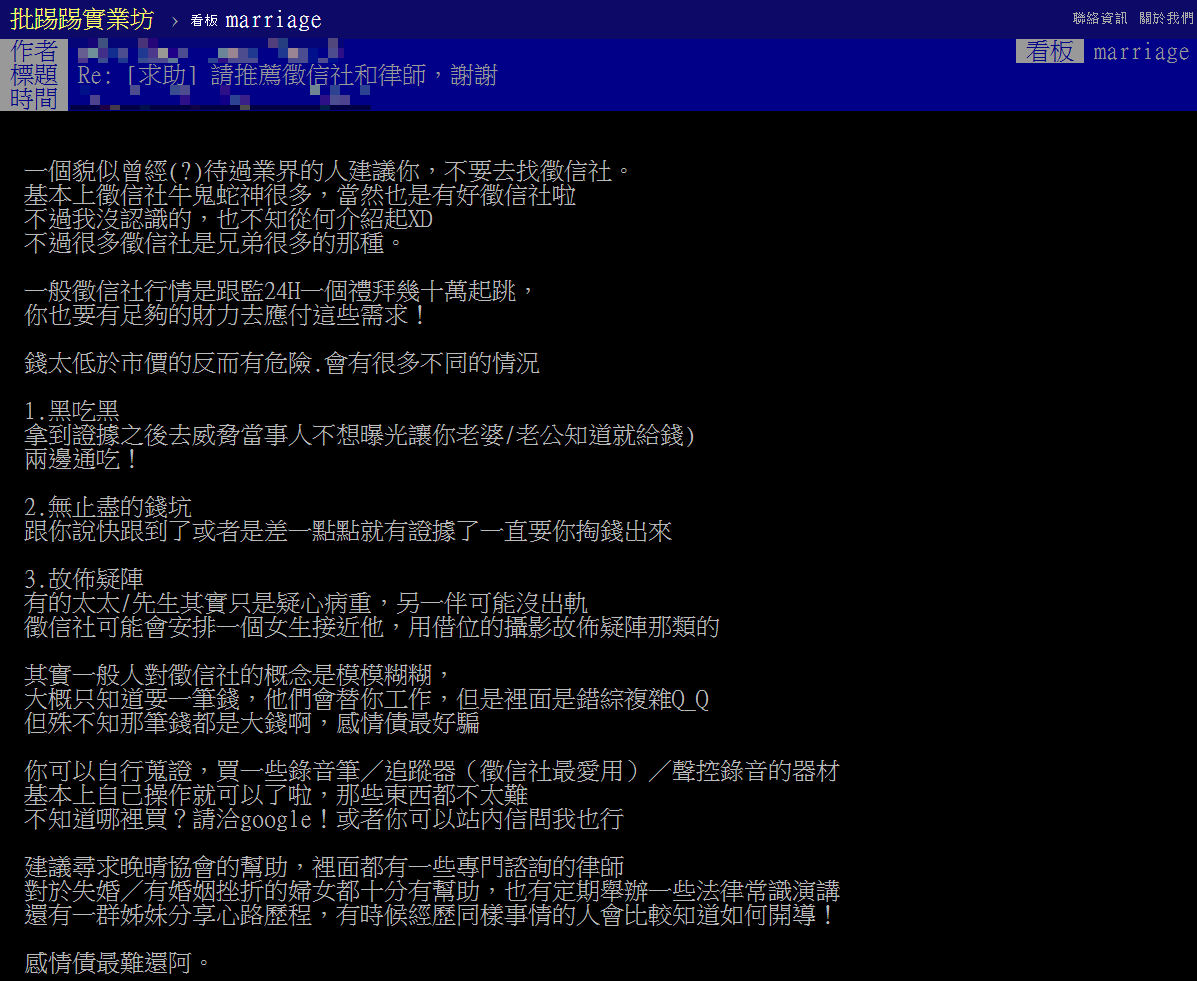
PTTNetizens expose3Big credit trap Online discussions reflect real-life anxiety
In recent years, with the fermentation of discussions on online community platforms and forums, the credit reporting industry has gradually been put under public scrutiny. Whether it is questioning, criticizing or sharing experiences, it is pushing society to rethink the role and boundaries of this special industry. A PTT netizen who claimed to have worked in the credit reporting industry shared his experience. Among them, the most commonly mentioned risks can be roughly divided into three types:
1. Concerns about “bilateral charges”
This netizen believes that if a third party is involved in the evidence collection process, some unscrupulous businesses may turn to the other party to put pressure on the other party after obtaining the evidence, threatening the third party or the subject of the investigation with “paying money without being exposed” and charging inappropriate fees. This situation is called “both sides take it all”, “black eats black”, “wash both sides”, etc. in online discussions.
2. Multiple setups of “cost trap”
Some credit reporting agencies attract clients with low prices, but during the execution process, they continue to ask for and add fees to the parties for various reasons. For example, malicious extension of monitoring time, opacity of manpower or equipment costs, etc., cleverly designed to make the final cost much higher than originally expected.
3. The conspiracy theory of “creating false evidence”
This netizen also shared that some credit reporting companies may take advantage of the client’s emotional state or serious suspicion to deliberately create ambiguous scenes by arranging personnel to approach the subject of investigation, use the location to shoot suspicious scenes as evidence, and instigate the client to further arrest the client.
Although the authenticity of these claims needs to be verified, the reason why they are widely circulated on the Internet reflects public uneasiness about the opacity of information and the investigation process. The power of community discussions has also continued to amplify these doubts. For many people, “credit reporting agencies” are not just investigative agencies, but a special industry full of mystery and gray imagination.
Senior detective analysis: A truly legal credit investigation is actually very different from the imagination of ordinary people
In order to clarify the truth, our reporter specially called a senior detective for his opinion. according toRieter International Credit BureauCEO Xie Zhibo said that he does not deny the “dark side” of PTT’s hot discussion, because those problems are indeed shortcomings that have always existed in the credit reporting industry. However, the process of a truly legal credit reporting investigation is quite rigorous and cumbersome, and is far from the “mysterious surveillance” or “manipulation incident” that ordinary people imagine.
First, legal evidence collection must adhere to legal boundaries. For example, behaviors such as secret photography in private places, intrusion into residences, or illegal monitoring may constitute criminal liability in law. Professional detectives typically avoid these high-risk operations and instead conduct investigations through public field observations, behavioral records, and contextualized time trajectories. In addition, legitimate businesses usually have clear company registration, business projects and contract procedures, rather than just accepting cases through online advertisements or social messages.
Secondly, whether the evidence has legal effect is also key. If the method of investigation and evidence collection itself is illegal, such as illegal wiretapping, intrusion into private space, or fabrication of situations, even if there are so-called “decisive” images or information, they will still not be admissible by the court in the litigation process, and the client may also face legal risks. Therefore, Xie Zhibo usually does not recommend that parties collect evidence on their own to avoid alerting the public and instead allow the person under investigation to gain control.
In view of this, the actual investigation and evidence collection work is often more complicated than outsiders imagine. In addition to observing and recording facts for a long period of time, it also involves work such as data compilation, action route analysis, and report writing. This is why the cost of professional investigation services is usually not low. If there is any doubt about the fee, the entrusting party has the right to ask the other party to explain the fee structure, including basic fees, possible additional items and payment methods. This should be explained clearly before entrustment to avoid subsequent disputes.
In this regard, Xie Zhibo reminded that if the credit agency charges too low a price, fails to sign a contract process, or promises to “certainly capture evidence,” there may be higher risks such as “double-washing,” “faking evidence,” “fee traps,” and “taking money without doing anything.”
In response to the opinions provided by the original poster and netizens, Xie Zhibo believes that for most clients, the reason why they seek investigation assistance from credit reporting agencies is usually the last choice when they encounter major difficulties in life, so they should avoid persuading the parties to be generous.
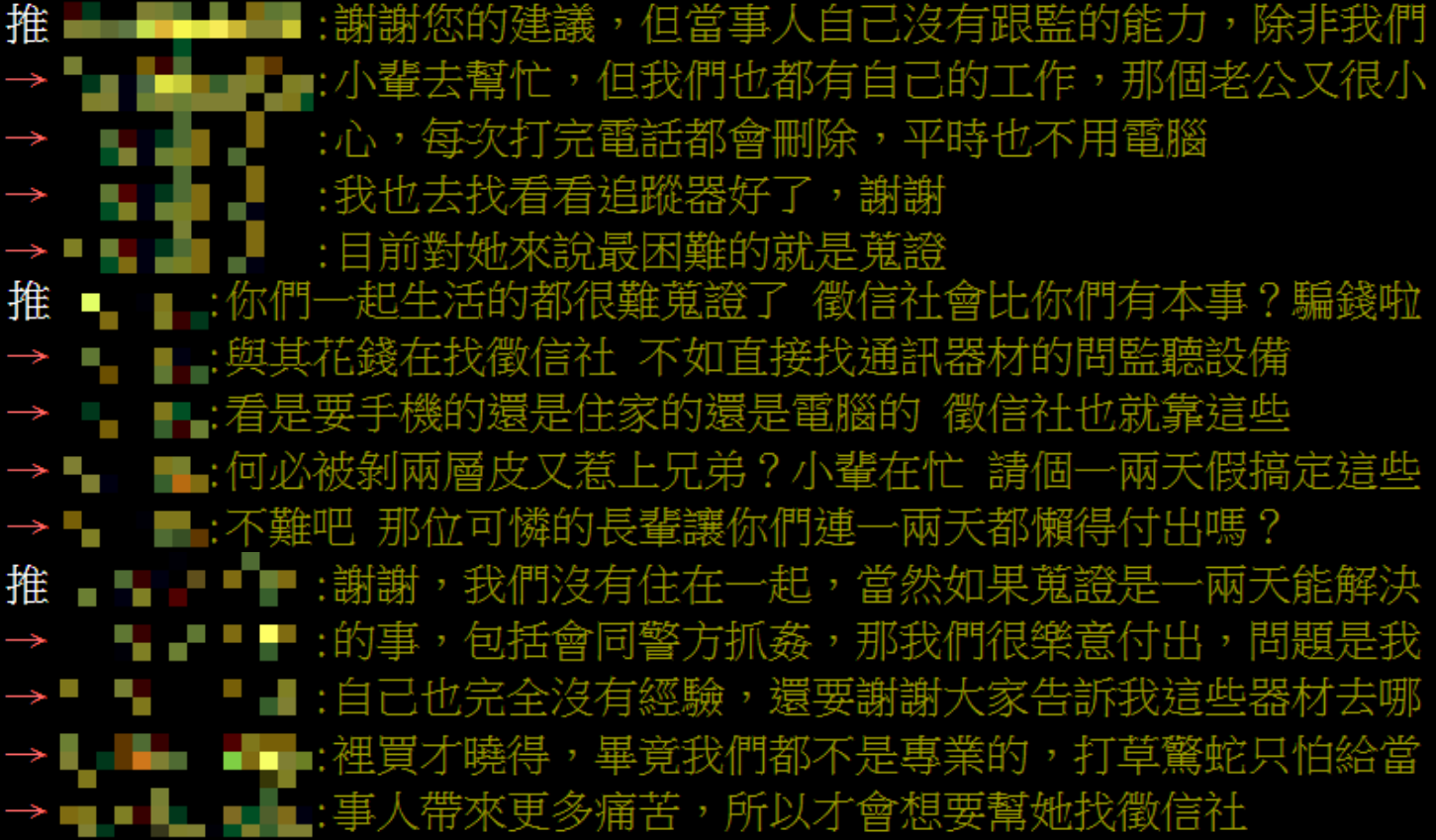
Don’t persuade others to be generous without others’ suffering: Behind the difficulties in marriage, it is not as simple as others imagine
In a related discussion thread, the original poster admitted that his friend and his partner did not live together, and the other party usually acted very cautiously. Communication records were often deleted after calls, and he did not usually use the computer at home, making it extremely difficult to collect evidence. For her, the real problem is not whether she is willing to face the truth, but the lack of experience and tools, and not knowing how to obtain evidence within the legal scope. Even if I had considered purchasing tracking or monitoring equipment on my own, I was worried that improper operation would cause greater harm, so I finally came up with the idea of seeking credit reporting assistance.
However, online discussions tend to be quick and direct. Some netizens believe that instead of spending money to contact a credit reporting agency, it is better to install monitoring equipment yourself. In addition, some people also question that if it is difficult to obtain evidence if they live together for a long time, external investigation agencies may not be able to do more.
In response to this series of discussions,Xie ZhiboIt is believed that netizens’ responses may seem rational, but in fact they have the least understanding of the situation the parties are in, and ignore the emotional pressure and psychological burden behind them. For most clients, the reason why they seek investigation assistance from credit reporting agencies is usually because they encounter major difficulties in life and are in a situation where they have been struggling with anxiety and doubt for a long time. Therefore, netizens should avoid advising the parties to be generous.
Therefore, when major doubts arise in a relationship, the most important thing is not to rush to take any extreme action, but to first understand the boundaries of legal evidence collection and possible risks. Whether you choose to collect evidence on your own or commission a professional investigation, you need to strike a balance between law and rationality to avoid allowing already difficult emotional issues to evolve into more complex legal and family conflicts.
For this reason, Xie Zhibo further believes that how the credit reporting industry can establish a transparent, legal and trustworthy service environment may be the most noteworthy issue behind this online discussion. When the truth needs to be clarified, rational choices and clear information are often more important than any promise of “quickly catching evidence”.
Source: KOCPC Chinese