


XiaomiOfficially released on August 24.Mystic Ring O3On the night of the chip’s release, a well-known Chinese tech channel, “Geek BayGeekerwan also simultaneously released a first-hand in-depth testing video. Compared to the earlier official-basedreports of party dataIn contrast, Geekerwan received a development board with the XRING O3 and ran a full energy efficiency curve test. The results show that this chip, still built on TSMC’s 3nm process, comprehensively outperforms current Android flagships in energy efficiency, and even approaches the Apple A19 Pro.
Xiaomi XRING O3 In-Depth Review by Geekerwan: Energy Efficiency Crushes All Current Android Flagships
Chip area exceeds 130 mm², with metal layer optimization enhancing integration density.
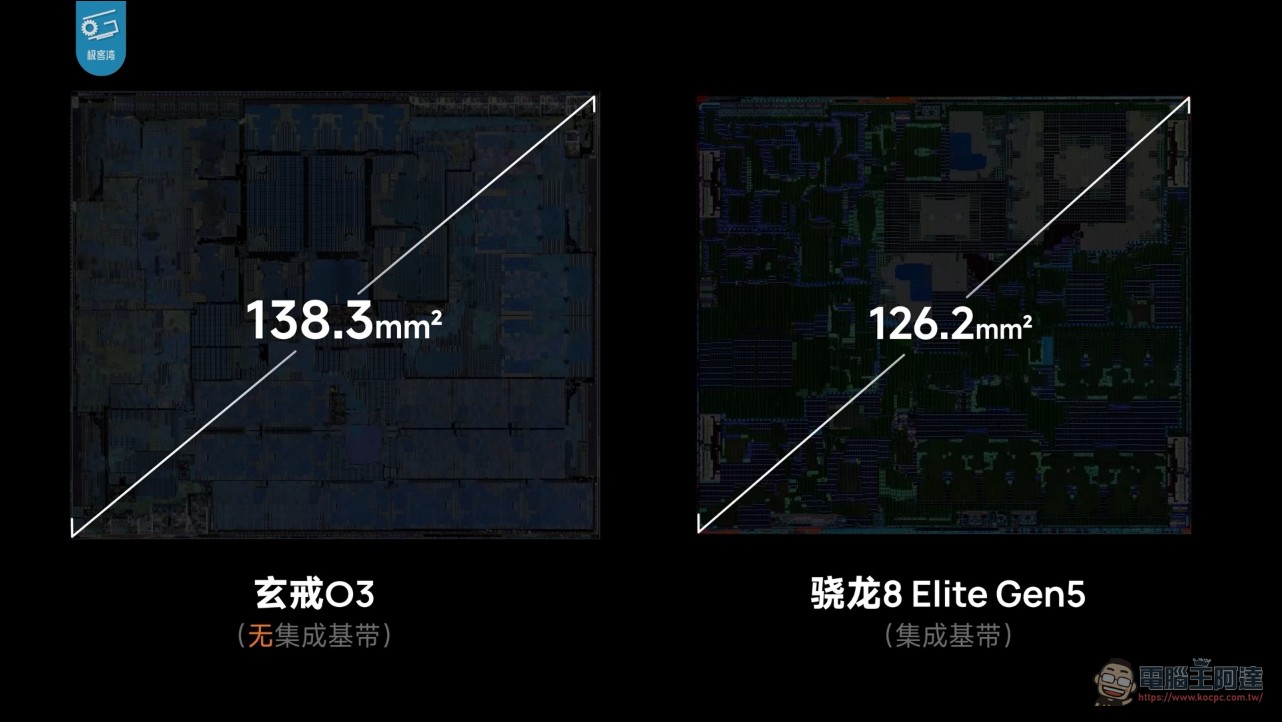
Geekerwan first performed a delidding analysis (die shot) on the O3. Without an integrated baseband, the O3’s chip area exceeds 130 mm², even larger than the Qualcomm Snapdragon 8 Elite Gen 5, which does integrate a baseband, and second only to the Dimensity 9500.
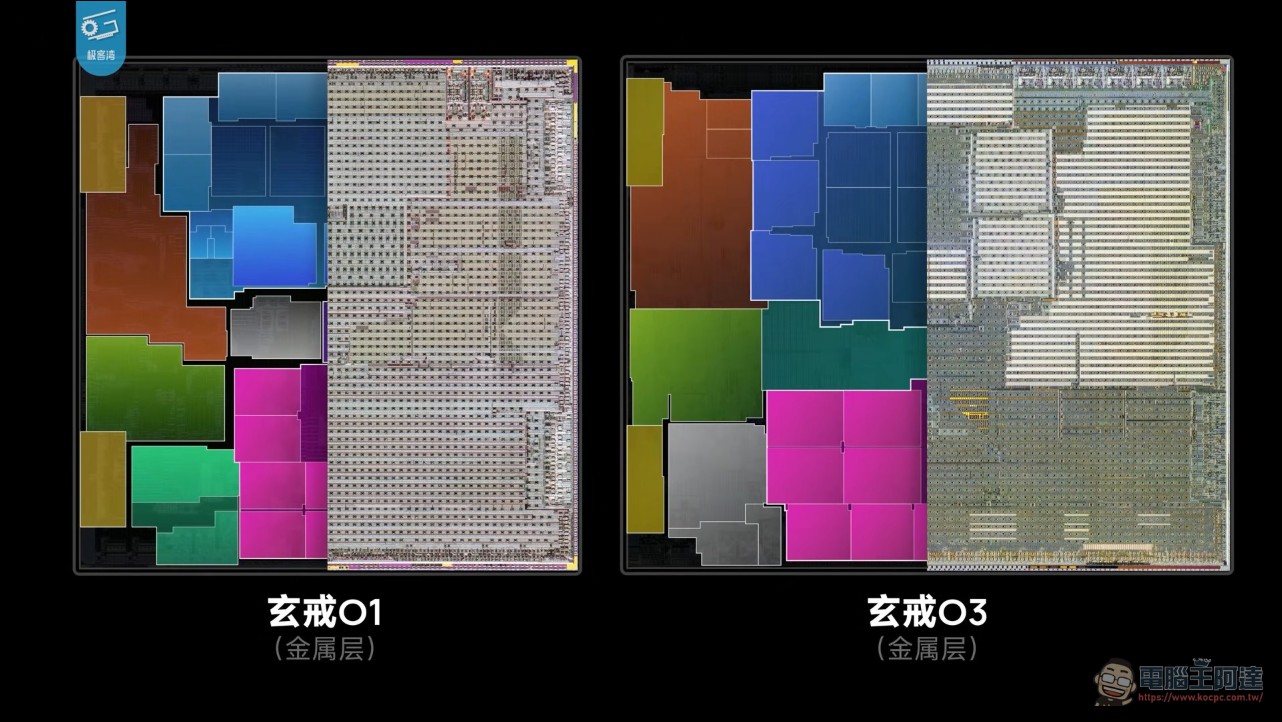
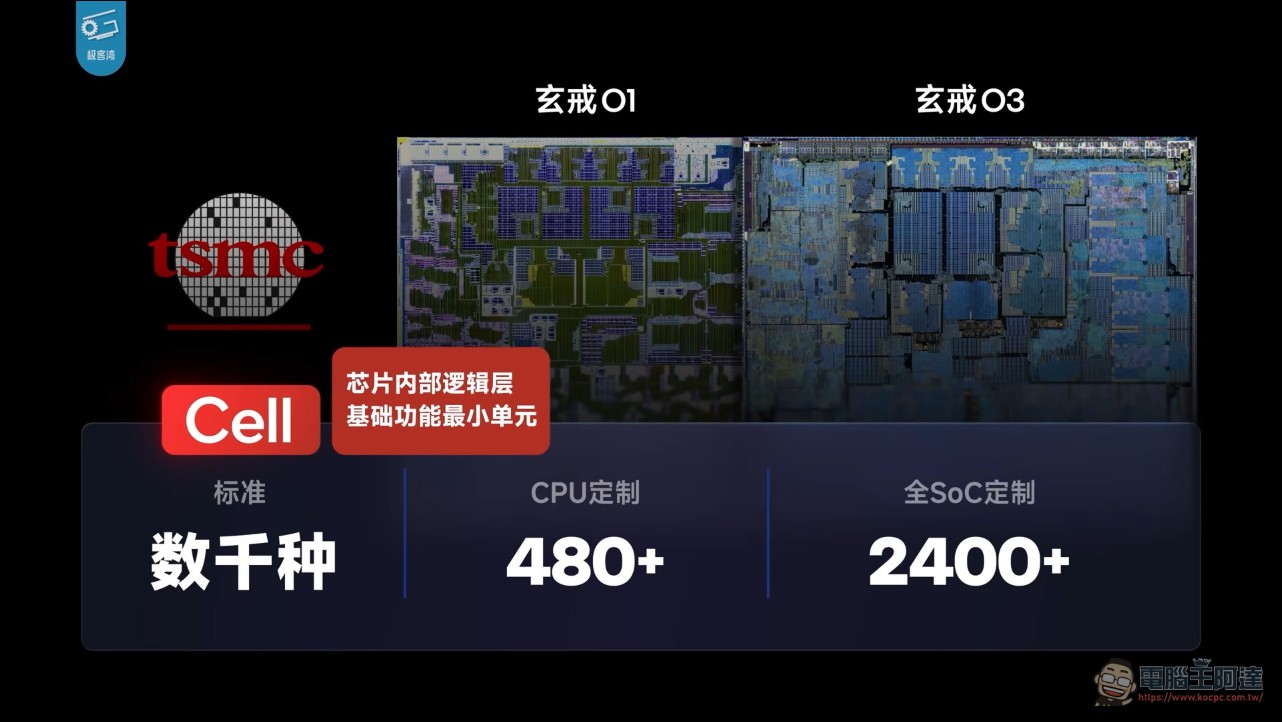
Compared to the previous-generation O1’s dieshot, the gaps between functional blocks in the O3 have narrowed significantly. Geekerwan noted that XRING introduced metal-layer optimization this time, significantly reducing the channels between modules and greatly improving SoC integration. Although the process remains TSMC’s N3P node, without upgrading to 2nm, the tighter chip layout successfully packed in more circuitry. Additionally, the XRING team custom-built over 2,400 custom cells beyond the standard cells provided by TSMC, demonstrating deep expertise in back-end design.
CPU specs: ten-core all-big-core configuration, the pinnacle of mobile CPUs.
The O3’s CPU uses three core types from ARM’s C1 family, with the same architecture as the Dimensity 9500, but with a more aggressive configuration. The ten-core, three-cluster design features 2 C1-Ultra super-large cores, 4 C1-Premium large cores, and 4 C1-Pro mid cores, completely abandoning filler small cores. Geekerwan says this CPU spec is so massive that it “should be the most extensive phone CPU currently,” and it’s unlikely any other phone SoC this year will pack this much into its CPU.
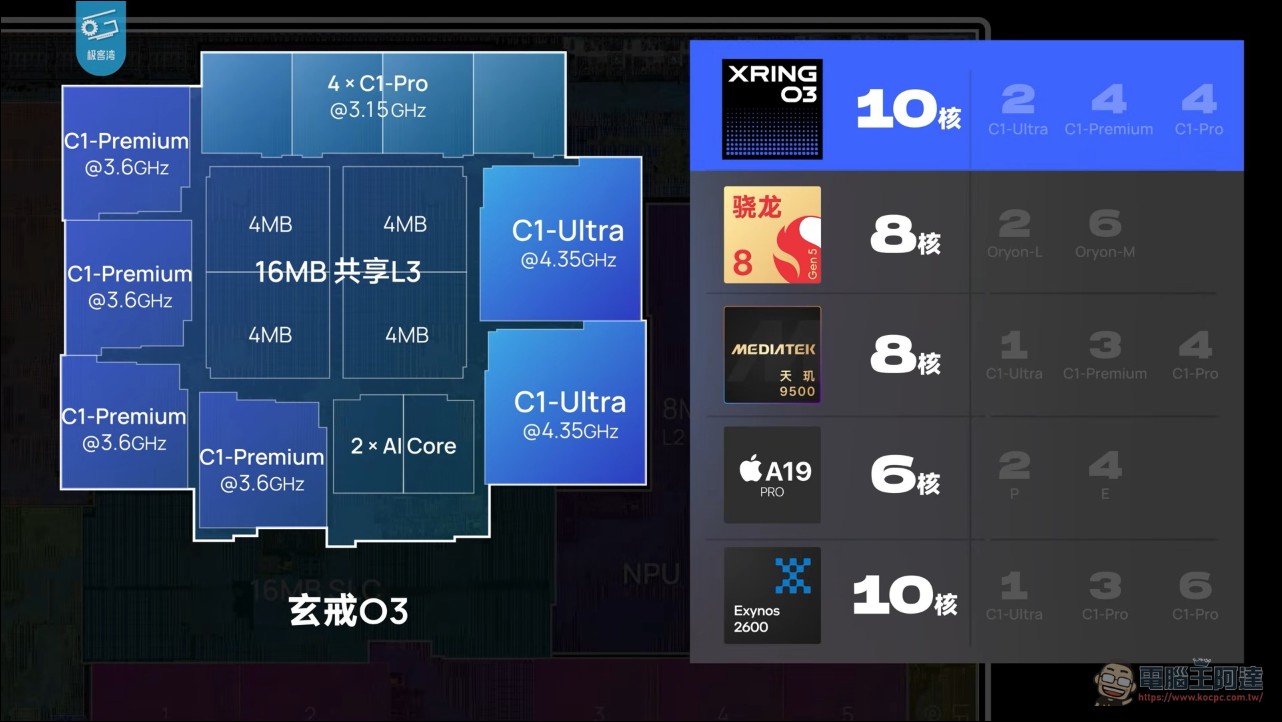
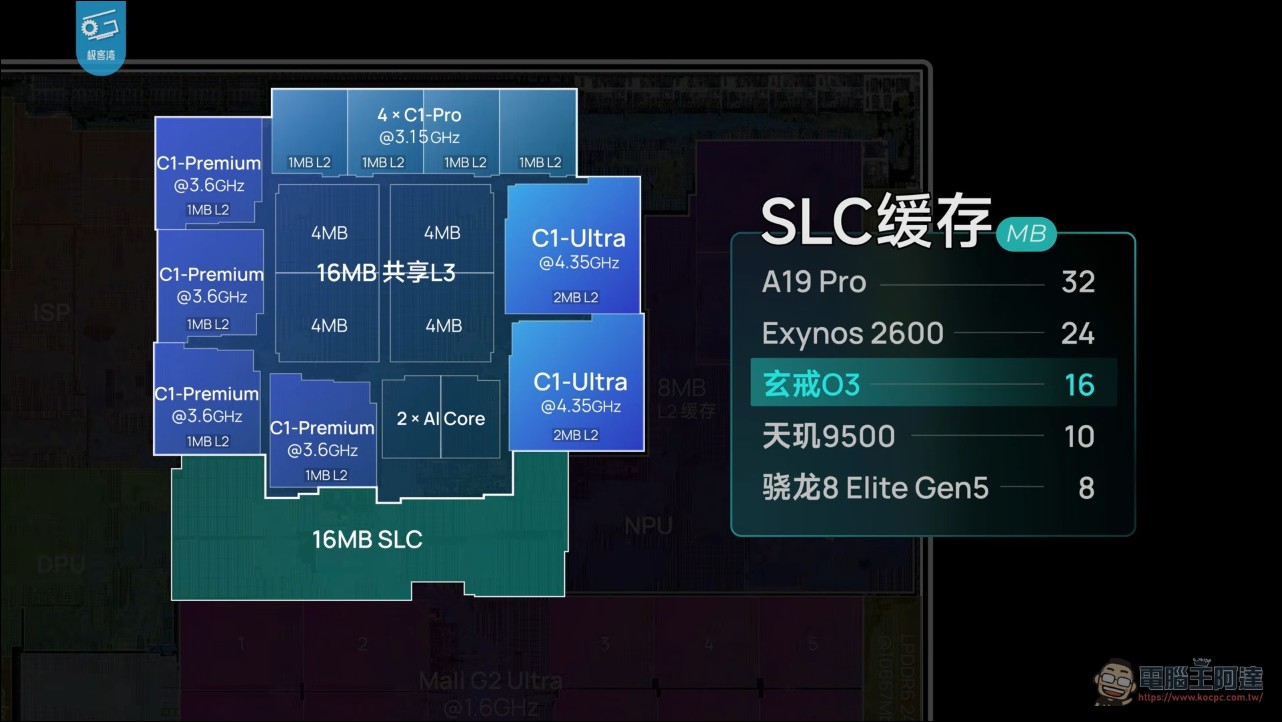
In terms of cache, besides each core having ample L2, all cores share a 16MB L3. The SLC cache that was missing from the previous-generation O1 has also been added this time, with 16MB allocated—much larger than both the Dimensity 9500 and Qualcomm 8E5.
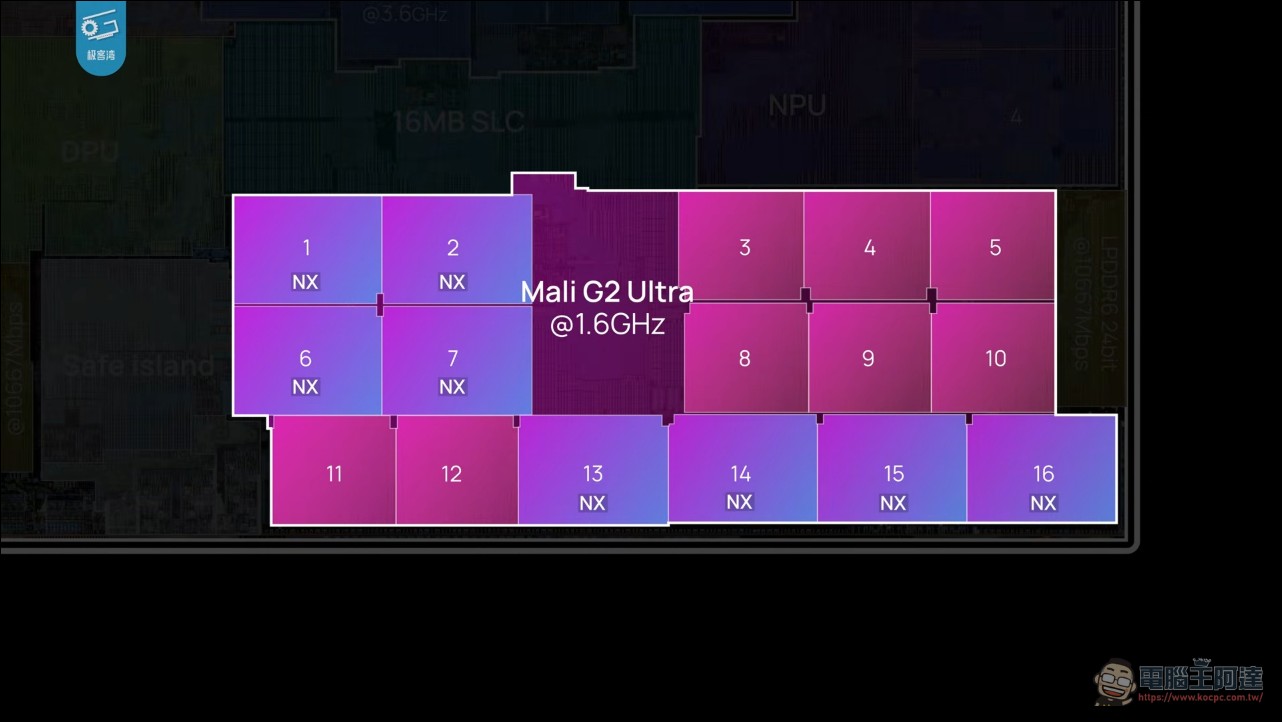
O3 debuts ARM’s new-generation Mali G2-Ultra architecture. The GPU scale is also quite impressive, with 16 GPU cores in total, eight of which are NX units (similar to NVIDIA’s Tensor Cores) that handle NSS AI upscaling and NFRU frame interpolation.
Additionally, the XRING O3 also has a fairly large self-developed NPU, delivering up to 200 TOPS of computing power at INT4 precision: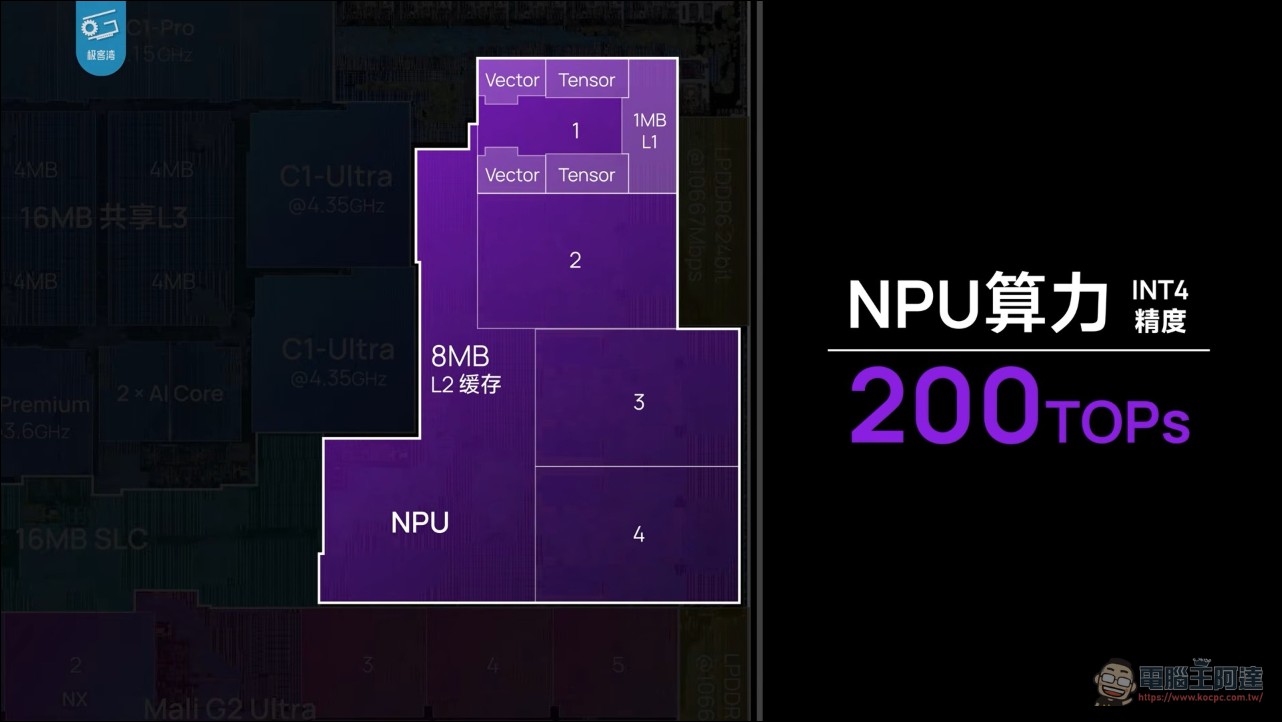
SPEC CPU 2026 real-world test: Energy efficiency reveals a generational gap
Geekerwan, starting from this episode, has fully adopted the new SPEC CPU 2026 test suite (the first new release in nine years) as the standard for measuring performance, power efficiency, and IPC. The energy efficiency curve for the prime core (C1-Ultra) shows that the O3 easily takes the top spot among all currently released Android SoCs, coming in only slightly behind the Apple A19 Pro’s prime core. In integer tests, the gap with the 8E5’s prime core is limited, but in floating-point tests, which rely more heavily on memory and cache performance, the O3 is significantly stronger than both the 8E5 and the Dimensity 9500.
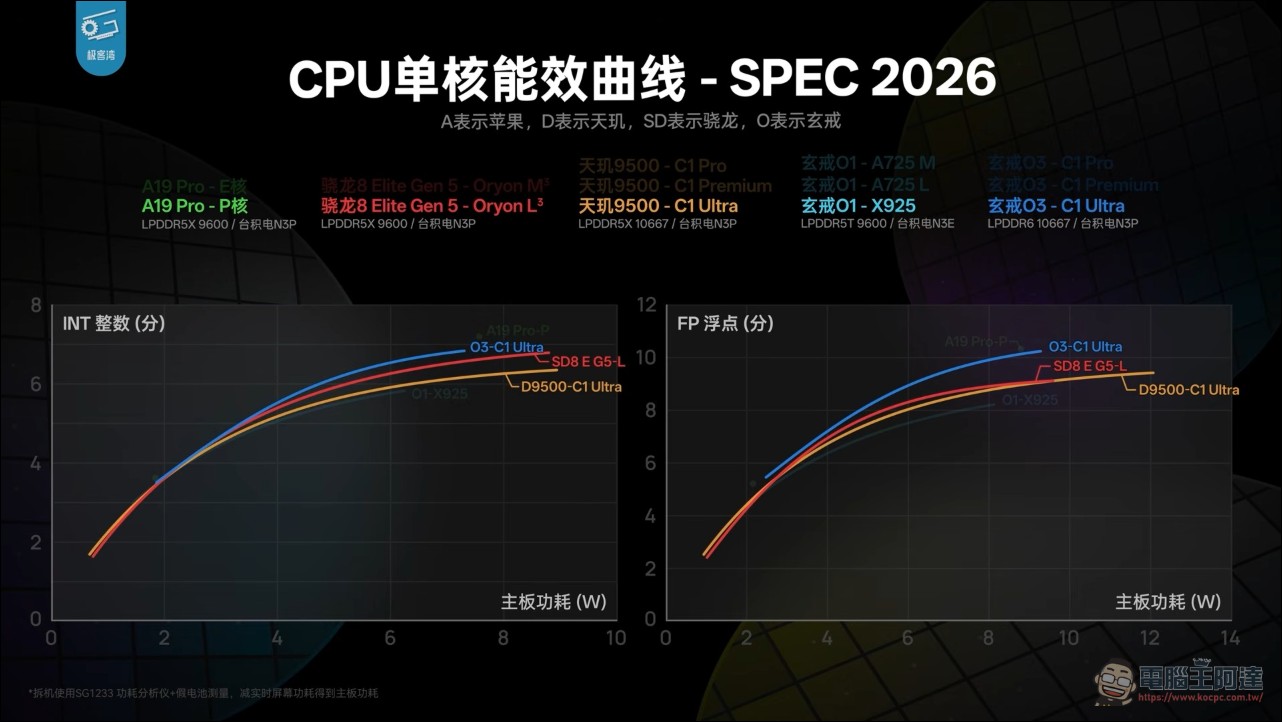
Geekerwan specifically noted that the O3’s C1-Ultra uses the same architecture and the same process as the Dimensity 9500, yet its energy efficiency is “a whole dimension ahead,” and its area is even smaller than the C1-Ultra inside the 9500. They said bluntly: “The gap in backend design is truly not just a minor one.”
Big Core and Mid Core: Three Cores in Perfect Relay
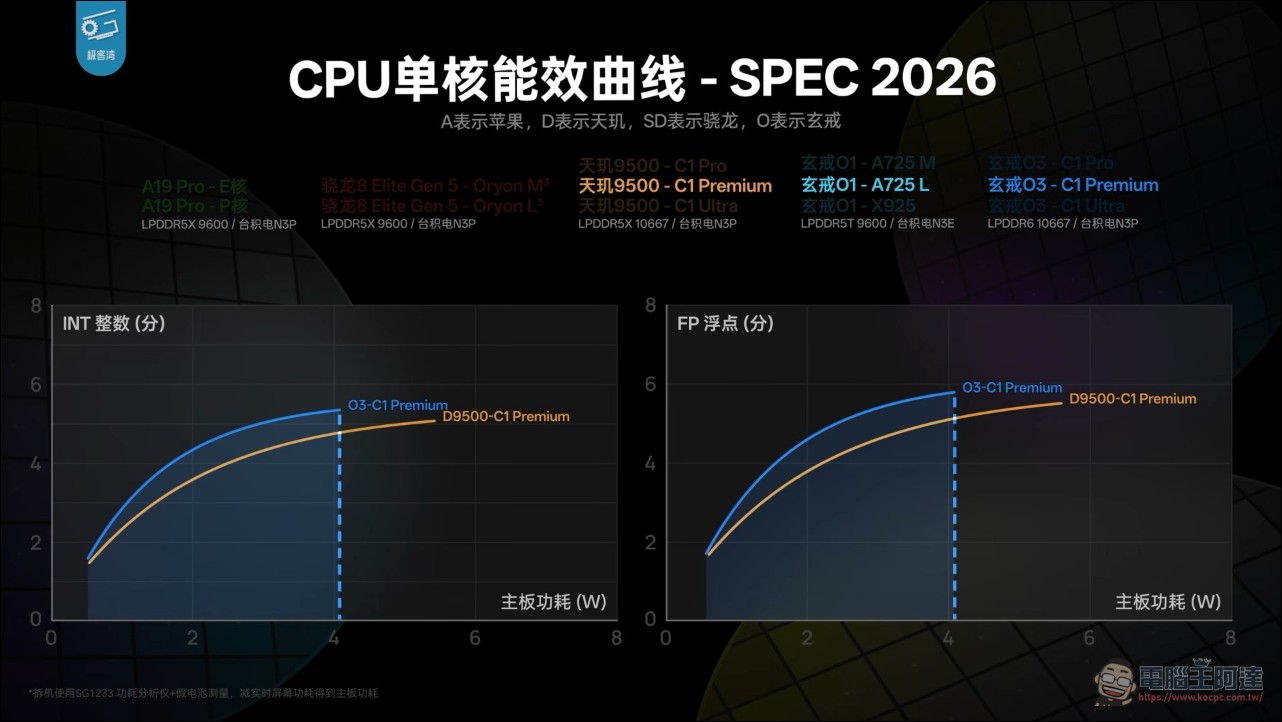
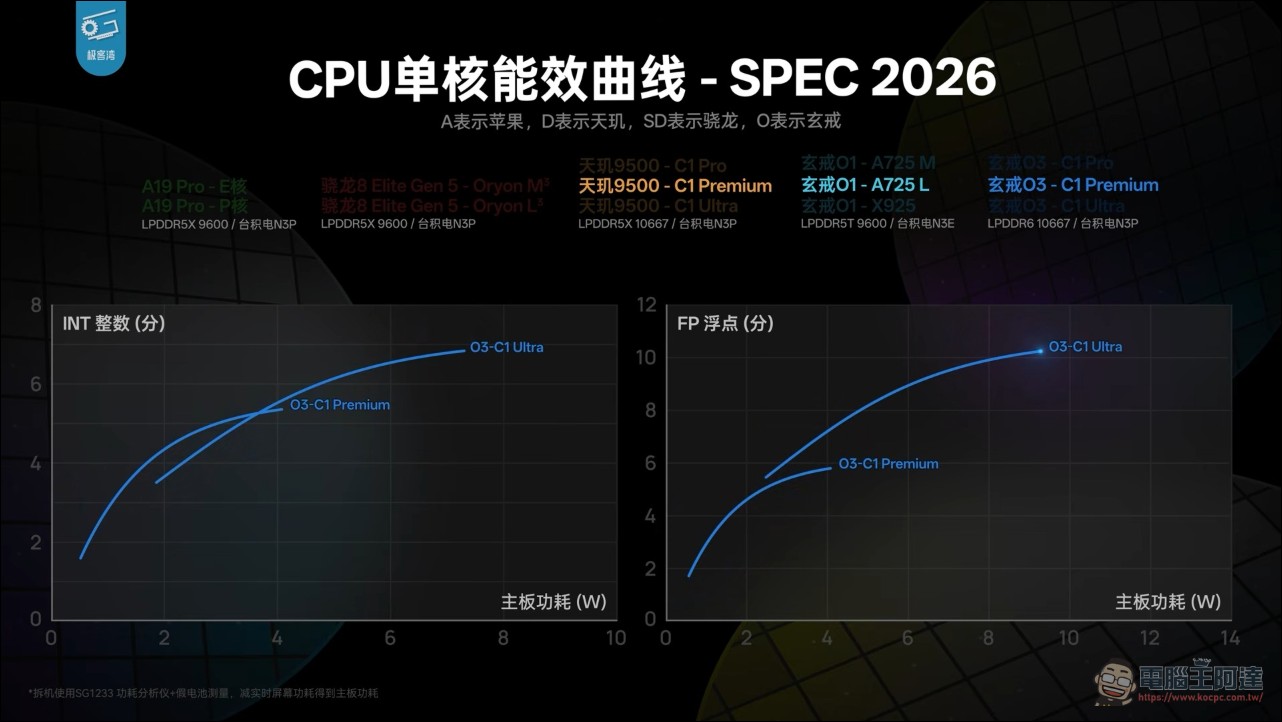
The performance of the C1-Premium big core is equally impressive. Geekerwan previously criticized the poor energy efficiency of the C1 Premium in the Dimensity 9500, saying “compared to the ultra-large core it falls short, compared to the mid core it also falls short—the three core types simply don’t connect well.” But on the O3, this C1 Premium delivers excellent energy efficiency in both integer and floating-point workloads, truly complementing the Ultra core.
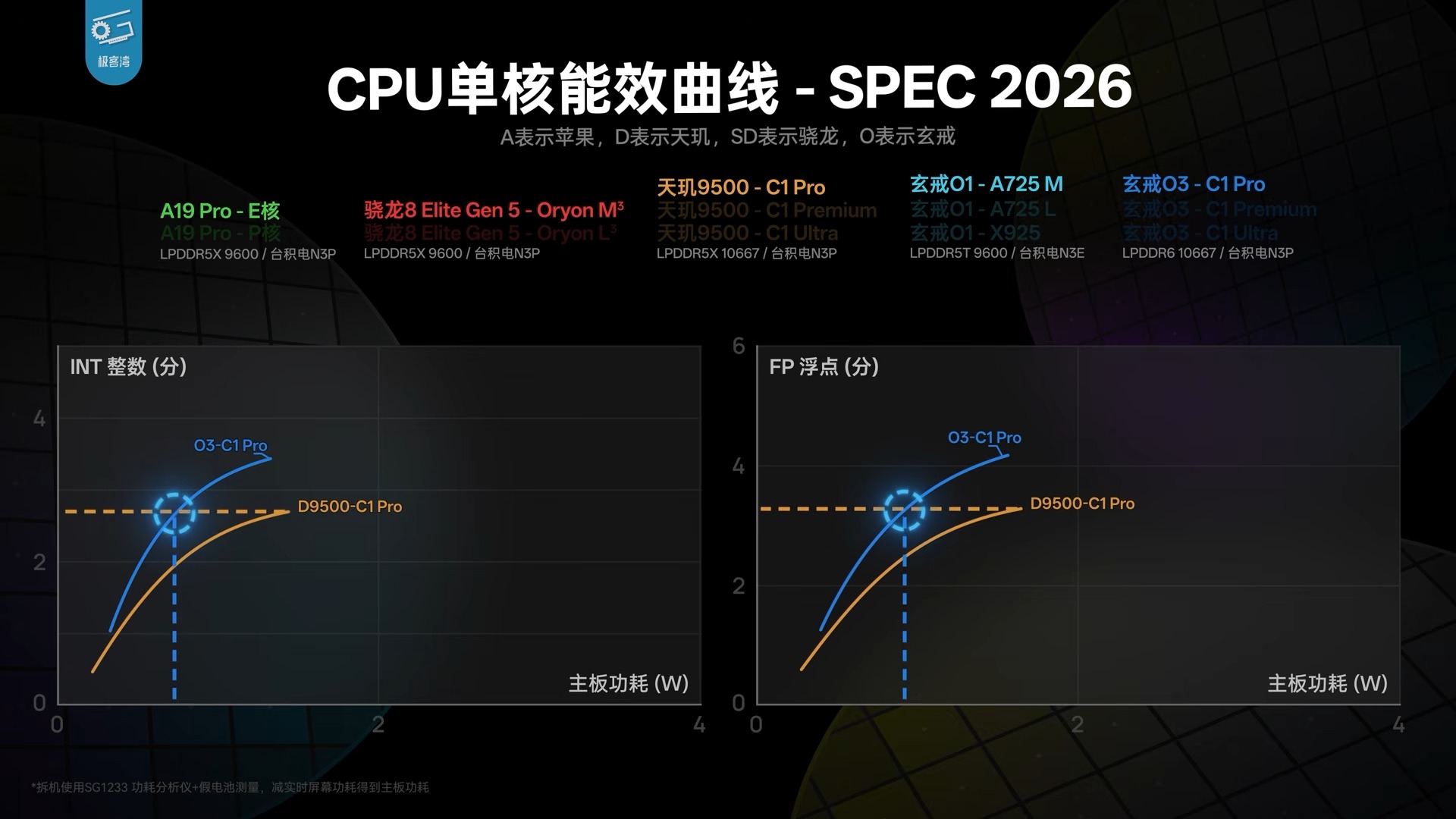
The C1-Pro mid-core is the core that Geekerwan is most excited about. The A725 mid-core in the O1 era was already impressive, and the C1-Pro in the O3 further extends that advantage. To achieve the peak performance of the C1-Pro in the Dimensity 9500, the O3’s C1-Pro only needs half the power consumption, and it holds its own even against the E-core of Apple’s A19 Pro.
Geek Bay’s summary: O3’s three core types form a perfect relay across different power segments—the ultra-large cores handle burst performance above 2.2GHz, the large cores take over the mid-frequency range, and the mid cores handle low-power scenarios. “There’s always a core that suits you—that’s the real meaning behind configuring multiple core types.”
Memory and Cache Latency: Beyond Apple
The O3’s ultra-large core has a memory latency of only 85ns at 128M depth, outperforming both the Dimensity 9500 and Snapdragon 8E5, and even beating the Apple A19 Pro. Even more impressive, the O3’s C1-Pro mid-core memory latency is lower than that of the Dimensity 9500’s C1-Ultra ultra-large core.
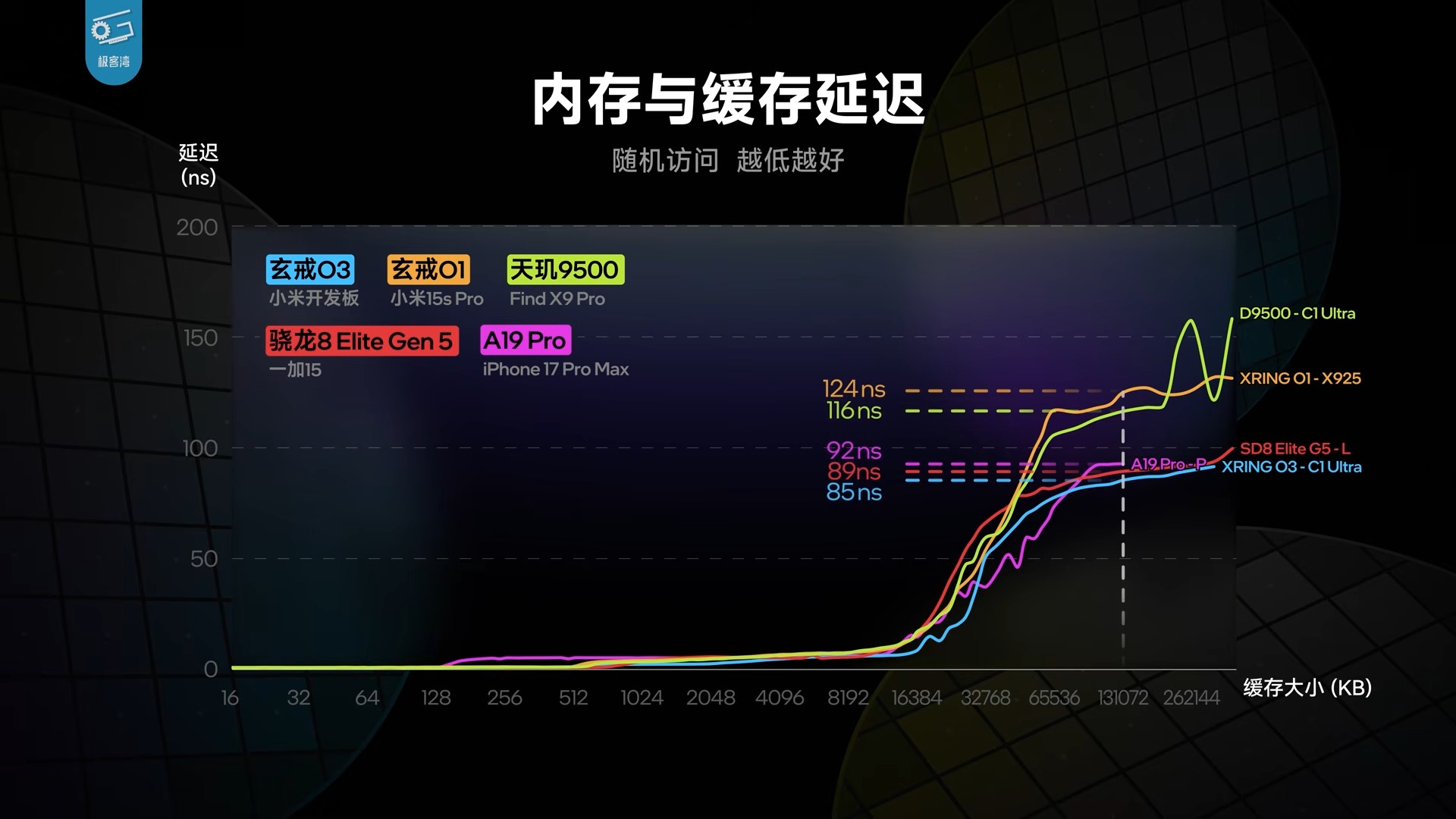
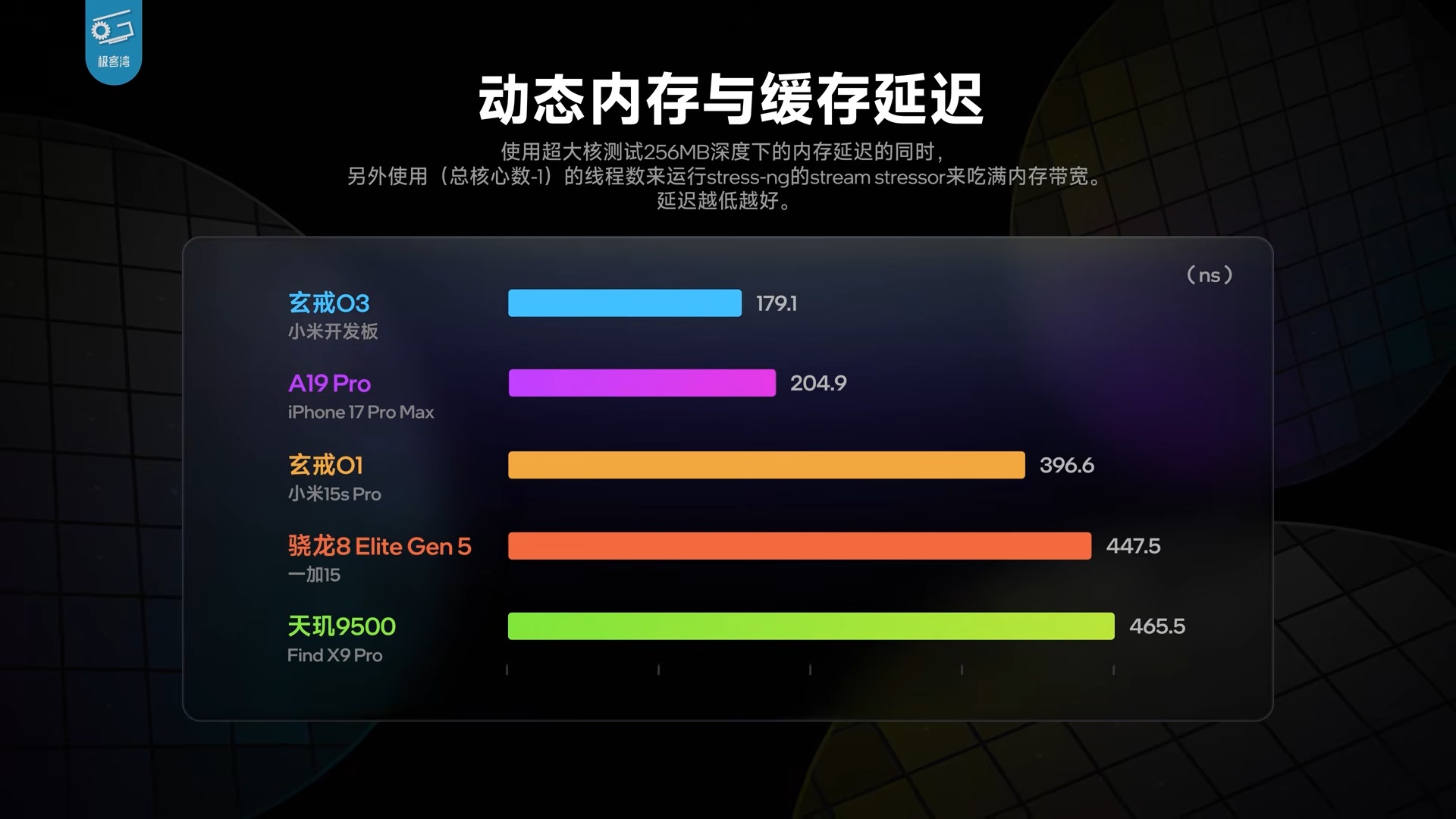
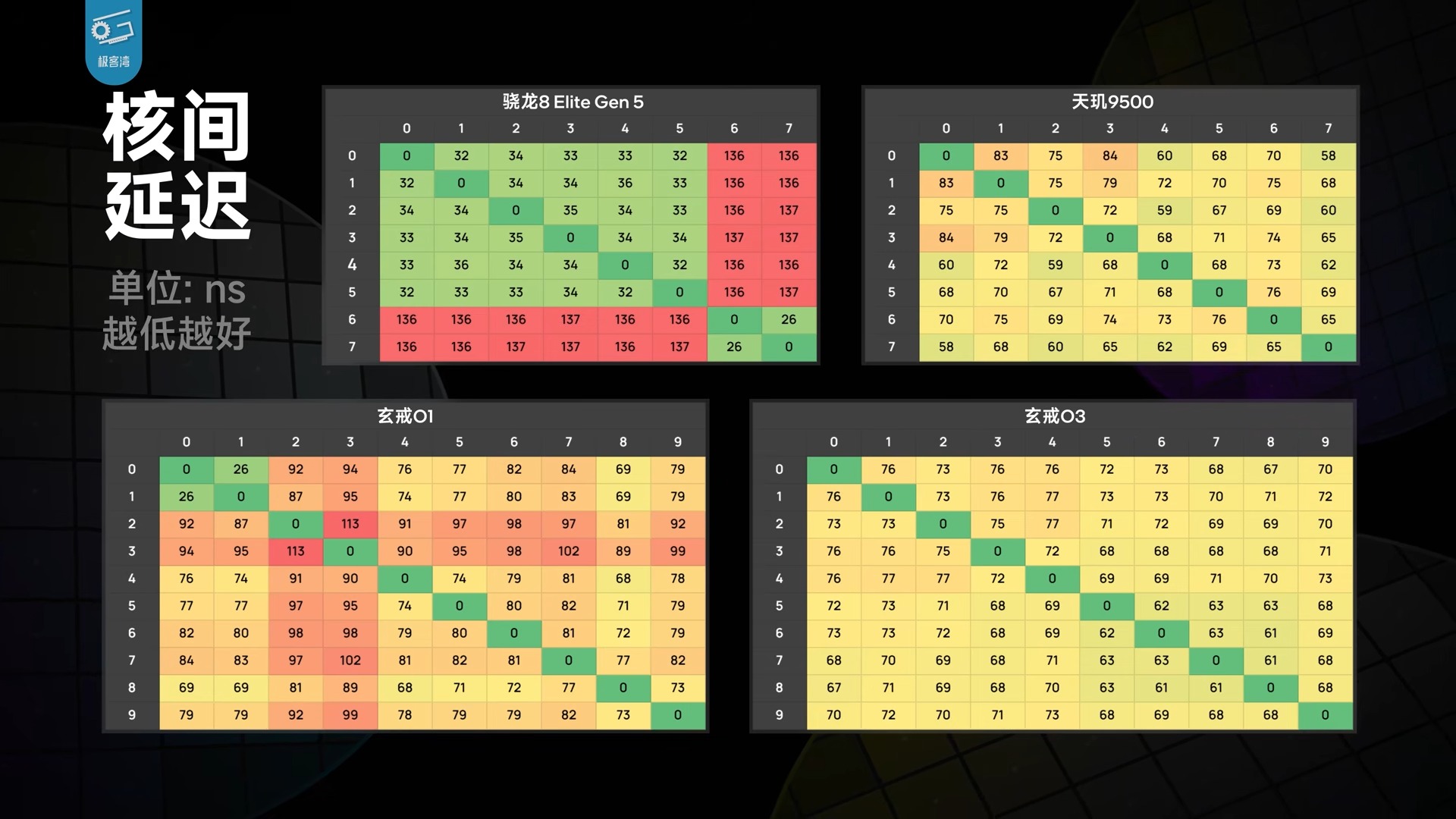
In the dynamic memory latency test (one core measuring latency while other cores run bandwidth tests to increase load), the O3 achieves around 180ns latency at 256M memory depth, lower than the A19 Pro’s approximately 200ns, and significantly outperforms other Android SoCs. In terms of inter-core latency, all cores stay under 80ns, placing it at the top tier among all mobile processors.
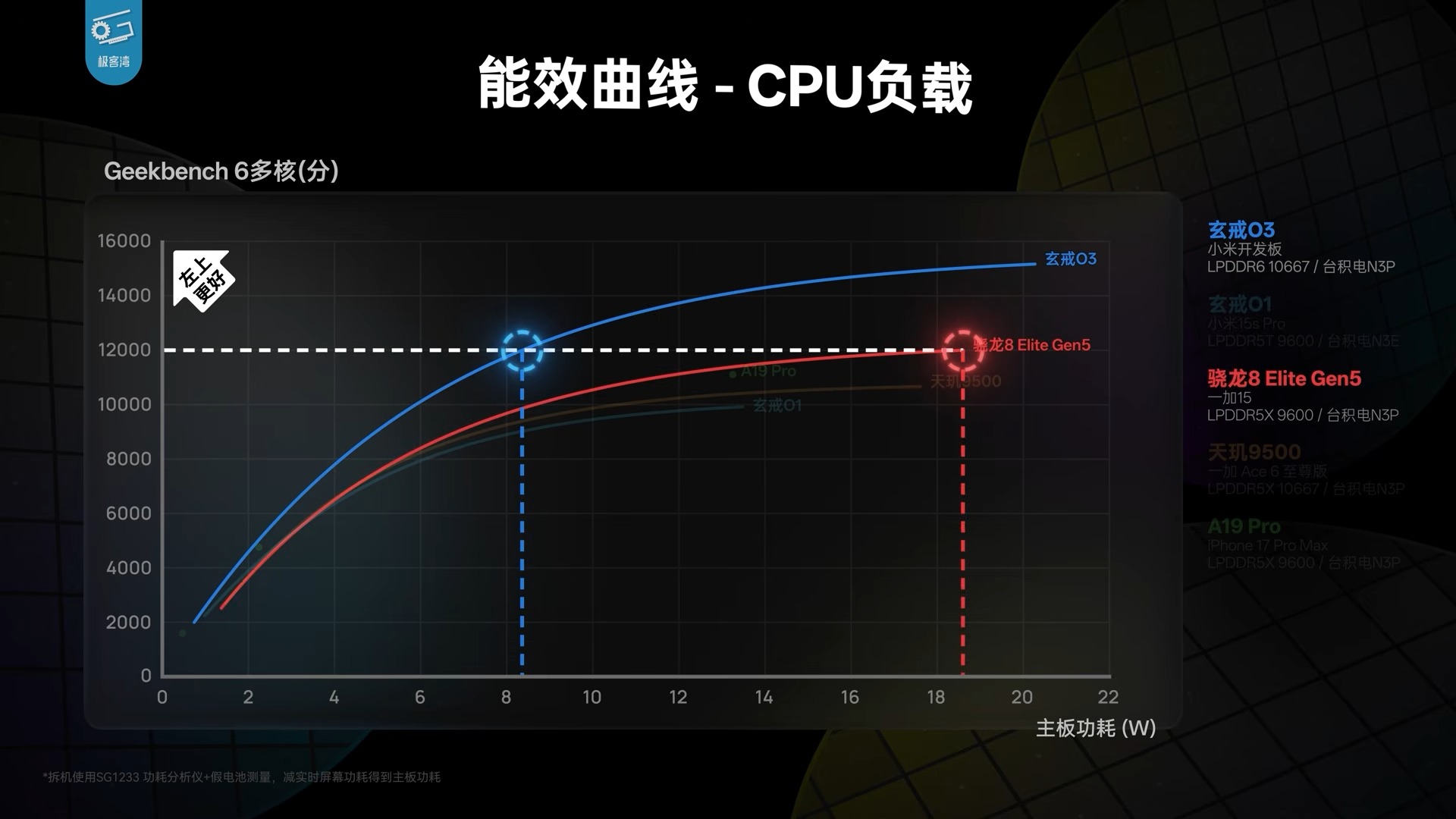
Multi-core performance: GeekBench 6 surpasses 15,000 points, reaching M4-level performance.
In GeekBench 6 multi-core testing, the O3 scored over 15,000 points. Geekerwan said, “This is already Apple M4-level multi-core performance.” However, when all ten cores are fully loaded, power consumption reaches 20W, which is exactly the level of a thin-and-light laptop processor.
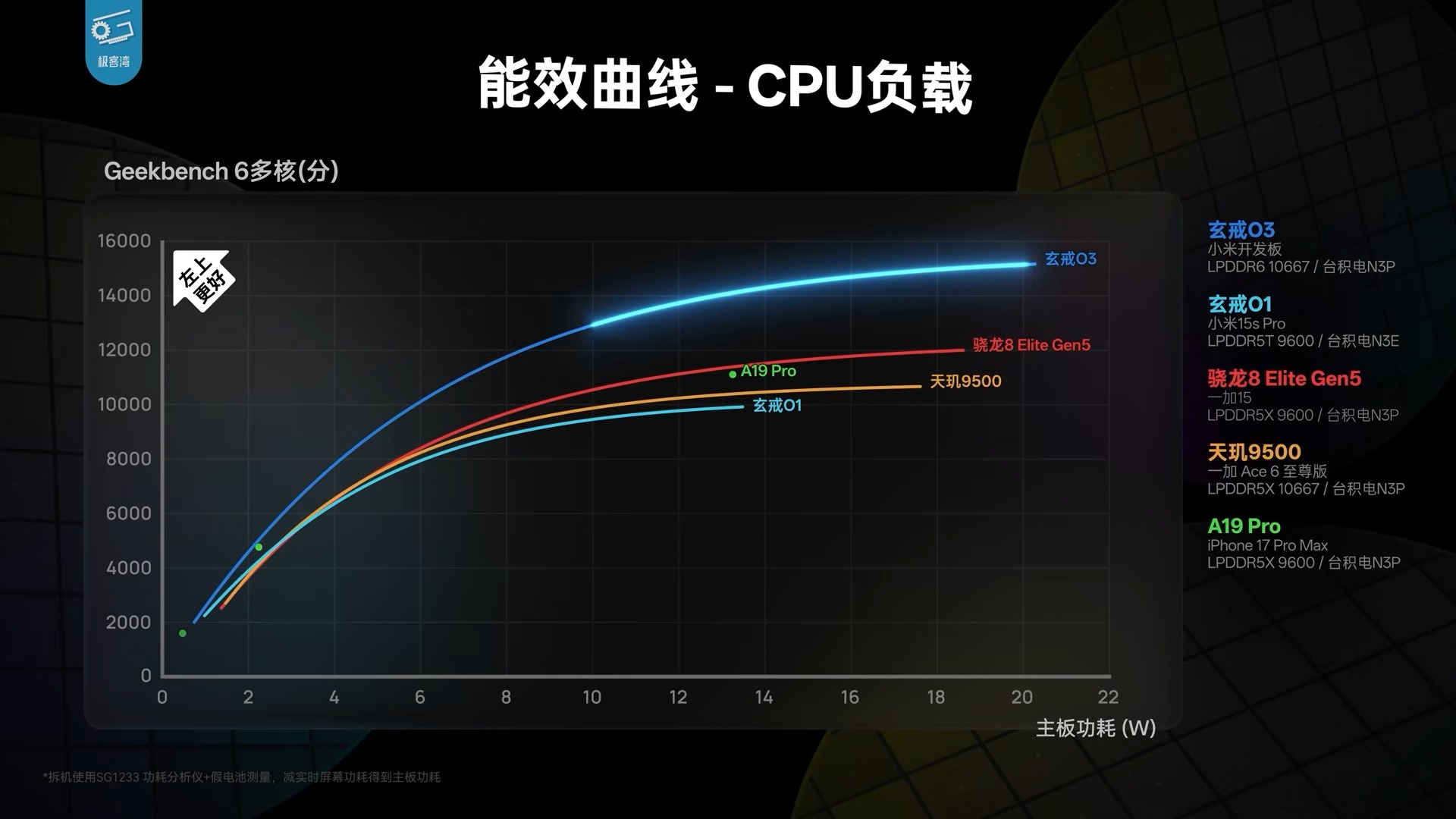
In terms of the efficiency curve, the O3 is excellent across the entire power-consumption range. When running the 8E5’s peak score of 12,000 points, its power draw is less than half that of the 8E5. Its mid-to-low frequency efficiency is also on par with the Apple A19 Pro. Compared with the O1, the O3 has improved efficiency by at least two generations.
GPU: Surpasses GTX 1060, Closes in on Apple M5
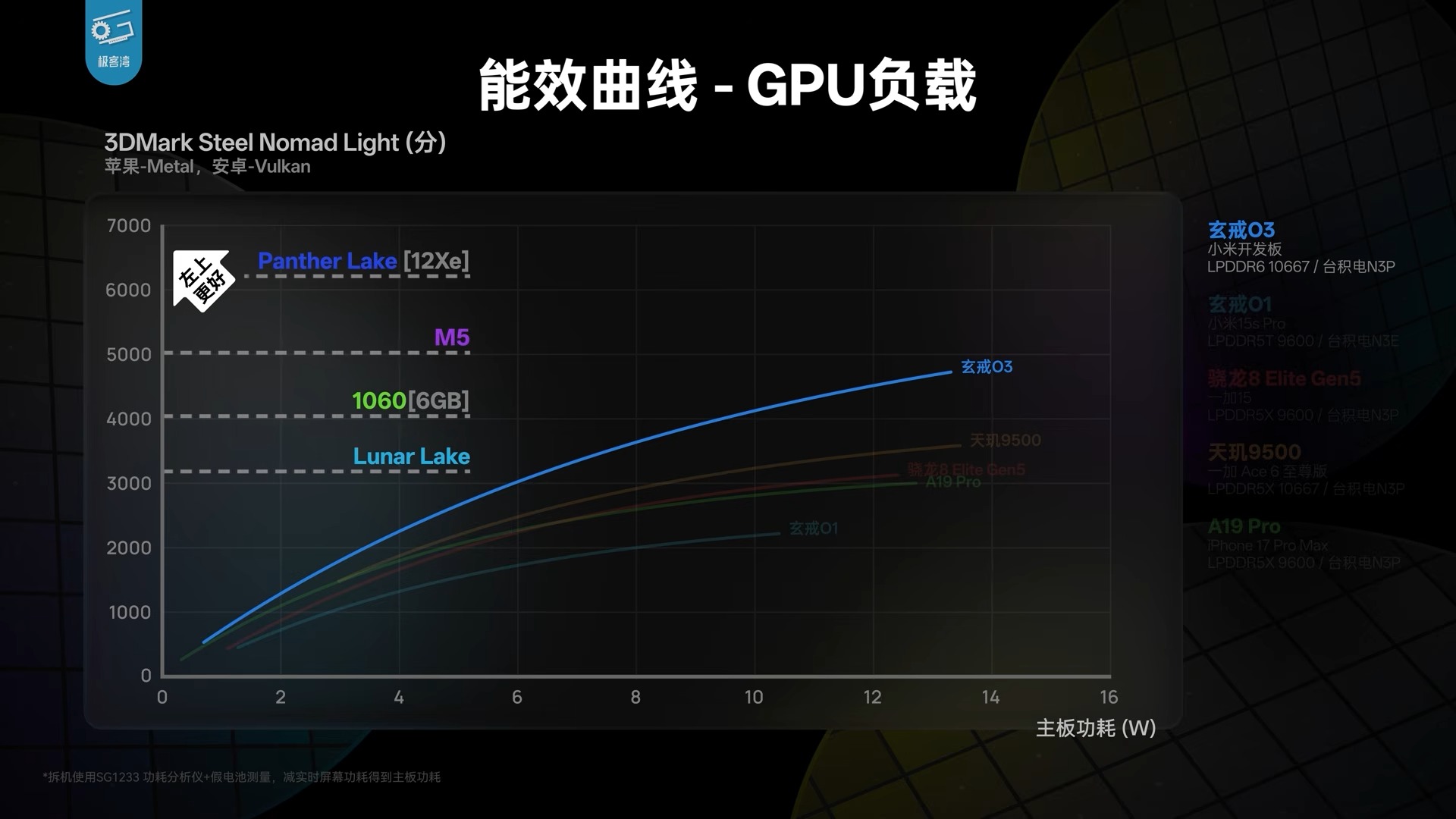
In the 3DMark SNL test, the O3’s GPU peak score exceeded 4,700 points. Geekerwan provided a direct comparison: the laptop Lunar Lake scores around 3,200 points, the Apple M5 just over 5,000, Panther Lake’s 12 Xe iGPU about 6,200, and the desktop GTX 1060 6G just over 4,000. In other words, the O3’s GPU peak has already surpassed the GTX 1060 6G and is approaching the level of the Apple M5.
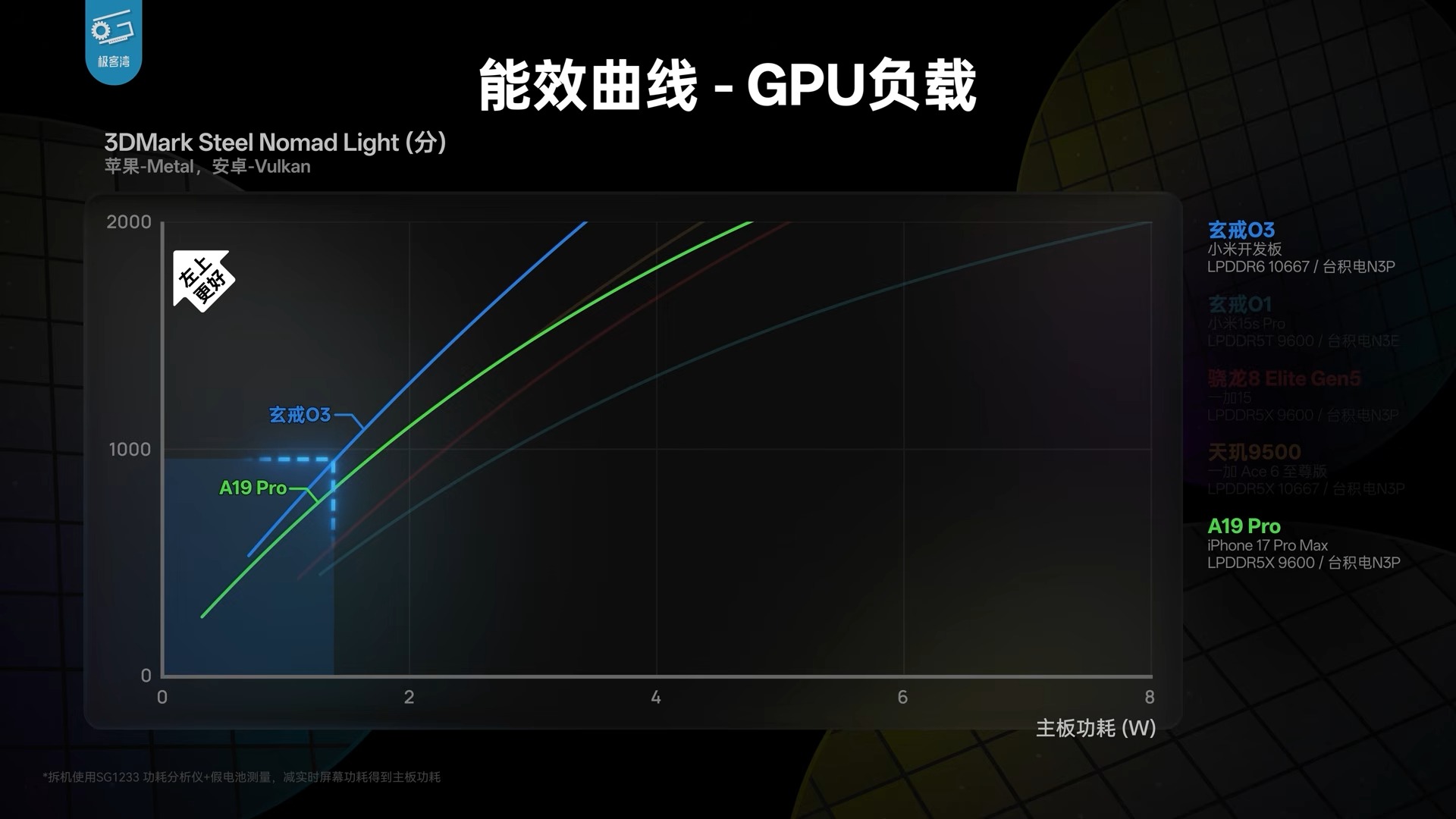
Its energy efficiency is equally outstanding, reaching 2,500 points at just 4.5W, already surpassing the peak score of the XRING O1. Only in low-power scenarios does the Apple A19 Pro close in, yet it still claims the GPU efficiency crown throughout.
The only regret: traditional PoP packaging
Geekerwan pointed out that the only drawback of the O3 is that it still uses traditional PoP packaging, without adopting enhanced thermal dissipation packaging like HPB. This may limit the O3’s thermal performance under prolonged high loads, but it has little impact on everyday usage scenarios.
Conclusion: 3nm takes on 2nm with full confidence.
At the end of the video, GeekBay candidly admitted that when it learned XRING had skipped O2 to go straight to O3 in order to directly take on Qualcomm and MediaTek’s new flagships, “they were sweating bullets.” After all, rivals are all moving to TSMC’s 2nm process this year, while Xiaomi is still using 3nm, with an older CPU architecture—”every possible debuff is stacked.”
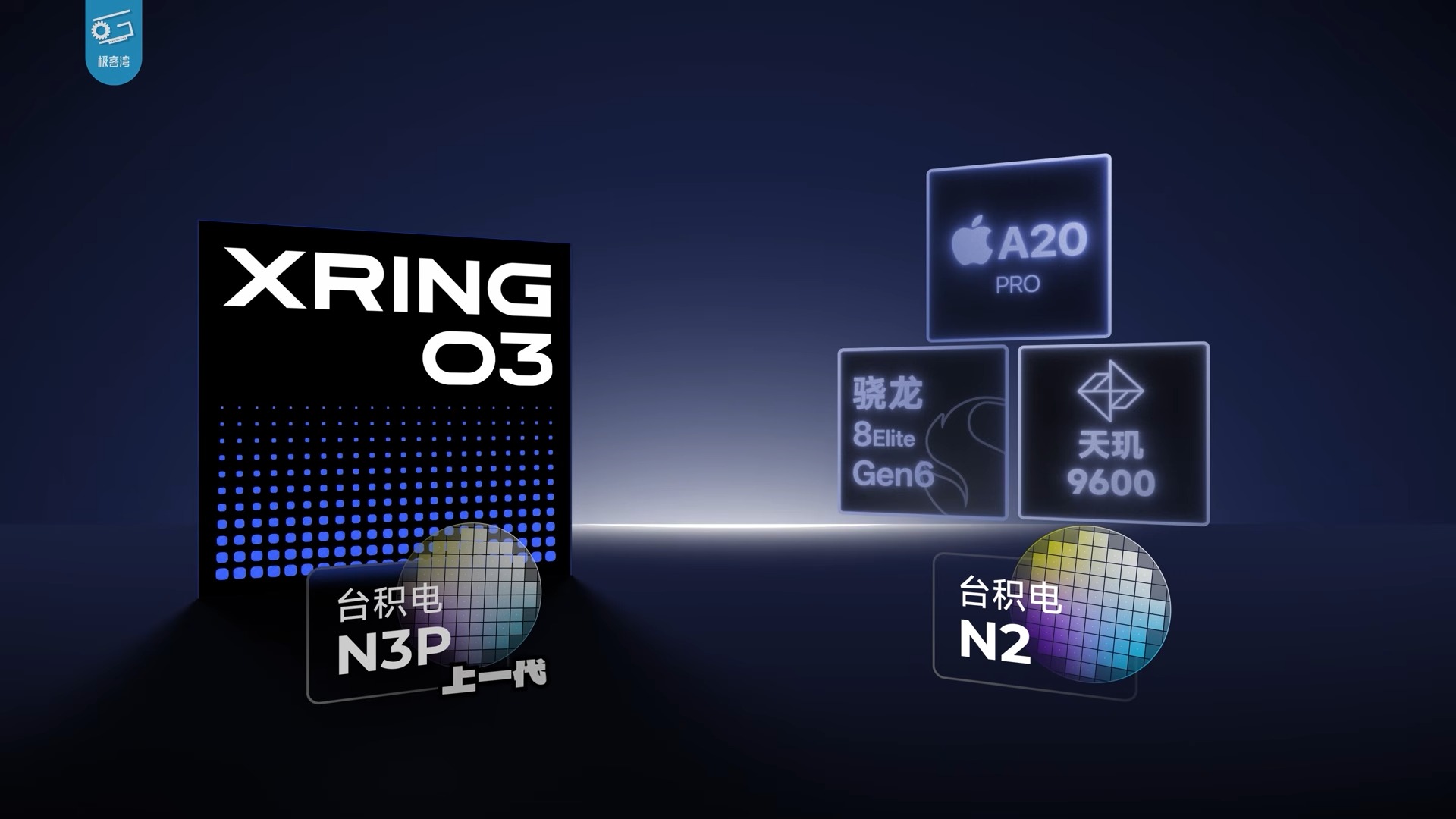
However, the actual test results completely exceeded expectations. “Crazy spec-stacking combined with excellent design capabilities has produced an incredibly powerful SoC with absurd energy efficiency. This thing can beat all current flagship chips on the market without any problem.” The only suspense is whether the O3 can continue to maintain its lead after this year’s new 2nm flagship SoCs are released. As for whether it will perform just as well when actually installed in a phone, we’ll have to wait for Xiaomi’s latest foldable phone (Lei Jun has already officially announced it will be equipped with the XRING O3). If you want more complete content, you can also watch Geekerwan’s review video:
Source: KOCPC Chinese