


NVIDIA and Microsoft jointly announced today that the first wave of the Vera Rubin platform has officially begun installation. NVIDIA’s official X account posted: “Vera Rubin is accelerating toward full production—congratulations to the Microsoft team on reaching this exciting milestone.” Over the past few months, NVIDIA’s pace from announcing full production at GTC Taipei to actually shipping to customers has been faster than the market expected. This marks the next-generation flagship AI computing platform’s transition from the production phase into actual deployment, making Microsoft the first cloud provider worldwide to deploy Vera Rubin in large-scale data centers, establishing a real-world precedent for subsequent adoption by competitors such as AWS and Google Cloud.
NVIDIA Vera Rubin is ramping into full production. Congrats to the teams at @Microsoft who made this exciting milestone happen. https://t.co/kXX1JPTeVe
— NVIDIA (@nvidia) August 21, 2026
Vera Rubin platform: seven chips and five racks form an AI supercomputer
Vera Rubin is NVIDIA’s largest POD-class system to date. From Blackwell to Vera Rubin, NVIDIA took only 18 months, significantly compressing the industry-typical 24- to 30-month development cycle. The entire platform consists of five dedicated racks, encompassing seven dedicated chips: Rubin GPU, Vera CPU, NVLink 6 Switch, ConnectX-9 SuperNIC, BlueField-4 DPU, Spectrum-6 Ethernet switch, and Groq 3 LPU. NVIDIA calls this architecture “extreme co-design,” treating the entire rack system as a distributed accelerator rather than a combination of independent chips.
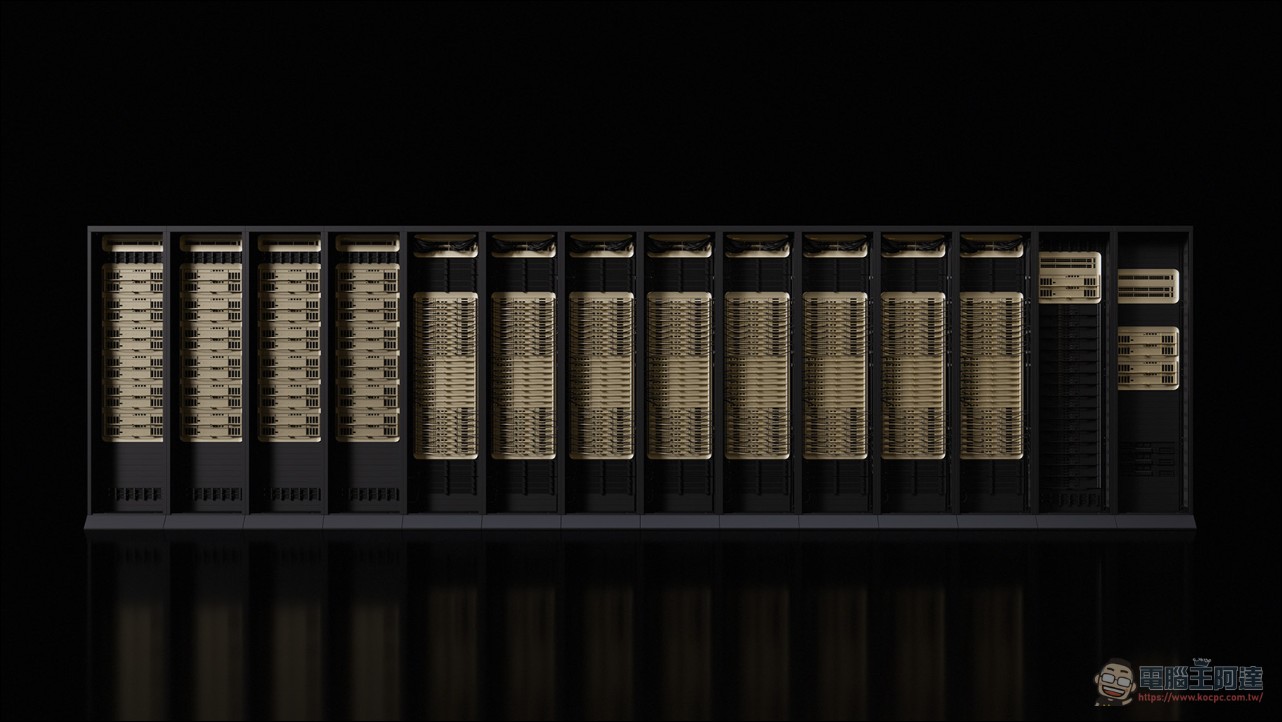
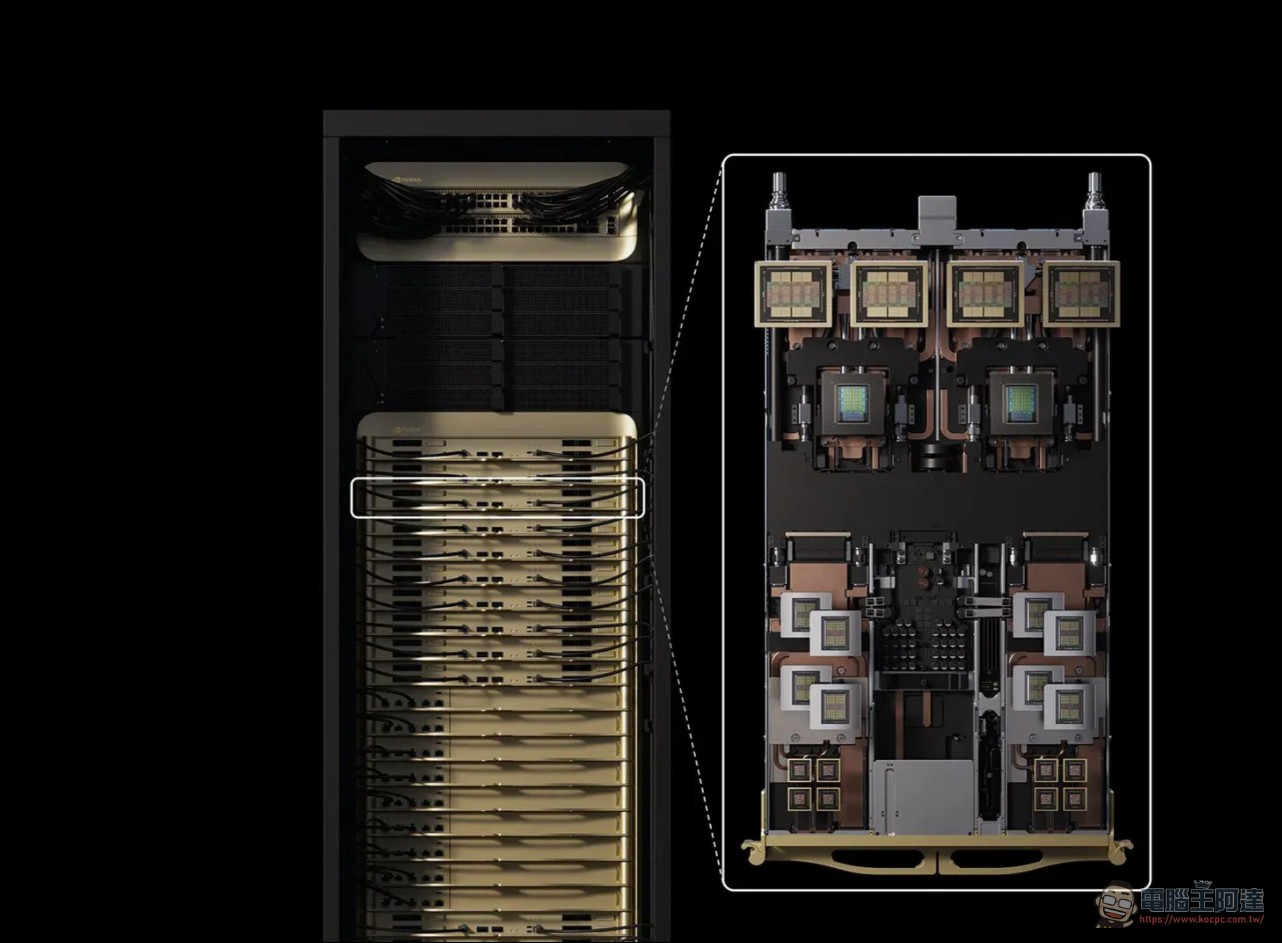
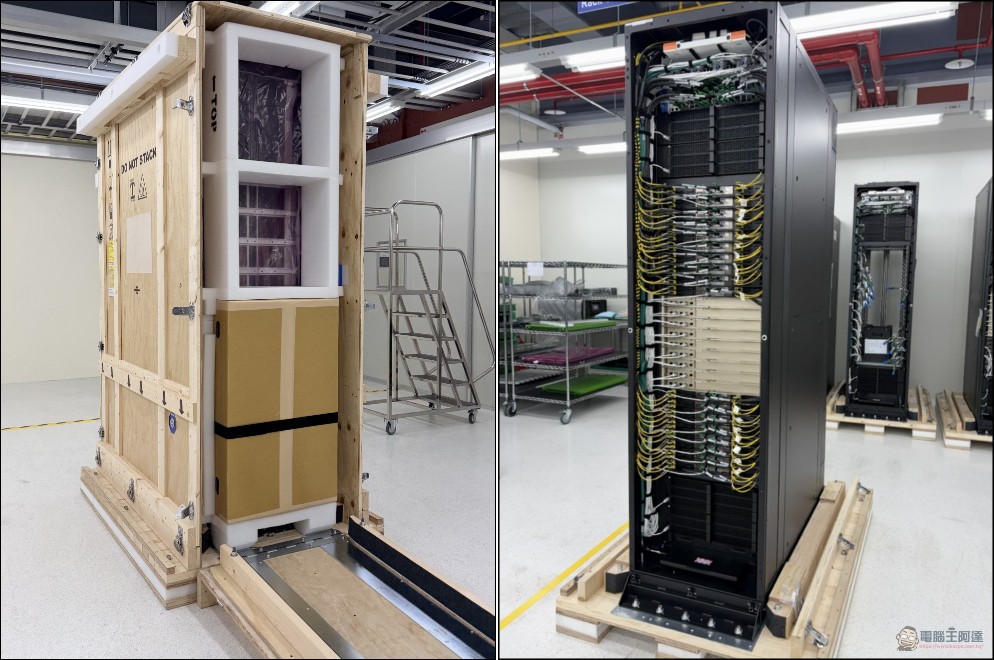
The flagship model Vera Rubin NVL72 cabinet houses 72 Rubin GPUs and 36 Vera CPUs, interconnected via high-speed NVLink 6. Each Rubin GPU is equipped with 288 GB of HBM4 memory, delivering bandwidth of up to 22 TB/s—nearly triple the 8 TB/s memory bandwidth of the Blackwell Ultra B300. NVIDIA claims Rubin delivers 5x higher inference performance, 3.5x higher training performance, and a 10x reduction in inference cost per token compared to Blackwell. The entire NVL72 cabinet uses 100% liquid cooling and features a cable-free modular tray design, cutting installation time from two hours with Blackwell down to just five minutes. NVIDIA states that these innovations achieve unprecedented levels of deployment speed and density for AI factories.
Microsoft takes the lead in deployment, Fairwater AI super factory set to launch soon.
Microsoft is Vera Rubin’s first hyperscale deployment customer. Microsoft will deploy Vera Rubin NVL72 rack systems in next-generation AI data centers, including the previously unannounced Fairwater AI superfactory site. These systems will provide the underlying compute foundation for Azure cloud AI services, supporting OpenAI’s model training and large-scale inference workloads. Ian Buck, NVIDIA’s vice president of accelerated computing, recently confirmed to media at the company’s headquarters that systems have begun shipping to customers, with OpenAI, CoreWeave, Google Cloud, Microsoft Azure, Meta, and Dell on the initial list. CoreWeave told Bloomberg that its NVL72 rack’s token output has reached 10 times that of the previous generation, confirming that NVIDIA’s proposed 10x token cost reduction has moved from specification to an actually achievable target.
In addition to Microsoft and CoreWeave, the confirmed initial wave of cloud deployment partners also includes AWS, Google Cloud, Oracle Cloud Infrastructure, as well as NVIDIA cloud partners such as Lambda, Nebius, and Nscale. NVIDIA also confirmed that major systems vendors including Dell Technologies, HPE, Lenovo, and Supermicro, as well as Taiwanese supply chain partners such as ASUS, Foxconn, Gigabyte, Pegatron, QCT, Wistron, and Wiwynn, have all adopted the NVIDIA DSX platform to accelerate the mass production of Vera Rubin. Vera Rubin also integrates the BlueField-4 DPU, supporting software-defined networking up to 800Gb/s and hardware-level multi-tenant isolation, and provides a rack-scale trusted execution environment through full-stack confidential computing technology, ensuring the security of data and models in multi-tenant cloud environments. NVIDIA also emphasized that the DOCA software platform can deliver advanced security protection at every rack and layer of the AI factory, protecting data and inference processes through capabilities enforced directly in the BlueField-4 chip, with all encryption and threat detection offloaded from host CPU resources. This enables security without impacting compute performance while also achieving multi-tenant isolation and zero-trust policy enforcement.
Mass production scale and supply chain mobilization
On May 31 this year, NVIDIA officially announced at GTC Taipei that Vera Rubin has entered full-scale mass production. The supply chain scale is twice that of Grace Blackwell, spanning 350 factories across 30 countries. In Taiwan alone, more than 150 partners are involved, with leading ODM manufacturers from Hon Hai to Wiwynn all joining the production lines. NVIDIA CEO Jensen Huang said at GTC Taipei: “Agentic AI is a brand-new workload. A single prompt can launch a computational pipeline spanning thousands of steps, including reasoning, information retrieval, tool calling, and response generation. Vera Rubin was built precisely for this.” He also emphasized that AI has transformed from a cost item into a true profit engine and GDP generator.
According to supply chain sources, mass production shipments of Vera Rubin are expected to officially begin this fall, with shipment volume climbing to 250,000 to 300,000 GPUs (approximately 3,500 full systems) in Q4 2026, followed by industry-wide large-scale delivery in Q1 2027. NVIDIA has also integrated its production-ready Spectrum-X Ethernet photonic technology, combined with co-packaged optics (CPO), to enable a million-GPU-scale AI factory network architecture. This technology uses switches with 200Gb/s SerDes, delivering 5x better energy efficiency than traditional pluggable transceivers, 5x longer AI uptime, and 1.3x faster deployment. According to NVIDIA’s official data, Vera Rubin delivers 10x higher agentic data throughput than the Grace Blackwell platform in大规模 deployment, and the system has been validated through the open-source MGX architecture design, ensuring that hundreds of supply chain partners can quickly ramp up production. CoreWeave, Lambda, and Oracle Cloud Infrastructure are the first wave of cloud providers to adopt CPO networking, and CoreWeave has publicly stated that token output from its Rubin racks indeed reaches 10x that of the previous generation—not just citing NVIDIA’s official claimed figures.
Conclusion
NVIDIA directly named Microsoft’s team in its official post this time to celebrate the installation, highlighting the strategic partnership between the two companies. Microsoft needs the latest Rubin hardware to maintain Azure AI’s competitiveness in model training and inference services, while NVIDIA needs first-tier customers like Microsoft to validate Vera Rubin’s production maturity and large-scale deployment capabilities. As AWS, Google Cloud, and CoreWeave follow suit, the period from the second half of 2026 to 2027 will be a critical window for AI computing infrastructure to fully transition from the Blackwell generation to the Rubin generation. According to data from the Semiconductor Industry Association (SIA), global semiconductor sales reached $120.6 billion in May 2026, up 104% year-over-year, with a significant portion of that growth driven by hyperscale data centers’ strong demand for AI computing chips. The mass production and deployment of Vera Rubin will further accelerate this industry cycle.
Source: KOCPC Chinese