


Renowned overclocking developer 1usmus (Yuri Bubliy) recently released the latest version of his overclocking monitoring tool, HYDRA 2.3B Pro, which now officially supports deep permission unlocking for NVIDIA GeForce RTX 50 series graphics cards, including GDDR7 memory frequency limits and power limits. This update lets users bypass factory-set restrictions at the software level without flashing the GPU BIOS or modifying low-level drivers. 1usmus is well known in the overclocking community, having previously developed widely praised AMD Ryzen processor tuning tools, including ClockTuner for Ryzen (CTR) and other popular software. With this HYDRA update, his focus expands from CPUs to GPUs, targeting NVIDIA’s latest Blackwell architecture RTX 50 series graphics cards.
I’m back—and every week brings something special.🙃
Today, I’m excited to introduce an exclusive HYDRA capability: unlocked VRAM overclocking and Power Limit control for NVIDIA GeForce RTX 5000 Series graphics cards.
More info:https://t.co/trqvEUQhgf pic.twitter.com/2duo8dxdAi
— 1usmus 🇺🇦 (@1usmus) August 17, 2026
HYDRA itself is an integrated overclocking and monitoring tool that supports features such as automated silicon quality detection and voltage curve adjustment. In the past, it mainly served AMD platform users, and this is its first large-scale support for NVIDIA graphics cards.
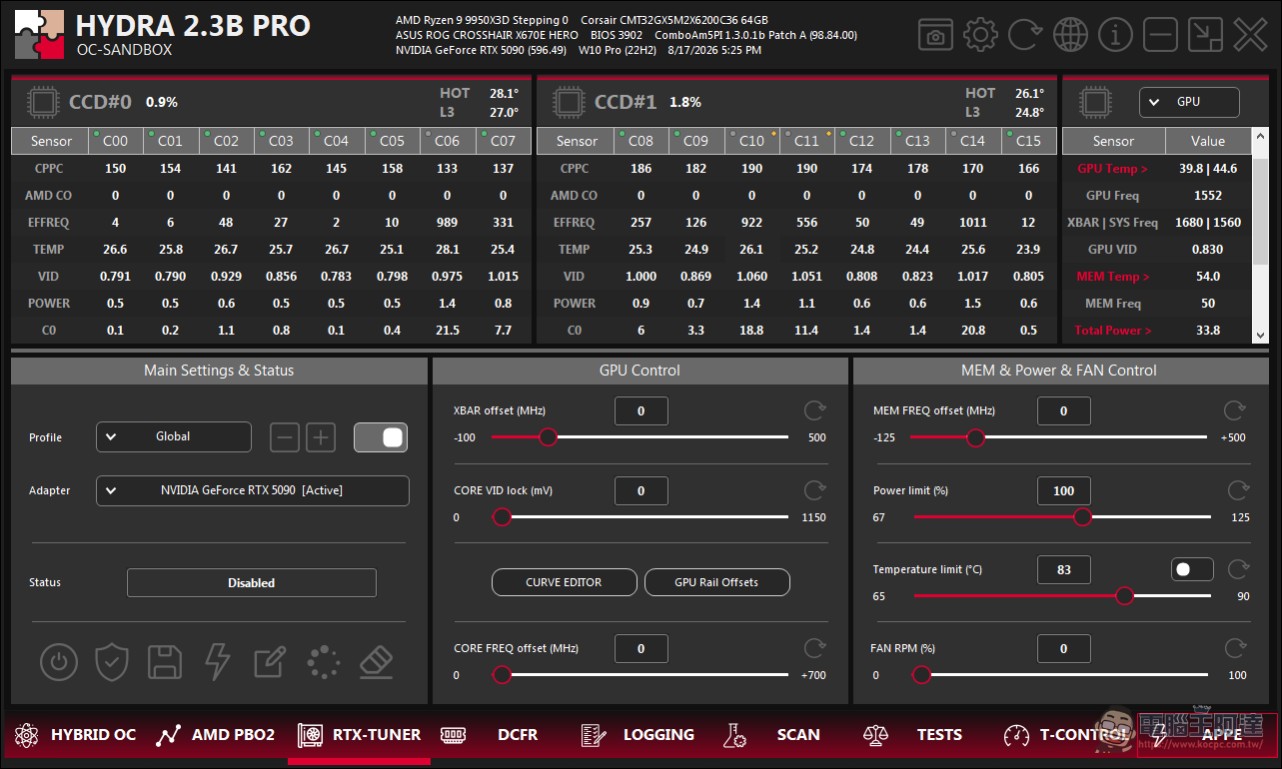
The RTX 50 series adopts GDDR7 VRAM technology, a next-generation memory standard making its debut in consumer graphics cards. Compared to the previous generation GDDR6X, GDDR7 delivers higher transfer rates at the same power consumption, with peak bandwidth per chip reaching 36Gbps. However, at the factory, NVIDIA limits the memory speed to a safe range based on each model’s cooling design and power configuration. Taking the RTX 5090 as an example, the stock memory speed is approximately 28–34Gbps, while HYDRA pushes this ceiling to 36Gbps, effectively unlocking the full potential of the GDDR7 modules.
What’s been unlocked? VRAM 36Gbps, power draw 125%
HYDRA 2.3B Pro offers two key unlocks for RTX 50 series graphics cards:
- GDDR7 memory frequency unlocked to 36GbpsThe RTX 50 series factory memory speeds vary by model, ranging from 28Gbps to 34Gbps. HYDRA uniformly raises the memory speed ceiling across the entire graphics card lineup to 36Gbps, and provides memory frequency offset control of up to +3,000MHz.
- Power limit adjusted to 125%The power limit, originally locked at 100%, can now be adjusted up to 125% through HYDRA, providing greater power headroom for advanced overclocking.
Additionally, HYDRA also adds an XBAR offset control feature, letting advanced users fine-tune the GPU’s internal crossbar switch module to further unlock performance potential. XBAR is a key channel inside the GPU that connects compute units and memory controllers; adjusting its frequency offset can improve data transfer efficiency, which is particularly helpful for memory-intensive workloads such as high-resolution gaming and AI inference.
From a practical performance perspective, what does 2.3TB/s of memory bandwidth represent? Taking 4K gaming as an example, the loading speed of high-resolution textures and frame rate performance largely depend on VRAM bandwidth. The RTX 5090’s bandwidth at a 36Gbps memory speed is about 28% higher than the factory-default 28Gbps version, and this gap becomes even more pronounced for 8K gaming or application scenarios that require extensive texture caching. In AI inference workloads, higher VRAM bandwidth can also effectively accelerate token generation speed for large language models.
RTX 5090 benchmarked: 2.3TB/s bandwidth, 640W power draw
Using the flagship RTX 5090 as an example, this graphics card is equipped with a 512-bit memory bus. At factory settings, the VRAM speed is approximately 28–34Gbps; after unlocking to 36Gbps via HYDRA, the theoretical memory bandwidth reaches 2.304TB/s, setting a new record for VRAM performance among current consumer graphics cards.
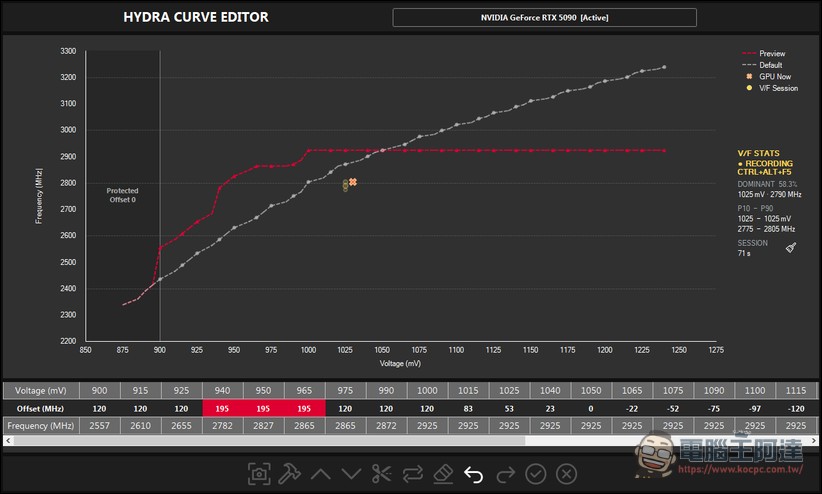
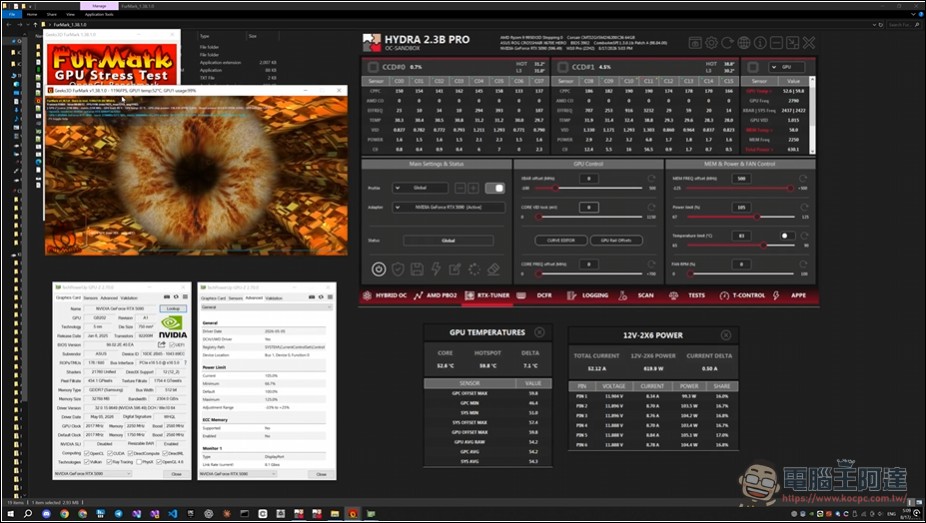
In a hands-on demonstration by 1usmus, an ASUS ROG Astral LC (Night God liquid-cooled edition) RTX 5090 graphics card saw its total board power climb from the native 600W limit to over 640W when HYDRA was set to a 105% power limit. This all-in-one liquid-cooled card just happens to have the cooling capacity to handle the waste heat generated by the extra power draw.
The entire unlocking process requires no BIOS flashing on the graphics card, nor any modification to NVIDIA’s underlying drivers. HYDRA bypasses the factory power and VRAM frequency limits at the software level, and it currently supports RTX 50 series graphics cards from all major non-reference board partners.
Compatibility and Limitations
According to official data, HYDRA 2.3B Pro’s unlocking range covers the following models:
- GeForce RTX 5090VRAM unlocked from 28–34Gbps to a maximum of 36Gbps.
- RTX PRO 6000VRAM unlocked from 28Gbps to a maximum of 36Gbps
- RTX 50 full seriesThe power wall can be adjusted up to a maximum of 125%.
However, this feature is still only available in the paid Pro version, requiring players to purchase a HYDRA Pro license to use it.
Risk Warning: Cooling and Hardware Damage
Although HYDRA offers a convenient software unlocking solution, the risks inherent in overclocking itself cannot be overlooked. After unlocking the power limit, the graphics card’s actual power consumption and waste heat increase significantly, placing extremely high demands on the cooling environment. Take the RTX 5090 for example: after unlocking, power consumption soars from 600W to over 640W, and insufficient cooling may lead to thermal throttling or even hardware damage.
Moreover, the price of the RTX 5090 in Taiwan approaches or exceeds NT$130,000, while the RTX 5080 also costs around NT$60,000 or more, and there have even been recent reports of the RTX 5060 Ti carrying an 88% premium. Given such high acquisition costs, players must bear the risk of hardware damage caused by overclocking themselves. It is recommended to attempt it only in an environment with a high-end liquid cooling solution, and to ensure you understand the graphics card’s temperature and power consumption limits.
Conclusion
The release of HYDRA 2.3B Pro gives RTX 50 series owners a BIOS-flash-free overclocking path. The 36Gbps memory frequency unlock and relaxed 125% power limit push the performance ceiling of flagship cards even higher. For players who’ve already spent tens of thousands on top-tier graphics cards, HYDRA offers a relatively safe way to squeeze out every last bit of performance. That said, cooling conditions and hardware risk are factors every user should carefully weigh before getting started. The tool is currently available through a paid Pro subscription, and interested users can check out 1usmus’s website for more details. Patreon The page provides more details.
Source: KOCPC Chinese