


DeepSeek officially launched its first vision-capable model, DeepSeek-V4-Flash-Vision-Exp, this evening (August 21). The company announced on X (formerly Twitter), “Multimodality unlocks more agent use cases.” The model has been simultaneously made available on the DeepSeek API platform, allowing developers to directly input images via the API for image description, screenshot text recognition, and chart analysis. This marks the first time DeepSeek has integrated image understanding capabilities into its own models since its founding, filling the multimodal gap for this Chinese AI company known for its text-only reasoning models.
DeepSeek-V4-Flash-Vision-Exp is now live on the DeepSeek API Platform! 🚀
🔹 This experimental multimodal model matches DeepSeek-V4-Flash on text capabilities—including agents, reasoning, and world knowledge.
🔹 On multimodal agent benchmarks, V4-Flash-Vision-Exp makes a major… pic.twitter.com/t2ELUZAagW— DeepSeek (@deepseek_ai) August 21, 2026
DeepSeek-V4-Flash-Vision-Exp official benchmark: multimodal Agent capabilities tie Opus 4.8 at 2-2
DeepSeek also released the first batch of Agent benchmark scores for its new model. In four multimodal Agent evaluations, V4-Flash-Vision-Exp and Anthropic’s Opus 4.8 each secured two wins: Agents’ Last Exam came out on top at 27.3 versus 25.7, and ZeroBench won 35.0 to 34.0; meanwhile, ApexBench trailed at 36.5 to 39.4, and Chartography lost by a narrow margin, 64.3 to 65.0.
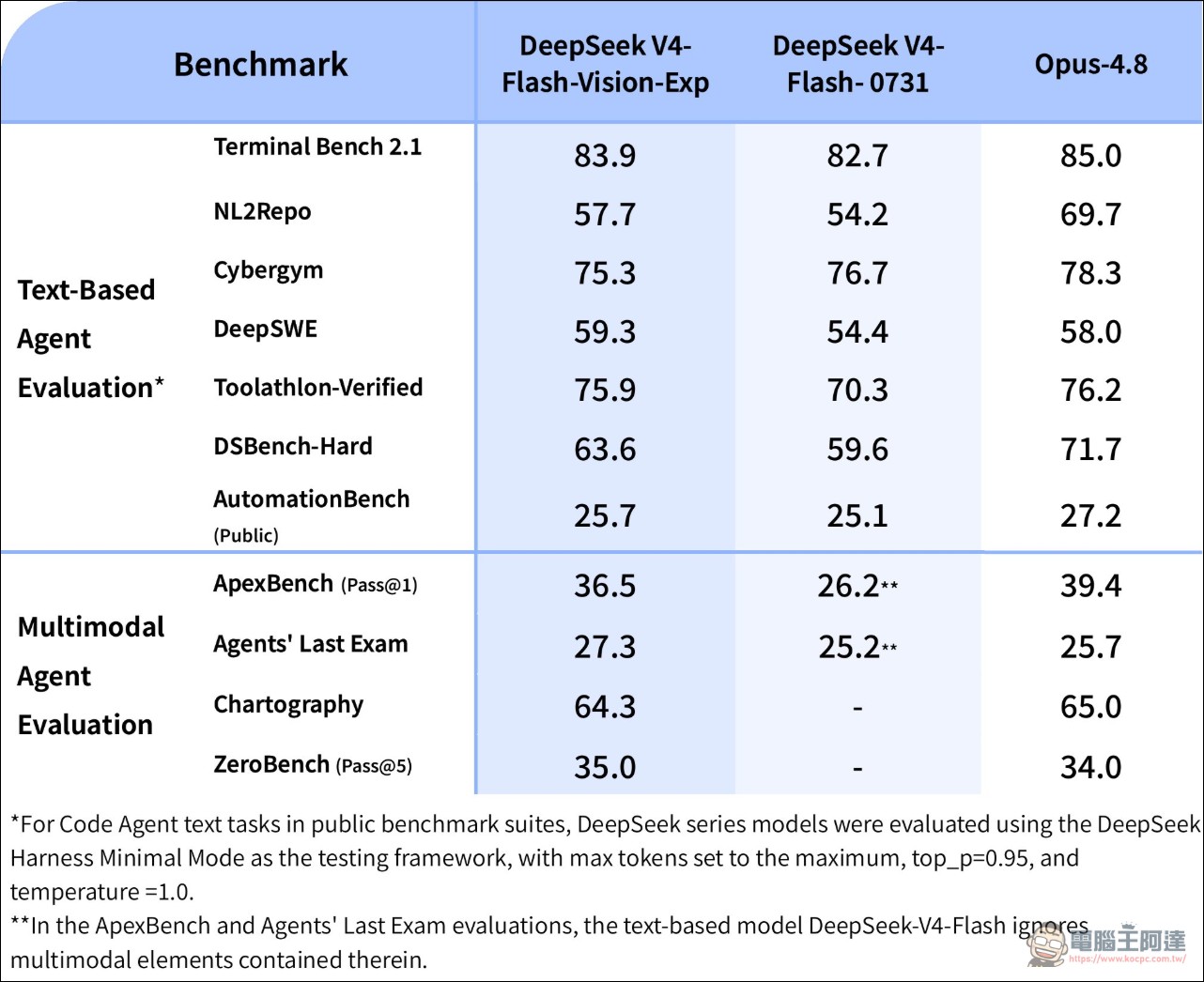
Compared to the text-only V4-Flash-0731 from the end of last month, the vision-enabled version shows clear improvement: ApexBench rose from 26.2 to 36.5, and Agents’ Last Exam went from 25.2 to 27.3, showing that the added image input capability directly translates into better performance on agent tasks. The company also stressed that adding vision capabilities did not come at the expense of text agent performance—6 of the 7 text benchmarks scored higher than V4-Flash-0731, with DeepSWE climbing from 54.4 to 59.3, even surpassing Opus 4.8’s 58.0, and Toolathlon’s 75.9 nearly matching Opus 4.8’s 76.2. It’s worth noting that these results come from DeepSeek’s own internal testing rather than an independent third-party leaderboard, with the reasoning setting configured to max.
DeepSeek’s first vision model: text capabilities remain uncompromised, images billed by token
According to the latestOfficial API DocumentationThe new model is launched under the model ID “deepseek-v4-flash-vision-exp” and is listed alongside the existing deepseek-v4-flash and deepseek-v4-pro in the available models list. It supports text and image inputs, while output remains text; images are transmitted via the OpenAI-compatible image_url data structure. In terms of specifications, the model offers a 1 million token context window, a maximum output of 384,000 tokens, and supports JSON Output, Tool Calls, Responses API, and the Anthropic API-compatible interface.
Reasoning capability has four levels: off, low, high, and max, with high as the default. Users can adjust it based on task complexity. As early as August 19, on DeepSeek’s official GitHub, deepseek-harness The project publicly committed the vision route as “feat(llm-deepseek): publish the vision model”, declaring text and image as the input modalities; it went fully live on the API platform two days later.
The pricing model is a rarity in the market — it does not charge per image. According to DeepSeek’s official explanation, images are converted into tokens based on their size (up to 384 tokens), then calculated together with text tokens; the image itself incurs no additional fee. Based on the RMB pricing for the China region, input costs RMB 3 per million tokens during peak hours (approximately NT$14), and RMB 1.5 off-peak (approximately NT$7); with a cache hit, it drops to just RMB 0.1 and RMB 0.05. For output, the peak rate is RMB 9 per million tokens (approximately NT$43), and off-peak is RMB 4.5 (approximately NT$21). Peak hours are 9:00–12:00 and 14:00–18:00 Beijing time, with prices halved during all other hours. The international version matches V4-Flash, at approximately US$0.14 per million tokens for input (about NT$4.5) and US$0.28 for output (about NT$9).
The long-awaited visual capability—DeepSeek’s catch-up on multimodal learning.
For DeepSeek, this model has been a long time coming. From V3, R1, to the V4 series this year (2026), DeepSeek’s models have always been known for pure text-based reasoning, and the company has never officially offered vision capabilities. Users who needed to process images had to rely on other tools to convert images into text before feeding them to the model. On August 19, a commit in the deepseek-harness project removed the old note saying “vision models will not be announced until model endpoints are ready,” and officially renamed this route the “official DeepSeek vision route,” effectively giving a two-day head start on announcing this release.
In terms of application scenarios, the official pitch centers on three things: describing image content, recognizing text in screenshots, and analyzing chart data. For Agent developers, the key is the combination of visual input and tool calling—for example, reading an interface screenshot and directly operating the system, answering questions while looking at charts, or extracting data from scanned documents and writing it into a database. On X, the official account stated that the model runs smoothly in mainstream Agent frameworks, and visual understanding can be integrated with various tools to unlock more practical workflows.
Multimodality unlocks more agent use cases. 👀
V4-Flash-Vision-Exp works smoothly across agent frameworks, combining visual understanding with a wide range of tools to unlock more practical workflows.
2/n pic.twitter.com/pZFf8Yqw3D
— DeepSeek (@deepseek_ai) August 21, 2026
Priced at only a fraction of what comparable rivals charge, DeepSeek is using a Flash-style strategy to break into multimodal AI.
DeepSeek’s vision model is priced exactly the same as V4-Flash-0731, sticking to the same “good enough, rock-bottom cheap” approach. V4-Flash was already one of the lowest-cost million-context inference models on the market, and the late-July V4-Flash-0731 update pushed agent capabilities and coding skills up another notch. Now the vision version simply carries over the same price point, effectively compressing the entry cost for multimodal agents to a fraction of what comparable competitors charge.
The comparison group is Anthropic’s Opus 4.8, a flagship model from mid-2026 that is considered the current leader in agentic coding, and DeepSeek’s official benchmarks directly use it as a baseline. Third-party analyses estimate that V4-Flash-Vision-Exp achieves 90% to 95% accuracy on visual tasks at roughly 1/50th to 1/170th the cost of comparable Opus capabilities. In the Chinese market, Alibaba’s Qwen-VL, Moonshot AI’s Kimi, and MiniMax have all already deployed multimodal models, making DeepSeek the last among these top-tier players to add vision capabilities (GLM has also recently been rumored to add multimodal support in version 5.3).
For developers, the appeal of this model lies in its low migration cost—existing Agent workflows can be switched over directly (simply by changing the model codename). The official documentation also states that the model runs smoothly across mainstream Agent frameworks, and its visual understanding can be integrated with various tools.
Conclusion
DeepSeek-V4-Flash-Vision-Exp is still an experimental version. The “Exp” in the model name indicates that both specifications and pricing may still be adjusted, and the weights have not been open-sourced yet—the official release is currently API-only. Given DeepSeek’s history of open-sourcing models like V3 and R1, whether the vision model will eventually follow suit with open weights is a key point of interest for the open-source community going forward. In the short term, this model marks DeepSeek’s first entry into the multimodal arena, finally making it a model with virtually no significant gaps. Going forward, usage volume is likely to grow even further.
Source: KOCPC Chinese