


As [travel eSIM] has the advantages of being cheap, requiring no card installation, no need to download, and can be activated with just a QR Code, it has gradually replaced physical international roaming cards or WiFi sharers and become one of the first choices for global travelers to use the Internet when traveling abroad. Opensignal recently published [Current status of tourism eSim global industry】Survey, a survey report on the latest status of the global tourism eSim industry.
What is [Travel eSIM]? What is the current status of the global travel eSIM industry? How to choose a travel eSIM? The following is a summary and explanation:
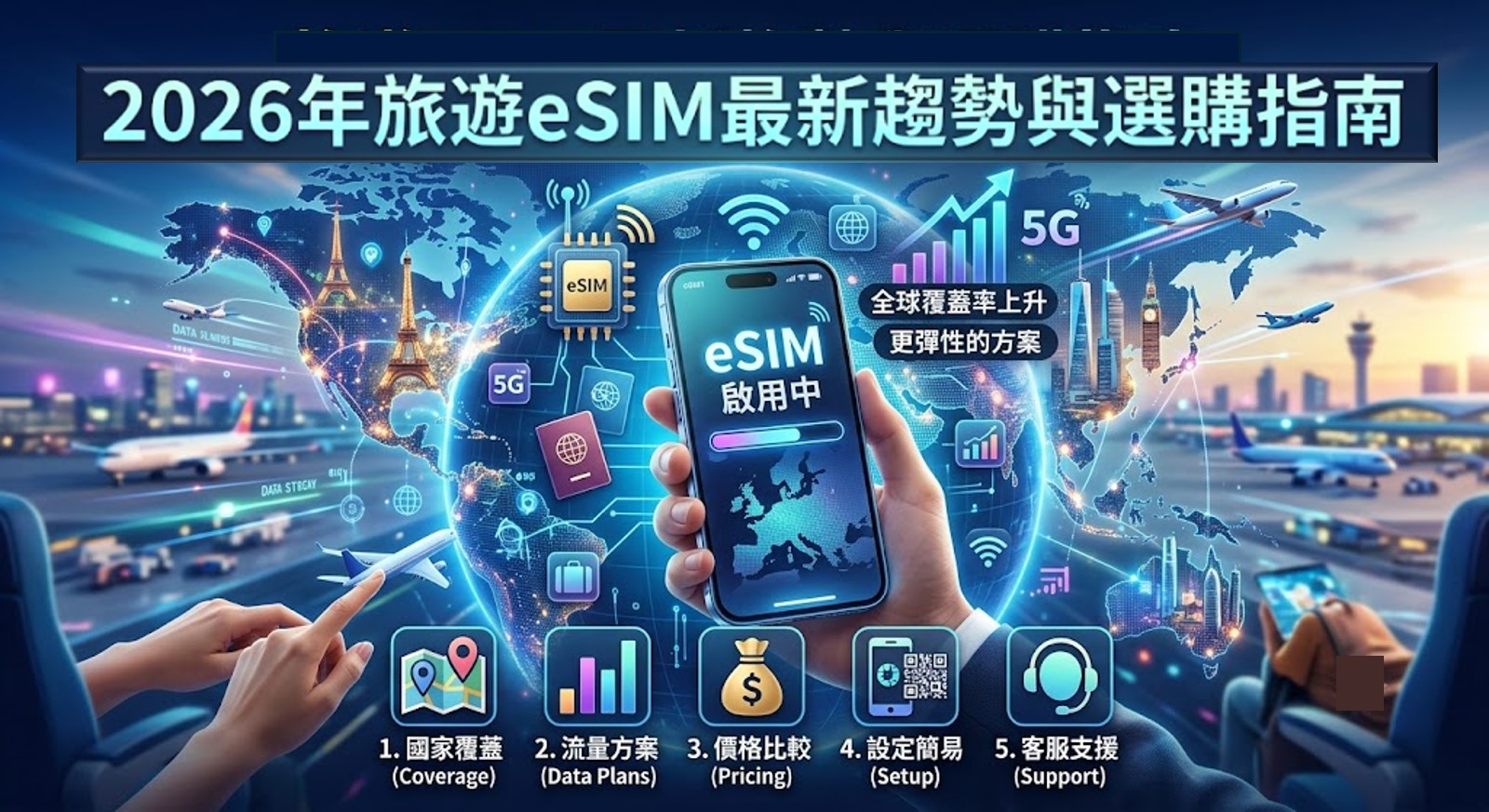
Travel eSIM has gradually gained popularity among the public due to its low cost, free shipping, easy setup, diverse and flexible plans. Not only has the number of users doubled, but consumption has increased by 133% year-on-year. It is estimated that retail consumption will reach US$5 billion in 2026. For the latest industry status and purchasing guide of travel eSIM in 2026, please refer to the summary video and detailed instructions:
1.What is [Travel eSIM]?
[Travel eSIM] is an eSIM specially used for international roaming when traveling abroad. Since eSIM does not require physical SIM cards and does not require logistics delivery, as long as the mobile phone supports it, users can activate foreign networks by scanning QR Codes or downloading apps without the need to replace or purchase physical SIM cards, making it very suitable for use when traveling abroad. Currently, well-known tourism eSIM operators in Taiwan include DJB, WaySim, Klook, KKday, Xiangyi, WifiMi, Wi-Ho!, Wi-Go, Wi-Go, Joytel… and so on.
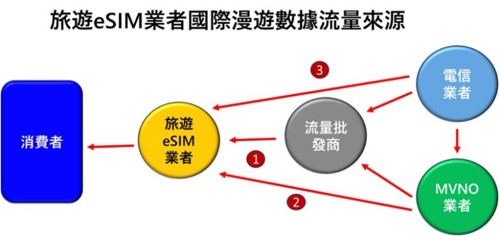
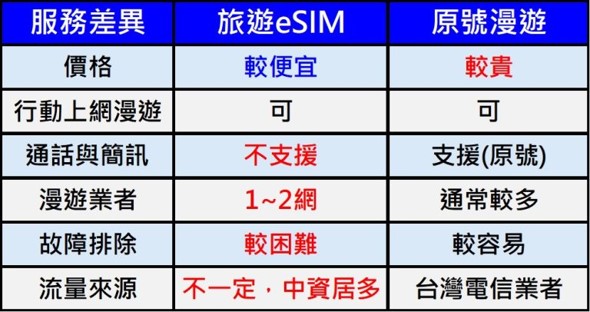
The international roaming data traffic resources of travel eSIM operators can come from traffic wholesalers, MVNO operators or traditional telecommunications operators. In order to obtain low connection traffic costs and reduce entry barriers, most of the international roaming traffic of travel ESIM sold in Taiwan comes from “traffic wholesalers”. Travel eSIM operators do not need to hold any type of domestic or foreign telecommunications licenses. They only need to establish their own sales brand and customer service mechanism. After obtaining traffic resources, set up the main and backup lines, and convert them into QR Codes for consumers to scan to start business. The entry threshold is relatively low.
However, most users of travel eSIM are traveling abroad, and travel eSIM operators must have customer service capabilities to handle urgent and difficult customer issues in real time. Some well-known travel eSIM brands are just eSIM aggregators (eSIM aggregators, such as Agoda or Klook..), and their customer service staff are ignorant of urgent and difficult medical issues, often leaving users without a way to seek help. Therefore, when purchasing travel eSIM products, in addition to price, you should also pay attention to its customer service reputation for solving problems in a timely manner.
2. Survey on the current status of the global tourism eSim industry:
According to Opensignal published on July 2, 2026 [Travel eSIM Reality Check: An Industry Perspective on Adoption and Quality of Experience], with the following summary highlights:
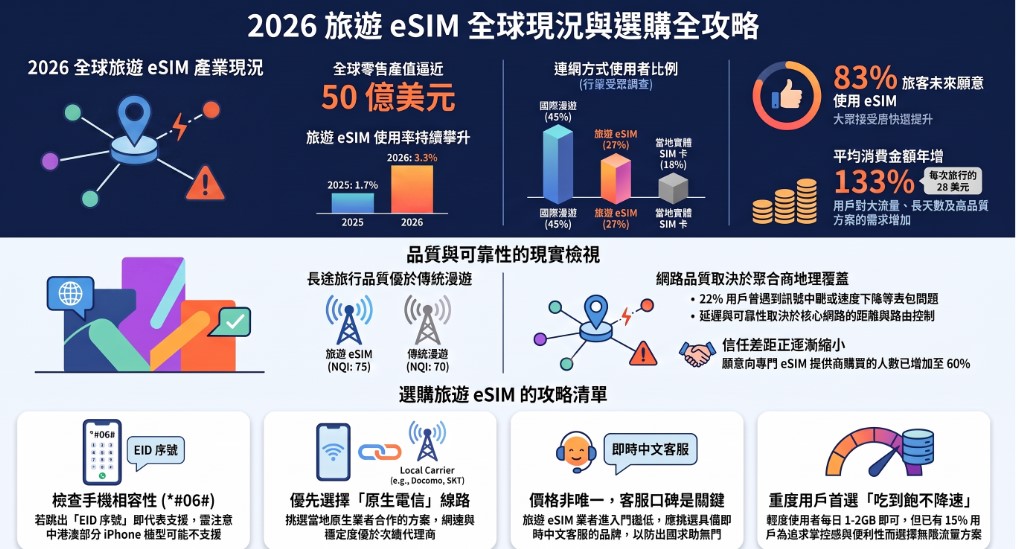
A. The retail output value of travel eSim in 2026 will be close to 5 billion US dollars. The use of travel eSIM for overseas travel has doubled, and the usage rate of industry audiences is as high as 27%:
According to Opensignal, the share of travel eSIM users among its global user base has almost doubled from 1.7% in the second quarter of 2025 to 3.3% in the second quarter of 2026.
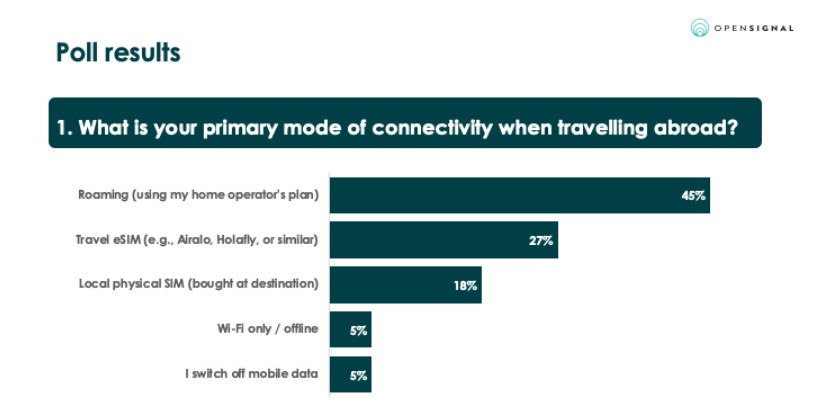
Additionally, when Opensignal webinar attendees were surveyed on how to connect to the Internet when traveling abroad, 27% said they used a travel eSIM card, 18% used a local SIM card, and 45% still chose roaming. It can be seen that although travel eSIM is limited by the fact that mobile phones must support eSIM and most people are still unfamiliar with this technology, it has not yet been quickly accepted by ordinary travelers who occasionally go abroad. In particular, industry audiences are more inclined to adopt travel eSIM cards early.
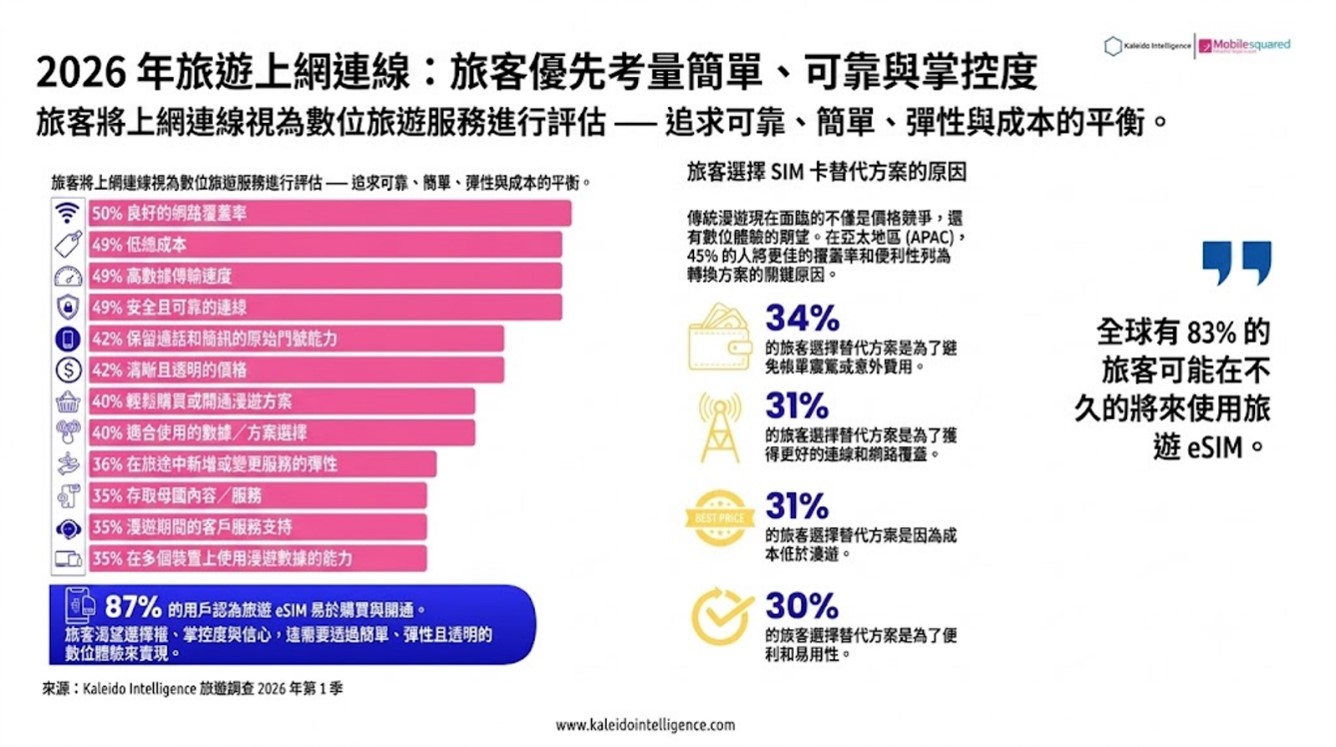
According to the latest survey data from Kaleido Intelligence’s annual research on 20 outbound markets, 83% of global travelers are willing to use travel eSIMs in the near future. Kaleido predicts that global travel eSIM retail sales will be close to US$5 billion in 2026. It can be seen that the usage rate of travel eSIMs will continue to increase, which is an irreversible trend.
B. There is a slight gap between the quality of travel eSIM networks and roaming (each has its own advantages and disadvantages, but the reliability is poor), which mainly depends on the geographical coverage of the wholesale aggregator:
According to the Network Quality Index (NQI), which Opensignal uses to measure the percentage of users getting a connection quality sufficient to run everyday applications, travel eSIM outperforms roaming on long trips (NQI 75 vs. 70). In regional travel, traditional roaming (original aircraft and original number) still has advantages. The difference is due to infrastructure, = the quality cap depends on the geographical coverage of the aggregator (eSIM aggregator), not the brand on the eSIM card. The farther a user is from the aggregator’s core network, the higher the latency.
Travel eSIMs currently have the advantage when it comes to latency. But in terms of packet loss, they usually lag behind telecom operators because they do not have full control over the routing path like telecom operators. Packet loss directly affects the reliability of your connection, not just its speed, so it’s not an insignificant flaw.
According to a webinar survey asking about their most recent internet connection experience abroad, 43% of respondents said the experience was excellent and 30% said it was good. But 22% of respondents said the experience was average, with obvious signal interruptions or speed drops. The 22% of respondents with mediocre experiences mainly described packet loss and delay issues directly related to them, indicating that neither roaming nor travel eSIM can fully solve network reliability issues.
In other words, the quality of the travel eSIM network depends on the geographical location of the aggregator (eSIM aggregator), and is slightly less reliable than traditional roaming.
C. Price is no longer the only consideration, simplicity, reliability and control have become the focus of evaluation:
[Travel eSIM] was favored by industry audiences mainly because it was cheaper than traditional roaming in the past, but surveys show that price is no longer the only consideration.
According to the latest survey by Kaleido Intelligence, travelers choose travel eSIM cards not just because of price. Today’s travelers want a sense of control, knowing what they’re buying, what their data allowance is, and what happens when they run out of data. They want to complete their purchase within an existing digital journey, rather than going to a physical store or calling customer service.
Kaleido’s data for 2026 shows that the average eSIM consumption per trip increased by 133% year-on-year to approximately US$28, while roaming travel consumption fell to US$42, a decrease of 9%. The growth in travel eSIM spending reflects increasing user demand for larger data packages, longer travel times and more confident usage. At present, 15% of travel eSIM users have purchased unlimited data packages, and this category is no longer based on price.
D. Overseas tourists still tend to purchase travel eSIMs from their telecom operators, but this is gradually shrinking:
The survey showed that 89% of travelers said they would prefer to purchase travel eSIM cards from their own telecom operators, while only 60% said they would purchase them from specialized travel eSIM card providers. This shows that there is still a significant trust gap between overseas tourists between telecom operators and specialized travel eSIM operators, but it is gradually narrowing and is not permanent.
Due to the NCC KYC policy in Taiwan, Taiwan’s three major telecom operators have many restrictions on promoting travel eSIM. Currently, they still mainly use the original physical card with the original number for international roaming. Taiwan’s telecom operators are showing a herd of eSIM travel card sales. Currently, most of the travel eSIMs purchased by Taiwanese overseas tourists are not products of their respective telecom operators.
F. Tourism eSIM regulatory loopholes still exist:
The regulatory obligations borne by travel eSIM providers and telecom operators are not the same. Telecom operators are required to comply with lawful interception requirements, emergency service obligations, and security and compliance regulations. However, many travel eSIM providers operating as resellers or intermediaries are not required to bear these obligations. This asymmetry creates a gap in cost and flexibility, and also exacerbates the gap in product experience. Seminar experts believe that the focus of competition in the next stage of the travel eSIM market is no longer who provides the cheapest overseas data traffic, but who can control the customer relationship before, during and after travel.
Due to the consideration of telecommunications fraud prevention, Taiwan has set up many barriers to apply for eSIM from Taiwan’s three major telecommunications companies. This is equivalent to the Taiwanese government tying the hands of domestic operators. As a result, the three telecommunications companies lack interest in promoting travel eSIMs. This not only limits Taiwan’s travel eSIM market to word-of-mouth among travelers, but also makes using travel eSims involve huge hidden risks, so you can only seek blessings.
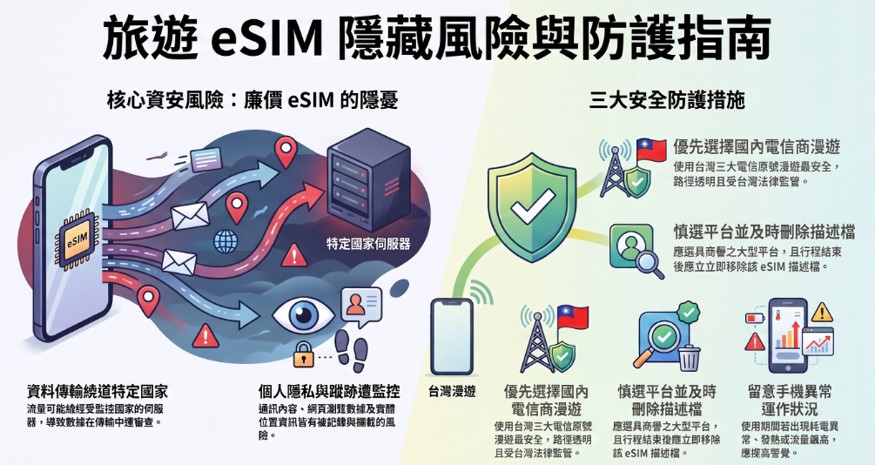
In short, [Travel eSIM] takes advantage of the advantages of “cheap, no need to install a card, no need to download, and can be activated with just a QR Code”. Currently, it is becoming more and more popular among travelers who need to travel abroad. However, travel eSIM still suffers from poor network quality and hidden regulatory loopholes. When purchasing travel eSIM, Taiwanese people should pay attention to the use of the product and customer service reputation, and do not suffer any disadvantages when shopping around!
3. Instructions for purchasing travel eSIM:
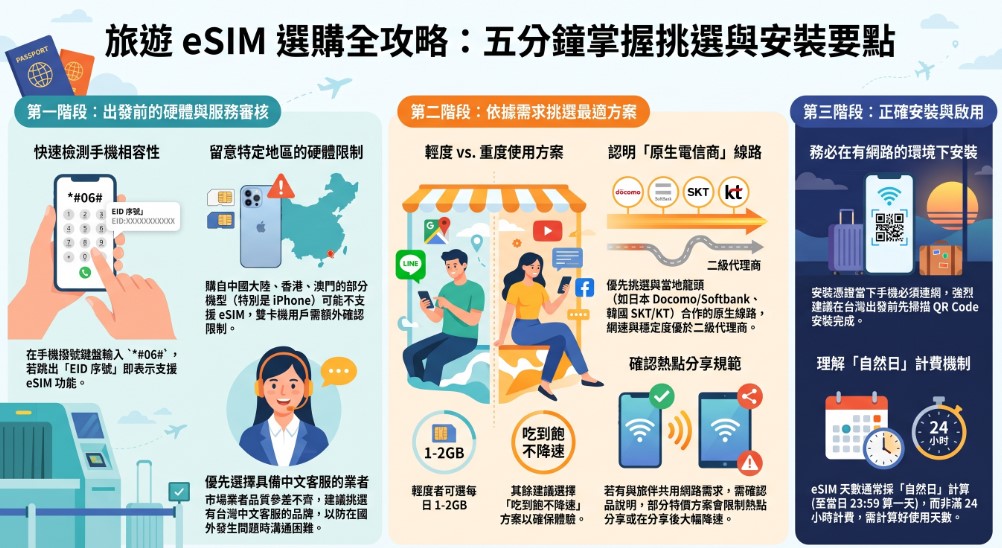
When purchasing a travel eSIM, it is recommended to give priority to the product’s usage and customer service reputation, mobile phone support, total data volume and speed reduction mechanism, native telecommunications lines and installation timing.
A. Product use and customer service reputation:
Travel eSIM providers are uneven, so you should pay more attention to the usage and customer service reputation of the purchaser (it is especially good if there are Taiwanese Chinese customer service staff), so as to avoid problems when using it abroad, leaving you with no way to ask for help, which will ruin your interest in traveling abroad.
B. Check mobile phone compatibility. Not all mobile phones support eSIM:
How to check whether the mobile phone supports eSIM: Enter *#06# on the mobile phone dial pad. If the “EID Serial Number” pops up, it means it is supported. Special note: Some models (such as iPhone) purchased in mainland China, Hong Kong, and Macau may not support eSIM. Dual-SIM models also need to confirm whether there are any restrictions.
C. Choose the appropriate plan according to your needs. It is recommended to give priority to the “all you can eat without slowing down” plan:
Choose the appropriate plan based on the number of days you travel and your personal Internet habits. If you are not a light user (you only need to look up maps, find restaurants, and upload LINE, the 1 GB ~ 2 GB plan per day will suffice), it is recommended to choose the “all you can eat without slowing down” plan.
D. Pay attention to the quality of telecom providers and share hot spots with native telecom providers:
Try to choose a solution that cooperates with local “native telecommunications” (such as Docomo and Softbank in Japan, SKT and KT in South Korea). The network speed and stability are usually better than those of sub-agents.
E. Prioritize hotspot shareable solutions:
If you need to share the Internet with your travel companions or use multiple devices to access the Internet, be sure to read the product description carefully before purchasing. Some special offers may limit hotspot sharing or slow down the Internet speed after sharing.
F. Confirm installation and activation time installation conditions:
When installing the eSIM certificate, the mobile phone must be in an environment with Internet access (it is recommended to install the QR Code before departure in Taiwan). Enable time calculation: eSIM days are mostly calculated in “natural days” (non-24-hour format).
Source: KOCPC Chinese