


SpaceXAI(formerly xAI) officially released on August 12 US time. Grok 4.6, the official post wrote: “Grok 4.6 brings frontier intelligence, a significant upgrade over Grok 4.5, at the same price.” Grok 4.6 has 1.5 trillion parameters, a context window of 500K tokens, supports text and image input, and offers four reasoning levels: low, medium, high, and extreme. This is a rapid iteration arriving less than a month after Grok 4.5’s release, with the product focus clearly aimed at long-running AI agents and code development tasks.
Grok 4.6 API pricing: 85% cheaper than Fable 5
Grok 4.6 API pricing is as follows (per million tokens):
- Input: $2.00 (cache hit $0.50)
- Output:$6.00
Grok 4.6 is faster than comparable models and can handle much more challenging tasks than Grok 4.5.
It’s half the price of other frontier models at $2/M input and $6/M output tokens.
— SpaceXAI (@SpaceXAI) August 12, 2026
Compared to its main competitors, Grok 4.6’s pricing advantage is very clear. Grok 4.6’s performance is close to Fable 5 Max, but costs about 85% less, with input costs 80% cheaper and output costs 88% cheaper. In contrast, GPT-5.6 Sol Max is priced higher, while DeepSeek V4-Pro is cheaper but lags behind on some benchmarks.
The official documentation specifically recommends that developers set `prompt_cache_key` to route requests from the same conversation to the same server, ensuring cache hit rates. Without this setting, you’ll often end up paying full input fees on servers where the cache has cold-started.
Benchmark results: Ranked first in all three benchmarks.
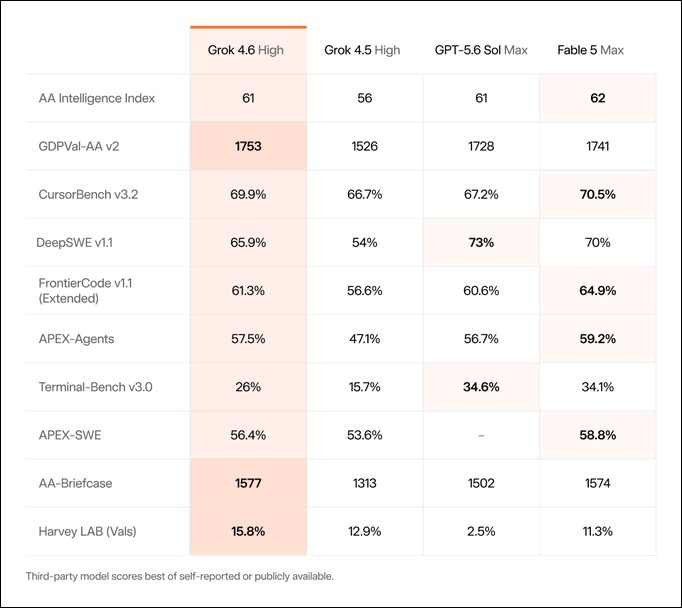
According to the benchmark data released by SpaceXAI, the comparison of Grok 4.6 (High reasoning intensity) with GPT-5.6 Sol Max, Fable 5 Max, and the previous-generation Grok 4.5 is as follows:
Categories where Grok 4.6 scored the highest:
- GDPVal-AA v2Composite intelligence index: 1,753 Elo, surpassing Fable 5 Max (1,741) and GPT-5.6 (1,728)
- AA-Briefcase(Tool Use and Agentic Tasks): 1,577 Elo, surpassing Fable 5 Max (1,574) and GPT-5.6 (1,502)
- Harvey LAB(Reasoning verification): 15.8%, significantly ahead of Fable 5 Max (11.3%) and GPT-5.6 (2.5%)
Grok 4.6 performed excellently but did not take first place in:
- AA Intelligence Index: 61 points, tied with GPT-5.6, trailing Fable 5 Max (62)
- CursorBench v3.2(IDE code performance): 69.9%, trailing Fable 5 Max (70.5%)
- APEX-Agents(Agent capability): 57.5%, behind Fable 5 Max (59.2%)
Grok 4.6 lagging items:
- DeepSWE v1.1(Software Engineering): 65.9%, behind GPT-5.6 (73%) and Fable 5 Max (70%)
- Terminal-Bench v3.0(Terminal operation): 26%, behind GPT-5.6 (34.6%) and Fable 5 Max (34.1%)
- FrontierCode v1.1(Advanced Code): 61.3%, behind Fable 5 Max (64.9%)
Grok 4.6 shows significant improvement over its predecessor Grok 4.5 on every benchmark, particularly GDPVal-AA, which jumped from 1,526 to 1,753, and Harvey LAB, which rose from 12.9% to 15.8%.
Technical Specifications and Features
The complete technical specifications of Grok 4.6 are as follows:
- parameter scale1.5 trillion
- Context window: 500,000 tokens
- Knowledge cutoff dateFebruary 1, 2026
- Input modalityText and images
- Output limit: No text output limit
- Reasoning intensityLow, Medium, High (Default), Extreme
- API Support:Responses API、Chat Completions
- toolFunction Calling, web search, X search, code execution
Knowledge cutoff is February 1, 2026, meaning the model has no direct knowledge of events occurring after that date and needs to rely on tool calls or web search to fill the gap. This is standard practice for Agent tasks requiring real-time information, and Grok 4.6’s built-in web search and X search features are exactly what fill that void. On the platform support front, Grok 4.6 is now available on the xAI API, Grok Build (default model), Cursor (all plans), OpenRouter, Vercel, and Cloudflare. Cursor users can use it without any additional configuration.
The design of reasoning strength is particularly noteworthy. Developers can switch between four levels based on task complexity: “Low” or “Medium” for everyday conversations to get quick responses, or “High” or “Maximum” for complex code reviews or long-chain agent tasks, allowing the model to spend more time reasoning. This flexibility lets a single model serve both lightweight queries and heavy workloads without needing to switch between different models.
Same-Day Showdown with DeepSeek V4-Pro
The timing of Grok 4.6’s release is quite telling. On the very same day, DeepSeek’s V4-Pro-0813 also appeared on the official API documentation page, bringing the two companies’ rivalry in agent capabilities to the forefront. This is a rare “same-day release” scenario in the AI industry, with frontier models from two different camps vying for headlines on the same day. On the DeepSWE benchmark, Grok 4.6 (65.9%) edges out DeepSeek V4-Pro (62.7%), but both trail GPT-5.6’s 73%.
In terms of pricing, Grok 4.6 ($2/$6) is nearly seven times more expensive than DeepSeek V4-Pro ($0.435/$0.87), but DeepSeek is about to raise prices significantly, which could narrow the gap in the short term. For developers, which model to choose depends on the use case: go with DeepSeek if you need the lowest inference cost, or choose Grok if you need stronger Agent collaboration and Cursor integration.
Another aspect worth observing is ecosystem integration. Grok 4.6 is already deeply embedded across all of Cursor’s plans, and Cursor is in the process of merging with SpaceXAI. This means Grok 4.6 is not just an API endpoint, but the default engine for Cursor workflows. DeepSeek, on the other hand, takes an open approach, offering its models on multiple third-party platforms such as OpenRouter and Together, giving developers greater flexibility in their choices.
Roadmap: Grok 4.7 and Grok 5
Musk revealed during SpaceX’s Q2 earnings call thatFollow-up planGrok 4.7 is expected to launch three to four weeks after Grok 4.6, with the parameter count further expanding to 2.1 trillion. Grok 5 is planned for release before the end of 2026. The rapid iteration pace of Grok 4.6 reflects SpaceXAI’s competitive strategy: proving technical capability through product strength before the Cursor merger closes. The gap from Grok 4.5 to 4.6 was less than a month, and the expected gap from 4.6 to 4.7 is only three to four weeks—such a dense release cadence is uncommon among major AI companies.
Musk also hinted that Grok 4.7 will be a “much larger model,” combining Cursor’s coding capabilities with SpaceXAI’s infrastructure advantages. If Grok 4.6 is capturing market share through value for money, Grok 4.7 may attempt to catch up to or even surpass GPT-5.6 and Fable 5 in absolute performance.
Source: KOCPC Chinese