


Global 5G commercial services have been launched one after another since 2019, with major telecom operators in South Korea, the United States, and China launching it first, and Taiwan officially launching 5G commercial services on June 30, 2020. Since its inception, 5G has had mixed success. Recently, the foreign media “Business Insider” produced a film called “Is 5G the scam of the century? Spending hundreds of billions of dollars, why don’t we feel anything at all?“The short film explores the process by which US 5G technology, under the marketing packaging of telecom operators, has transformed users’ high expectations into a gap in reality.Since 5G has brought down two telecommunications companies in Taiwan, the video titled 5G is the scam of the century has been hotly debated by netizens in Taiwan. Comments almost unanimously agree that 5G is the scam of the century. But what is the actual truth?
The following is a summary of “Business Insider”‘s views discussed in the film, as well as the author’s personal opinions:
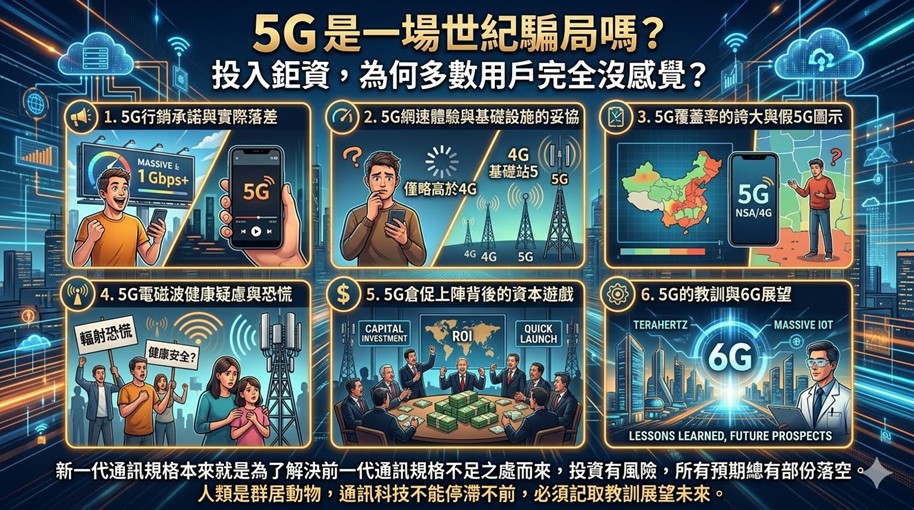
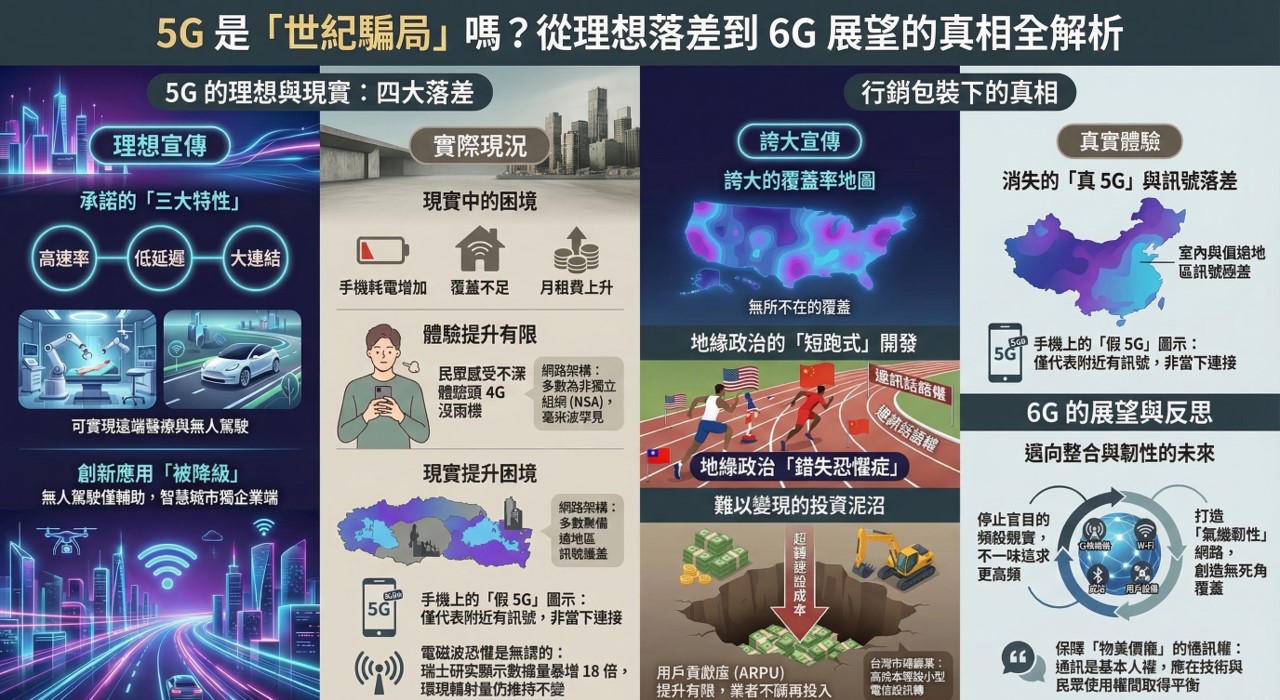
《Business Insider》「Is 5G the scam of the century? Spending hundreds of billions of dollars, why don’t we feel anything at all?“The main topics discussed in the video include the gap between 5G marketing promises and reality, the compromise between 5G network speed experience and infrastructure, exaggerated 5G coverage and fake 5G illustrations, 5G electromagnetic wave health concerns and panic, the capital game behind the rush to launch 5G, the lessons of 5G and the prospects for 6G.
However, to discuss whether 5G is the scam of the century, we must first understand: humans are social animals, and communication technology cannot stand still. The development of new generation communication specifications is often to solve the shortcomings (pain points) of previous generation communication specifications and to meet the needs of the future digital society. There are always risks in investment. All expectations cannot be fully realized, and it is normal for there to be gaps.
Video source: “Business Insider”
1. The gap between 5G marketing promises and reality:
5G has three major characteristics: high speed (eMBB), low latency (uRLLC), and large connectivity (mMTC). In the past, telecom operators and governments have promoted that 5G can not only significantly increase the network speed (1Gbps), but also enable future technologies such as remote surgery, driverless cars, and smart cities without traffic congestion to change and save lives. But today, five years later, 5G coverage is insufficient, mobile phone power consumption is increasing, monthly telecom fees are rising (not falling but increasing), and all promised innovative applications have been downgraded. The gap between marketing promises and reality has made people doubt that 5G is a scam.
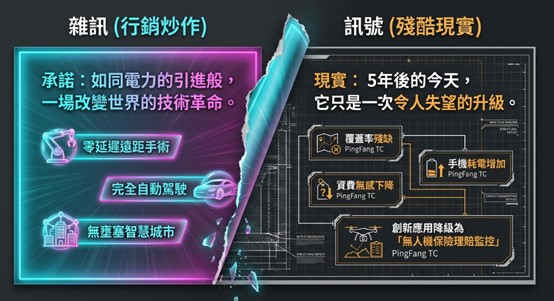
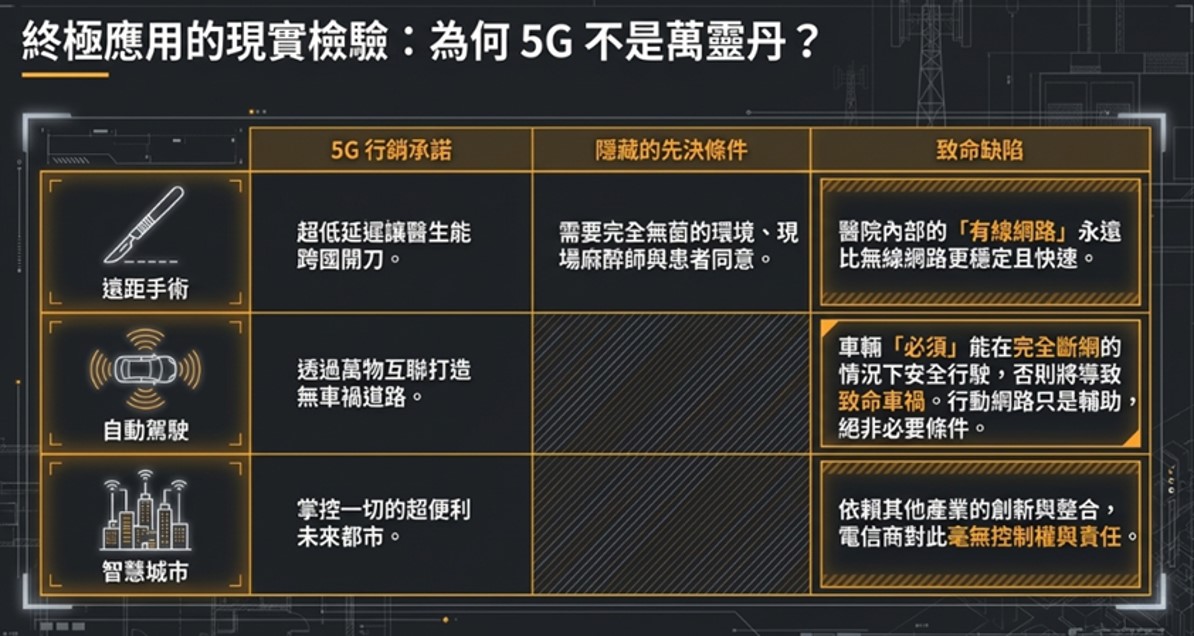
The downgrade or gap in 5G applications in telemedicine, driverless cars, and smart city management is actually a vision. The author visited several senior telecommunications engineers in Taiwan’s telecommunications industry before the launch of 5G. The engineers were originally not optimistic about the application of 5G in driverless cars (human lives are at stake, and the physical limitations of radio waves being susceptible to external interference mean that 5G can only be used as an auxiliary), as well as the bottleneck in telemedicine and smart city applications. Five years later, the predictions of the telecommunications engineers at that time came true, but it was a secret that could not be told at the time.
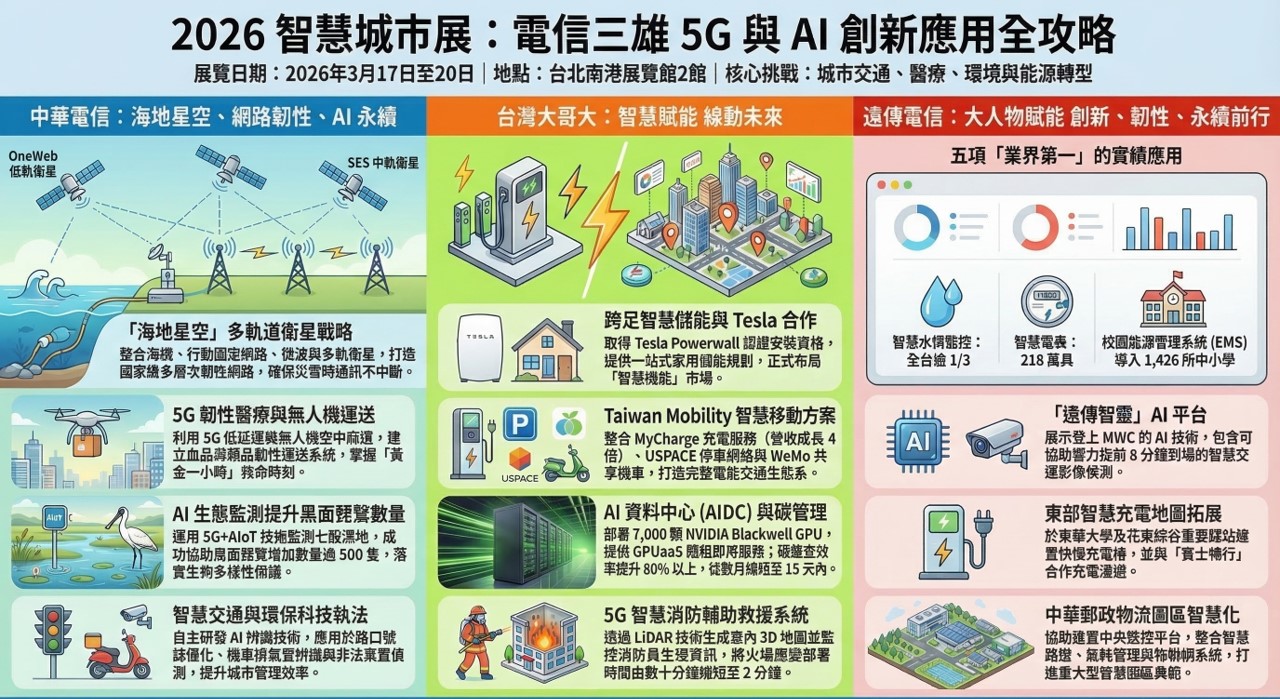
Although 5G has been downgraded in telemedicine and smart cities, with the introduction of AI technology, telecom operators have not achieved nothing. It’s just that many applications are geared toward enterprise or city management, and the general public is relatively indifferent to them.
Compromise between 2.5G network speed experience and infrastructure:
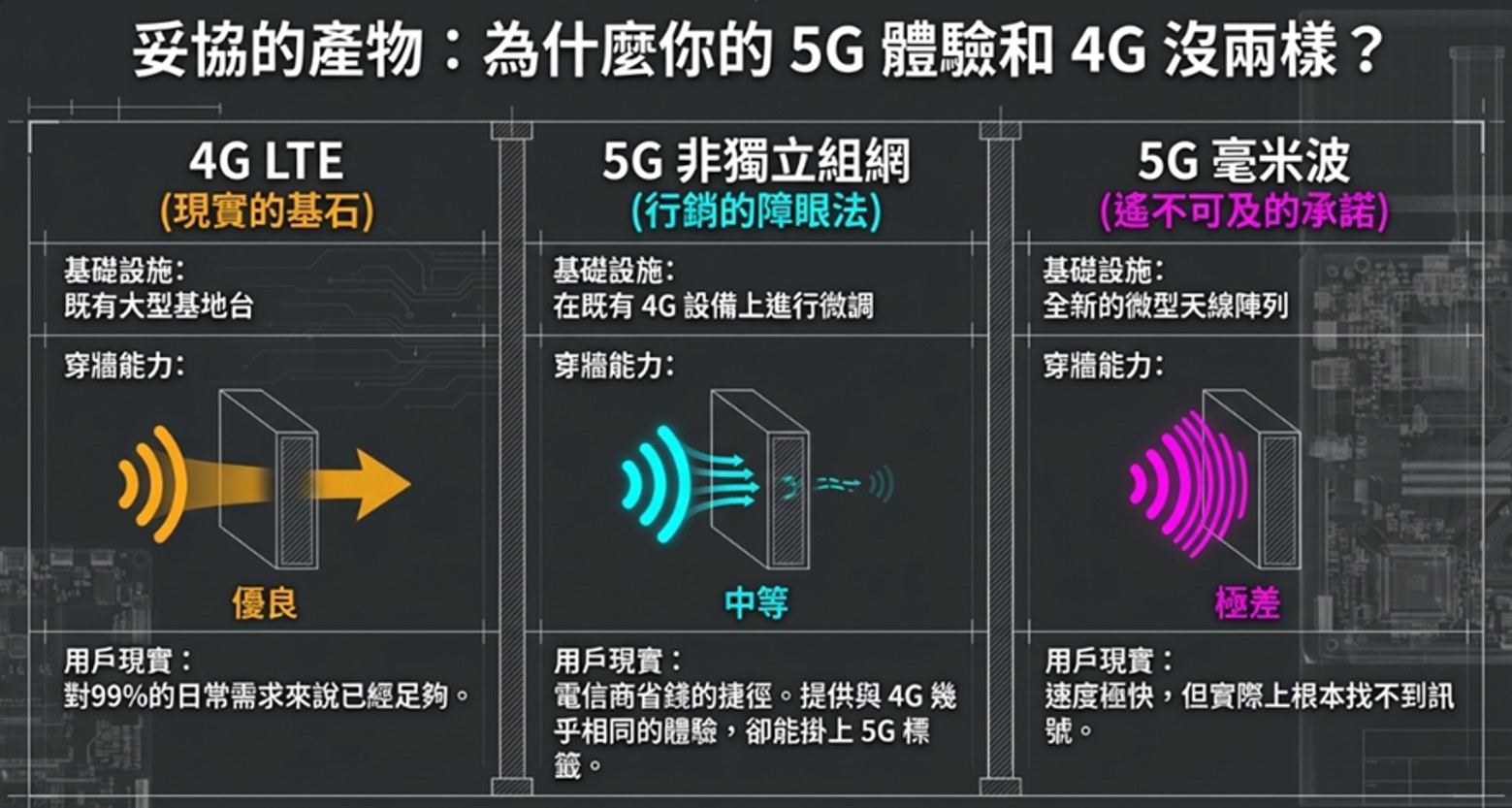
Why is your 5G experience no different from 4G? The network construction originally promised by 5G included not only the first phase of 5G non-standalone network (5G NSA), but also 5G independent network (5G SA) and 5G millimeter wave (5G mmWave). However, the current global 5G network construction layout still mostly relies on 5G non-standalone networks. The layout of 5G independent networks is slow, and 5G millimeter wave has disappeared without a trace.
In order to carry more users and solve network congestion problems, 5G uses high-frequency radio waves (3.5GHz and 24GHz). The physical limitations of high-frequency radio waves mean that the high cost of “network density” must be paid. However, enterprises have cheaper communication options (WiFi, Bluetooth…), coupled with the evolution of these communication technologies, the application of 5G in the Internet of Things/Internet of Vehicles has failed, and 5G applications are still mainly mobile communications. In order to save money, telecom operators naturally take a wait-and-see attitude towards the construction of 5G independent networks or 5G millimeter wave technology. For the public, with the downgrading of 5G base station construction and the advancement of streaming compression technology, 4G networks can meet most mobile network applications, so the public feels that the 5G experience is the same as 4G.
However, 5G is not only faster than 4G, it can carry more users and improve upload speeds. Otherwise, it will be difficult for people to use mobile communications at the Taipei Arena and the Chiayi Light Show.
3. Exaggerated 5G coverage and fake 5G illustrations:
The 5G coverage maps on the official websites of telecom operators and TV advertisements make people think that 5G is almost ubiquitous and that everyone can enjoy services. However, in fact, the high-frequency short-wave characteristics of 5G make the “coverage” poor in remote areas and indoors. Experts in the video point out that the coverage maps of (U.S.) telecom operators are extremely inaccurate and exaggerate the actual coverage. According to 2024 data, users of some mainstream telecom operators in the United States are actually connected to 5G networks only about one-tenth of the time.
However, the video accuses the vast United States of America, while Taiwan is narrow and densely populated. According to the latest report from Opensignal, the 5G availability rate of Taiwan’s three major telecoms exceeds 70%. In addition to Taiwan’s indoor environment, there is still a difference, and the outdoor environment should not be much different from the coverage map published by the industry.
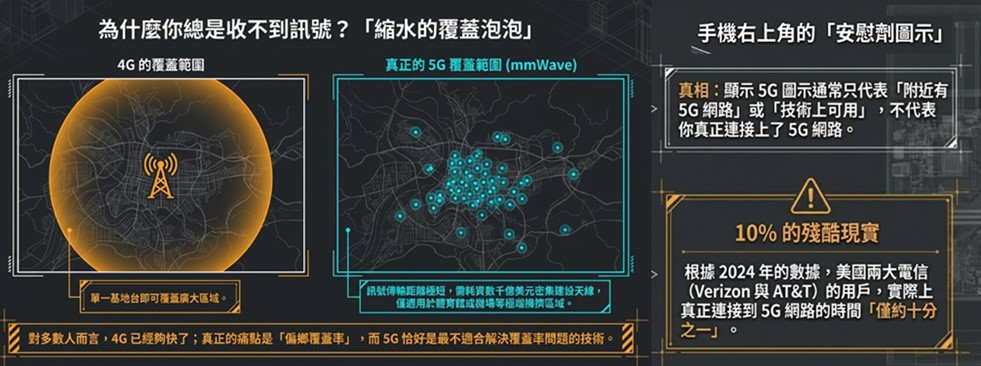
As for the “5G icon” displayed in the upper right corner of the mobile phone accused in the video, it usually only means that there is a 5G network nearby and does not mean that it is actually connected to the 5G network.
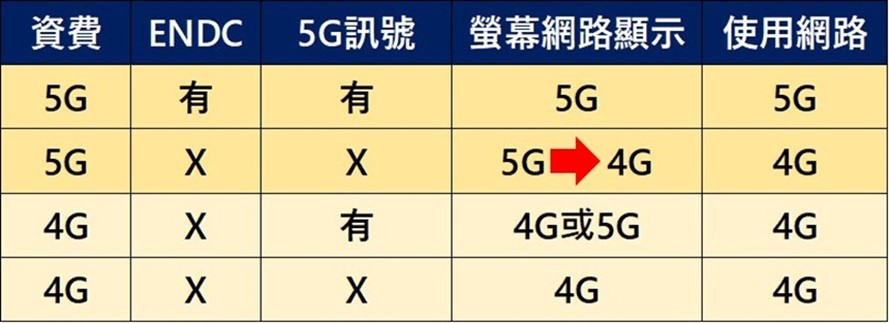
This is related to the fact that most of the world’s 5G base stations currently adopt non-standalone NSA architecture. When the user’s 5G mobile phone network settings are set to [5G network priority/5G automatic mode], if a 5G network signal appears at the location, the 5G mobile phone will receive SIB2 from the 5G base station to inform the 5G mobile phone that there is a 5G base station on the 4G core network connected to it. At this time, the mobile network status bar on the mobile phone screen actually displays the “best available network”, not the network currently in use. If a user uses a 4G phone number and is in an environment with a 5G signal, it is easy for a bug to occur where the network symbol displayed on the phone screen does not match the actual network used, leaving the user in vain.
Panic caused by doubts about 4.5G electromagnetic waves:
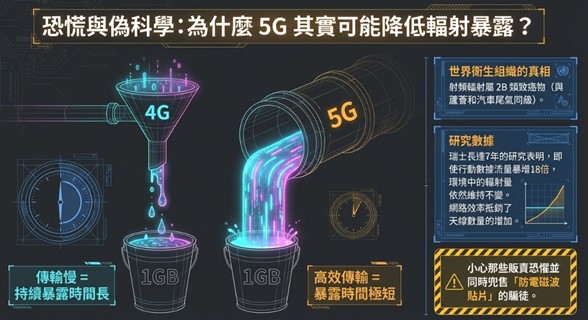
“Ignorance” is the mother of fear. When new communication specifications are launched, certain groups and media will appear to demonize new technologies by selling fear of electromagnetic waves. When 5G was launched at a time when COVID-19 was prevalent, there were incidents of people being tricked into burning 5G base stations. In fact, according to a seven-year Swiss study, even if mobile data traffic surges by 18 times, the amount of radiation in the environment remains the same, and the network efficiency offsets the number of antennas. There is no need to demonize 5G by selling fear!
The capital game behind the hasty launch of 5.5G:
Telecom operators have spent unprecedented amounts of money to bid for 5G spectrum and invest in the deployment of 5G base stations. However, over the past five years, they have not brought much improvement in user revenue (ARPU). In some countries, ARPU has even declined instead of rising. Telecom operators were unable to monetize 5G and were trapped in a financial quagmire, resulting in unwillingness to invest in more advanced 5G technology and technological applications. Taiwan also indirectly led to the merger and acquisition of two telecom operators.
After the launch of 5G, Taiwan’s telecom operators have achieved record profits and ARPU has stopped falling and rebounded. However, the profits are due to the market monopoly dividends generated by telecom mergers and the operators’ promotion of other value-added services or the telecom currency ecosystem. They are not pure telecom revenue contributed by users.
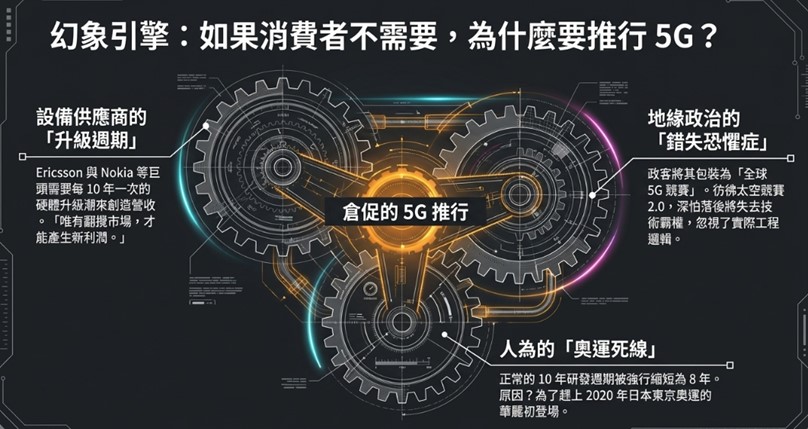
If there was no urgent need from consumers, why did countries rush to launch 5G more than six years ago? Since in the past 2G, 3G, and 4G eras, European and American powers had the say in global communication standards, the rush to launch 5G is related to the Chinese government’s plan to join hands with Huawei to “rise in the east and fall in the west”, triggering geopolitical “phobia of missing out”.
In other words, behind the 5G game is actually the product of the geopolitical dispute between the great powers of the East and the West. The “sprint-style” development has led to many problematic decisions, and it has also led to the fact that 5G is ultimately unable to be significantly different from 4G in the eyes of consumers. Insufficient supporting facilities have resulted in half the effort with half the effort, and the global penetration rate is naturally not as good as that of 4G.
6.5G lessons and 6G prospects:
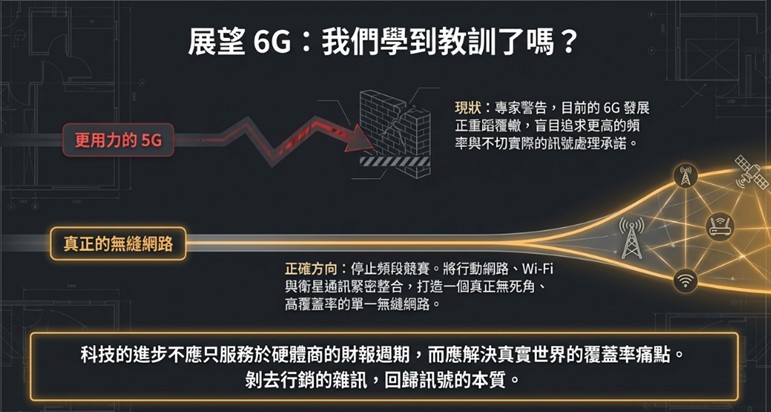
The reason why 5G is considered a scam by many is because it has been given the aura of saving the world and changing the future. The video reminds that 6G development is repeating the mistakes of the past. The blind pursuit of higher frequencies, unrealistic signal processing promises and the hype of low-orbit satellites will only make telecom companies continue to make investments that are difficult to repay, and people will not be able to obtain the right to use “high-quality and affordable” Internet. Exaggerating and not using sales tactics to declare victory cannot conceal the fact that users perceive that the experience of new-generation communication technology is not much different from that of 4G networks.
The video calls for the right direction for 5G and 6G to stop competing for frequency bands and closely integrate mobile networks, WiFi, Bluetooth, and low-orbit satellites to create a truly seamless and resilient network with no dead ends and high coverage.
Humans are social animals, and communication technology cannot stand still. Internet access is a basic human right in modern society. In order to eliminate the digital divide, promote information equality, and ensure people’s communication and self-realization in the digital age, the government or telecom operators cannot sacrifice the majority of people’s desire for “high-quality and affordable” Internet access due to geopolitical competition or unrealistic visions. How to strike a balance between the development of new generation communication technology and the protection of people’s Internet access rights to create a win-win situation is a common issue and benefit for the government and telecom operators.
Source: KOCPC Chinese