


It’s an open secret in the film and television post-production industry: It’s easy to remove an object from a film, but extremely difficult to make it look like it was never there. If you remove the actor holding the instrument from the picture, the picture may be left with a weird picture of a suspended instrument (normally the guitar should be adjusted to the ground). In the past, it would often take Hollywood visual effects teams weeks to fix such problems. In April 2026, the Netflix R&D team joined hands with the INSAIT institution of Sofia University “St. Kliment Ohridski” to jointly release an open source video object removal framework “VOID“(Video Object and Interaction Deletion). This model doesn’t just “P” out objects in the scene: it also understands how other objects in the scene should react physically when the object disappears.

Blind spots of past technologies: only fixing pixels, not understanding physics
To understand how groundbreaking VOID is, you must first understand the limitations of existing technology. The standard video inpainting model used in most image editing workflows today is essentially an extremely sophisticated “background painter.” They are trained to fill in pixel areas after objects have been removed, butNever reason about cause and effect: If I remove an actor holding a prop, what happens to that prop?
Existing video object removal methods are good at repairing the content “behind” the object, and can correct appearance defects such as shadows and reflections. However, once the removed object has more substantial interactions with other objects in the scene: such as collisions: the existing model fails, producing illogical images.
VOID’s core innovation: neural network for physical perception
VOID is built on the CogVideoX architecture and fine-tuned for video patching with interaction-aware masking conditions. The key innovation lies in the way the model understands the scene – asking not just “Which pixels should I fill in?” but also asking: “What is physically reasonable after this object disappears?”
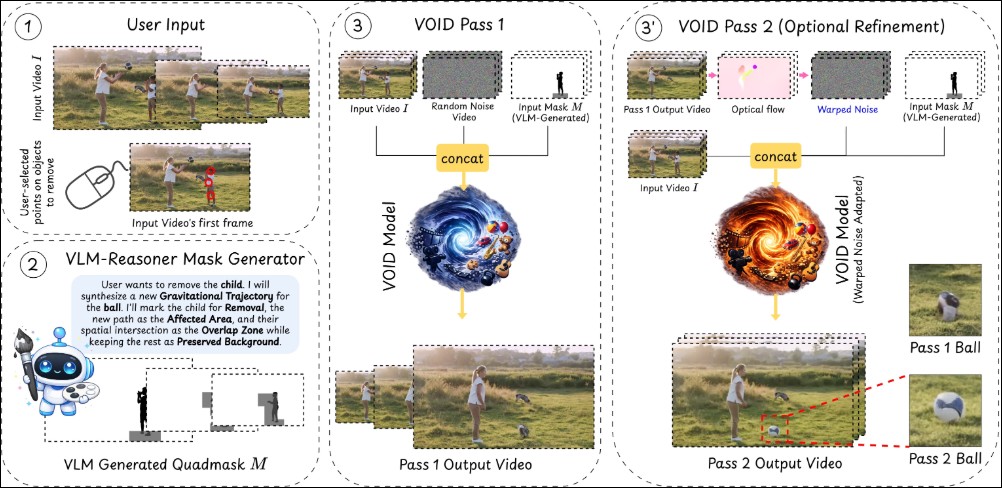
VOID’s workflow is divided into two stages:
First Pass: After the user clicks on an object to remove, the system’s built-in VLM (Visual Language Model) inference pipeline identifies which areas of the scene will be causally affected: which objects will fall, collide, or change trajectory. These regions are encoded into a so-called “quadmask” that guides the diffusion model to produce physically consistent, counterfactual video results.
The second stage (Pass 2 Refinement): If the first stage produces so-called “object morphing” artifacts: a known failure mode of small film diffusion models: the system re-executes the inference using the flow morphing noise from the first stage, stabilizing the object shape along the newly synthesized trajectory.
The classic example in the research paper perfectly demonstrates the capabilities of VOID: if you remove the person holding the ukulele in the picture, VOID will also remove the influence of this person on the guitar: let the guitar fall to the ground naturally.
This seems simple, but is actually extremely complex. The model must understand that the guitar is being supported by this person: a so-called “support relationship.” Only by understanding this kind of physical cause and effect can the picture after removal be natural and credible, instead of having obvious flaws like floating props.
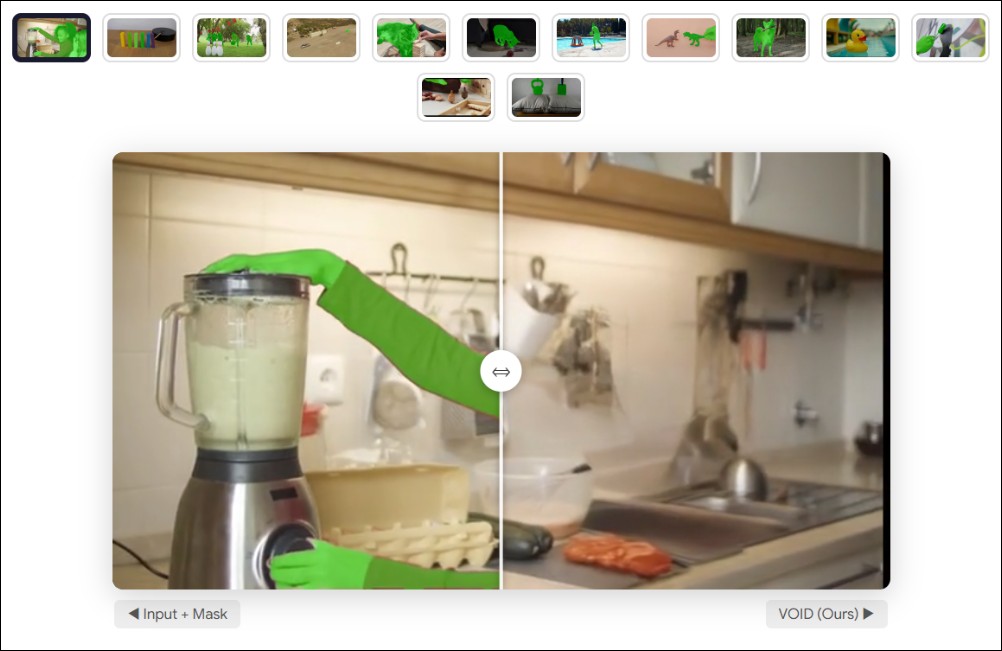
VOIDOfficial websiteProvides multiple interactive comparison displays, including bowling balls, stacked dominoes, car collisions, cats playing with building blocks, and other scenes. Users can drag the slider to compare the difference between the input screen and the VOID output with their own eyes (it is recommended that you check the official website, there are many interactive examples).
Training data: Kubric and HUMOTO
VOID is trained using two important synthetic data sets:
Kubric: A framework for generating synthetic movie data with physics simulations for creating scenes containing physical interactions such as objects colliding, collapsing, etc.
HUMOTO: A physical simulation data set for human actions, specifically dealing with scenarios where the human body interacts with objects.
Each training example contains three parts: the input movie, the quadrupole mask, and the counterfactual movie as ground truth. This paired data design enables the model to accurately learn “what the correct physical result should be when something is removed.”
Open source license: Apache 2.0, free for commercial use
VOID is licensed by Apache 2.0 and is free and open for global commercial use. All film and television production companies, special effects studios or creative teams of any size can freely download, use and integrate it into commercial products without paying any licensing fees.
Game changer for film and television post-production
For the film and television industry, the emergence of VOID represents a fundamental change in post-production costs and time thresholds. In the past, if a prop, actor or element was found to need to be removed after filming, the crew usually had only two options: spend a lot of money on reshoots, or accept irreparable flaws in the picture. Now, VOID provides a new shortcut – not only removing the object itself, but also automatically calculating and filling the gaps left by its physical interaction.
In addition to film and television special effects, the technical potential of VOID also extends to many fields such as game cutscenes, live video modification, educational film production and even virtual reality content generation.
Source: KOCPC Chinese