


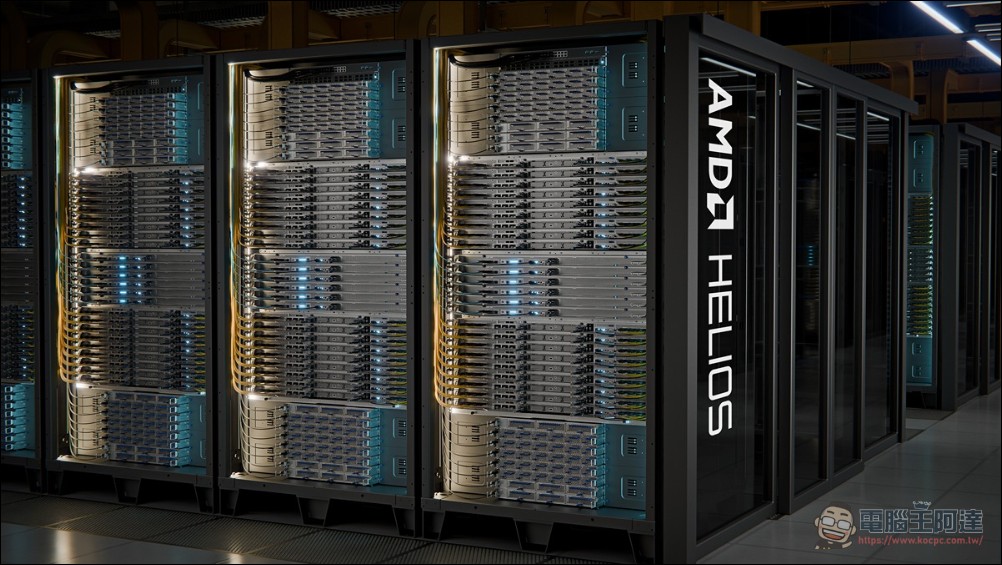
AMD officially released its first cabinet-level AI solution “AMD Helios” at the Advancing AI 2026 annual conference on July 24. This time it is not just a single chip upgrade, but an integrated solution for an entire cabinet. With 72 MI455X GPUs and 18 sixth-generation EPYC “Venice” CPUs packed into a single cabinet, paired with Pensando network architecture and ROCm software, the goal is clear: to compete head-on with NVIDIA’s Vera Rubin cabinet. Su Zifeng said very directly at the conference: “The next stage of AI will cover cutting-edge models, agent AI and entity AI. To realize these things, the entire industry needs to work together.” She emphasized that AMD takes the open platform route, and customers can freely choose the most suitable computing power according to different workloads without being tied to a single supplier.
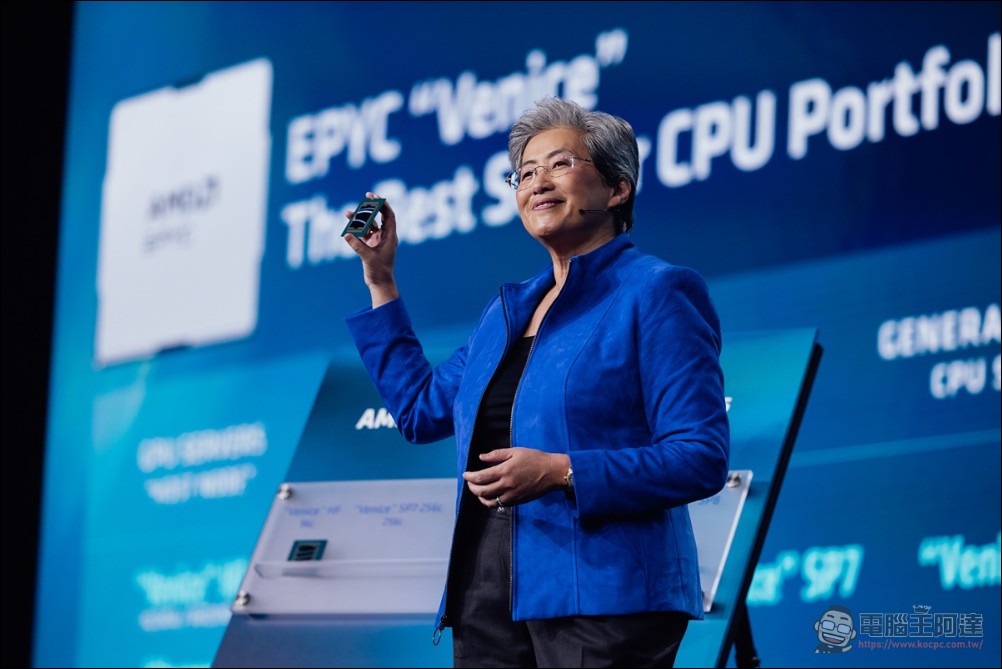
Helios Cabinet: 30% higher Token output per dollar than competitors
The specs of the Helios cabinet are pretty impressive. There are 72 Instinct MI455X GPUs built into a single cabinet, with a total of 31TB of HBM4 memory, FP4 computing power up to 2.9 exaFLOPS, and liquid cooling. According to AMD’s internal testing, under Kimi K2 Thinking workloads, the Helios cabinet can produce 30% more inference tokens per dollar than the NVIDIA Vera Rubin NVL72 cabinet.
MI455X GPU is the main computing power this time. Compared with the previous generation MI355X, the Token throughput of MI455X on the DeepSeek V4 Flash model is directly increased by 34 times. For high-precision computing needs, AMD has also launched the MI430X accelerator, with native FP64 performance up to 288 TFLOPS, targeting the scientific computing and sovereign AI markets. The next wave of Exascale supercomputers in the United States and Europe have already been adopted.
There’s also an interesting card: the MI350P GPU. The main purpose of this card is to “allow existing infrastructure to painlessly accelerate AI”. It uses a PCIe interface and does not require the replacement of the entire machine. AMD’s test data points out that the MI350P can process 4.2 times the number of tokens per dollar per second than its opponents, locking in enterprise customers with limited budgets who want to run inferences.
Anthropic signs 2GW deal, AMD invests another $5 billion
The most important news at this conference is that Anthropic officially announced that it will deploy AMD Instinct MI450 series GPUs with up to 2 gigawatts, all running on Helios cabinets. The first batch of 1GW is expected to be online in the first half of 2027.
AMD has also invested up to US$5 billion (approximately NT$162.5 billion) in Anthropic for this cooperation. The two parties have also launched a multi-year engineering cooperation plan: Anthropic’s Claude model will directly participate in the development and optimization of AMD’s ROCm software, and AMD’s internal engineering team will also fully introduce Claude. The CUDA ecosystem has always been the most difficult moat for NVIDIA to break. Now it has hired Claude to help write ROCm software, which basically uses AI to break down AI barriers.
OpenAI and Meta team up to acquire 12GW, Microsoft and Oracle are also lining up to enter the market
Anthropic isn’t the only big customer. OpenAI and AMD are collaborating to integrate OpenAI’s Triton framework with ROCm software to optimize MI455X GPUs and Helios chassis for GPT-class workloads. OpenAI expects to begin importing Helios in the fourth quarter of 2026 and fully accelerate deployment in 2027.
Meta is also validating the sixth-generation EPYC CPU platform in its own labs and has begun testing workloads on Helios cabinets in preparation for gigawatt-level large-scale deployments. In addition, Microsoft Azure, Oracle, and Cerebras also appear on the customer list. According to foreign media statistics, OpenAI and Meta alone have a total of 12GW of AMD accelerator capacity.
Cerebras’s cooperation model is quite special. They integrate their own ultra-low-latency AI computing with AMD Helios high-throughput rack-level infrastructure, focusing on the deployment efficiency of ultra-low-latency inference services.
Sixth generation EPYC Venice: TSMC 2nm blessing, proxy AI dedicated CPU
The CPU is not idle either. The sixth-generation EPYC “Venice” processor is the industry’s first TSMC 2nm x86 server processor to enter mass production, with up to 256 cores and 512 threads, and supports 12-channel MRDIMM memory and PCIe Gen 6. AMD positions Venice as “the computing base for the agent-based AI era.” On the AI host node, the CPU must have sufficient speed and memory bandwidth to ensure that the GPU accelerator does not idle.
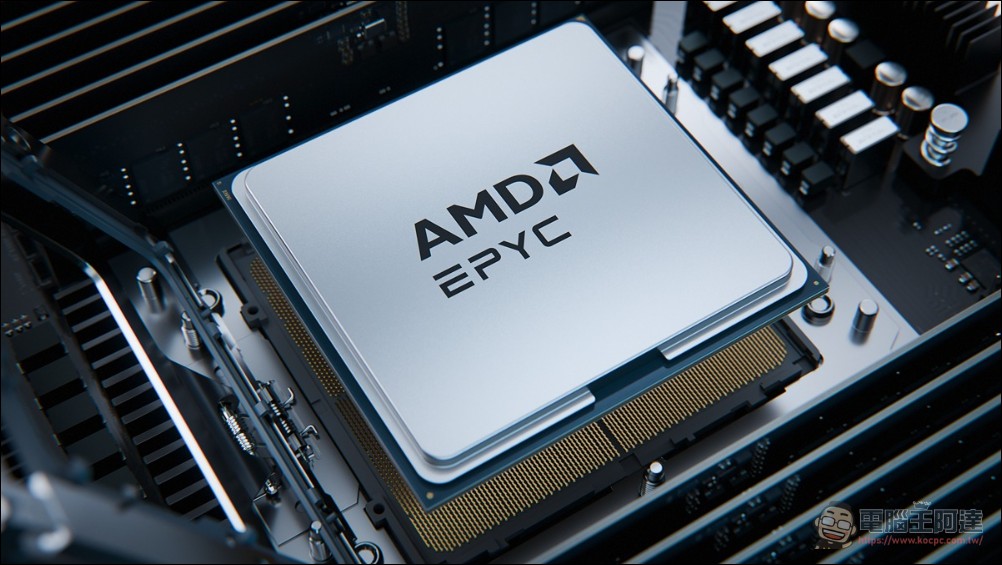
Data provided by AMD points out that within the 100kW power consumption range per cabinet, the EPYC 9996 (256 cores) can support the largest number of AI agents, 2.08 times more cores than the NVIDIA Vera CPU (88 cores).
ROCm.ai is here: using Claude and Codex to help developers write GPU programs
Software has always been the most questioned aspect of AMD’s AI field, and this time they launched ROCm.ai. This is an AI-driven development platform that allows popular code agents such as Claude, Codex, and Cursor to natively understand the AMD platform and ROCm. Developers can directly use AI assistance to write GPU programs and optimize performance.
Currently, mainstream open source frameworks such as PyTorch, Hugging Face, vLLM, and SGLang can already run on MI455X. For AMD, the maturity of the software ecosystem will directly determine whether customers are willing to switch from CUDA. The cooperation with Anthropic is obviously aimed at this pain point.
Draw a product roadmap all the way to 2030
AMD simultaneously updated its product roadmap to 2030, and the rhythm is quite intensive:
- 2027: MI500 series GPUs with next-generation compute, memory and interconnect technologies
- 2027: Helios 500 rack with MI500 GPU + EPYC “Verano” CPU + Pensando “Como/Monza” network
- 2028: MI600 Series GPUs
- 2028: Helios 600 rack with MI600 GPU + EPYC “Ferrara” CPU + Pensando “Palma/Levanzo” network
- 2028: EPYC “Florence / Ferrara / Fidenza” CPU based on Zen 7 architecture
- 2030: EPYC “Ravenna” CPU based on Zen 8 architecture
Su Zifeng said at the conference that AI is accelerating the demand for AMD’s full range of chips, ranging from data centers, PCs, edges to embedded processors. AMD’s potential market size (TAM) in 2030 is estimated to reach approximately US$2 trillion.
From the cloud to the factory: Kria AI platform targets the robot market
In addition to the data center arms race, AMD has also officially entered the physical AI field this time. The new AMD Kria AI solution consists of two major products: the Kria AI system module (SOM), powered by Ryzen AI embedded X100 series processors; and the Kria AI robot development platform, which is the industry’s first open autonomous robot platform that integrates CPU, GPU, NPU and FPGA.
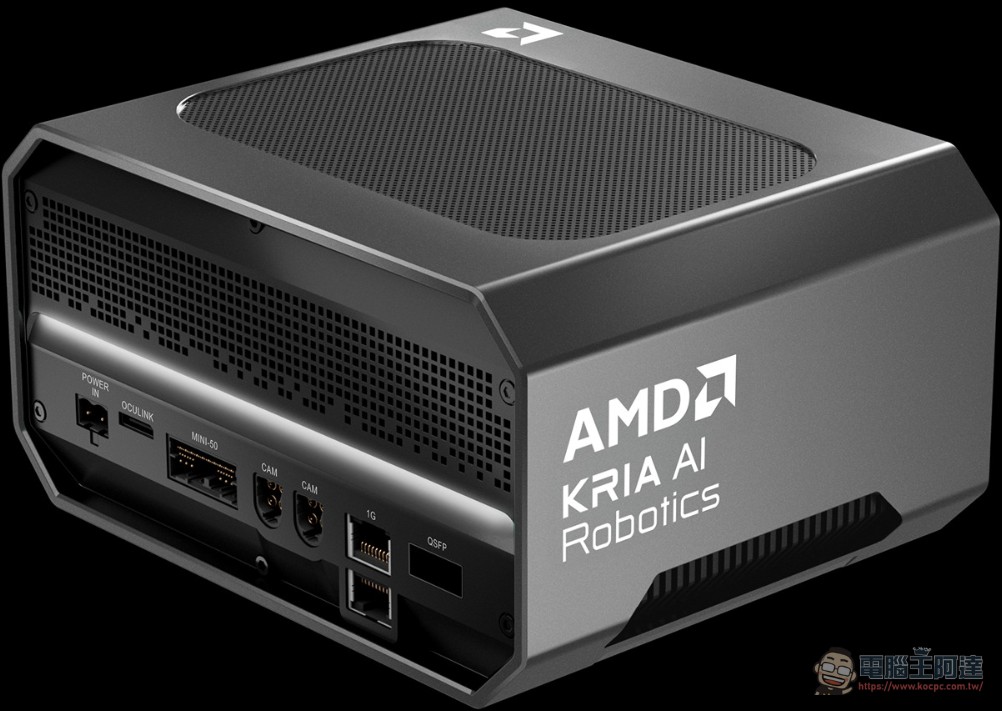
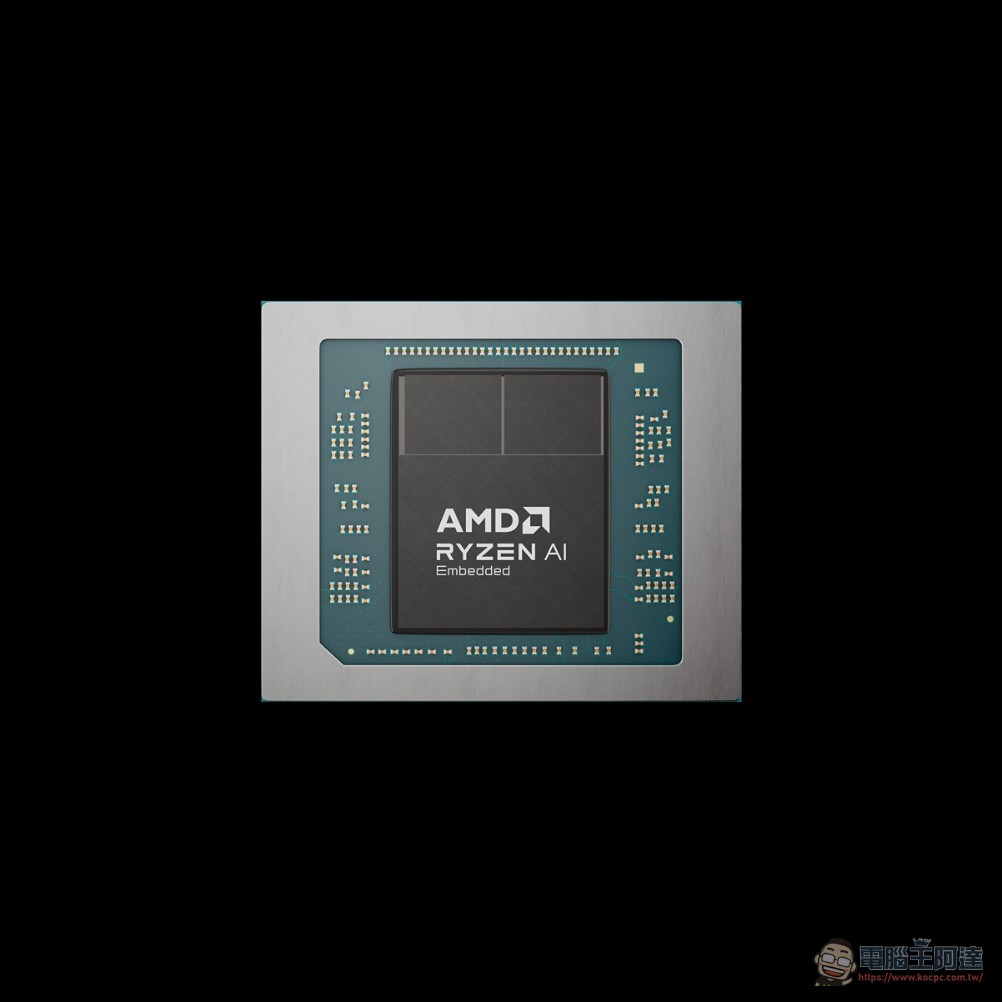
AMD has been working in the field of FPGA and self-adjusting SoC for a long time. This time it extends the robotic technology from the “robot body” (perception and control) to the “robot brain” (reasoning and decision-making), all on the same platform, and takes an open route and is not tied to a specific manufacturer. The threshold for developers is much lower.
There is also progress on the enterprise side. AT&T demonstrated at the conference how to use AMD technology to deploy AI in the cloud, on-premises and physically isolated environments, and even used AMD Instinct GPU and ROCm software to train its own open source model OTel 2.0 dedicated to telecommunications. Cisco is working with AMD to integrate the Ryzen AI Halo system with Cisco’s networking, observability, and security capabilities to allow enterprises to manage hybrid and local agent AI at scale.
Su Zifeng’s open platform bet
Overall, AAI 2026 is AMD’s most ambitious launch since its establishment. From chips (MI400, EPYC Venice) to systems (Helios cabinets) to software (ROCm.ai), to customers (Anthropic, OpenAI, Meta total package 14GW), AMD will not sell components this time, but directly sell a complete set of AI factory solutions.
Su Zifeng’s bet is clear: the AI market is big enough, and customers don’t want to be tied to a single supplier. As long as AMD can come up with good enough performance, an open enough platform, and a complete enough software ecosystem, it will have the opportunity to carve out a piece of its own territory in the market dominated by NVIDIA. For Taiwan’s supply chain, from TSMC’s 2nm process, Wiwynn’s cabinet assembly to various ODM’s server shipments, AMD’s AI expansion will also be an important growth driver in the next few years.
Source: KOCPC Chinese