


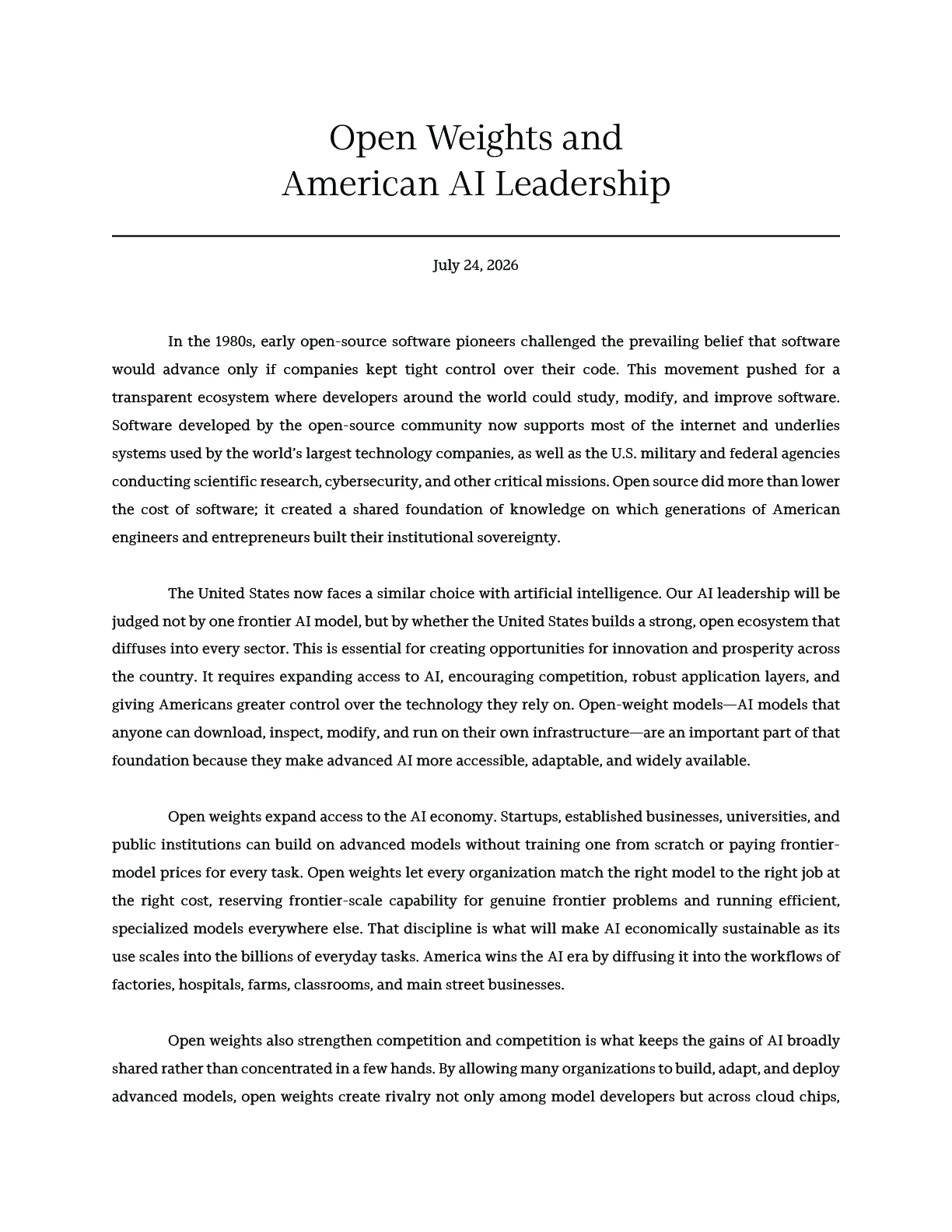
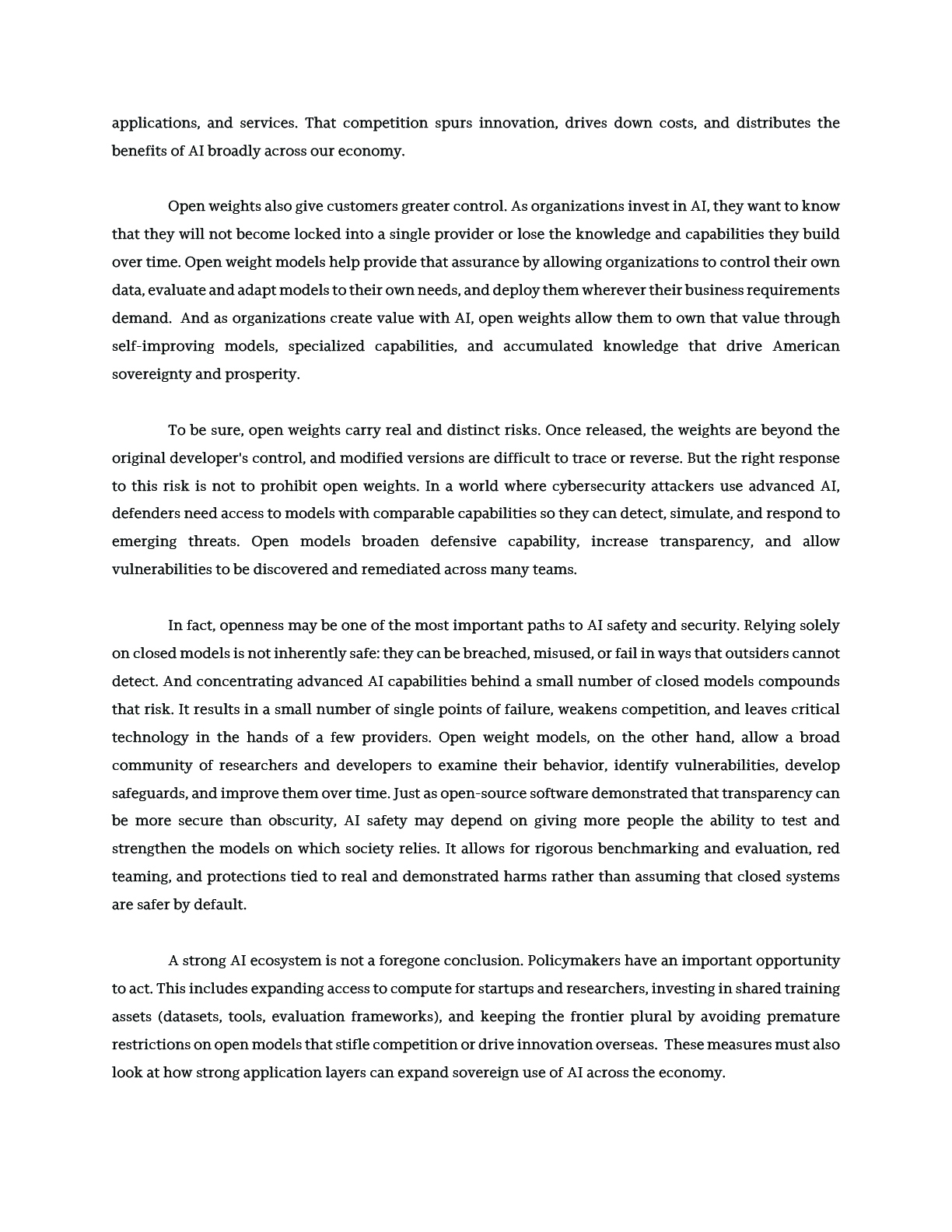
NVIDIA CEO Jensen Huang posted his first tweet on the X platform on July 25, which contained an open letter signed by 25 technology companies. The title of the letter is “Open Weights and American AI Leadership” (Open Source Weights and American AI Leadership). The core appeal is only one sentence: the United States should support the open model instead of banning it. The tweet racked up more than 59,000 likes and 10,000 retweets in 24 hours. Huang Renxun wrote in the article: “AI will transform every industry, drive every company, and be built by every country. Open models strengthen security and network security, accelerate innovation and popularization, and achieve sovereignty. The world needs cutting-edge closed models as well as cutting-edge open models.”
For my first post, I’m sharing a letter @NVIDIA signed on why open models matter.
AI will transform every industry, power every company, and be built by every country.
Open models strengthen safety and cybersecurity, accelerate innovation and diffusion, and enable sovereignty.… pic.twitter.com/t02bi51N4C
— Jensen Huang (@JensenHuang) July 24, 2026
25 companies signed the petition, but OpenAI and Anthropic did not join.
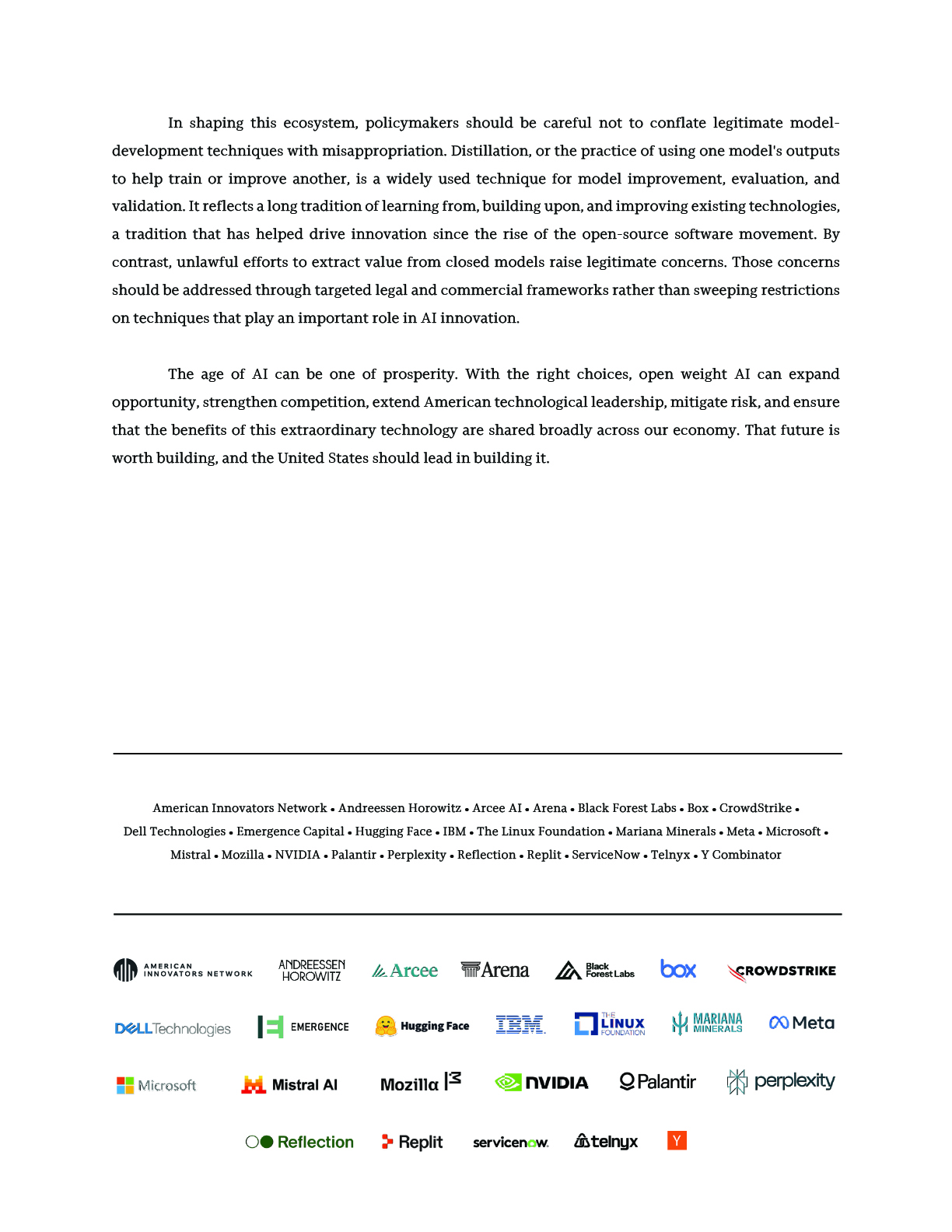
The list of co-signers covers 25 companies and institutions including NVIDIA, Microsoft, Meta, Dell, IBM, Palantir, CrowdStrike, Mozilla, Hugging Face, Mistral, Perplexity, Y Combinator, Andreessen Horowitz, and the Linux Foundation. The list ranges from chip giants to venture capital, from open source foundations to defense technology contractors. The cross-spectrum signature itself sends a strong signal.
However, it is not surprising that there are two absent names on this list of co-signers: OpenAI and Anthropic. Both companies are currently valued at close to US$1 trillion each. They are also preparing for IPOs that may be launched within this year. Both of them are based on closed frontier (closed source) models. This battle over “open versus closed” routes is clearly visible on the list of co-signers.
Although Elon Musk did not officially co-sign in the name of SpaceX, he forwarded the letter on X and wrote “full support”.

The core argument of the open letter: Openness is security
The open letter begins with the open source software movement in the 1980s, pointing out that open source code now supports most of the Internet’s operations and is the cornerstone for the U.S. military and federal agencies to perform critical tasks such as scientific research and network security. The letter directly analogizes the historical experience of open source software to the field of AI, arguing that “the United States’ leadership in AI should not be measured by a single frontier model, but depends on the ability to build a strong and open ecosystem.”
The letter makes four main arguments:
- Expand popularization: Open source weights allow startups, universities, and public institutions to build on advanced models without having to train models from scratch or pay the high fees of cutting-edge models for each task.
- strengthen competition: Open source weighting prevents the monopoly of a single supplier, allowing organizations to control their own data, adjust models according to needs, and avoid being kidnapped.
- Safety depends on transparency: The letter reverses the common argument that “openness equals danger,” arguing that closed models may “be cracked, abused, or malfunction in ways that are undetectable by outsiders.” Concentrating advanced AI capabilities on a few closed models creates “single points of failure.” Open models allow the broad research community to examine behavior, identify vulnerabilities, and develop defense mechanisms.
- In defense of distillation technology: The letter specifically names “distillation” (using the output of one model to train another model) as a legitimate model development technology and should not be confused with illegal extraction of value. It calls on policymakers to deal with infringement issues through a targeted legal framework rather than imposing blanket restrictions on the technology itself.
Sensitive timing: Rise of China’s open source model sparks anxiety in Washington
Huang Renxun chose to speak out at this time. The background is that the attitude of American political circles towards open source weight models is tightening. Currently, Chinese open source models such as KIMI K3, GLM 5.2, and DeepSeek V4 have recently been rapidly catching up with cutting-edge American models in terms of capabilities. In particular, the Kimi K3 model launched by Chinese startup Moonshot AI in early July surpassed leading American products in some industry benchmark tests, triggering policy debates.
U.S. Treasury Secretary Scott Bessent earlier this weekTell CNBC, the Trump administration is investigating whether Chinese companies have stolen American intellectual property and claimed that the government “has the ability to impose sanctions on them for this theft.” The open letter was an apparent rebuttal to calls for restrictions, warning policymakers to avoid “prematurely imposing restrictions on open models that would stifle competition or push innovation overseas.”
Open letter defends “distillation” technology
A particularly striking passage in the open letter is a clear defense of the “distillation” technology. Distillation refers to the practice of using the output of one model to assist in training or improving another model. It is widely used in the industry for model improvement, evaluation, and verification. The letter points out that this technology “embodies a long tradition of learning from, building on, and improving upon existing technologies,” consistent with the spirit that has driven countless innovations since the rise of the open source software movement.
The letter also acknowledges that illegal extraction of value from closed models does raise legitimate concerns, but emphasizes that these should be addressed through targeted legal and commercial frameworks rather than imposing blanket restrictions on the distillation technology itself. This statement was obviously written in response to the recent controversy surrounding whether Chinese companies improperly used American model exports.
Full text of the open letter Chinese translation
Open source weight and U.S. AI leadership
July 24, 2026
In the 1980s, early open source software pioneers challenged the prevailing view that software could only develop if companies had tight control over its source code. This movement promotes a transparent ecosystem that allows developers around the world to study, modify and improve software. Today, software developed by the open source community powers much of the Internet and is the cornerstone of systems used by the world’s largest technology companies, the U.S. military, and federal agencies that perform scientific research, cybersecurity and other critical missions. Open source lowers the cost of software and creates a shared knowledge base upon which generations of American engineers and entrepreneurs have built their autonomy.
Today, the United States faces a similar choice in the field of artificial intelligence. Our leadership in the field of AI will no longer be measured by a single cutting-edge AI model, but by whether the United States can build a strong and open ecosystem and spread it to all fields. This is critical to creating opportunities for innovation and prosperity across the country. This requires expanding access to AI, encouraging competition, developing a robust application layer, and giving Americans greater control over the technologies they rely on. “Open Weight Models”—AI models that anyone can download, view, modify, and execute on their own infrastructure—are an important part of this cornerstone because they make advanced AI more accessible, adaptable, and more widely available.
Open source weight expands access to the AI economy. Startups, established businesses, universities, and public institutions can build on advanced models without having to train them from scratch or pay the high cost of cutting-edge models for each task. Open source weights allow every organization to apply the right model to the right job at the right cost, leaving cutting-edge scale capabilities to the cutting-edge challenges and executing efficient, purpose-built models everywhere else. This efficiency discipline is key to making AI economically sustainable as its use expands into billions of daily tasks. America will win the AI era by integrating AI into the workflow of factories, hospitals, farms, classrooms, and local businesses.
Open source weight also increases competition, which is key to ensuring that the benefits of AI are widely shared rather than concentrated in the hands of a few. By allowing many organizations to build, improve, and deploy advanced models, open source weight not only creates competition among model developers, but also stimulates healthy competition in cloud chips, applications, and services. This competition drives innovation, lowers costs, and distributes the benefits of AI broadly throughout the economy.
Additionally, open source weighting gives customers greater control. As organizations increase their investments in AI, they want to ensure they are not locked into a single vendor or lose the knowledge and capabilities they have built up over time. The open source weight model helps provide this assurance: it allows organizations to take control of their own data, evaluate and adjust the model to meet their needs, and deploy it as the business requires. As organizations create value through AI, open source weight empowers them to own that value through self-improving models, specialized capabilities, and accumulated knowledge, driving American autonomy and prosperity.
To be sure, open source weighting does carry real and unique risks. Once the weight is released, it is beyond the control of the original developer, and modified versions are difficult to track or restore. However, the right way to deal with this risk is not to ban open source weights. In a world where cyber attackers use advanced AI, defenders need access to equally capable models to detect, simulate and respond to emerging threats. An open model expands defense capabilities, increases transparency, and allows vulnerabilities to be discovered and remediated across multiple teams.
In fact, openness may be one of the most important paths to AI safety and security. Relying solely on closed models is not safe: they can be cracked, misused, or malfunction in ways that are undetectable to outsiders. Concentrating advanced AI capabilities behind a few closed models will only exacerbate this risk, which will create a few “single points of failure”, weaken competition, and leave key technologies in the hands of a few suppliers. In contrast, open source weight models allow a broad community of researchers and developers to interrogate its behavior, identify vulnerabilities, develop defense mechanisms, and improve over time. Just as open source software proves that “transparency is safer than concealment,” the safety of AI may depend on giving more people the ability to test and strengthen the models that society relies on. This allows for rigorous benchmarking, assessments, red teaming, and protection against real and proven compromises, rather than blindly assuming that closed systems are safer by default.
A strong AI ecosystem is not a given. Policymakers have an important opportunity to take action. This includes expanding computing resources for startups and researchers, investing in shared training assets (datasets, tools, evaluation frameworks), and maintaining diversity at the cutting edge by avoiding premature restrictions on open models that stifle competition or push innovation offshore. The above measures must also focus on how a strong application layer can drive the autonomous application of AI across the economy as a whole.
In shaping this ecosystem, policymakers should be careful not to conflate legitimate model development techniques with infringing practices. “Distillation”, the practice of using the output of one model to assist in training or improving another model, is a technique widely used for model improvement, evaluation, and verification. It embodies a long tradition of learning from, building on, and improving upon existing technologies that has driven countless innovations since the dawn of the open source software movement. In contrast, illegal extraction of value from closed models does raise legitimate concerns. Concerns should be addressed through targeted legal and commercial frameworks rather than blanket restrictions on technologies that play an important role in AI innovation.
The age of AI can be a prosperous one. With the right choices, open source weighted AI can expand opportunity, strengthen competition, continue America’s technology leadership, mitigate risk, and ensure that the dividends of this remarkable technology are shared broadly across our economy. This future is worth building, and the United States should play a leadership role in building it.
Co-signing organization:American Innovators Network、Andreessen Horowitz、Arcee AI、Arena、Black Forest Labs、Box、CrowdStrike、Dell Technologies、Emergence Capital、Hugging Face、IBM、The Linux Foundation、Mariana Minerals、Meta、Microsoft、Mistral、Mozilla、NVIDIA、Palantir、Perplexity、Reflection、Replit、ServiceNow、Telnyx、Y Combinator
Source: KOCPC Chinese