


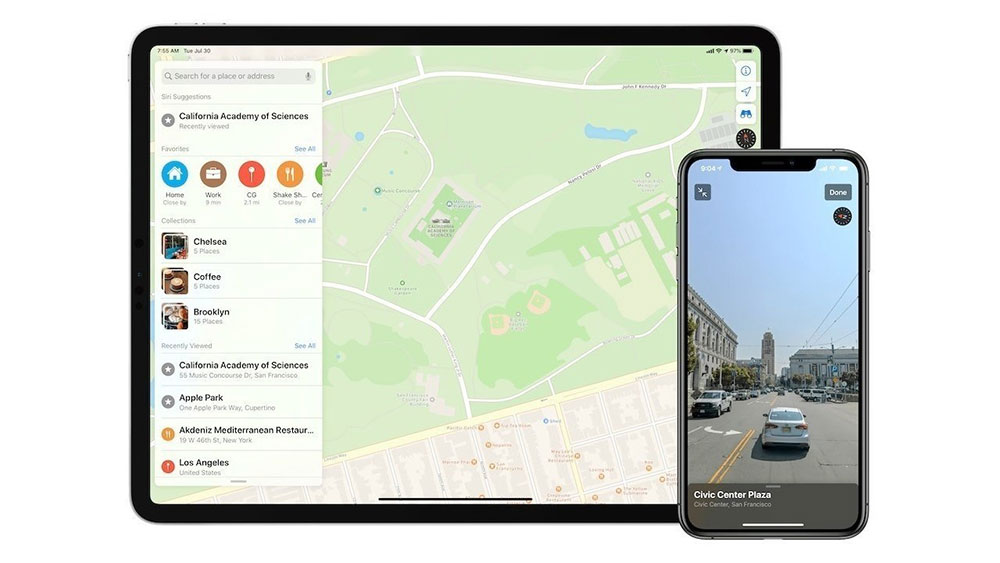
In recent years, Apple has gradually introduced advertising into its own services, including the App Store, Apple News, and some live sports broadcasts on Apple TV. Now,Apple reconfirms, the map service will also include advertising. Starting in summer 2026, users in the United States and Canada will see promoted content when searching on Apple Maps. Ads may appear directly in search results or through the new Suggested Places feature, which recommends nearby stores to users.

Apple Maps begins accepting advertising, starting with pilots in the United States and Canada
Apple emphasizes that privacy will not be sacrificed when importing ads. All personal data will remain on the user’s device and will not be shared with Apple or third parties. Enterprises will not be able to obtain your precise location, and your interaction with ads will not be associated with your Apple ID. Although Apple Maps has continued to improve over the years, it is still difficult to shake the status of Google Maps in the minds of many people. For many iPhone users, Google Maps remains the more reliable navigation tool, but Apple Maps has always had one advantage over Google Maps: no ads.

Google Maps also launched ad-free in 2005, but Google later began allowing businesses to pay to improve its search rankings. In 2016, “Promotion Pins” were launched, allowing companies to replace ordinary pins with brand logos and display them directly on the map. Nowadays, Google Maps’ ads are becoming more and more precise, and it will even push personalized suggestions or promotional information for businesses along the way based on your itinerary records. These functions rely on a large amount of personal data and are not privacy-friendly.

In the past, Apple Maps was a relatively safe choice if you valued privacy. Even if the early features are not as complete as Google Maps, at least there will be no advertising interference. After years of improvements, Apple Maps is now good enough as an alternative when you don’t want to be bombarded with ads, but that advantage is about to disappear. Not only has Apple Maps lost its “ad-free” feature, it has also begun to move in the direction that Google Maps has been most criticized for.

Apple’s choice to include ads in Maps reflects a larger change in company strategy. Ten years ago, Apple’s main profits came from hardware, with service revenue accounting for only a small part. However, in recent years, the proportion of services business has continued to rise, while hardware revenue has gradually declined. As the cost of components such as memory rises, the high profits of the services business may not be enough to completely offset the weakness in hardware sales. Apple may therefore be more active in seeking growth from services, and advertising is one of the most direct ways.

However, consumers have never been very receptive to advertising. Apple’s move will inevitably make people think: does it mean that the growth of the hardware business is no longer as bright as before, forcing the company to find new sources of profit? In the future, whether advertising will penetrate more Apple services has also become a worrying issue. It is worth noting that Apple is not the only technology giant to move toward “advertising.” Many companies are adopting similar strategies, often at the expense of user experience, and this phenomenon is not limited to navigation applications.
Streaming is the most obvious example. Even if you have a paid subscription to Amazon Prime or HBO Max, ads may still appear on the standard plan. If you want a truly ad-free experience, you’ll have to pay extra. The “clean, ad-free” advantages of streaming media are gradually disappearing, and the overall experience is becoming more and more like the cable TV they were originally intended to replace. This trend of “service garbage” is frustrating. When companies continue to expand their advertising footprint in order to increase revenue, it is often the users who ultimately bear the cost. Nowadays, we even have to pay more to avoid ads, which is a worrying reality across the tech industry.
Source: KOCPC Chinese