


In the second quarter of 2026, Intel delivered revenue of US$16.1 billion, a 25% increase from the same period last year, setting the fastest annual growth rate since 2011. This report card was personally set by CEO Lip-Bu Tan: This year is the “Year of Execution.” The three reform lines of factory yield, cycle time, and responsibility ownership that he has promoted in the past year since taking over as CEO are being reflected in the financial report figures. However, in addition to the popularity of the financial report, what is more worthy of the industry’s attention is that Intel announced at the same conference that 14A (1.4 nm) risk trial production will be advanced from 2028 to the second half of 2027, and the mass production schedule will be extended from 2029 to the first half of 2028, a full 12 months forward. Compared with the 18A process, which is currently advancing at a rate of about 30,000 wafers per month, the advance of 14A will put Intel on the same starting line as TSMC A14 in 2028, laying the groundwork for whether major customers such as Apple and AMD will return.
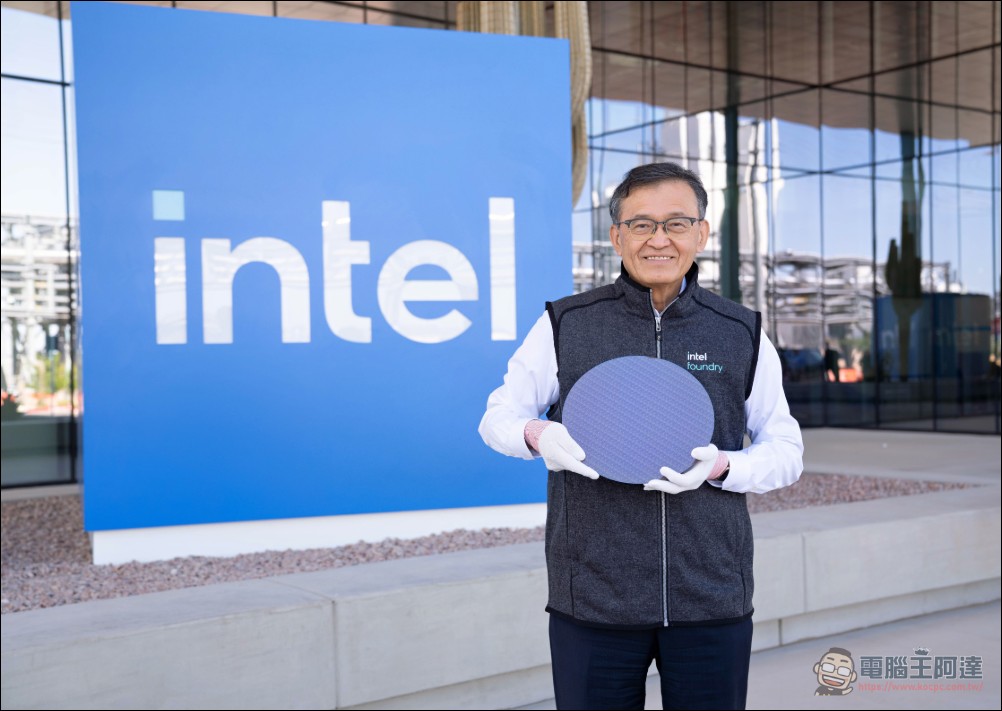
Intel 2Q26 financial report announced: revenue increased by 25% year-on-year, hitting a 15-year high
Intel’s second-quarter revenue was $16.1 billion, a 25% increase from $12.9 billion in the same period in 2025, the fastest year-over-year growth in 15 years. Spreading the numbers, the growth momentum mainly comes from two sources: Data center AI demand drives CPU and ASIC shipments, and the single-quarter shipments of the three process nodes of Intel 7, Intel 3, and Intel 18A all exceeded internal targets. An improved version of 18A, 18A-P, has also entered the risk trial production stage.
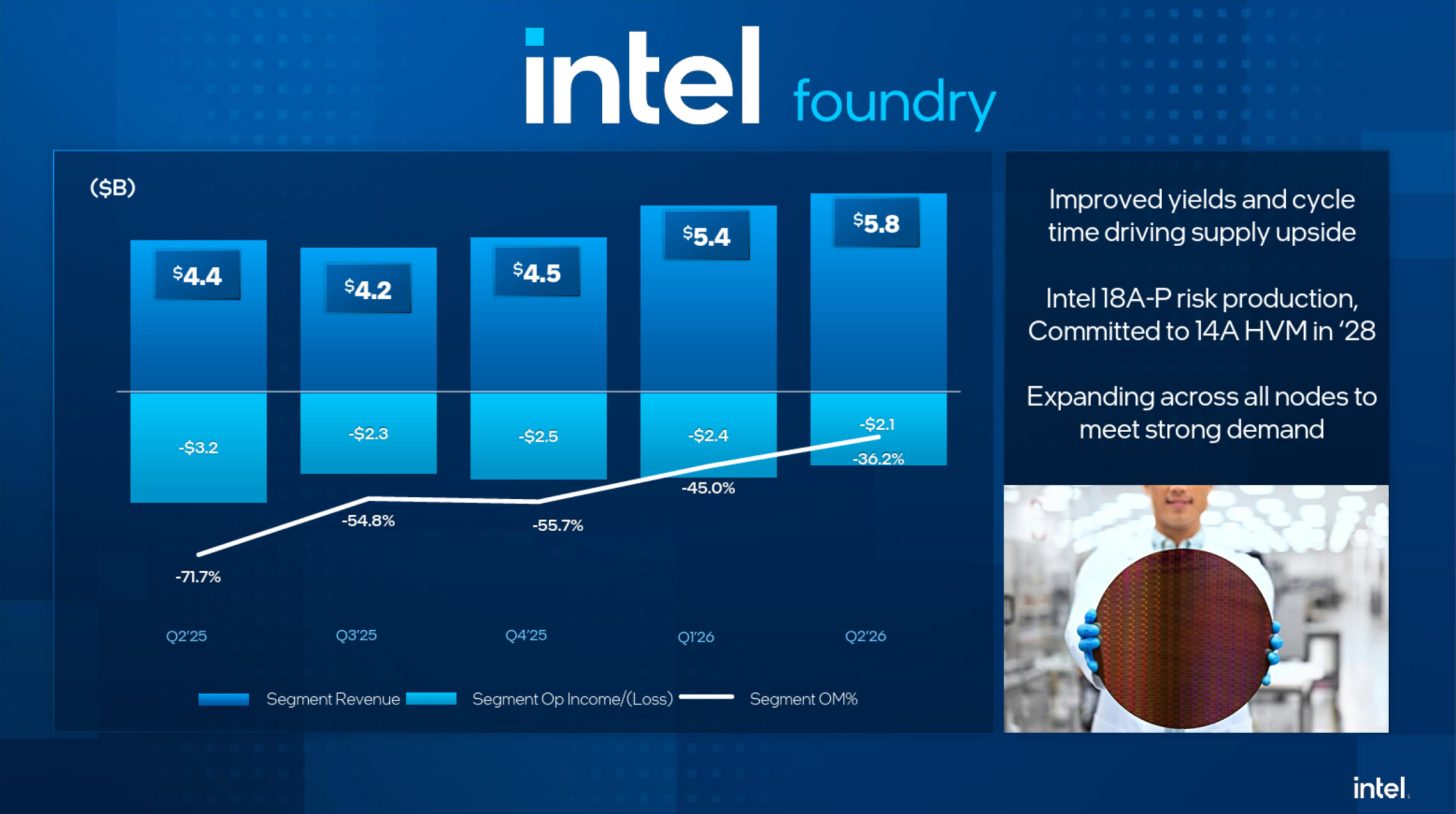
However, there are still gaps behind the impressive figures. Intel Foundry in Season 2Still in the red at $2.1 billion, although it is considered a “turnaround loss” compared to the previous period, it is still some way from being self-financing. In the statement, Chen Liwu described the demand for AI computing power as “unprecedented” and emphasized that Intel has structural growth opportunities in its four business lines of CPU, ASIC, advanced packaging, and wafer foundry. Chief Financial Officer Dave Zinsner further explained that in the second quarter, improved factory yields, shortened cycle times, and additional CPU shipments driven by AI inference demand were the main reasons for exceeding financial forecasts. In order to support product and foundry growth this year and next year, Intel is “meaningfully increasing” investment in equipment, clean room space, and substrates. The third-quarter guidance range is $15.8 billion to $16.8 billion, with non-GAAP EPS of $0.38.
14A roadmap one year ahead of schedule: technical interpretation
14A is the first time Intel has made public the compressed process node of “two-stage trial production”. The new schedule postpones the risk trial production of internal products to the second half of 2027, and mass production will start in the first half of 2028. This time point aligns with TSMC’s A14 scheduled mass production in 2028. For customers who want to spread supply chain risks, the possibility of “dual sourcing” between two same-generation processes has become concrete.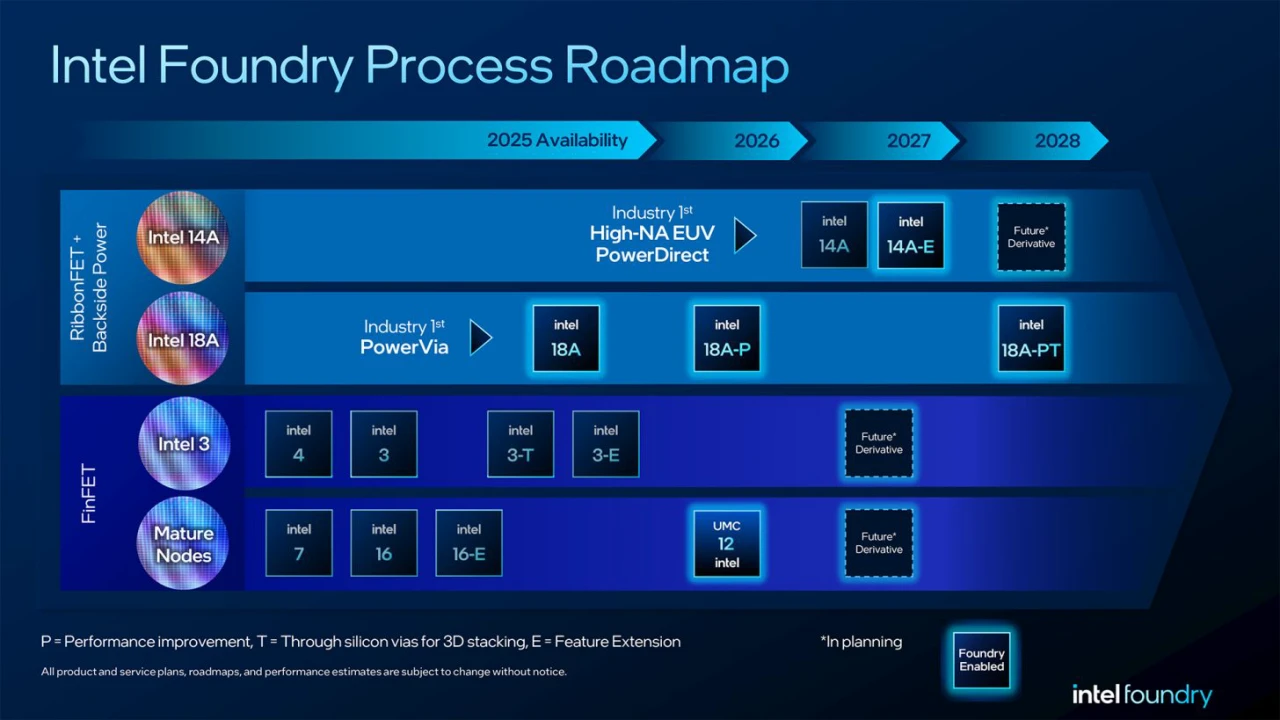
Intel’s internal confidence in 14A comes from comparisons with 18A. Chen Liwu said at the conference that the development speed of 14A is ahead of the performance of 18A at the same stage in the two key indicators of defect density and transistor performance. This is related to 18A’s current ramping performance of 30,000 wafers per month, and preliminary preparations for 18A-P risk trial production have also been completed. The simultaneous advancement of three process nodes is an important prerequisite for 14A to “go forward” this time.
On the design side, the 14A process design kit (PDK) has been advanced to version 0.5, and version 0.9 is expected to be released in October as a basis for joint advancement of internal products and external customers.[2] Tan’s external commitment to 14A covers five aspects: performance, power consumption, transistor density, cost, and mass production schedule; in other words, Intel will benchmark TSMC A14 in the “pentathlon” instead of just taking the lead in a single indicator.
Front alignment of Intel 14A and TSMC A14
14A mass production falls in 2028, almost overlapping with the time point when TSMC A14 enters mass production. For the high-performance computing and flagship mobile chip supply chain that has been accustomed to “TSMC being the dominant player” in the past decade, this is a long-lost “dual-process within the same generation” pattern. Intel itself is also aware of the importance of this position. Tan emphasized at the conference that 14A will compete with its peers in five aspects: performance, power consumption, density, cost and schedule, showing that the new management has put the “foundry business” back on the strategic axis.
Market news indicates that Apple has made preliminary contact with Intel for some future chip production, and AMD has reported that the next generation Zen 7 processor will be bound to TSMC’s A14 process. The two completely different customer strategies put together highlight Intel’s attempt to become a “true second source” again. However, whether it can maintain the yield rate and actual order volume in 2028 will determine whether 14A is an alignment in a technical sense or a turnaround in a commercial sense.
Chen Liwu has taken over Intel for a year. This second quarter financial report and 14A are ahead of schedule, which is his “phased report card”. In his statement, he summarized the internal reform direction with the words “speed, accountability, and customer focus.” Corresponding to the financial report, it is 18A yield improvement, cycle time shortening, and CPU regaining share on the AI inference side. 14A’s decision one year in advance is essentially Chen’s recalibration of his predecessor’s roadmap, compressing the two rhythms of “risk trial production → mass production” into a more competitive window in the industry.
However, Intel Foundry is still in a loss-making state. Although the direction is correct, it is still far from self-financing; the biggest risk of advancing 14A is to put the trial production schedule of internal products and the PDK verification of external customers at the same time in the second half of 2027. The pressure on yield and production line ramping will be greater than that of 18A. For Chen, the second quarter of 2026 is just a starting point: proving that 14A is ahead of schedule is not a PPT schedule, but that it is really capable of being productive and can really receive customer orders. This is the next report card that must be handed over in the next year.
Source: KOCPC Chinese