


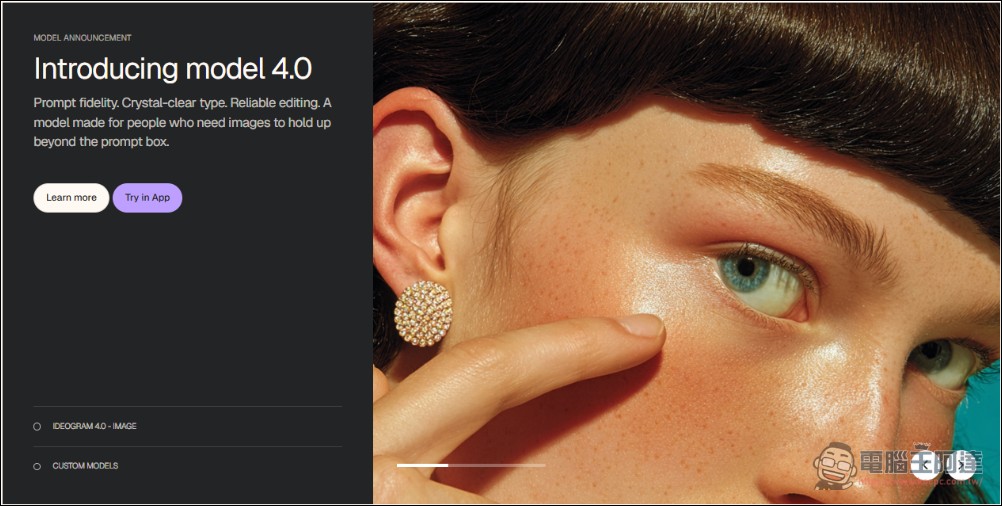
In the past, the field of top-tier aesthetic AI image generation was long dominated by closed-source models—from Midjourney and ChatGPT to Nano Banana… If you wanted top-quality AI-generated images, almost the only option was to rely on the cloud-based, closed-source generation capabilities of major vendors. Recently, Ideogram broke through this limitation: it released its first open-weights model, Ideogram 4.0, fully open-sourcing a 9.3-billion-parameter, design-grade image-generation foundation model, with weights hosted on Hugging Face and inference code released on GitHub under the Apache 2.0 license. This is not a fine-tuned version of an existing model. Ideogram emphasizes that 4.0 is a “foundation model trained from scratch” (trained from scratch), with architecture, training data, and text encoder all designed in-house.

Who is Ideogram? Google Imagen’s core team left to start their own company.
Ideogram AI was founded in 2022 in Toronto, Canada, by a team of seven, four of whom are co-authors of the paper on Google’s image generation model Imagen. Key figures include:
- Mohammad Norouzi(CEO): Ph.D. in Computer Science from the University of Toronto, recipient of the Google PhD Fellowship in Machine Learning during doctoral studies, former Senior Research Scientist at Google Brain, and co-first author of the Imagen paper.
- Jonathan HoCo-founder, former Google Brain researcher, and author of the foundational diffusion model paper “Denoising Diffusion Probabilistic Models,” the theoretical starting point of the entire diffusion model wave.
- William ChanCo-founder, former Google Brain researcher
- Chitwan SahariaCo-founder, former Google Brain researcher, co-author of the Imagen paper.
This team’s technical lineage traces directly back to Imagen—Google’s core project in text-to-image generation. That they left Google Brain together to start their own company also says something about these researchers’ commitment to open source and independent development.
In terms of funding, Ideogram completed a $16.5 million (approximately NT$540 million) seed round led by a16z and Index Ventures when it was founded in August 2023, and raised another $80 million (approximately NT$2.6 billion) in Series A funding in February 2024. As of 2025, the team has about 49 employees, and its annual recurring revenue (ARR) is approximately $7 million (approximately NT$22.75 million).
With a team of under 50 people, Ideogram secured first place for open models on Design Arena and beat all competitors in typography blind tests, giving it one of the highest per-capita output efficiencies in the AI image generation field.
Model Architecture: Fully Single-Stream Diffusion Transformer
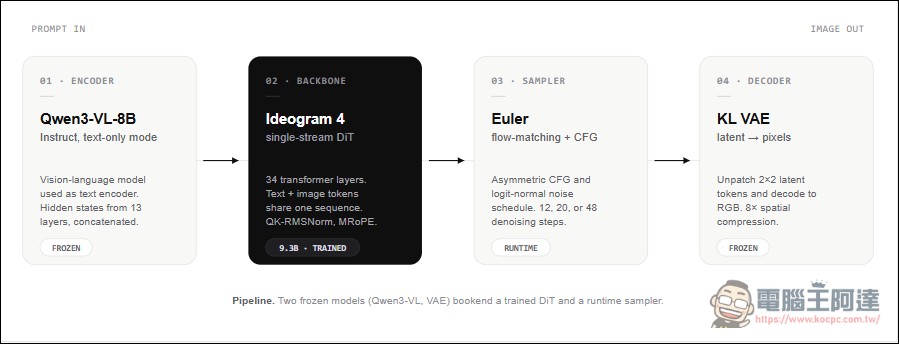
Ideogram 4.0 Adopt / Use Full Single-Stream Diffusion Transformer (DiT)The architecture has 34 layers and 9.3 billion parameters. The so-called “fully single-stream” design means text tokens and image latent tokens are concatenated into a single sequence and processed through the same set of Transformer layers, with every attention layer attending to both modalities simultaneously. This differs from the approach used in some models, which split text and images into separate branches before aligning them, and theoretically enables the development of deeper cross-modal representations.
Architecture Details:
- text encoderQwen3-VL-8B-Instruct (vision-language model, text-only mode): extracts concatenated hidden states from 13 intermediate layers, providing multi-scale semantic features ranging from surface token understanding to deep compositional reasoning.
- decoderFrozen KL VAE, 8× spatial compression, 128 latent channels
- Sampler: Euler flow matching (flow matching), asymmetric CFG (unconditional pass completely discards text tokens)
- resolutionNative maximum of 2048 × 2048 pixels; supports arbitrary side lengths from 256 to 2048 in increments of 16, with aspect ratios up to 6:1.
- Inference presetV4_TURBO_12, V4_DEFAULT_20, V4_QUALITY_48 (quality tail reduces guidance strength at t≈0)
Only the 9.3-billion-parameter DiT backbone is trained; the text encoder and VAE remain frozen. Training and inference share the same JSON prompt format, and the system validates whether the input JSON structure is compliant before generation, rejecting non-compliant prompts outright.
Structured JSON Prompts: More Than Just Typed Descriptions
This is Ideogram 4.0’s core differentiating feature. Traditional image models can only accept natural-language descriptions, making it difficult for users to precisely control the position and style of every element.
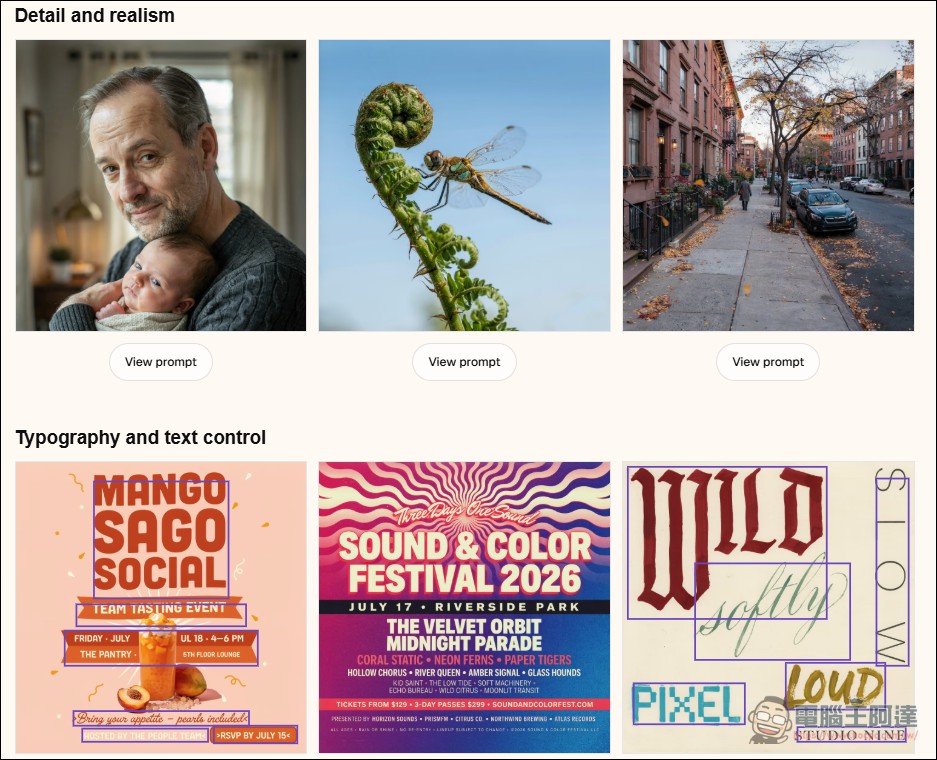
Ideogram 4.0 switches to Structured JSON As a prompt format, it allows you to define:
- Bounding boxesSpecify the position and size of each object using 0–1000 normalized coordinates (origin at top-left).
- color paletteEach image can have up to 16 hex colors, with a maximum of 5 per element.
- text elementCarries literal strings and style descriptions, supporting multi-font poster design.
- Background description, object description, style settings.Separate fields
The point of this system is that training and inference use the exact same format, so the model learns from the start to “arrange elements according to structured instructions” instead of trying to guess the layout from a vague description. For use cases that demand precise layout control—such as posters, ads, social media graphics, and brand assets—this kind of control is something natural language prompts simply cannot match.
Benchmark Scores: King of Open Models
Ideogram 4.0 delivered impressive results across multiple third-party benchmark tests:
- Design ArenaRanked #1 among all open-weight models, and overall only behind the closed-source models from OpenAI and Google.
- ContraLabs Blind Layout TestIn a review by ten leading designers, Ideogram 4.0 won with a 47.9% first-choice rate, significantly ahead of Gemini 3.1 Flash Image Preview (30.0%), FLUX.2 [max] (15.5%), and Grok Imagine 1.0 (15.0%). On the question, “Would you use it in actual client work?” designers gave it a 3.55/5 rating, again ranking it first.
- X-Omni English OCRText rendering accuracy reached 0.97 points.
- Cross-Model Text Rendering ComparisonAt the 9.3B parameter scale, its text rendering performance surpasses Qwen-Image (20B), FLUX.2 dev (32B), and even HunyuanImage 3.0 (80B MoE), delivering better results with fewer parameters.
- Text-to-Image ArenaRanked first in Quality Mode and ninth overall.
The Decoder’sIndependent testingIt noted that Ideogram 4.0 “easily surpassed Midjourney v8” on its benchmark prompts, tied with FLUX, but lagged behind GPT-Image-2, Nano Banana Pro, and Luma Uni-1.1.
Open Source Details: Weights, Licensing, and Deployment Thresholds
Ideogram 4.0’s open strategy is divided into two tiers:
- inference codeLicensed under Apache 2.0, fully open source, and free to use and modify.
- model weightsIdeogram 4 Non-Commercial License: available for download on Hugging Face (terms must be accepted), free for non-commercial use; commercial use requires a separate licensing agreement.
Weights are provided in two quantized versions:
- NF4 versionRuns on a single graphics card with 24GB VRAM (e.g., RTX 4090); CUDA support only.
- FP8 versionSupport for a broader range of hardware platforms
This means creators with consumer-grade high-end graphics cards can fully control this model locally. There’s no need to rely on cloud services, no need to send data to external servers, and they can even fine-tune it according to their own brand style. For businesses and individual creators who value privacy and data sovereignty, this is a highly attractive option.
Ideogram 4.0 GitHub page
Platform Integration: Not Just a Model, but an Ecosystem
Ideogram 4.0 isn’t just a standalone model file. Ideogram has also made it available across multiple platforms:
- Official website:ideogram.ai, providing a web-based generation interface
- API:developer.ideogram.ai, three quality tiers (Turbo $0.03 per image, Standard $0.06 per image, Quality $0.09 per image)
- Subscription PlansBasic $8/month (400 priority generations), Plus $20/month (1,000), Pro $60/month (3,000); all plans include unlimited slow generations.
- ComfyUIFull workflow now supported; requires 32GB VRAM to run the FP8 model.
- Collaboration platformMore than ten platforms, including Hugging Face, fal, Runware, Magnific, Krea AI, Leonardo AI, Picsart, Cloudflare, Replicate, Gamma, Flora AI, and Kittl, went live simultaneously.
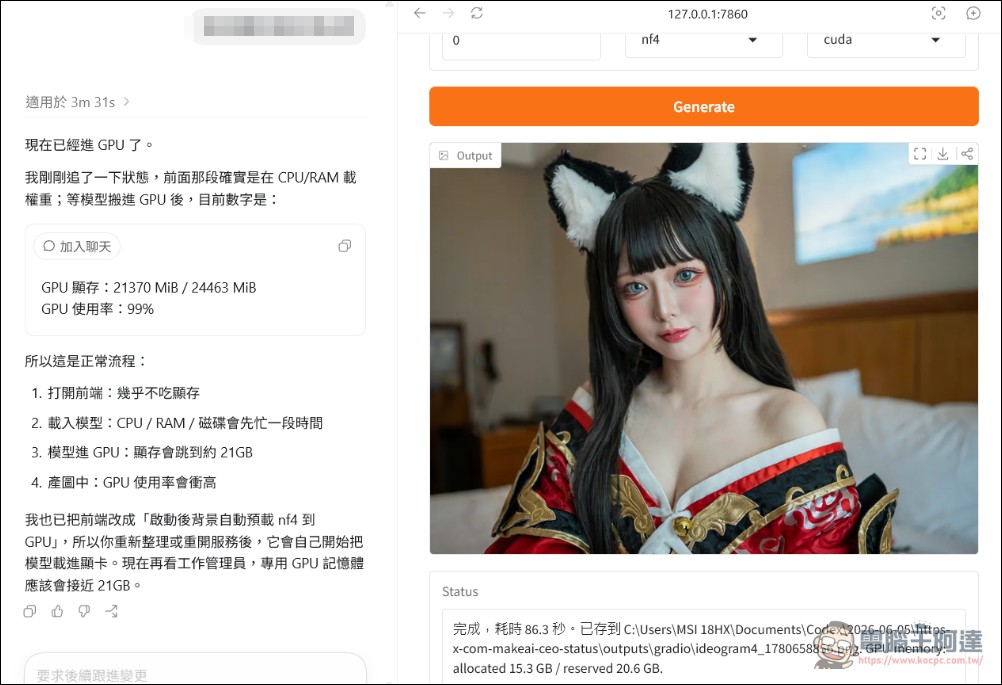
ComfyUI integration is particularly noteworthy. The community has already built complete workflows, with detailed tutorials covering model downloads, node configuration, and generation examples, which significantly lowers the technical barrier for local deployment. I also successfully deployed it locally and generated images; the quality is really quite good, and image sizes start at 1024:

Product features: Design workflows that go beyond generation.
Beyond the model itself, Ideogram has also introduced multiple design-oriented features to its product:
- Prompt Editing(Prompt Edit): Directly modify specific regions on a generated image
- native transparent backgroundDirectly export transparent PNG layers.
- Layered textText elements can be edited independently.
- Expand and Recompose(Extend / Reframe): Expand the frame outward or change the aspect ratio
- Enlarge(Upscale): Improve resolution
- Mix and match(Remix): Generate variations based on existing images
- Magic Fill(Magic Fill): Local Area Fill
- MCP IntegrationSupport Agent Workflow
Editable text and layers are coming soon.
Significance for the Industry: Open Source Catching Up to the Frontier
The release of Ideogram 4.0 represents an important signal:Open-weight models are already approaching the closed-source frontier in design-grade image generation.On Design Arena, Ideogram 4.0 ranked just behind OpenAI’s and Google’s closed-source models, and in typography and text rendering—the two dimensions professional designers care about most—it even surpassed all competitors.
This strategy is reminiscent of Meta’s approach in the LLM space: trading open weights for community ecosystems, and using those ecosystems to solidify a technical position. Ideogram is choosing to take the same path in image generation, and doing so in a market still dominated by closed-source solutions. For users concerned about data privacy, those who need brand-specific fine-tuning, or those who simply want to run models locally, this is an unprecedented option.
Of course, commercial licensing remains the barrier to entry. The Non-Commercial agreement on the model weights means that businesses looking to integrate them into products or services must pay for a separate commercial license. This is the dividing line between open source and “free to use,” and it is the foundation of Ideogram’s business model.
Source: KOCPC Chinese