


The Microsoft Research AI Frontiers team released Fara1.5, a completely open source computer-operated Agent model family in May 2026, and provides three parameter sizes of 4B, 9B, and 27B, all released under the MIT license, and the weights are hosted on HuggingFace. Among them, Fara1.5-27B achieved a high success rate of 72.3% in the Online-Mind2Web benchmark test, surpassing OpenAI Operator’s 58.3% and Google Gemini 2.5 Computer Use’s 57.3%. A small model with 27B parameters beats a large closed-source commercial model in browser operation tasks.
Purely visual operation, without looking at the source code
The way Fara1.5 operates is quite intuitive: the model receives browser screenshots and conversation history, directly outputs mouse and keyboard actions after inference, and performs operations such as clicking, scrolling, and typing at the predicted coordinates. The entire process does not require an accessibility tree (accessibility tree structure), nor does it require additional parsing models to convert web pages into structured data. The model looks at pixels and outputs action coordinates.
The action space covers standard mouse and keyboard input, as well as meta actions such as web search and context management. The model can record certain facts for use in subsequent steps, and can also proactively ask questions when the user lacks information. Each step refers to the most recent three screenshots and outputs an action, forming a cycle of observation, thinking, and action. The loss function is only applied to the last three steps of each trajectory, allowing training to focus more on recent decision points rather than distant history.
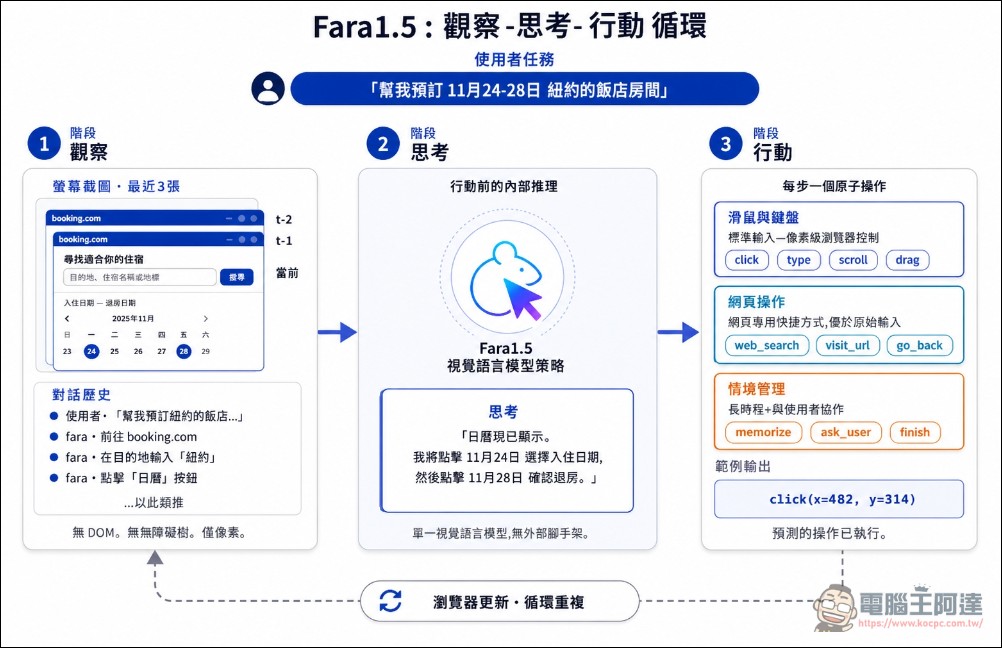
The advantage of this purely visual approach is its versatility. Unlike solutions that rely on DOM trees or accessibility trees, Fara1.5 sees the same screen as human users, and the operation logic is not limited to specific web frameworks or front-end technologies. Whether the website uses React, Vue, or traditional server rendering, the model is just pixels. The price is higher reasoning cost: each step needs to process a complete screenshot, and the generation time of a single action of the 27B model will be significantly higher than that of the lightweight DOM parsing solution.
Three sizes, each with its own positioning
The Fara1.5 family is based on the Qwen3.5 architecture, and the three versions correspond to different cost and performance requirements.[1]:
- Fara1.5-4B: Minimal version, 80.8% on WebVoyager benchmark
- Fara1.5-9B: Medium version, Online-Mind2Web reaches 63.4%, WebVoyager reaches 86.6%, surpassing opponents such as MolmoWeb 8B, GUI-Owl-1.5 8B, Holo2 8B among similar models.
- Fara1.5-27B: The largest version, Online-Mind2Web reaches 72.3%, WebVoyager reaches 88.6%
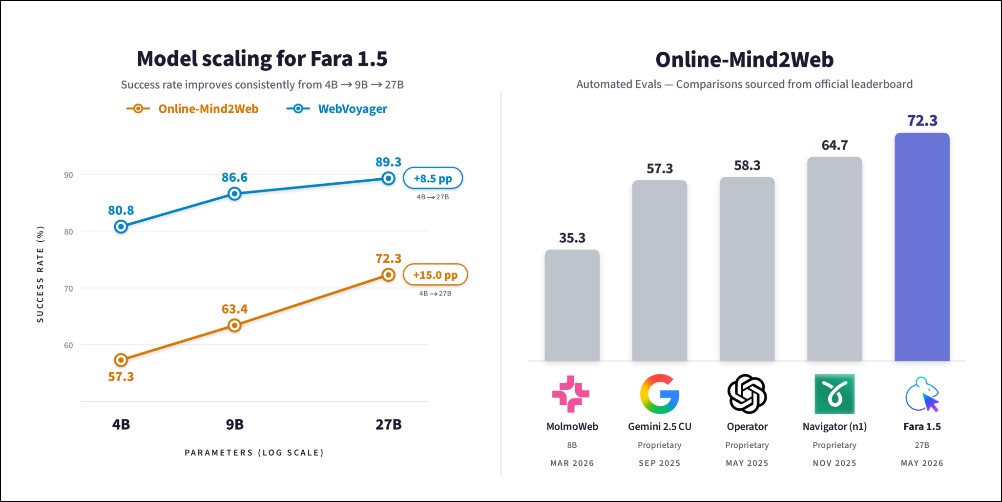
Online-Mind2Web covers 300 tasks on 136 popular websites and is the standard benchmark for evaluating browser agents. Fara1.5-27B’s 72.3% success rate is nearly double that of its predecessor, Fara-7B (34.1%).
Fara1.5 is trained to pause and ask the user in three situations: the task requires personal information that the user has not provided, the task description is ambiguous or missing, and an irreversible operation is about to be performed but has not been approved. The model also runs with the MagenticLite sandbox browser. All operations are logged for review. The sandbox also acts as a security boundary between the model and the user’s machine.
Fara1.5 is not Microsoft’s first attempt in the field of computer operating agents. In November 2025, Microsoft released Fara-7B, a 7B parameter model that is on par with GPT-4o on some benchmarks, completing the task in 16 steps on average, far better than UI-TARS’s 41 steps. The Fara-7B model is 16.6GB in size and can be executed locally on a regular PC without the data leaving the device.
In actual use, Fara1.5 can be driven through the command line tool fara-cli, or can be integrated into the Magentic-UI sandbox environment to operate. The deployment method supports obtaining the model endpoint from Microsoft Foundry, and then specifying the endpoint URL and API key in the JSON configuration file to start using it. Users can also download weights directly from HuggingFace and host them locally using inference frameworks such as vLLM, without the need for cloud services.
Fara1.5 HuggingFace Page
Comparison of open source AI Agent landscape
On the computer operation Agent track, OpenAI takes the closed API route, and the Operator can only be used through a paid interface; Google’s Gemini 2.5 Computer Use is also bound to cloud services. Microsoft chose to fully release the weight of Fara1.5 under the MIT license. Anyone can download it from HuggingFace and deploy it locally without relying on any cloud API. Models can also be hosted and executed via Microsoft Foundry.
However, Fara1.5 still has limitations. On the WebTailBench v1.5 long-tail task benchmark, the success rate of Fara1.5-9B is 32.3%, while GPT-5.4 reaches 57.4%. Large-scale commercial models still retain their advantages when dealing with rarer web page operation scenarios. Fara1.5 is currently positioned as a research preview and is still some way away from being deployed in production environments.
Source: KOCPC Chinese