


After widespread rumors that “Notepad++ will soon launch a macOS version”, this 22-year-old lightweight text editor that is loved by Windows users has once again become the focus. However, when everyone thought that this meant that the official version was finally going to be cross-platform, Don Ho, the original author of Notepad++, immediately came out to clarify: This macOS porting was not an official plan, and he himself was not involved in it.
Notepad++ developers remind users: the current version on macOS is not officially authorized
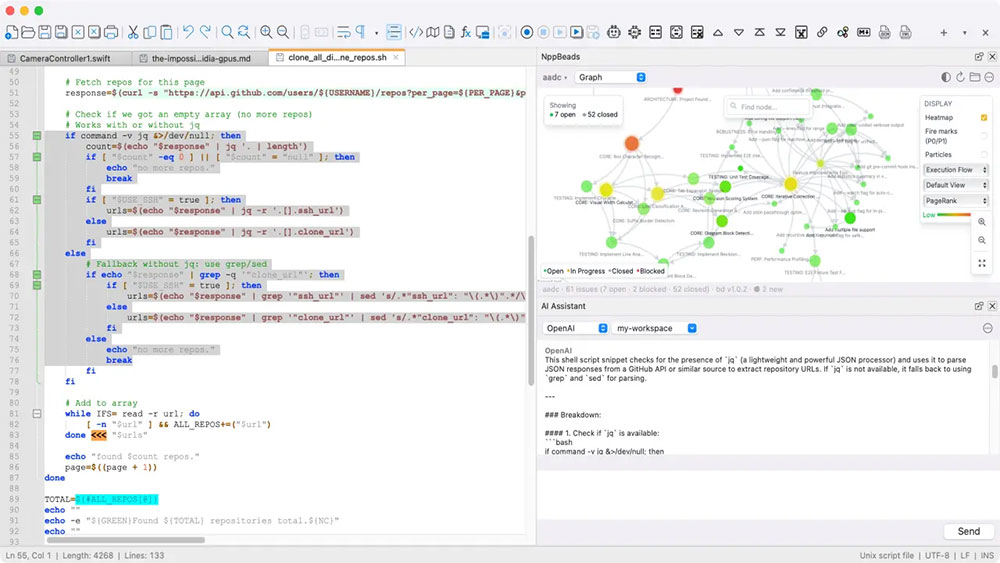
The macOS version that triggered the discussion this time was created by independent developer Andrey Letov using “vibecoded encoding” and used notepad-plus-plus-mac.org as the project website. Rather than relying on Wine, CrossOver, or virtual machines in the past, Letov’s version is a true native macOS application in Universal Binary format that runs directly on Apple Silicon and Intel Macs, which is one of the reasons why it has quickly attracted attention.
Notepad++ itself is licensed under GPLv3. Don Ho has always encouraged developers to fork the code and port it to other platforms. However, GPL does not mean that you can use trademarks arbitrarily. The name of Notepad++ and the chameleon icon are both protected by law. If a third-party port uses the same brand identity, it is easy for users to mistake it for the official version. This is the red line that Letov’s macOS version stepped on.
Not only did Letov use the official name and icon in the application, he even added Don Ho’s name to the “Notepad++ for Mac Authors” page on the project website, as if this was an officially endorsed collaborative project. when When users on GitHub questioned the move, Don Ho intervened and asked Letov to change the name and logo to avoid trademark confusion. Although Letov removed Don’s name, he still hopes that Don can “support” this transplant, and even expressed the hope that both parties can jointly expand the brand.
Don Ho’s attitude is quite clear: He refused to support the project and demanded that Letov immediately stop using the Notepad++ trademark and domain name. Letov refused to make immediate changes on the grounds that “rebranding will take a few weeks” and continued to put pressure on Don Ho, hoping to obtain official recognition. In the end, Don Ho reported the website to Cloudflare as a phishing/phishing website, believing that its behavior was enough to mislead users.
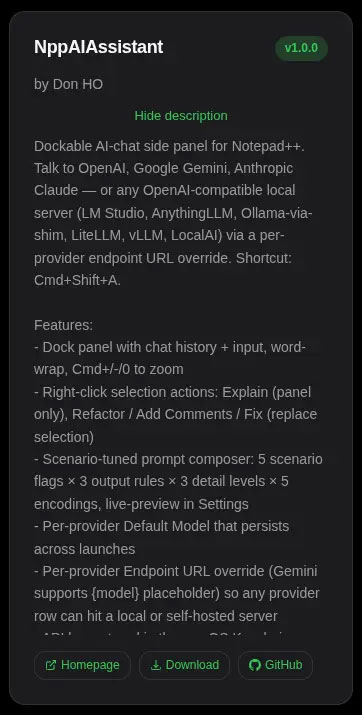
After the backlash in the community continued to mount, Letov finally made an announcement on the homepage of Notepad++ for Mac, stating that it would “cooperate” with Don Ho on brand adjustments, including a new logo, a new name and a possible new domain, and promised to launch relevant updates in version 1.0.6. He also removed inappropriate information from the author page. However, technology website Neowin discovered that Letov still mistakenly listed Don Ho as the author of an AI plug-in called NppAIAssistant (also using vibecoded encoding) on the plug-in page. The plug-in provides a dockable AI chat sidebar and supports OpenAI, Google and other models, which once again raised questions about the way its brand is used.
This incident also makes people think again: Why is there no official macOS version of Notepad++? The reason is actually quite technical. Almost all functions of Notepad++ rely on pure Win32 API, including menus, dialog boxes, file systems, and window management. Win32 API does not exist on macOS, so existing code cannot be directly compiled. To create a truly official macOS version, Don Ho had to rewrite the entire UI layer, which is equivalent to developing a new set of software. Even more troublesome is the plug-in ecosystem. Notepad++ plug-ins exist in the form of Windows .dll and are deeply dependent on the Windows architecture. Even if Don Ho is willing to invest a lot of time in rewriting the UI, the vast majority of plug-ins still cannot work on macOS, which is equivalent to destroying one of the core values of Notepad++. This is also the key reason why the official has never been cross-platform.
Source: KOCPC Chinese