


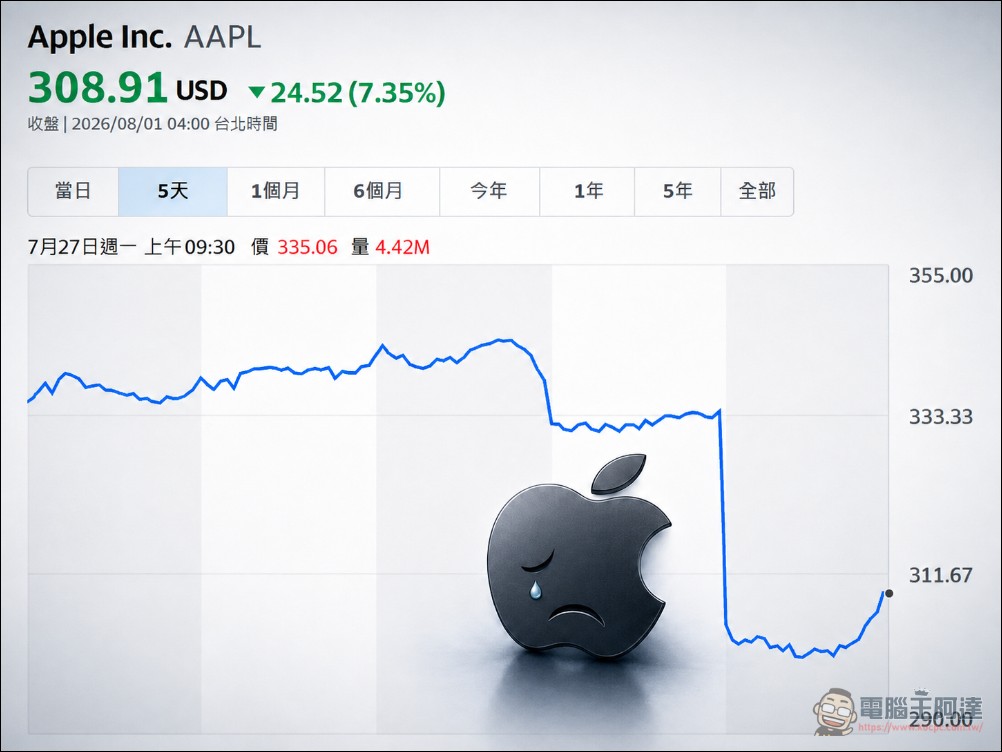
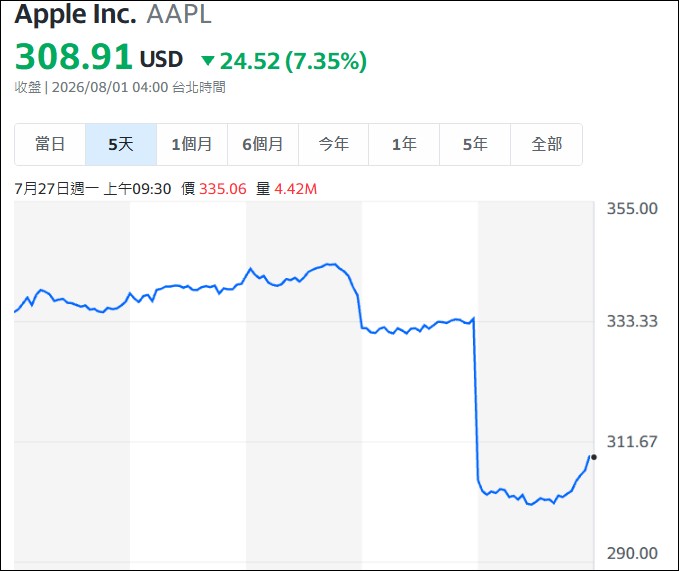
In its latest 10-Q filing submitted to the U.S. Securities and Exchange Commission (SEC), Apple issued a rare warning about its own artificial intelligence (AI) computing capacity: the company cautioned that computing resources required for AI and machine learning could face shortages, and that without sufficient capacity, features of its products and services could be limited, potentially even forcing delays to the launch schedules of new products and services. The filing comes as Apple faces multiple pressures from surging memory chip prices and expanding supply chain bottlenecks, with its stock plunging for two consecutive trading days after the earnings report, wiping out nearly $500 billion in market value at one point.
In the fiscal Q3 2026 earnings report just released on July 30, covering the period ending in June, Apple posted its highest revenue ever at $109 billion (approximately NT$3.5 trillion), up 16% year over year. iPhone and Mac sales beat expectations, growing 22% and 29% respectively, with profits reaching $29 billion, up 26% year over year. Apple called it the strongest June quarter in its history.
蘋果 Q3 財報營收 1,094 億美元創新高,iPhone 成長 22%、Mac 創史上最佳,但服務事業未達預期盤後跌 6%
New 10-Q Risk Section: Dual Warnings on Computing Power and Components
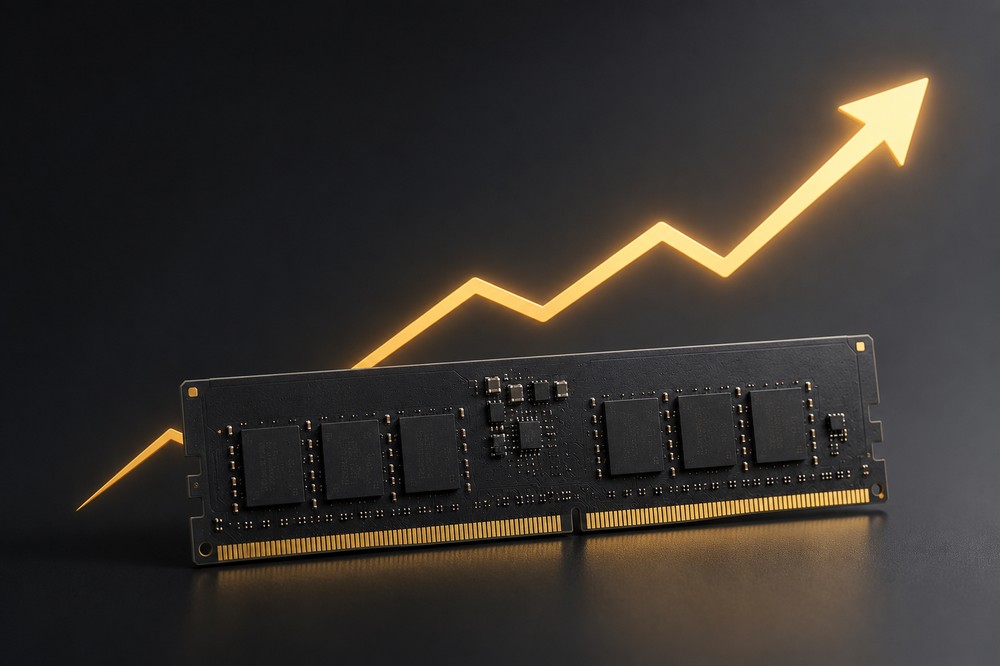
Behind the impressive surface performance, Apple has added a new risk disclosure section on “components and computing resources” in its 10-Q filing, expressing deeper concerns about its supply chain and AI infrastructure. Apple first noted that concentrating component procurement among a small number of specific suppliers makes the company more vulnerable to price fluctuations and supply shortages, which could ultimately hurt overall revenue. The ongoing shortage in the memory chip industry is causing Apple the most headaches, with price volatility in NAND Flash and DRAM already severely impacting Apple’s ability to secure sufficient components on commercially reasonable terms.
What draws more attention is the AI computing power side. Apple admitted that its AI and machine learning services are highly dependent on “whether it can obtain sufficient computing resources.” Unlike competitors such as Google and Amazon, which have poured huge sums into developing their own AI infrastructure and custom chips, Apple has never invested in AI data center construction on a large scale, instead relying on third-party computing power—such as renting Google’s infrastructure. Now that industry-wide demand for AI infrastructure has surged, the market is seeing tight supply, longer delivery lead times, and rising procurement costs. Apple warned that if it cannot secure sufficient capacity on commercially reasonable terms in the future, the functionality and availability of its products and services will be limited, and the rollout of new products and services may also be forced to be delayed.
Memory is experiencing a “once-in-a-century flood.”
The memory demand driven by the AI boom is the core source of pressure on Apple’s supply chain. Outgoing CEO Tim Cook described on the earnings call that memory prices are experiencing a “once-in-a-century flood,” significantly driving up manufacturing costs for products like the iPhone and Mac. He admitted: “We are seeing some very serious supply bottlenecks, and the supply chain has almost no slack to resolve them.” Cook also stated this is not an ordinary supply issue—the root cause lies in inaccurate demand forecasting, and supply will be extremely tight in the coming quarter.
Apple’s concerns about its supply chain have been reflected in its inventory strategy. As of this quarter, Apple holds $11.1 billion (about NT$360 billion) in inventory, nearly double the $5.7 billion from last September, breaking the “minimize inventory” principle that Cook has long followed. Last month, Apple also “reluctantly” raised prices for Mac and iPad. The supply chain squeeze is not over yet; Apple estimates revenue growth of 9% to 11% this quarter, lower than the roughly 16% level of previous quarters, while analysts had originally expected about 12%.
After the earnings report was released, Apple’s stock fell more than 7% in after-hours trading and plunged nearly 10% at the close on July 31, marking the biggest single-day drop since the pandemic-driven selloff in March 2020. The company lost nearly $500 billion in market value (approximately NT$16.2 trillion), and its crown as the world’s most valuable company was handed back to AI chip giant NVIDIA. Morgan Stanley analysts noted in a report that Apple’s bargaining power over its supply chain appears to be in question, and AI has so far not become a clear driver for its products or services, leaving how to monetize it an open question.
This wave of memory and computing power shortages is not just Apple’s problem. Meta, Samsung, Microsoft, and Sony have all raised prices on their hardware due to rising memory costs. The supply shortages and price increases triggered by major tech companies scrambling to secure advanced manufacturing capacity and memory chips for AI data centers are expected to shrink both the PC and smartphone markets this year. Ben Bajarin, CEO of market research firm Creative Strategies, said bluntly: “Even a company of Apple’s scale says it has exhausted supply chain flexibility—that’s bad news for everyone.”
Amid supply chain shadows, Apple also revealed expectations for its AI product line. During the earnings call, Cook noted that the new Siri has entered public beta, calling it a “huge opportunity” for Apple in AI. He said that running AI on-device has strategic significance and is, to some extent, a competitive weapon. Apple is in talks with EU authorities with the goal of launching the new Siri globally at the same time. Additionally, Apple’s gross margin this quarter rose by about 2 percentage points thanks to tariff rebates, amounting to roughly $1.1 billion. Cook said the money will be “reinvested in America,” continuing the previously announced four-year, $600 billion US manufacturing plan.
Apple’s AI Computing Power Strategy: Low-Key In-House Development, Reliance on External Support
Apple’s AI infrastructure strategy has always taken a different path from other tech giants. Apple primarily runs AI workloads through its “Private Cloud Compute” (PCC) ecosystem, emphasizing on-device computing and privacy protection. When it comes to details about its self-developed AI server chips, Apple has consistently kept a low profile, in contrast to Google and Amazon, which have aggressively rolled out their own chips. Previously, Apple revealed that it is working with Google and NVIDIA to expand the PCC ecosystem onto NVIDIA’s chip architecture through Google Cloud, aiming to ease computing power pressure—which also explains why Apple relies so heavily on third-party computing capacity.
Conclusion
In its 10-Q filing, Apple officially listed “compute shortage” as a risk factor, effectively admitting the Achilles’ heel of its AI strategy: by not building its own data centers and not aggressively developing its own AI chips, it now has to rely on others in the AI computing race. For investors, Apple’s compute anxiety compounded with its memory crisis shows no signs of easing in the near term. Cook will hand over the CEO role to Senior Vice President of Hardware Engineering John Ternus in September, and the new leader’s first test will be how to maintain Apple’s product launch and sales cadence amid the supply chain storm—but it looks like there’s little choice other than raising prices.
Source: KOCPC Chinese