


In recent years, new graphics cards have become more and more powerful and consume higher power. Therefore, when operating at high speed, in order to effectively reduce heat energy, the graphics card’s fan will spin very fast and make a loud sound, which some users may find noisy. Recently, two foreign netizens shared their modifications. Through 3D printing and modified fans, they can effectively reduce the fan noise of RTX 5090 and RTX 5080. Among them, the RTX 5090 netizen also shared a video of the noise before and after modification. The difference is really much different.
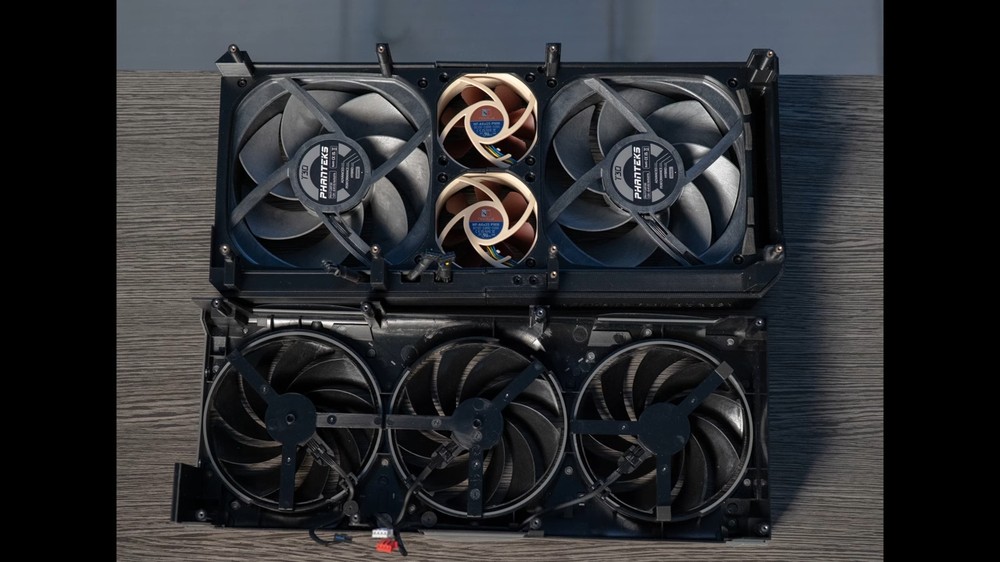
Image source: Reddit
After foreign netizens modified RTX 5090/RTX 5080 fans, they significantly reduced the noise during heat dissipation.
The first is a Reddit user madsmadalin. The graphics card he uses is MSI RTX 5090 Ventus. This card originally only had three fans, but after his skillful modification, it now has four fans, two large and two small.
Ultimate Shrouds uses a customized 3D printed air guide to allow the MSI RTX 5090 Ventus to accommodate two Phanteks T30 fans and two Noctua NF-A6x25 PWM fans. Not only that, but also similar to the design concept of ASUS ROG Astral, a third T30 fan can be installed at the rear:
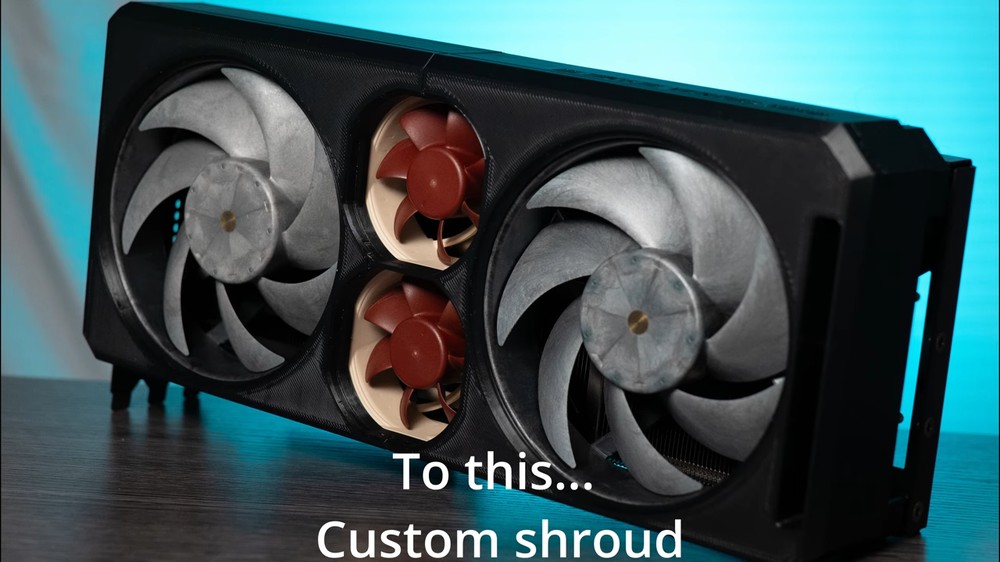
Image source: YouTube
In order to let everyone clearly understand the difference, he also recorded a test video. Although there is not much difference in low-speed operation, as the operation speed increases, the gap increases, especially in full-speed operation (maximum noise test). The fan combination of Phanteks T30 and Noctua only produces 41 decibels of noise, while the noise of the same graphics card using the original fan exceeds 50 decibels, a decrease of about 10 decibels:
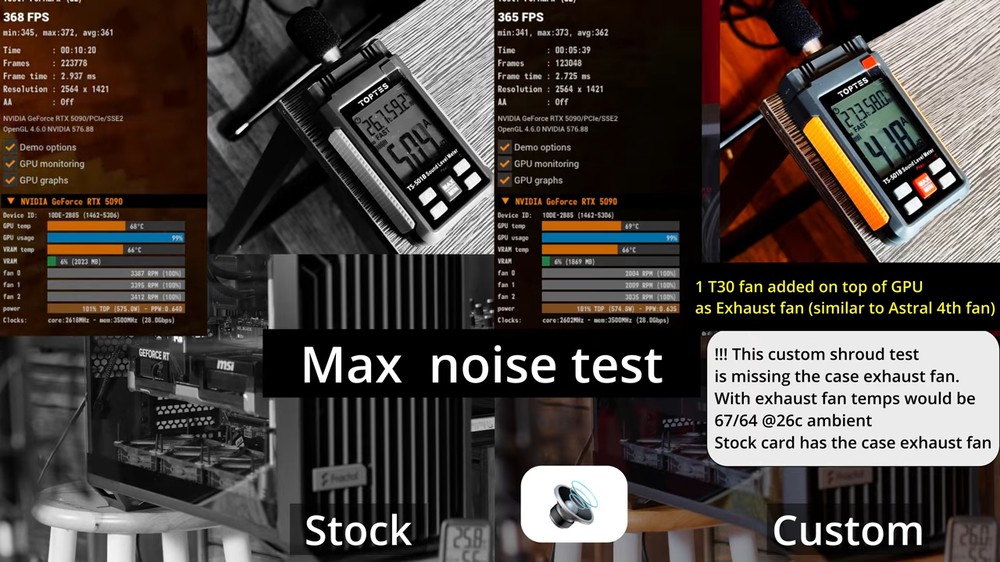
Image source: YouTube
Some other netizens believed that such modifications would melt. madsmadalin replied: “I haven’t seen any deformation. The lower half of the heat sink fins are not that hot. PETG 70°C will cause deformation, and the actual blown temperature is much lower than this number.”

This is a test video:
Next, another netizen aartr shared his Gigabyte RTX 5080 Gaming OC graphics card modification on the NVIDIA Reddit forum.
aartr said that although this graphics card is already very quiet, some sound can still be heard at the lowest fan speed of 30%, so it was decided to modify it. And luckily, this air guide can be removed without disassembling the radiator. You only need to unscrew one screw in each of the four corners of the graphics card, which is much simpler.
A bit similar to the previous one, aastr also designed a 3D customized bracket for the RTX 5080 Gaming OC graphics card, equipped with two 120mm and one 92mm fans, and fixed them on the original radiator. All fans are connected through a 2.0mm JST-PHD 2×6 connector:
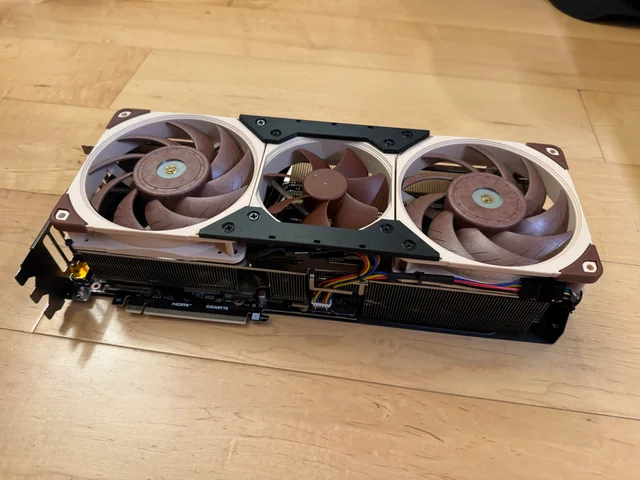
Image source: Reddit
He then also conducted tests. The graphics card was overclocked to about 3150 MHz. When running Steel Nomad, the power consumption was about 400W. The temperature did not exceed 74°C, and the fan speed was still lower than 1250RPM.
A netizen asked about the difference in temperature and noise, and aartr replied that using roughly the same fan settings, the temperature dropped by 6°C. At about 80°C (1200RPM) before modification, the noise has become smaller, but there is no specific data. It can still be heard at close range, but the frequency of the sound is less harsh.
Although it is said that only the bracket and fan are replaced, such modification still requires some relevant experience, as well as the skills to connect the fan.
Compared with other modifications, this is very safe. The internal cooling components are not changed, only the active cooling is changed, so just make sure the lines are connected correctly.
Source: KOCPC Chinese