


Google officially announced Android 17 and its most important strategic core at the “The Android Show | I/O Edition” online conference held on May 13, 2026:Gemini Intelligence,宣告 Android 从传统作业系统转型为「智能系统」(Intelligence System)的新时代。 This Google’s new AI platform may be first installed on Samsung’s new generation folding flagships Galaxy Z Fold 8 and Z Flip 8, debuting before the Pixel series.
What is Gemini Intelligence? The AI soul of Android 17
According to Google’s official statement, Gemini Intelligence is not a simple voice assistant upgrade, nor is it a functional extension of another Gemini chatbot, but a new capability framework that deeply embeds AI into the bottom layer of the Android system. It is a system-level agent that is completely driven by AI. Users can use voice or simple text commands to automatically perform complex multi-step tasks across applications without step-by-step manual operations.
For example, when users need to order food, they only need to state their needs, and Gemini Intelligence can automatically search for nearby restaurants, select meals and complete the order; it can also read the course syllabus in Gmail and directly complete the textbook purchase; it can even read the shopping list in the memo and automatically generate a shopping cart on the e-commerce platform, and the user can complete the checkout with a simple confirmation. Google positions Android 17 as “the transformation from an operating system to an intelligent system,” and Gemini Intelligence is the core engine of this transformation.
The first batch of exposed Gemini Intelligence functions include four highlights:
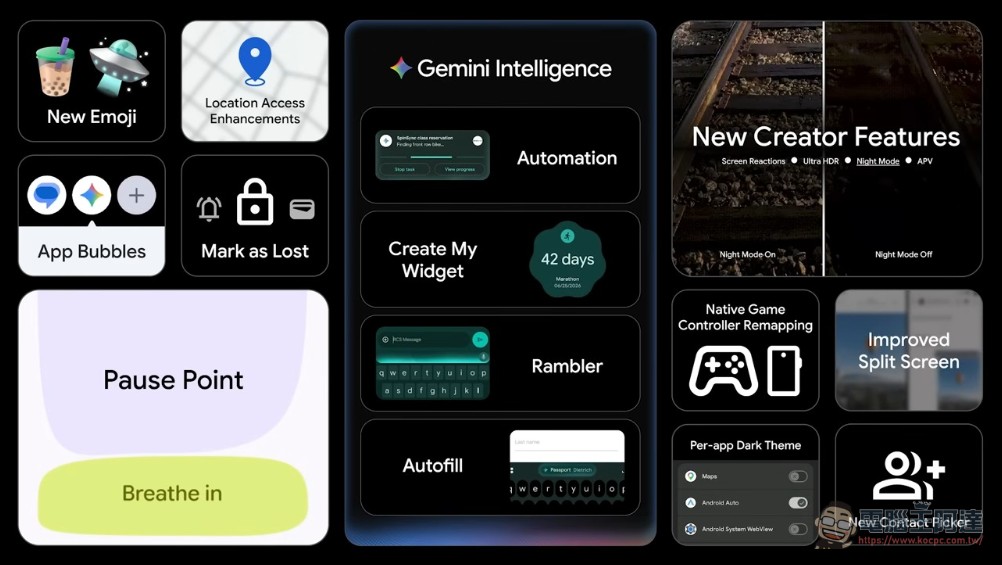
New Gemini task interface design language: When Gemini performs tasks in the background, the system will instantly display the processing status with a new visual design language, replacing the traditional background circles or small icons in the notification bar, allowing users to clearly understand what the AI is doing and where it is.
Smart Autofill cross-application automatic filling: This is not a traditional form auto-fill, but a more advanced version – the system can use the user’s data in Google applications (such as Gmail, Google Calendar, Google Maps) to perform more accurate and contextual auto-fill, such as automatically filling in passport information when booking a hotel, and automatically entering the delivery address when shopping.
Gboard “Rambler” voice input: The biggest highlight of the new speech-to-text function is that it can instantly correct recognition errors while the user is speaking, instead of the traditional “record first and then recognize”. Google calls it “error-corrected speech input,” and it’s especially useful in situations where spoken language is unclear, the environment is noisy, or there’s a mix of multiple languages.
“Create my Widget” AI desktop gadget generation: Directly generate desktop widgets using natural language descriptions. For example, if a user says “I want a widget that displays the weather and calendar,” the system will automatically generate widgets that meet the needs, greatly lowering the threshold for customizing the mobile desktop.
Why did Z Fold 8 become the launch platform? Samsung and Google deepen AI alliance
The partnership between Samsung and Google in the field of AI has already taken shape as early as early 2025. The Galaxy S25 series deeply integrated the Gemini AI assistant for the first time, setting a precedent for Samsung mobile phones to be directly equipped with Google’s system-level AI. Later at CES 2026, Samsung announced that Google Gemini would be introduced into the Bespoke series of home appliance product lines, marking the expansion of the cooperation between the two parties from mobile phones to the IoT ecosystem.
Samsung Electronics co-CEO Lu Taiwen revealed in an interview that by the end of 2025, Samsung had successfully promoted Gemini AI functions to approximately 400 million devices, covering the two major categories of smartphones and tablets, and plans to double the number of devices equipped with Gemini AI to 800 million units in 2026. At the Samsung Galaxy S26 launch in February this year, the two parties publicly demonstrated the actual operating prototype of the Gemini mobile phone smartphone for the first time. At that time, it was regarded by the industry as a preview of the subsequent upgrade of Apple Intelligence.
Based on this cooperation, it is not surprising that the Z Fold 8 series has become the first launch platform for Gemini Intelligence. The large internal screen of a foldable screen phone (the standard version of the Z Fold 8 will be equipped with an 8-inch internal screen) is the best stage to showcase the multi-tasking automation capabilities of Gemini Intelligence. In the unfolded state, users can simultaneously see the real-time progress of AI execution tasks, view the switching status of multiple applications, and preview the results of each step of the automation process. This is an experience that is unmatched by traditional candy bar phones.
According to the information currently exposed, Samsung is expected to The second half of the year Galaxy Unpacked launch event will be held in London on July 22, 2026, launched three new foldable phones in one go: the standard Galaxy Z Fold 8, Galaxy Z Flip 8, and the Galaxy Z Fold 8 Wide, which entered the wide folding market for the first time. The standard version of Z Fold 8 will be equipped with Qualcomm’s fifth-generation Snapdragon 8 Extreme Edition for Galaxy processor, an 8-inch inner screen and a 6.5-inch outer screen, a 200-megapixel main camera with a 50-megapixel ultra-wide-angle and a 10-megapixel 3x telephoto lens, up to 16GB of memory, a 5000mAh battery and support for 45W wired fast charging, and comes with One UI preloaded 9 system.
Other AI innovations in Android 17: Not just Gemini
In addition to Gemini Intelligence, Android 17 also brings a number of noteworthy system-level updates. Android 17 adopts the new Material 3 Expressive design language, the interface has richer translucency and blur effects, and the notification bar, quick settings and volume panel have been redesigned. In addition, a new App Bubbles feature that allows applications to run in the form of floating windows. This feature is particularly useful for large-screen folding devices and Android tablets. It is also seen as a direct response to Google’s increasing emphasis on folding screens and multi-tasking scenarios.
In terms of digital health, Android 17 also adds a “Pause Point” function to guide users to take a break after using their mobile phones for a long time, echoing the attention of technology giants on mobile phone addiction in recent years.
Competing product layout: Google, Samsung, and Apple’s three-party AI battle enters a system-level duel
The launch of Gemini Intelligence directly elevates the AI mobile battlefield from the application level to OS level competition. Review the three major AI smart platforms currently on the market:
- Apple Intelligence(Apple, published at WWDC 2024): Good at deeply integrating with the Apple ecosystem, and performs well in scenarios such as message summary, photo editing, and cross-device collaboration, but the advancement speed is relatively cautious
- Galaxy AI(Samsung, published in 2024): Focus on improving users’ creative productivity, such as AI drawing, voice transcription summary, real-time translation, etc., focusing on simple and intuitive creative tools
- Gemini Intelligence(Google, published in May 2026): System-level AI integration directly led by OS manufacturers, relying on Google’s technological leadership in cloud AI and large language models, focusing on seamless automation across applications
Google takes a completely different route from Apple. Apple Intelligence emphasizes privacy-first device-side processing and closed ecosystem integration, while Gemini Intelligence relies more on the computing power of Google Cloud AI and the advantages of the open Android ecosystem, emphasizing cross-brand and cross-application automation capabilities. Samsung is caught between the two. On the one hand, it deeply integrates Google Gemini as a system-level AI partner, and on the other hand, it continues to develop its own Galaxy AI functions to maintain brand differentiation.
According to the schedule announced by Google, Gemini Intelligence will be first launched on Samsung Galaxy series and Google Pixel series devices that meet the hardware requirements in the summer of 2026. The final official version of Android 17 is expected to be pushed to Pixel series devices in June, and will be expanded to other brands in the second half of the year. It is completely reasonable to speculate that if the Samsung Z Fold 8 series is released in late July, it will become the first hardware device equipped with Gemini Intelligence.
summary
The advent of Gemini Intelligence marks that the Android camp has officially entered the era of “AI native operating system”. Google chose to deeply bind with Samsung and use the Z Fold 8 series as the first hardware carrier. It is obviously that the large-screen multi-tasking attribute of the foldable model can best reflect the value of AI agents. On the unfolded 8-inch screen, the automated operation of system-level AI can present a real productivity upgrade.
The next key question is: Can this system-level AI surpass Apple Intelligence in actual experience? How can Samsung retain the brand differentiation of its own Galaxy AI while deeply integrating Google Gemini? With Galaxy Unpacked approaching in July, these questions will soon have answers. But what is certain is that the second half of 2026 will be the most fiercely competitive season in the history of AI mobile phones.
Source: KOCPC Chinese