


Far EasTone Telecommunications recently announced that it has officially signed a cooperation agreement with Amazon’s low-orbit satellite network service “Amazon Leo” to become its authorized distributor in Taiwan. This also means that Taiwan’s telecom operators have selected low-orbit satellite (LEO) service partners.It symbolizes that Taiwan Telecom’s three major players have taken a key step in the integrated communication layout of satellite and ground, gradually expanding into diverse scenarios such as consumer and enterprise applications and emergency response.
What is the content of Far EasTone Telecom’s low-orbit low-orbit service as an agent for Amazon Leo? What is Taiwan Telecom’s Sanxiong low-orbit satellite service deployment plan? The following is a summary and explanation:

With Far EasTone Telecommunications announcing that it has become the official authorized distributor of Amazon Leo low-orbit satellite services, the space battle for Taiwan’s three major telecommunications low-orbit satellite services has officially started! Although Taiwan has not introduced Starlink, which currently has the largest market share of low-orbit satellite services in the world, for some reasons, Taiwan has introduced Eutelsat OneWeb, AST SpaceMobile, and Amazon Kulper (Amazon Leo), each with its own characteristics. Below is a summary video and detailed description of Taiwan’s Space Satellite Battle:
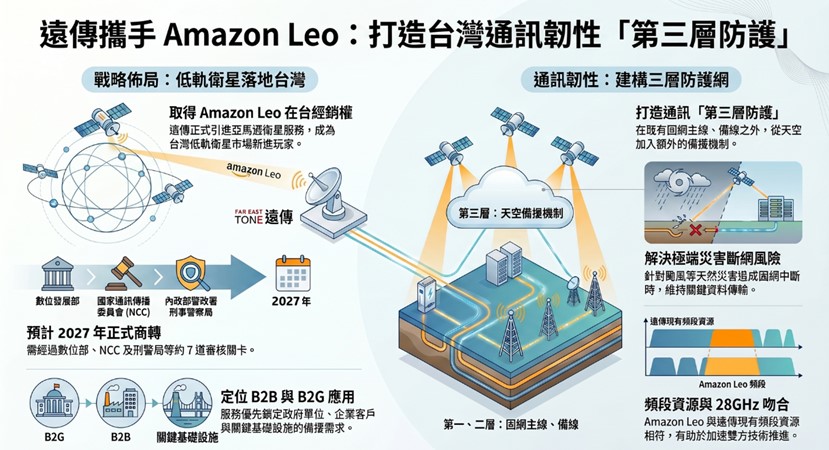
1. Far EasTone Telecommunications is the agent of Amazon Leo low-orbit satellite service:
Because the 5G 28GHz frequency band (28.5GHz ~ 29.3GHz) held by Far EasTone Telecom overlaps with the frequency band (28.5GHz ~ 29.2GHz) required for terminal equipment planned for the “Amazon Leo” low-orbit service (Amazon Kulper) low-orbit satellite, it successfully defeated Chunghwa Telecom and officially announced on May 19, 2026, that it would become the authorized agent of the “Amazon Leo” low-orbit satellite. Since Amazon plans to set up a terrestrial relay station in Taiwan, Far EasTone Telecom is expected to become Amazon’s partner in the terrestrial relay station in Taiwan and provide extremely low network latency and ultra-high bandwidth for the Taiwanese government and enterprises.
Far EasTone Telecommunications said: “Amazon Leo” low-orbit satellites are designed to support wide coverage, low latency, and connection needs in areas where terrain or extreme weather may limit traditional network performance. It can quickly provide stable connections to make up for the difficulty of full coverage of terrestrial networks. Compared with traditional satellite solutions, “Amazon Leo” low-orbit satellite services have lower latency, higher bandwidth and wide coverage characteristics, meeting enterprises’ high standards for performance and reliability. Among them, the enterprise-level flagship model Leo Ultra can achieve a download speed of up to 1 Gbps and upload speeds up to 400 Mbps, which can support high-traffic and high-immediacy enterprise-critical applications. Currently, Amazon Leo is still positioned mainly for enterprise and government applications, and is essentially closer to fixed-line services provided through satellites than to general consumer satellite networks. Far EasTone plans to incorporate “Amazon Leo” into the overall network architecture and telecommunications service portfolio, which will assist public sector livelihood applications and enterprise users in maintaining network connections required for key systems and operational processes to ensure uninterrupted services.
Amazon Leo When will the service be officially provided in Taiwan?
Far EasTone Telecom stated that “Amazon Leo” is still in the application and planning stages. Since telecommunications and satellite services are highly regulated industries, Far EasTone has submitted an application for spectrum assignment to the Ministry of Digital Development. It will also need to go through multiple processes such as NCC operation plan, construction plan, and criminal police station testing. The overall process has about 6 to 7 levels, and each level may take several months. If the overall process goes smoothly, Amazon Leo has the opportunity to officially launch services in Taiwan in 2027.
2. What are Taiwan Telecom’s Sanxiong low-orbit satellite service deployment plans?
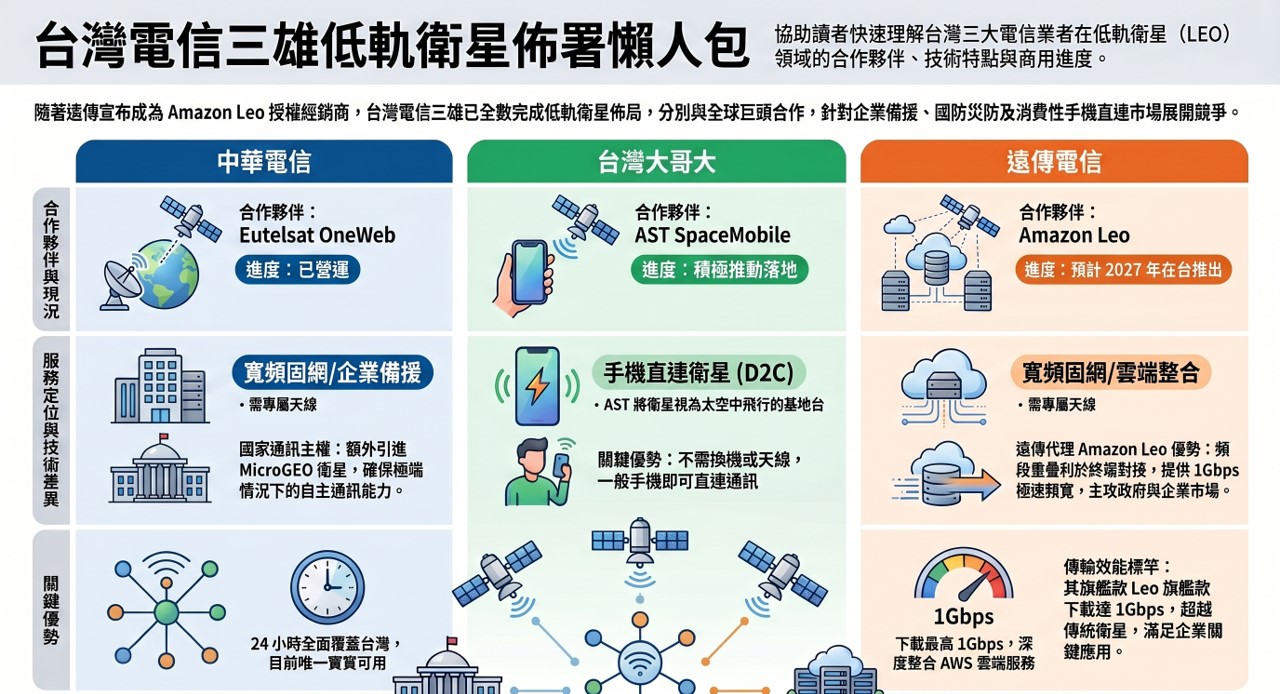
Chunghwa Telecom, Taiwan Mobile and Far EasTone Telecommunications have each introduced Eutelsat OneWeb, AST SpaceMobile, and Amazon Kulper (Amazon Leo) in their low-orbit satellite service deployments. Among them, Chunghwa Telecom OneWeb has officially been operating in Taiwan, SpaceMobile signed an MOU with Taiwan Mobile at MWC 2026, and Amazon Leo officially signed an authorized reseller with Far EasTone on May 19, 2026.
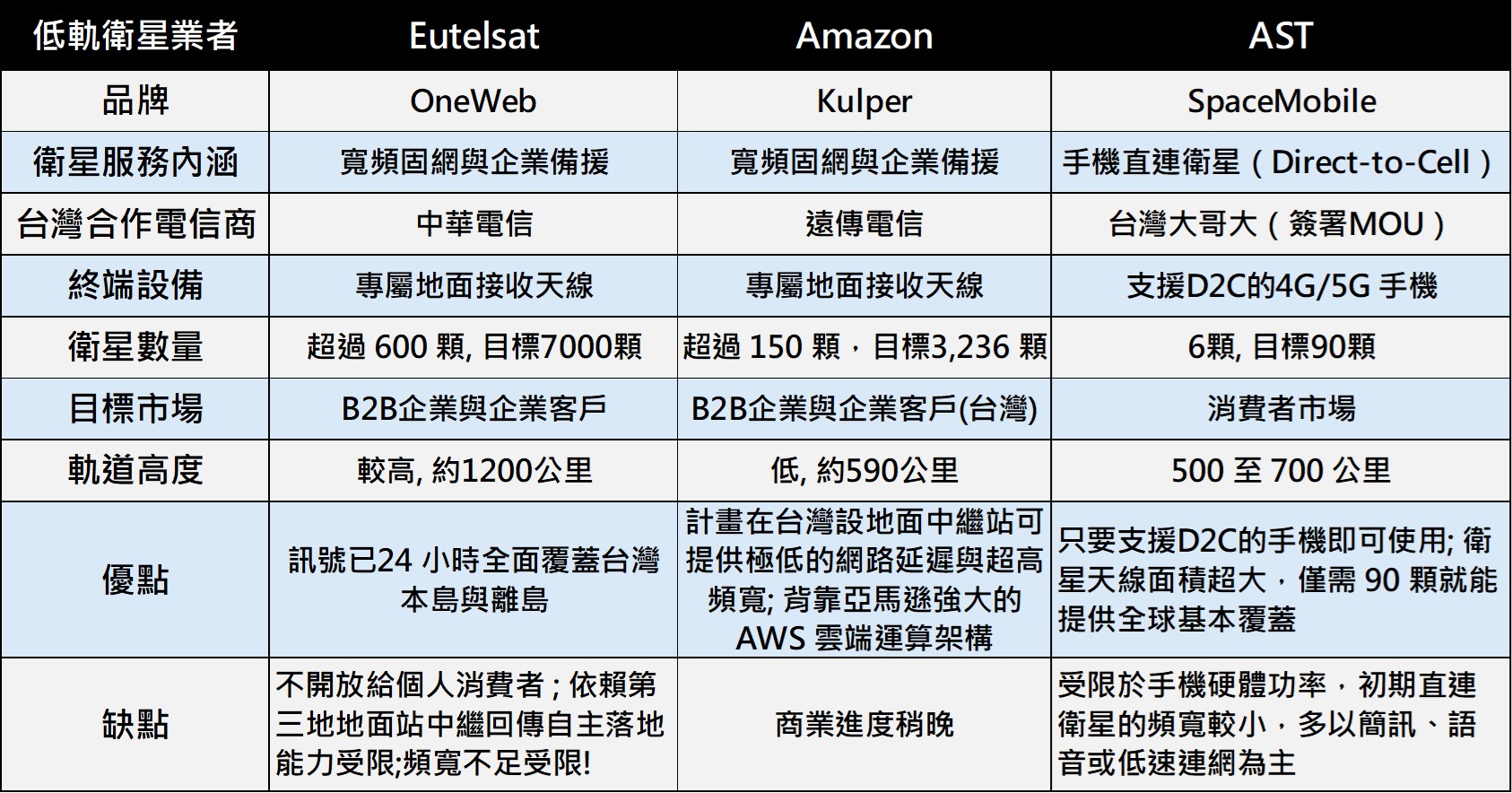
OneWeb and Amazon Leo are positioned as broadband fixed-line and enterprise network backup. Users must have exclusive ground receiving antennas, and their target customers are government and B2B corporate customers. AST SpaceMobile is positioned to provide mobile phone direct-to-satellite (D2C, Direct-to-Cell) services, targeting the consumer market. Consumers can use them only if they have a 4G/5G mobile phone that supports D2C function.
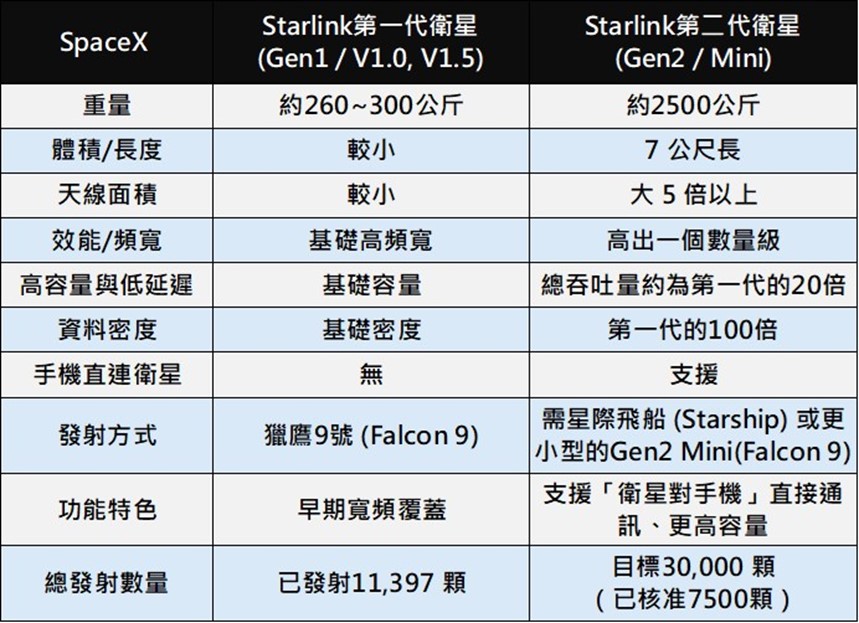
Due to regulatory restrictions and SpaceX’s unwillingness to introduce Starlink, which currently holds the largest market share in low-orbit satellite services in the world, to Taiwan, OneWeb and Amazon Leo are targeting the first-generation satellite services of SpaceX Starlink for the low-orbit satellite services that Taiwan will provide; AST SpaceMobile is targeting the second-generation satellite services of Starlink.
The following is a detailed description of Taiwan Telecom Sanxiong’s deployment of low-orbit satellite (LEO) services:
A. Chunghwa Telecom│OneWeb:
[Eutelsa OneWeb] is a multinational satellite communications service company established in 2023 by the merger of French satellite communications giant Eutelsat and British low-orbit satellite (LEO) startup OneWeb. It is the world’s first operator to combine “Geostationary Orbit (GEO)” and “Low Earth Orbit (LEO)” and is committed to providing seamless global broadband network coverage. The altitude of deployed satellites is about 1,200 kilometers, and more than 600 satellites have been launched so far, with the ultimate goal of 7,000 satellites.
OneWeb’s advantage is that it has matured internationally and ranks second in the global low-orbit satellite market. Currently, the signal has 24-hour full coverage of Taiwan’s main island and outlying islands. Currently, it is mainly used for measured download speeds up to 90~100 Mbps. It is the only low-orbit broadband satellite service currently available in Taiwan.;The disadvantage is that it is not open to general individual consumers to apply directly, and it mainly relies on relay backhaul from third-place ground stations such as Thailand and Guam. The ability to independently land when the submarine cable is interrupted is slightly limited. In addition, OneWeb’s bandwidth is still limited. When a large amount of demand comes in at the same time, there will still be insufficient bandwidth to meet Taiwan’s national defense needs.

Chunghwa Telecom officially obtained the OneWeb low-orbit satellite fixed communications commercial license approved by the government on June 3, 2025, becoming the first domestic operator to obtain this license. Currently, it has cooperated with the “non-synchronous orbit satellite” disaster preparedness network and Leihu Technology promoted by the Ministry of Data and Development to bring into play the key benefits of low-orbit satellites in diverse fields such as maritime patrol, disaster relief, offshore energy and ocean monitoring.
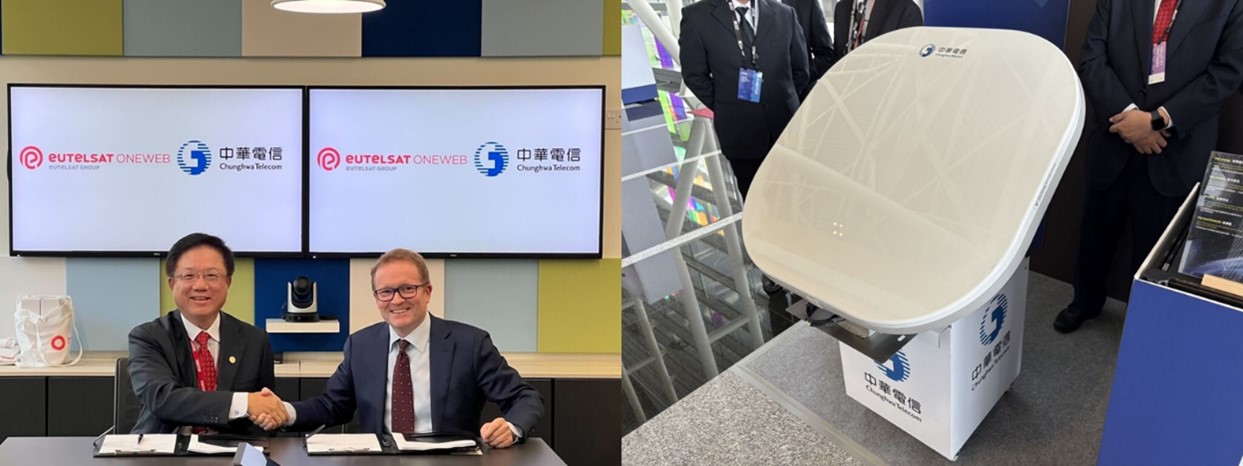
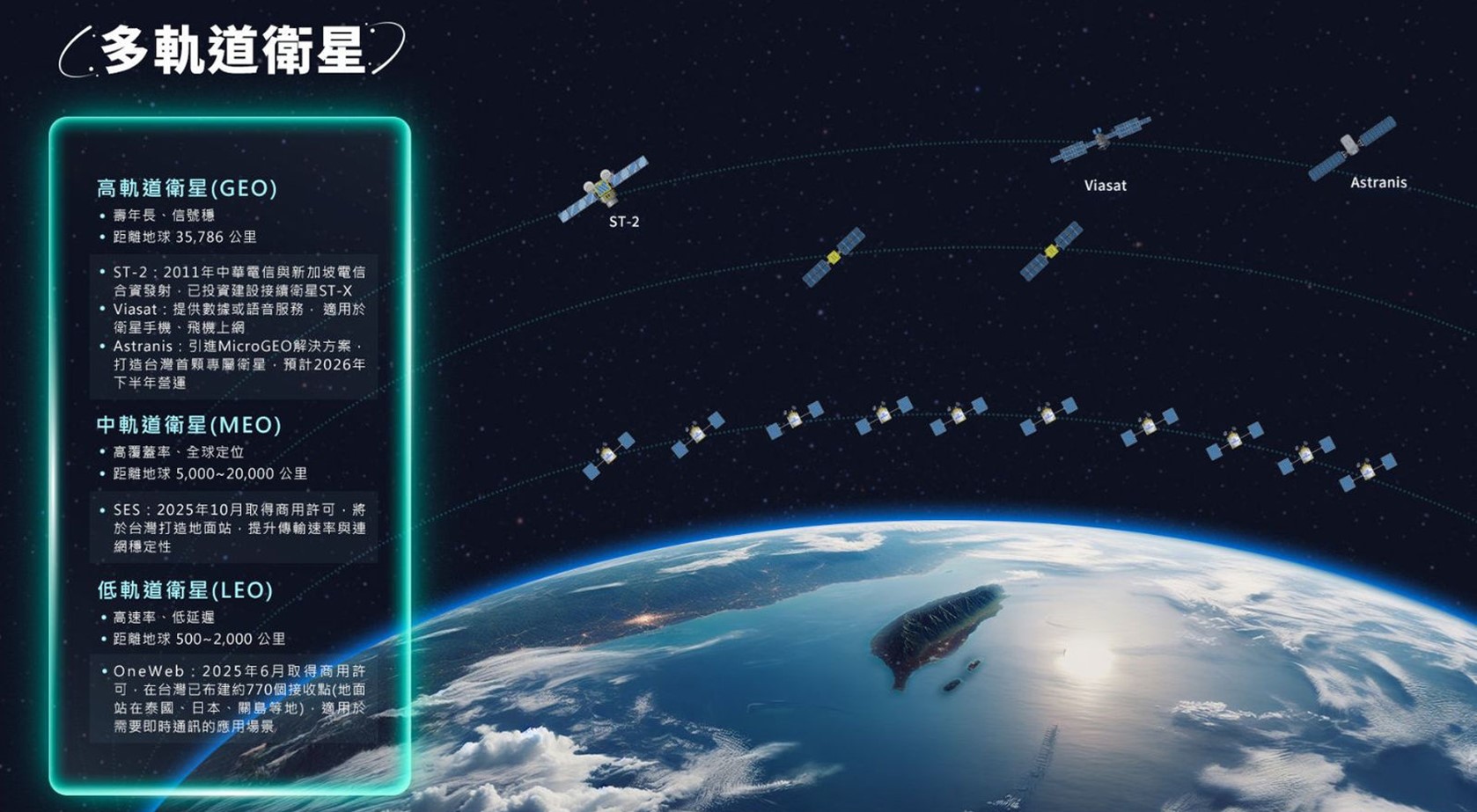
Due to the limited bandwidth provided by OneWeb, in order to strengthen Taiwan’s communications sovereignty and strategic resilience, Chunghwa Telecom has signed a cooperation with the American Astranis Satellite Company in addition to the original high-orbit satellite (ST-2) and low-orbit satellite (OneWeb) to introduce the third-generation MicroGEO satellite. As Taiwan’s first “sovereign satellite” with full control, the entire frequency band is fully reserved for Taiwan’s use without foreign control and interference, ensuring that the country can still maintain external communication capabilities under extreme circumstances.
B.Taiwan Mobile│AST SpaceMobile:
[AST SpaceMobile (ASTS)] is a listed satellite designer and manufacturer headquartered in Midland, Texas, USA. It has more than 3,000 patents and has solved the “Doppler effect” and “signal delay” problems when satellites are directly connected to mobile phones. Compared with SpaceX’s Starlink first-generation satellites, which require ground receivers (Dish), ASTS was established to build base stations in space with the goal of “eliminating signal dead zones (Dead Zones).”The [BlueBird Satellite] designed by ASTS is located 690 to 700 kilometers in space. When the satellite is deployed, it covers an area of approximately 2,400 square feet. It is like a tennis court flying in space. It can capture weak signals from mobile phones on the ground and send strong signals back to the ground. It is currently the “largest commercial area” communication array in low orbit.
The advantage of ASTS is to use “SpaceMobile” technology to realize direct-to-cell (D2C) satellite services, turning satellites into very large base stations in space. When users are in mountains, oceans, or wilderness areas with no signal, they do not need to change their mobile phones or buy expensive antennas. The original mobile phone can receive 5G signals transmitted by satellites for calls and Internet access. Because the antenna area is 9-10 times that of ordinary satellites, only 90 satellites can provide basic global coverage; the disadvantage is that the manufacturing and launch costs of a single satellite are extremely high, andBusiness progress is lagging behind. also,And limited by the hardware power of mobile phones, the bandwidth of direct satellite connections in the early stage is small and can only provide text messages, voice or low-speed Internet connections.
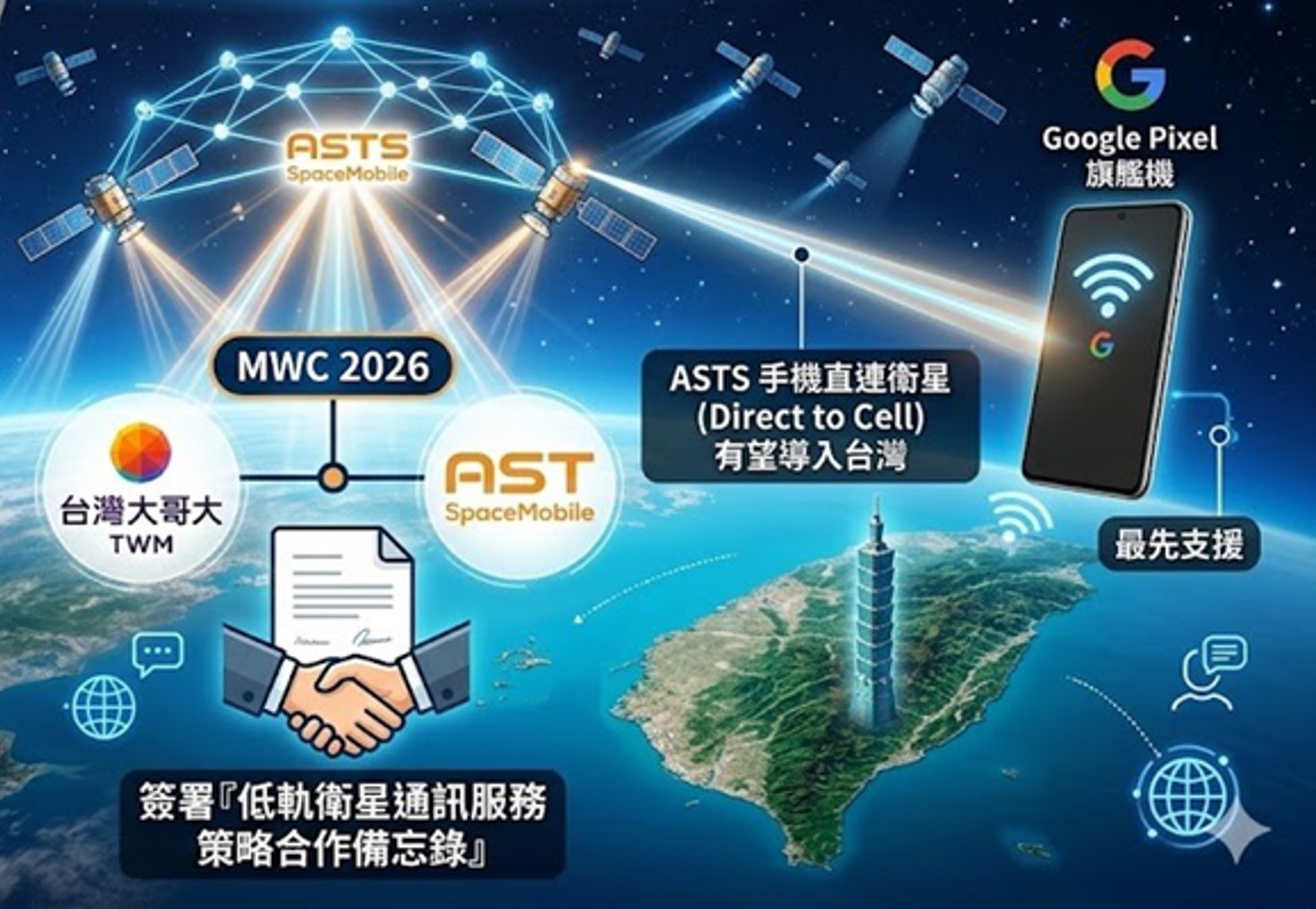
Taiwan Mobile announced on March 2, 2026 that it had signed a “Low Orbit Satellite Communication Service Strategic Cooperation Memorandum” with AST SpaceMobile. It will promote the coordinated operation of space base stations and existing mobile networks in Taiwan, accelerate the implementation of satellite-ground integrated communication architecture, strengthen all-time and all-terrestrial networking capabilities and communication resilience, and moreIt is no longer far off for Taiwan to provide direct to cell satellite (D2C) for mobile phones!
C. Far EasTone Telecom│Amazon Leo(Amazon Kulper):
[Amazon Leo (Amazon Kulper)] is a low-orbit satellite (leo) service owned by Amazon. It plans to build a low-orbit network of 3,200 satellites 590 kilometers above the earth to provide broadband services to consumers, businesses, and government customers around the world. The project has so far launched more than 600 satellites and is expected to launch services in the United States, the United Kingdom, France, Germany and Canada in March 2026, and launch satellite communication services in 26 countries and markets around the world in 2026. The advantage of Amazon Leo (Amazon Kulper) is that it plans to establish a wide range of ground relay stations in Taiwan, which can provide extremely low network latency and ultra-high bandwidth, with download speeds up to 1 Gbps and upload speeds up to 400 Mbps. In addition, the plan is backed by Amazon’s powerful AWS cloud computing architecture, which will be able to deeply integrate Amazon logistics, smart home and enterprise cloud services in the future; Amazon Leo’s disadvantage is that the commercial progress is slightly later than SpaceX Starlink and OneWeb, and it is still in the critical stage of intensively launching satellites to meet the FCC regulations. Taiwan will not be online until 2027 at the earliest.
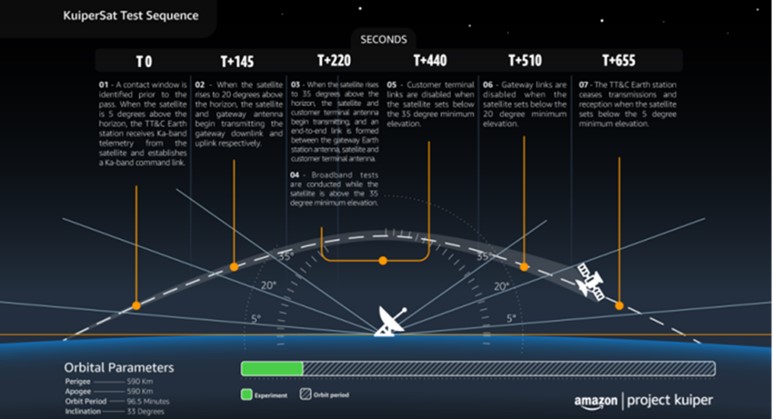
Amazon “Taiwan Amazon Kuiper Co., Ltd.” has been established in Taiwan and signed an official authorized dealer with Far EasTone Telecommunications on 2026/5/19, becoming the second low-orbit satellite operator to land in Taiwan after OneWeb. Amazon Leo service is positioned mainly for enterprise and government applications in Taiwan. The fixed network service provided through satellite will become one of the important backup mechanisms in addition to Taiwan’s terrestrial network.。

Source: KOCPC Chinese