


Since 2026, major technology companies have all made every effort to promote employees to use AI tools to improve productivity. However, this enterprise AI application craze is heading towards a situation that is completely out of control. From Microsoft asking employees to abandon Claude Code and switch to its own Copilot CLI, to Uber burning through its annual AI budget of US$3.4 billion in four months, to an employee known as “Token Legend” appearing within Meta who consumed 281 billion tokens in 30 days, it is estimated that the cost of AI use for enterprises has exceeded labor costs, and what is even more worrying is that the high investment in AI Tokens has not brought about an equal proportion of production capacity improvement.
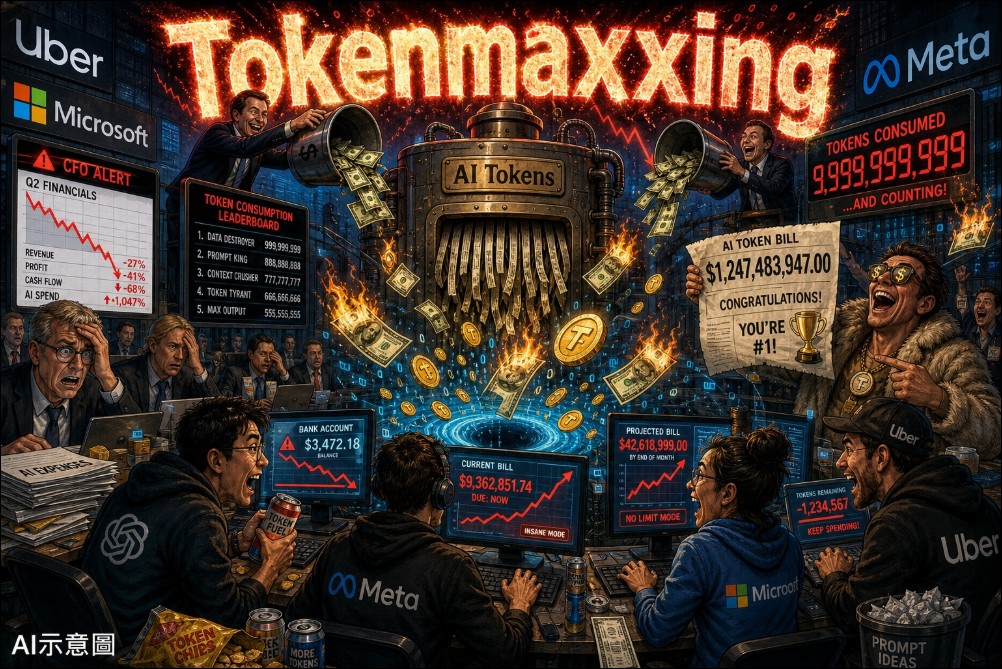
The cost of AI Token has exceeded human labor! Tokenmaxxing absurd drama under the frenzy
Microsoft takes the lead in chopping down Claude Code: On the surface it’s a company strategy, but in reality it’s a cost consideration
The starting point of the incident is within Microsoft. According to foreign reports, Microsoft’s Experiences + Devices department (covering major product lines such as Windows, Microsoft 365, Teams, Outlook and Surface) is canceling internal Claude Code authorization on a large scale, requiring thousands of developers to switch to GitHub Copilot CLI before June 30.

The official statement claims that this is to promote the adoption rate of internal Microsoft self-developed tools, but people familiar with the matter revealed that the real reason is that as the number of users increases, the token consumption cost of Claude Code continues to rise, which is far beyond the acceptable range of enterprises. Although Microsoft is also one of Anthropic’s largest investors, when it comes to internal tool selection, this is clearly not a charity competition.
Uber’s $3.4 billion annual AI budget reaches zero in four months
If Microsoft’s case still has a strategic color of “turning to its own ecosystem”, then Uber’s experience nakedly reveals the cruel reality of out-of-control AI costs. Uber CTO Praveen Neppalli Naga admitted in mid-April that the company had exhausted its entire 2026 AI budget, with US$3.4 billion (approximately NT$110.5 billion) evaporating in just four months.

This means that Uber burns an average of US$850 million in AI computing expenses every month. 95% of developers within the company have fully introduced AI auxiliary tools, each person spends up to US$500 to US$2,000 per month in tokens, and more than 70% of code submissions have been generated by AI. When token consumption changes from a production tool to a production indicator, cost control becomes an inevitable outcome.
Meta’s “Token Legend”: The absurd drama of Claudenomics rankings
Meta internally puts token consumption directly on the table and has become a core indicator for measuring employee productivity. It is reported that Meta has established an internal dashboard called “Claudenomics” to track the consumption of AI tokens by 85,000 employees, and awards titles such as “Token Legend” and “Session Immortal” to employees with the highest consumption.

The most astonishing figure is: the top user consumed 28.1 billion tokens in 30 days. If calculated based on API prices, this person alone spent millions of dollars. The entire Meta burned a total of 60 trillion tokens in 30 days, with an estimated cost of approximately US$9 billion (approximately NT$292.5 billion). Meta even sets “AI-driven impact” as its core performance expectation in 2026.
Tokenmaxxing culture: When AI usage becomes a vanity metric
NVIDIA CEO Jensen Huang once made a famous point on the All-In Podcast: an engineer with an annual salary of $500,000 would be “deeply worried” if he did not consume at least $250,000 worth of AI tokens. Fueled by this argument, this phenomenon of blindly piling up token usage has been called “Tokenmaxxing” (token maximization) and has become the 2026 version of “productivity measured by lines of code”, and it may be worse. Business Insider reported that in the Silicon Valley engineering community, showing off weekly token spending has become a status symbol: “I spend thousands of dollars on tokens every week. It feels crazy but I can’t stop.”
Amazon employees admitted to deliberately using AI to handle irrelevant tasks to boost internal usage data, and Microsoft and Meta have similar problems. However, Jon Chu, a partner at Khosla Ventures, bluntly said that this is an “extremely stupid policy” because Meta employees have begun to write robot programs that will only consume tokens in an infinite cycle to compete for rankings. Cristina Cordova, Linear’s chief operating officer, even mocked: “Using tokens to rank engineers is as ridiculous as using the marketing team to rank who spends the most money.”
10 times the cost, 2 times the output: the marginal benefit of AI investment is collapsing
Can the high cost be exchanged for an equal proportion of performance improvement? Research data suggests a negative answer. Performance analysis of AI coding tools by research organizations such as GitClear, Faros AI and Jellyfish pointed out:
- Invest 10 times the token budget and only get 2 times the output, the cost per unit of sustained output is 5 times higher
- Code churn soared 861%, AI generates a large amount of unnecessary code which is then repeatedly modified and discarded.
- Maintenance cost of AI-generated code reaches 4 times that of traditional code in Year 2
- GitHub Copilot expects to switch from flat monthly fee to usage billing in June 2026, because the difference in token consumption is too large, the per capita monthly fee model can no longer be maintained.
According to relevantThe investigation pointed out, an engineer with a token budget 10 times higher will only increase his output by 2 times, which is equivalent to paying 5 times the cost per unit of output. Moreover, a large amount of code generated by AI has not been actually verified, but is accumulated in the code to form invisible technical debt.

Jevons Paradox: The cheaper the token, the more shocking the bill
AI model training costs and API call prices have indeed continued to decline, but this reflects the Jevons Paradox in economics: when technical efficiency improves and reduces unit costs, it will stimulate more usage demand, ultimately leading to an increase in total consumption instead of a decrease. As CFOs of major companies begin to examine the actual bills of AI spending, Jevons’ Paradox is brutally unfolding.
Cleo founder Barney Hussey-Yeo is one of the CEOs most actively embracing tokenmaxxing. He said in an interview that he spends about 27,000 pounds (approximately US$36,000 / NT$1.17 million) per month on AI tokens and encourages employees to consume token quotas of up to US$2,000 per month. He firmly believes that “engineers who do not use AI extensively will soon be eliminated.” However, whether this extreme approach is sustainable remains to be tested by time.
Back to Output Metrics: Salesforce Leads the Rethink
Amid the token consumption frenzy, Salesforce has chosen a different path. The company is pushing for performance metrics based on business outcomes, explicitly rejecting token consumption as a vanity metric for productivity. This also implies that the industry has begun to reflect: when token consumption becomes the goal itself, real productivity is left behind.
Analysts pointed out that the practical value of AI tools is undeniable, but if companies try to use AI to completely replace manpower and reduce labor expenses, while ignoring the diminishing marginal nature of token consumption, this set of cost reduction measures will ultimately be counterproductive. When the growth rate of the number of tokens required for a task far exceeds the decrease in the unit price of tokens, the billing figures will continue to hit new highs.
Conclusion
From Microsoft’s mandatory conversion tool, Uber’s budget crunch, to Meta’s Token Legend rankings, enterprise AI applications in 2026 are facing a profound cost correction period. token 降价带来的不仅是普及,也制造了前所未有的浪费,这是一场技术进化与资源管理之间的经典矛盾。如何在不陷入「tokenmaxxing 陷阱」的前提下有效运用 AI,将是接下来所有企业必须面对的核心难题。
Source: KOCPC Chinese