


When it comes to specialized AI tools with “Code” in their names, like Claude Code and Codex, many people assume they can only be used for writing code—but that’s not actually the case.Anthropic recently released an official research report.We analyzed approximately 235,000 users and nearly 400,000 interactive Claude Code sessions between October 2025 and April 2026.
The results show that Claude Code’s usage has clearly expanded, and more non-engineers are starting to use it for technical tasks.
Anthropic analyzed nearly 400,000 Claude Code sessions: bug fixing is down, while software operation, data analysis, and documentation work are up.
Anthropic divides Claude Code’s work into nine modes; the results show that the majority still relates to programming and development. For example, “fixing broken things” accounts for 26%, and “building new things” accounts for 25%—about half of sessions still focus on typical use cases like writing and fixing code:
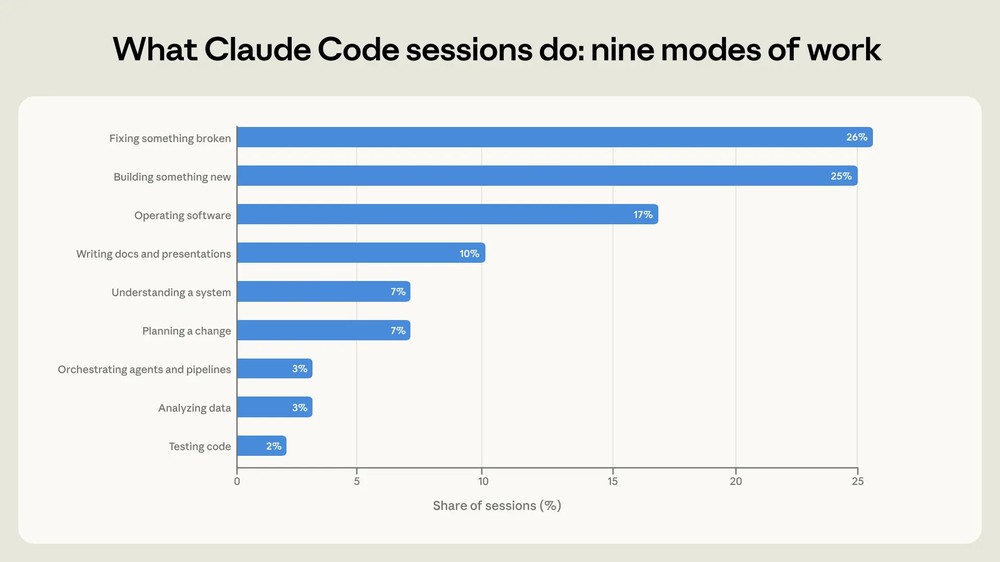
But looking further down, Claude Code’s use cases are clearly starting to expand: operating software accounts for 17%, writing documents and presentations 10%, understanding systems 7%, planning changes 7%, agent and automation pipeline orchestration 3%, and data analysis also 3%.
In other words, Claude Code’s practical use cases go beyond just generating code—it can also help you read projects, organize systems, run commands, adjust settings, and even produce documentation and data analysis results.
Looking at changes over time, this trend is even more pronounced.
Anthropic noted that from October 2025 to April 2026—a span of seven months—the share of Claude Code used for “bug fixing” dropped from 33% to 19%, a decrease of nearly half. In contrast, software operation rose from 14% to 21%, while writing and data analysis combined increased from roughly 10% to 20%:
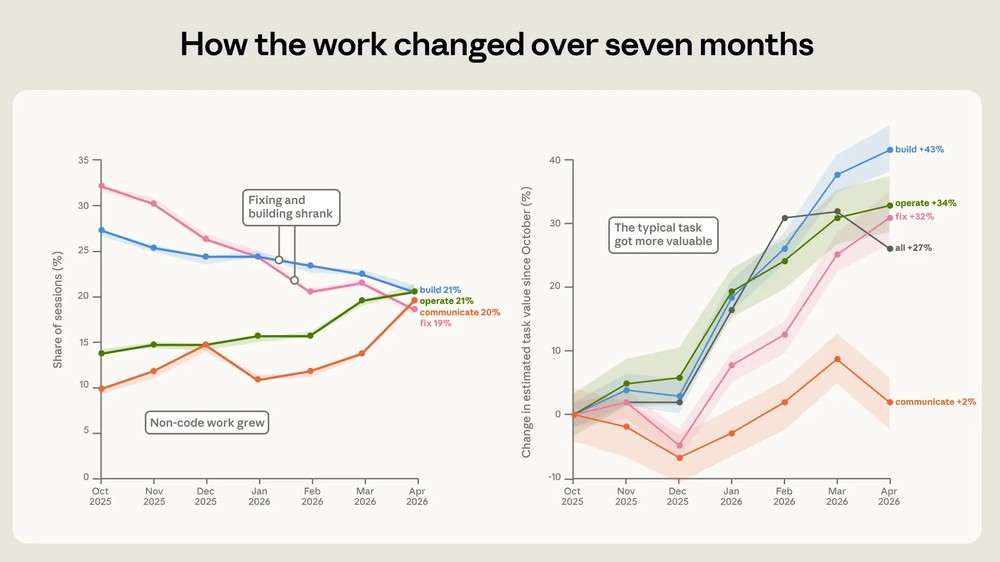
Anthropic also used freelance market postings to estimate the relative economic value of a session. The results showed that average task value rose 27% over those seven months. Tasks involving building something new increased by about 43%, operating software by about 34%, and repair tasks by about 32%.
However, please note that this is only a rough estimate used to compare how task value changes; it does not represent how much money each Claude Code session actually earns.
So who exactly is using Claude Code? Anthropic says they can infer users’ occupations from about 70% of sessions, and the largest group is still “computer and math-related occupations,” which covers most software-related jobs. That’s no surprise, since Claude Code originated as a developer tool.
But the second largest group is business and financial services, followed by fields such as arts, design, media, management, and life sciences, physical sciences, and social sciences.
The fastest-growing non-software occupational groups are management, sales, and legal-related positions.
Anthropic also shared how users and Claude Code split the work: in a typical session, users make roughly 70% of planning decisions but only 20% of execution decisions. In other words, users now mainly set goals, describe needs, and judge results, while leaving file searches, code edits, command execution, and content creation to Claude:
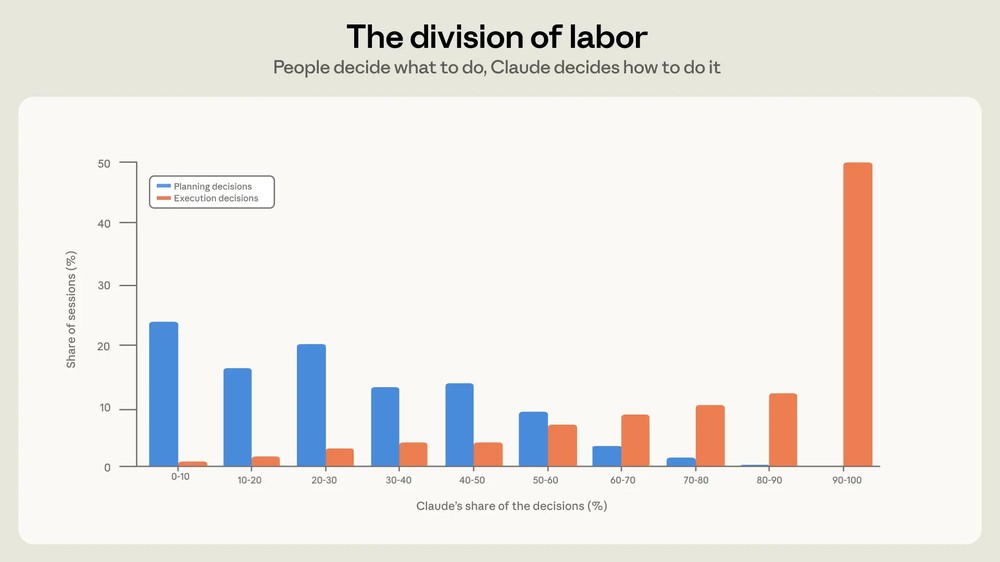
This is also why Claude Code is starting to appeal to non-engineers: now, as long as you can clearly explain the requirements and criteria, you don’t need to know how to code or how to get it done—you can leave it all to AI to execute.
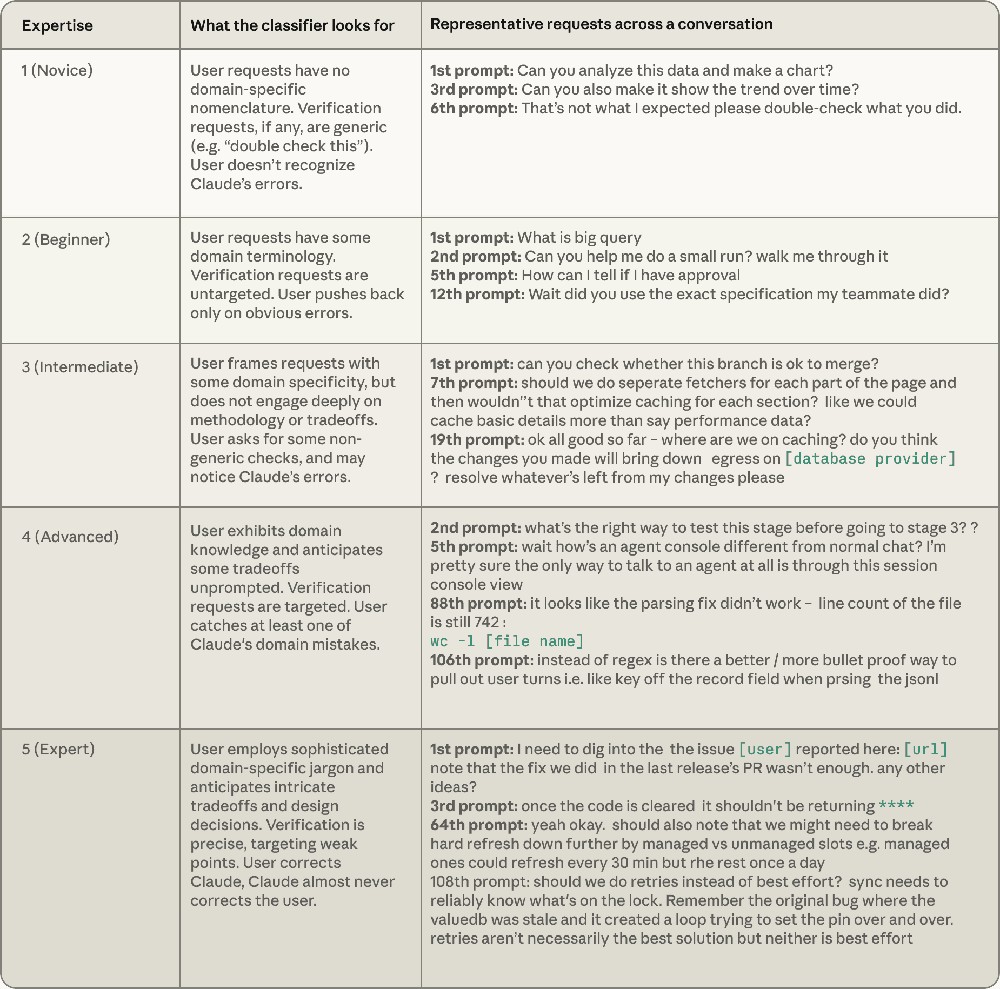
However, this doesn’t mean you can get away with knowing nothing. What Anthropic really wants to emphasize is that domain expertise is becoming more important. The company officially classifies users’ level of expertise for each task on a scale of 1 to 5, covering whether users can accurately describe their needs, know what to ask Claude to verify, and can catch Claude’s mistakes:
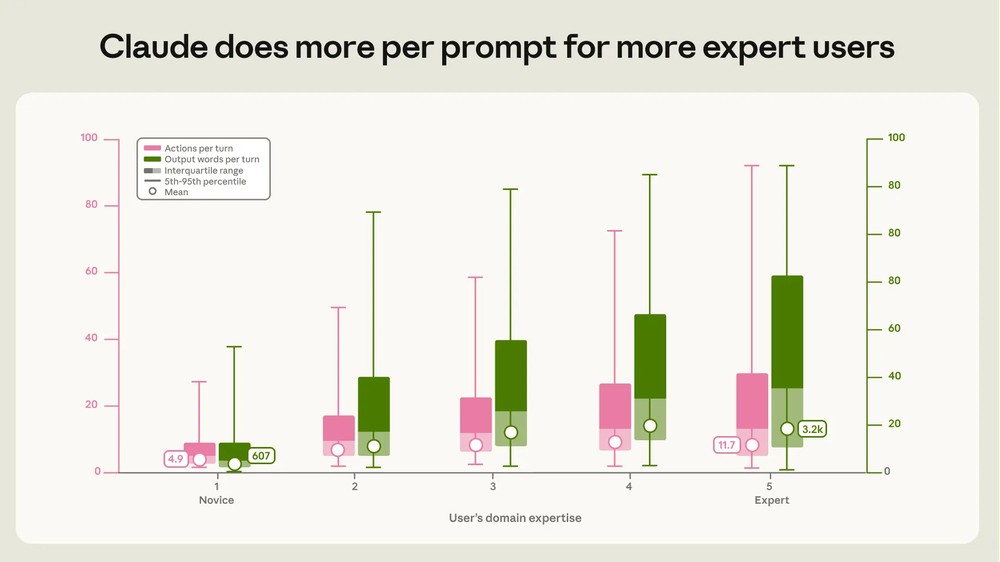
In a typical beginner session, each prompt from the user triggers Claude to perform about 5 actions and produce around 600 words of output; but in an expert session, each prompt triggers more than 12 actions and produces around 3,200 words. This means the more someone understands the problem, the more effective work they can get Claude to do with a single sentence.
Success rates also vary. Using Anthropic’s strictest “verified success” metric, novice sessions succeed roughly 15% of the time, with at least partial success at 77%. But for intermediate-level users and above, verified success rates rise to 28%–33%, while at least partial success reaches 91%–92%.
The biggest gap actually isn’t between intermediate users and experts, but between beginners and intermediate users. This means you don’t have to become an expert who really knows how to craft prompts; simply having a solid understanding of your own field is already very helpful.
Thus, with the emergence of AI agents, these tools are gradually becoming less exclusive to engineers and will become part of daily work across all industries.
Source: KOCPC Chinese