


Although the prices of DDR4 and DDR5 have increased significantly in the past, and DDR4 has even increased much more than DDR5, in terms of direct selling price, it is still cheaper than DDR5. Therefore, for players who are considering buying memory, they may want to buy DDR4 first. It shouldn’t have a big impact on game performance, right?
Recently, Tom’s Hardware re-tested 15 games and found that the performance loss caused by DDR4 is more obvious than expected, and some combinations will even make high-end processors completely unable to exert their due strength.
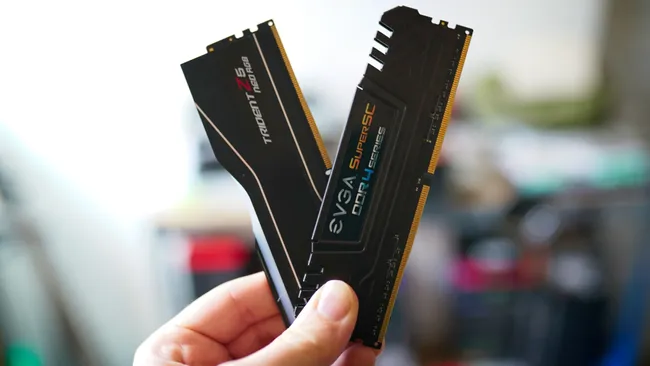
Image source: Tom’s Hardware
DDR5 is too expensive. How much can you save by switching to DDR4? LGA 1700 games are measured to be 11% to 14% slower on average, with a maximum difference of 25.3%.
Tom’s Hardware The processors tested this time include Intel’s 12th, 13th and 14th generation Core i5, Core i7 and Core i9, a total of 8 LGA 1700 processors. The purpose is not to compare Intel and AMD, but to take advantage of the fact that the same Intel processor can be paired with DDR4 or DDR5 to observe how big the difference in game performance will be after only changing the memory platform.
The graphics cards all use GeForce RTX 5090 Founders Edition, running at 1080p resolution, High and Ultra quality. The main reason for choosing 1080p and the fastest graphics card available is to minimize the GPU bottleneck and make the differences caused by the processor and memory easier to see.
As resolution increases and the load on the graphics card becomes heavier, the gap between DDR4 and DDR5 usually narrows.
The results for 15 games are as follows:
| processor | Performance gap with DDR4 |
|---|---|
| Core i9-14900K | -14% |
| Core i7-14700K | -13.2% |
| Core i5-14600K | -13.1% |
| Core i9-13900K | -11.3% |
| Core i7-13700K | -13.5% |
| Core i5-13600K | -11.4% |
| Core i7-12700K | -9.3% |
| Core i5-12600K | -9.5% |
It can be seen that the gap between the 12th generation Core i5-12600K and Core i7-12700K is about 9%. After switching to the 13th and 14th generations, most models have expanded to 11% to 14%. Therefore, it is obvious that the more powerful the processor itself, the higher the speed at which the memory is required to provide data, and the easier it is for DDR4 to hit a bottleneck.
In addition, this test also has a limitation that needs to be explained. The DDR5 platform uses 2×16GB DDR5-7200, while the DDR4 platform uses 4×8GB DDR4-3200. Not only are the memory generations and speeds different on both sides, but the number of installed modules is also different.
Next, let’s look at the actual game test. “Marvel Confrontation” is the popular game with the largest gap in this test.
Among the 15 games, Marvel Contest is the most obviously affected by DDR4. After the Core i7-14700K switched to DDR4, the average performance dropped by 25.3%, and the Core i5-14600K also lost 17.4%. Even the older Core i5-12600K has a gap of 13.9%, which is slightly higher than the overall average:
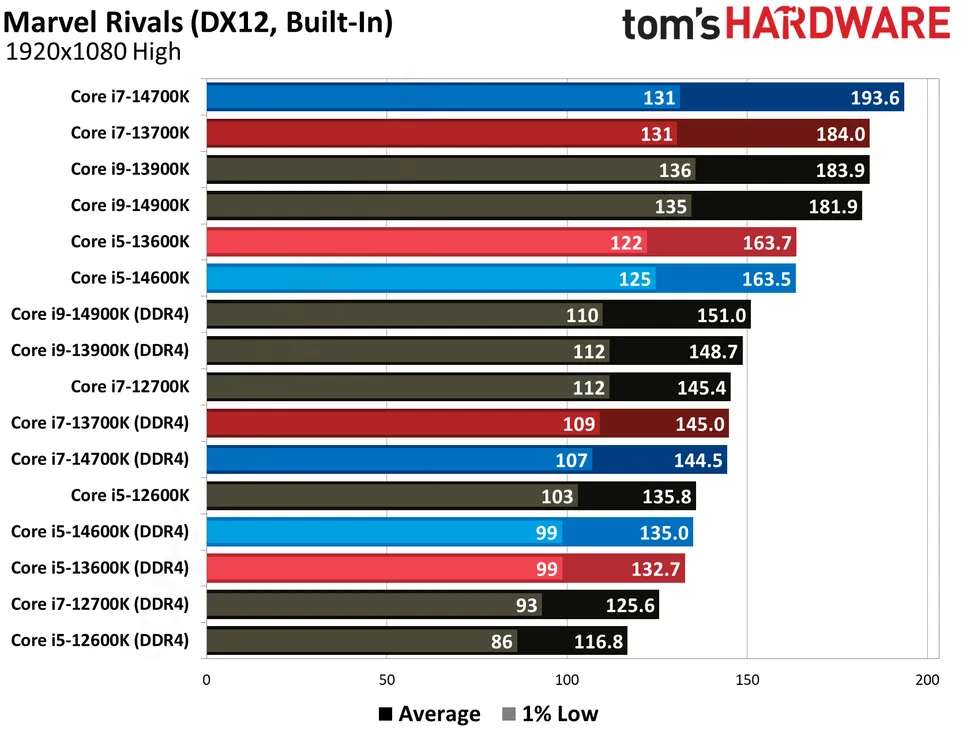
Image source: Tom’s Hardware
In “007 First Light”, the Core i9-14900K was 16.5% slower using DDR4, and the Core i5-13600K also lost 12.7%. This game further shows how DDR4 limits high-end processors: even the fastest Core i9-14900K, the performance curve will still be suppressed by the memory early, unable to widen the gap with other CPUs:
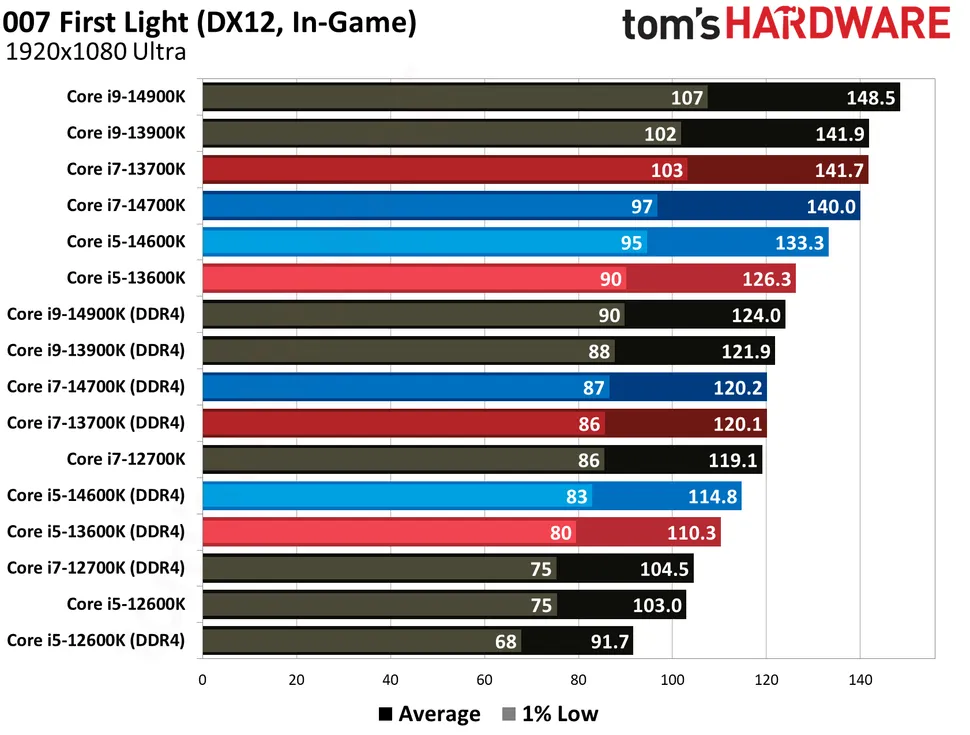
Image source: Tom’s Hardware
Spider-Man 2 is the game with the most consistent results this time around. Most of the processors tested experienced an average performance drop of about 18% when paired with DDR4. The Core i7-12700K loses 15%, and the Core i9-14900K is 18.7% slower:
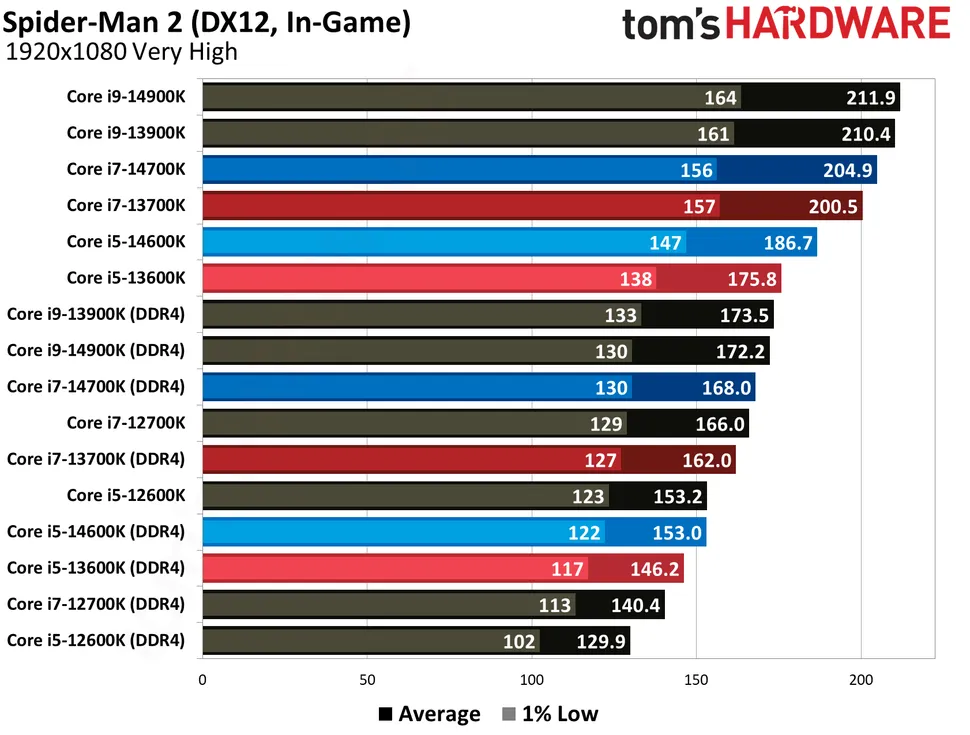
Image source: Tom’s Hardware
“Dynasty 2077” places a heavy burden on the graphics card, so logically speaking, the gap caused by memory should not be too big. However, in actual measurements, Core i7-14700K with DDR4 is still about 14% slower, and Core i5-13600K is about 13% slower:
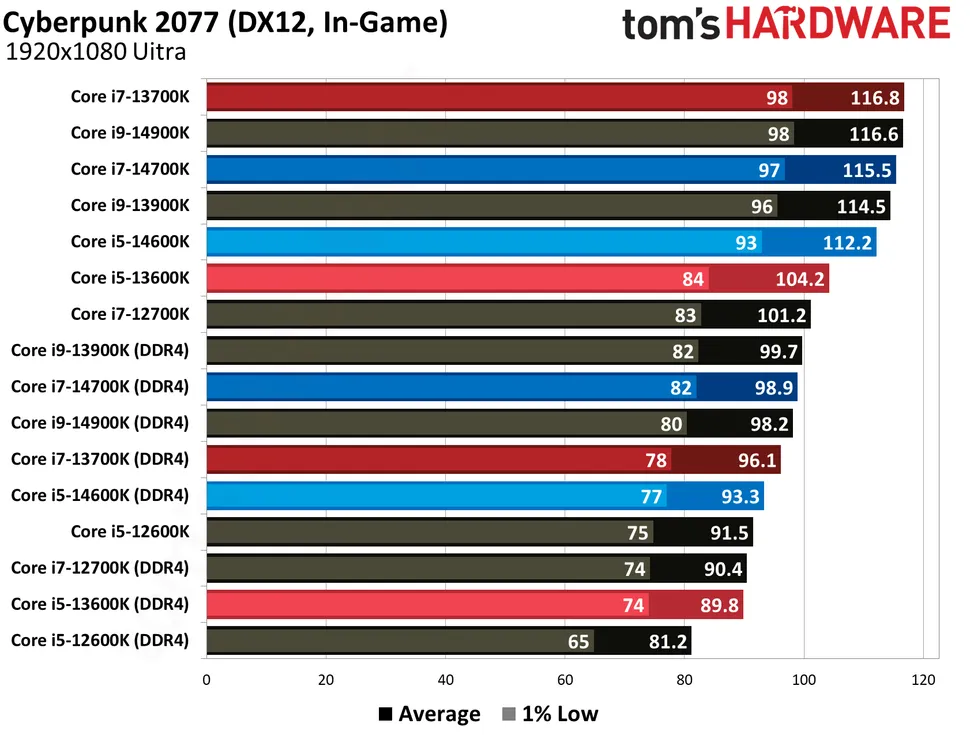
Image source: Tom’s Hardware
Things are less exaggerated in Force 2 . The measured performance of the Core i7-12700K when paired with DDR4 or DDR5 is almost identical. But after replacing it with the stronger Core i7-14700K, the gap between DDR4 and DDR5 gradually approaches 10%:
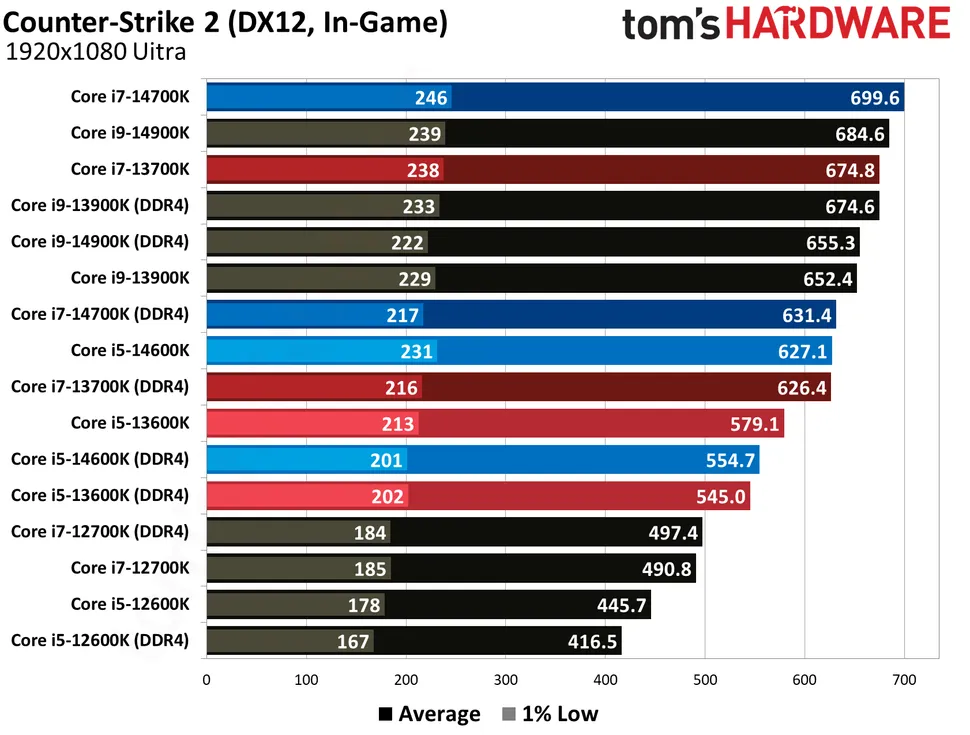
Image source: Tom’s Hardware
In addition to FPS, Tom’s Hardware found that CPU power consumption on the DDR4 platform will also increase slightly, but not by much. The processor temperature in the game is also far below the safe upper limit, but this also means that DDR4 is not only slower, but may also cause the CPU to consume a little more power.
So, if you are playing games and plan to use it for a long time, DDR5 may be a better option, not only avoiding the average game performance loss of about 11% to 14%, but in specific game and processor combinations such as “Marvel Confrontation”, the gap will even widen to 25.3%.
Source: KOCPC Chinese