


A laptop prototype that has not yet been launched on the market was picked up by someone on the roadside?TechPowerUp ForumNetizen Fouquin described in the article that he saw a silver square object on the roadside north of Redmond, Washington, USA, in mid-June. When he got closer, he discovered that it was a complete laptop. Of course, this should be just a made-up story, but he did get a prototype of the Microsoft Surface Laptop Ultra, codenamed EV1.5, which has not yet been released, and has been using it for about a month. As for how the machine came about, he did not publicly explain.
This prototype is equipped with NVIDIA’s upcoming RTX Spark N1X chip, which Fouquin has experienced and tested for a long time. Although the specifications are very strong, the current user experience can only be described as “not ready yet” because the driver is not yet mature.
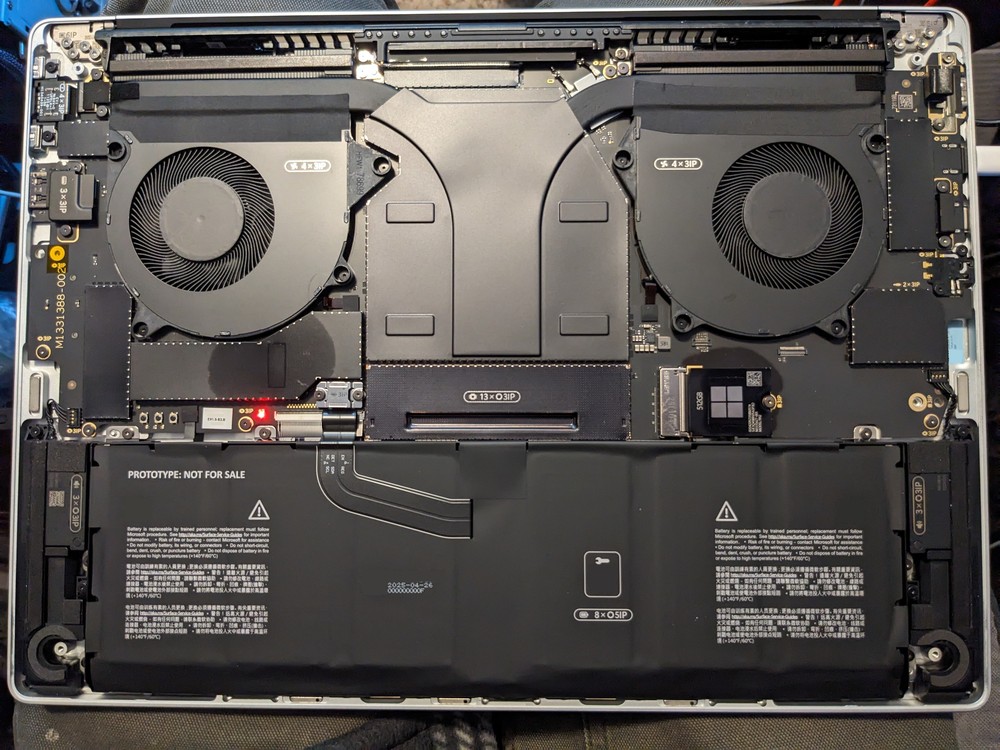
NVIDIA RTX Spark N1X prototype tested and exposed, games frequently freeze and the 616.00 driver is still not mature
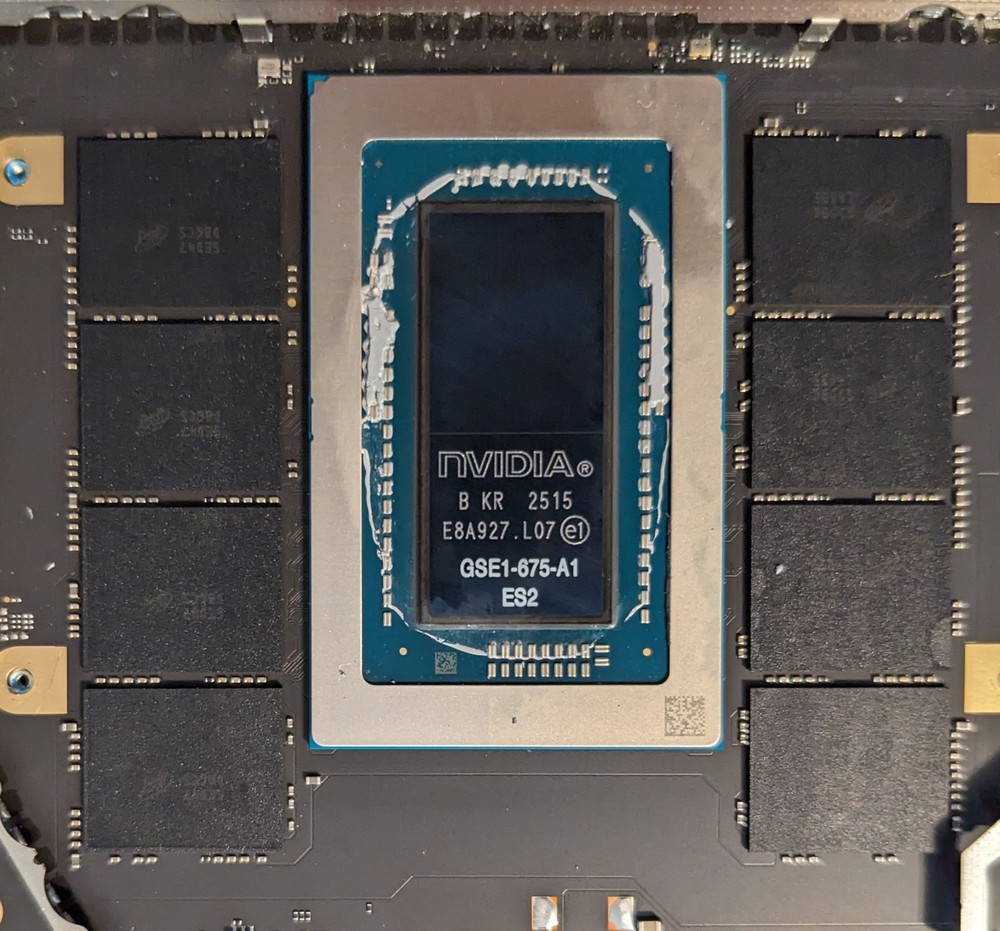
According to Wccftech reportThe Surface Laptop Ultra laptop tested by Fouquin is equipped with a full-spec RTX Spark N1X, built-in 20-core Arm processor and Blackwell architecture GPU. The GPU has 48 sets of SMs and 6,144 CUDA cores. Also comes with 24GB unified memory and 512GB SSD:
This prototype was originally installed with the Windows on Arm Game Ready driver version 591.33, launched in November 2025.
Although most games can be started directly, when executing 3D workloads, the GPU clock will jump irregularly between 1,500MHz and 2,300MHz, and severe stuttering will occur about every 6 seconds.
What’s even weirder is that the GPU performance is almost the same regardless of whether the battery is used or the power consumption is capped at 64W or 105W. Judging from his follow-up monitoring, although the top limit of the system can reach 105W, the highest PL2 is 95W. Generally, the “balanced” mode actually only allows about 75W to 80W. The Max-Q mechanism of the GPU may start to limit power consumption earlier.
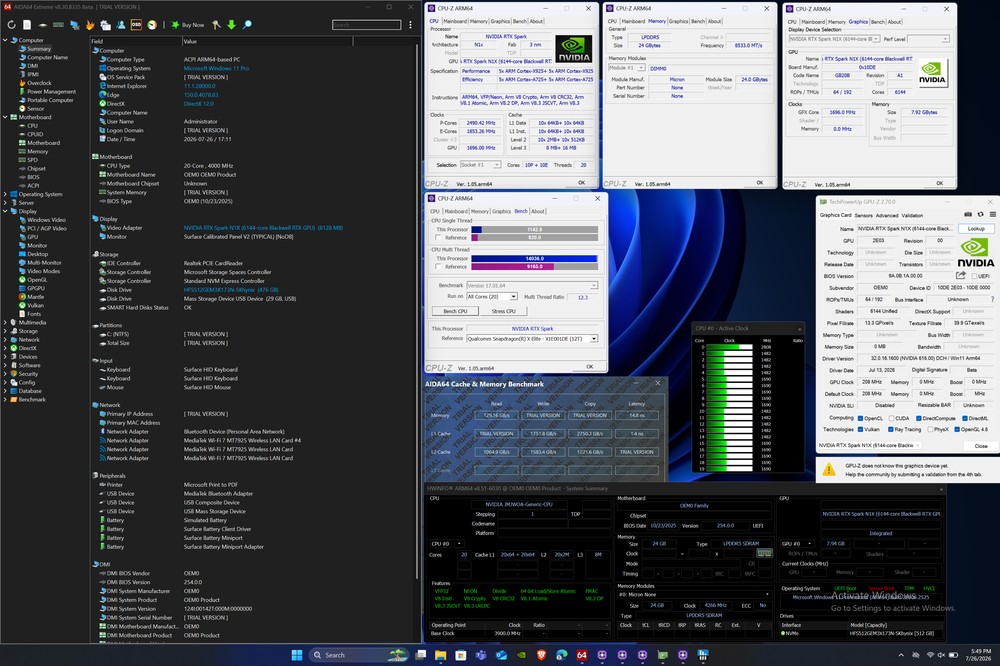
Fouquin speculates that the driver appears to be deliberately lowering performance to circumvent this version’s weaknesses. When he ran 32-bit and 24-bit integer GPGPU tests with external power and increased power limits, the entire system crashed.
While writing the test article, NVIDIA just released the 616.00 preview driver, adding CUDA 13.4 and updated OpenGL and Vulkan function support.
However, after Fouquin actually retested, there was no significant change in game performance and stability.
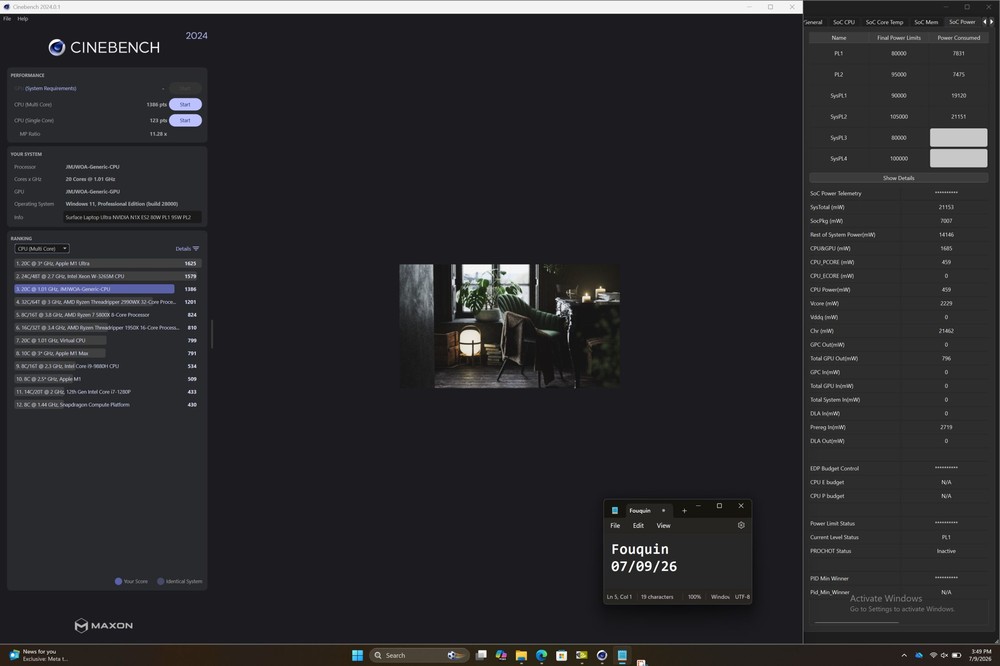
In terms of CPU running scores, Surface Laptop Ultra scored 123 points in the Cinebench 2024 single-core test and 1,386 points in the multi-core test:
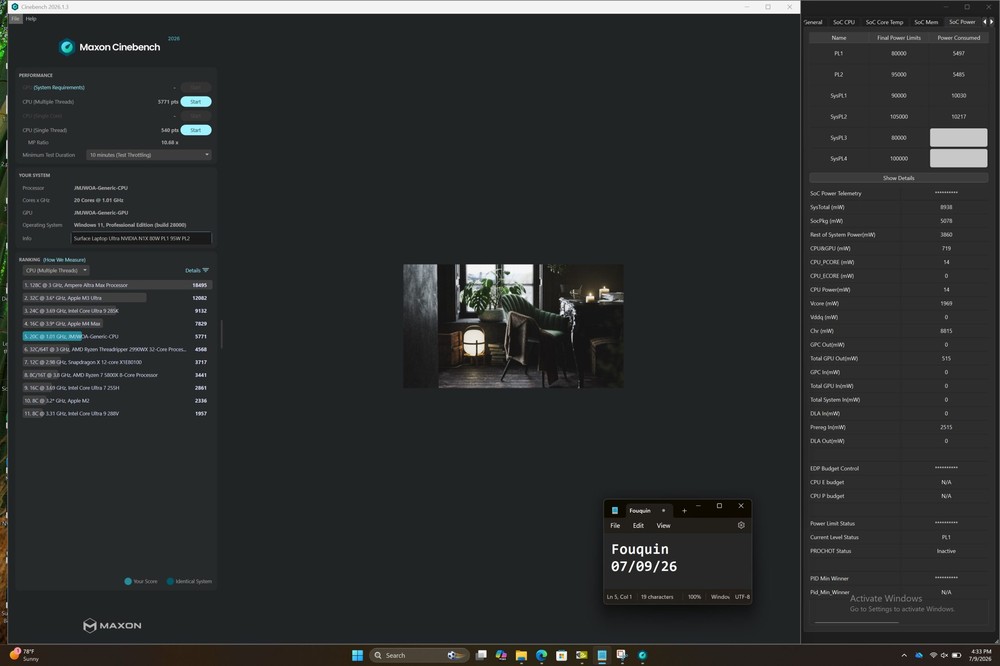
Cinebench 2026 has a single-core score of 540 and a multi-core score of 5,771:
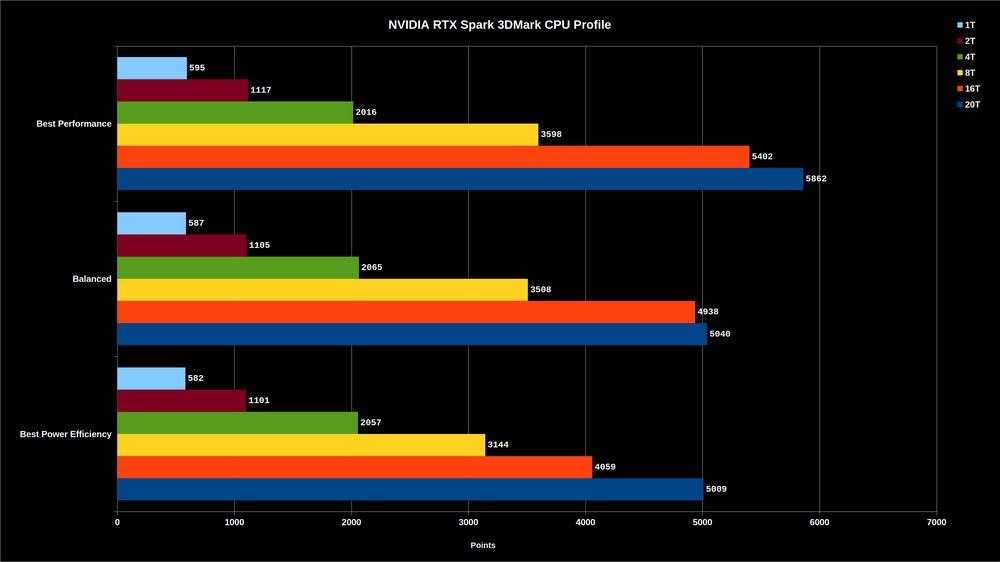
3DMark CPU Profile can better see the differences caused by different power modes. The best performance modes from 1, 2, 4, 8, 16 to 20 threads scored 595, 1,117, 2,016, 3,598, 5,402 and 5,862 points respectively; the balanced mode scored 587, 1,105, 2,065, 3,508, 4,938 and 5,040 points respectively; the best energy efficiency mode was 582, 1,101, 2,057, 3,144, 4,059 and 5,009 points:
The situation with AI testing is even more embarrassing. Although CUDA 13.4 has been installed on the system, none of the models in the Phoronix Test Suite can be completed properly through CUDA. Each attempt will get zero results and time out after a few seconds. During execution, NvMon shows that the SoC and GPU power consumption drops directly to zero.
Switching back to Vulkan Compute will cause the GPU to start functioning again, consuming approximately 40W. Fouquin tried multiple correction methods but still couldn’t solve it. In the end, he could only collect the Vulkan Compute and CPU BLAS results that were barely completed.
Fouquin uses llama-bench to test Q8_0 quantized Qwen3.5 9B with gpt-oss 20B.
When executing Qwen3.5 9B through Vulkan Compute, pp512, pp1024 and pp2048 are 1,543.16, 1,582.68 and 1,741.19 tokens per second respectively, and tg128 is 22.45 tokens per second:
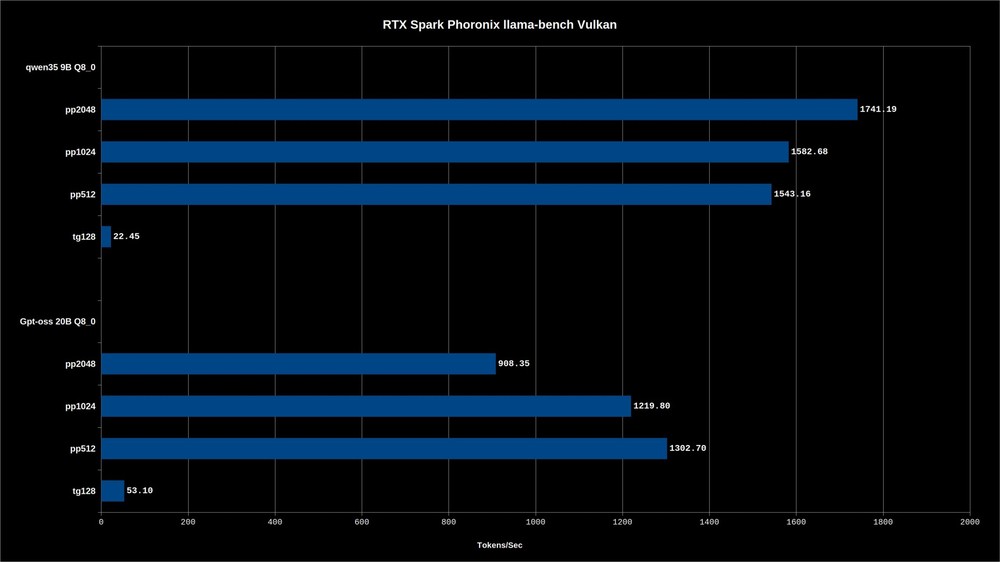
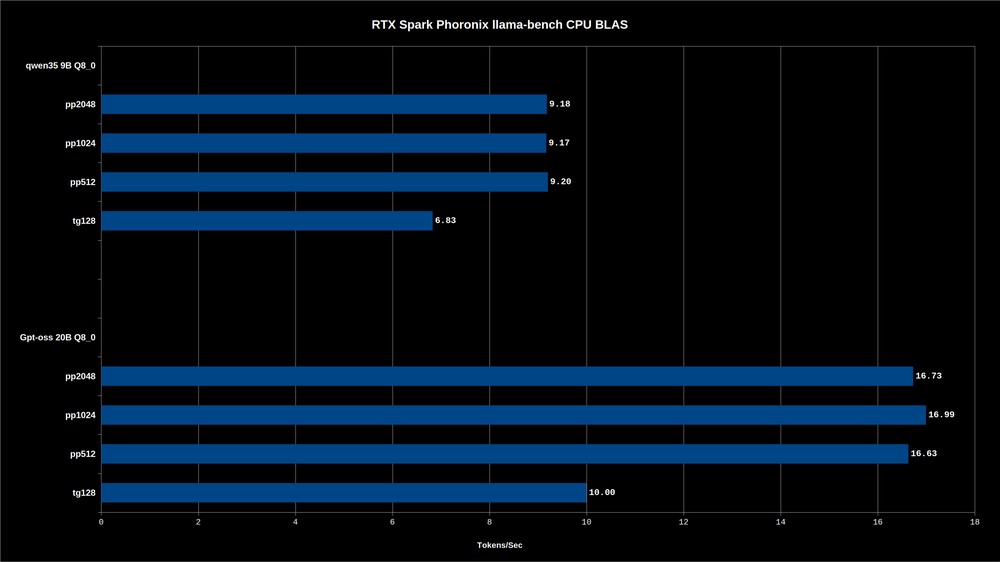
After switching to CPU BLAS, the three prompt word processing results are only 9.20, 9.17 and 9.18 tokens per second, and tg128 is 6.83 tokens per second. Calculated using the same model and test items, Vulkan’s prompt word processing speed is about 168 to 190 times that of CPU BLAS, but the text generation speed is only about 3.3 times faster:
The results of Gpt-oss 20B also have a similar gap.
Vulkan Compute’s pp512, pp1024, and pp2048 are 1,302.70, 1,219.80, and 908.35 tokens per second respectively, and tg128 is 53.10 tokens per second. CPU BLAS are 16.63, 16.99, 16.73 and 10.00 tokens per second respectively. Vulkan is about 54 to 78 times faster in the prompt word processing stage and about 5.3 times faster in text generation.
At present, for a platform with CUDA and AI as its main features, the results are indeed not very good. Foreign media Wccftech believes that the large amount of performance space left by this prototype is more likely to come from immature firmware and drivers rather than the N1X chip itself.
According to previous official announcements from NVIDIA, RTX Spark laptops and small desktops are expected to be launched in the fall of 2026. The first batch of partner brands include Microsoft Surface, ASUS, Dell, HP, Lenovo and MSI, so there is still some time before the official launch.
Source: KOCPC Chinese