


previously OpenAI It’s already been reported that they… Apple Design legend Jony Ive partners to create a brand new AI Devices and AI earphones, but that’s not all the hardware OpenAI wants to develop. Earlier, well-known analyst Ming-Chi Kuo revealed on social media that OpenAI has alreadyQualcomm、MediaTekJointly developing a proprietary mobile processor, with Luxshare Precision serving as the system co-design and manufacturing partner, targeting the premium smartphone market of 300 to 400 million units annually—sources say OpenAI has already begun paving the way for its own AI phone plan.
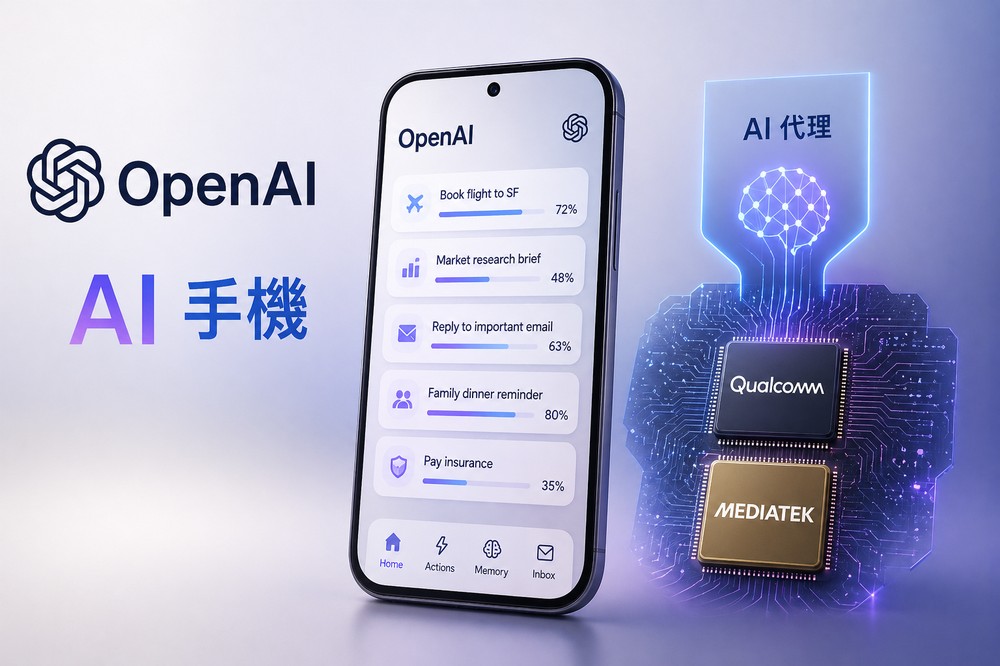
OpenAI is partnering with Qualcomm and MediaTek to develop smartphone processors! With an annual shipment target of 300 to 400 million units, paving the way for AI phone plans.
According to Ming-Chi Kuo’s latest leak, OpenAI has already begun seeking partners for its AI phone, with chips expected to be jointly handled by Qualcomm and MediaTek. This indicates that OpenAI won’t design chips from scratch but will customize based on both companies’ existing mobile chip technologies. Assembly will be handled by Chinese company Luxshare Precision. Kuo specifically emphasized that Luxshare is the exclusive system co-design and manufacturing partner, meaning the phone’s entire process from design to production won’t follow Foxconn’s mainstream route.
Regarding specifications and timeline, OpenAI is expected to finalize processor specifications and supply chain list between late 2026 and Q1 2027, with formal mass production not starting until 2028, so there’s still some time. However, the shipment targets are already very ambitious, with annual shipments expected to reach 300 to 400 million units, a volume essentially aimed at taking on the iPhone and Samsung Galaxy S series.
Ming-Chi Kuo noted that the processor’s core design considerations will focus on three aspects: power consumption, memory hierarchy management, and on-device inference for compact foundation models, while offloading more demanding computations to the cloud for processing—a hybrid on-device plus cloud inference design similar to Apple Intelligence.
As for why OpenAI is willing to spend big money on an AI phone – only by having complete control over the operating system and hardware can OpenAI build a truly comprehensive AI agent service.
Currently, ChatGPT runs on iPhones and Android devices, and many things are constrained by Apple and Google’s system permissions. For example, asking AI to order food delivery might require jumping through multiple apps and confirming multiple times, resulting in a less-than-ideal user experience. But with OpenAI’s own phone, AI could directly call underlying functions without being restricted by anything.
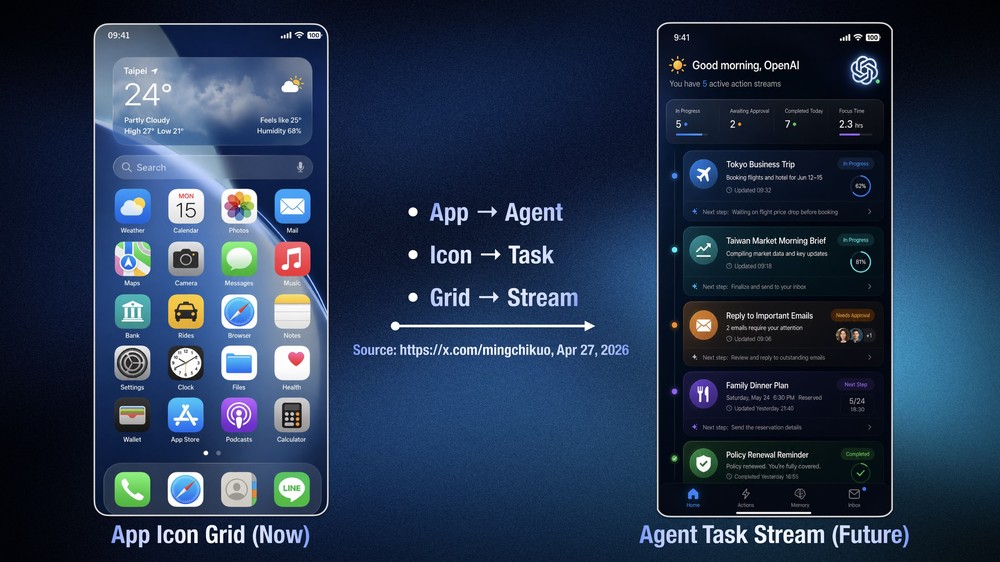
Ming-Chi Kuo also released a concept render of the OpenAI phone. The interface looks completely different from iOS and Android—there’s no screen filled with app icons and folders. Instead, there’s a “task list” showing items like: booking flight tickets, market briefings, replying to important emails, family dinner reminders, insurance premium payments, and more. Each task displays its current completion percentage, with four sections below: Home, Actions, Memory, and Inbox.
Since there’s at least two years left, it’s best to keep this news in mind for now, given how quickly the AI market is changing.
OpenAI and Jony Ive’s first AI device (internal codename “Gumdrop”) is expected to arrive first, possibly in 2026 or 2027. It will be a small screenless device that can fit in a pocket or hang around the neck. Additionally, there’s previous talk of an AI earphone with codename “Sweetpea,” which is said to use Samsung’s 2nm Exynos chip for some on-device processing.
Source: KOCPC Chinese