


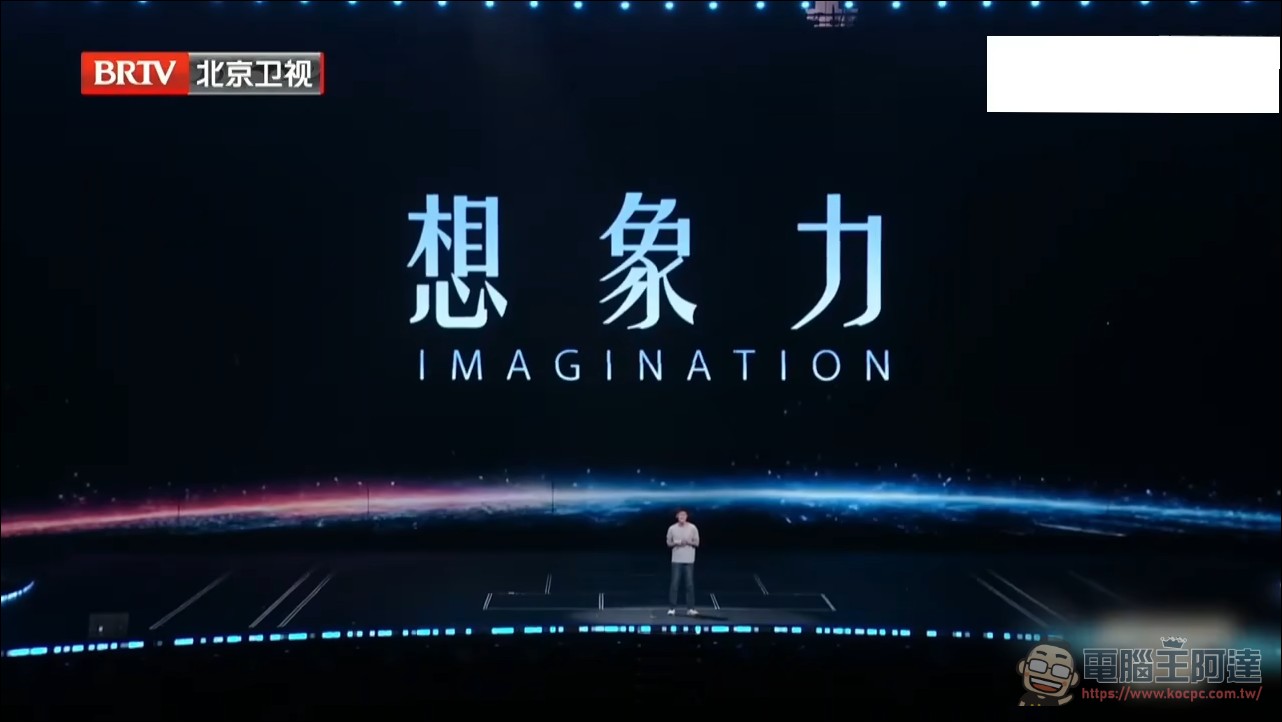
Douyin’s parent company, ByteDance Group, invited Media Storm founder Pan Tianhong (Tim) onstage during the technology segment of 2026 Wonderful Night to demonstrate a world model. After a user enters a text description, the system instantly generates a corresponding 3D virtual world that people can freely explore, and they can continue giving commands to modify the scene.
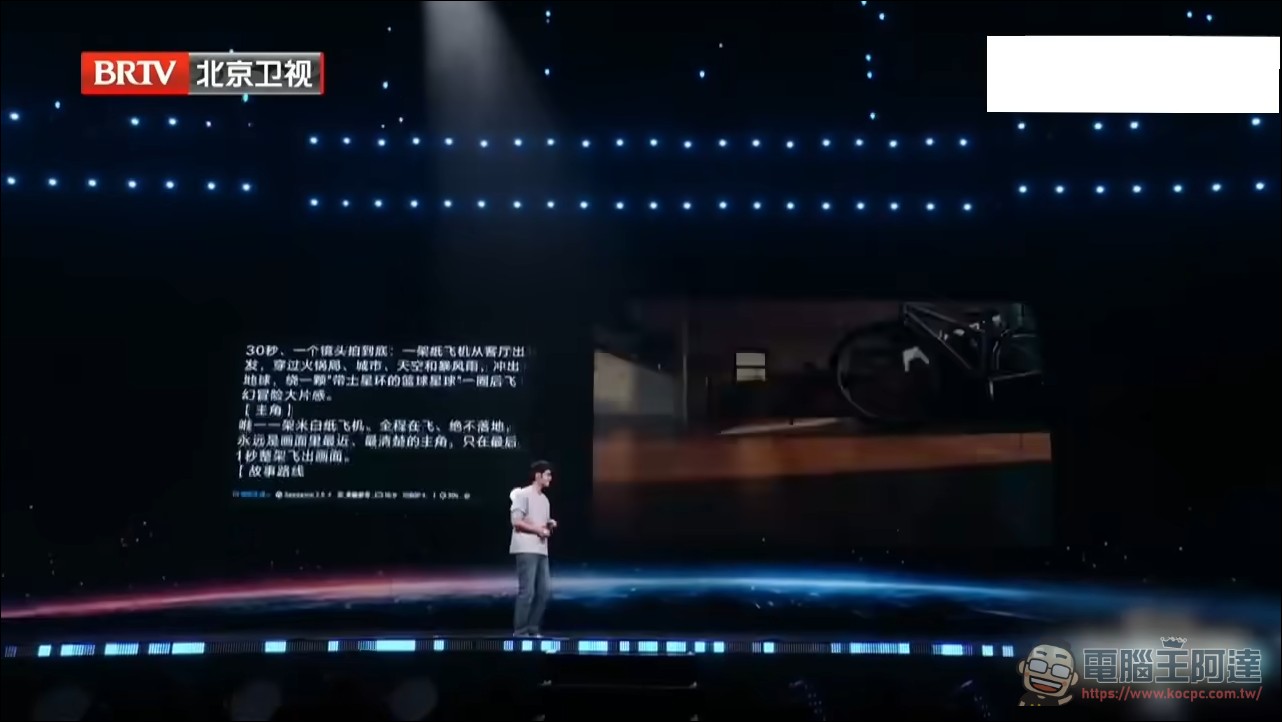
Throughout the demo, the user can jump off a paper airplane and interact with the scene, and the visual detail and fluid interaction are also highlighted. Even more unusual is real-time object creation: he casually said, “I want an extra spoon next to the cup,” and the next second a spoon appeared beside the cup. The character could even climb along it and interact with it. He described this ability to generate objects at will as “making his words reality”—a childhood fantasy come true.
From watching movies to stepping into movies.
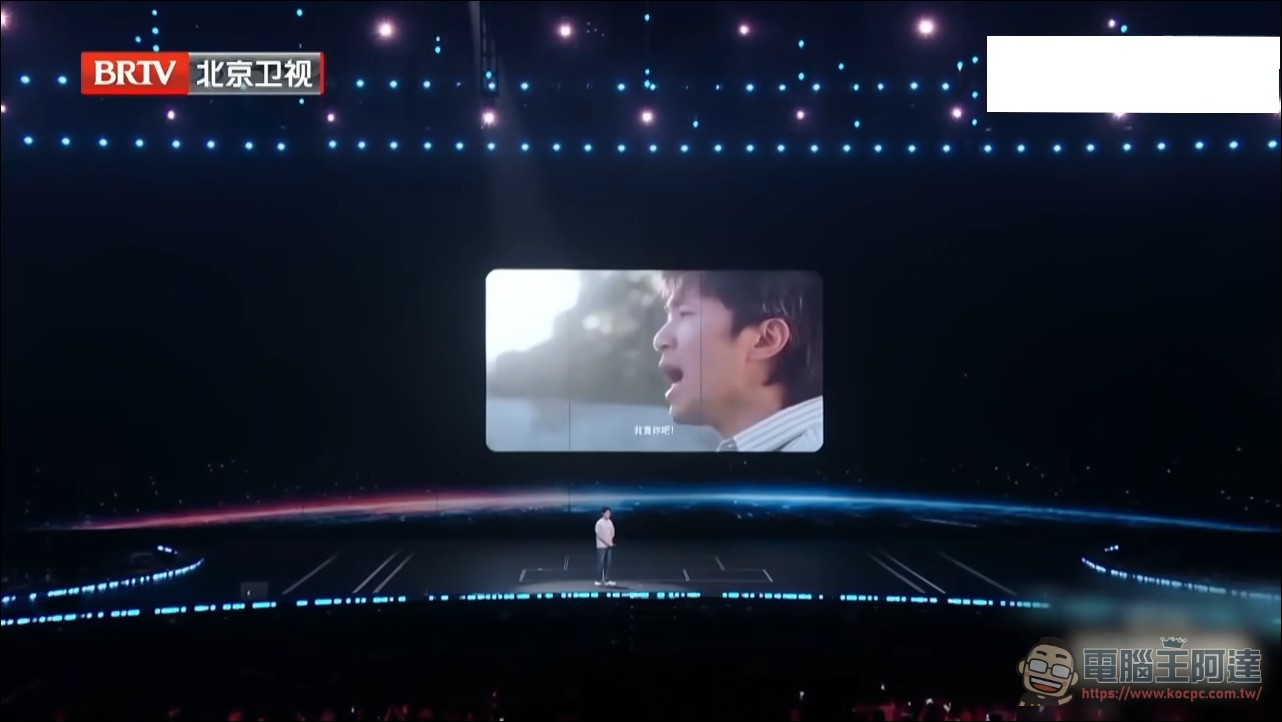
Next up is the application in film and television production. A clip from Stephen Chow’s directed King of Comedy was played on site, and it was explained that prior authorization had been obtained from the director. The footage is a work familiar to audiences, but it is shown from an angle different from what they usually see. In the past, blocking that required a dozen or more camera positions to complete can now be previsualized simply by drawing a trajectory. He summed up the significance of this demonstration as: the visual effect comes from the world model itself; pure video generation cannot achieve it; experientially, it is like “going from watching a movie to walking into a movie.”
Anywhere Door and World Coordinates
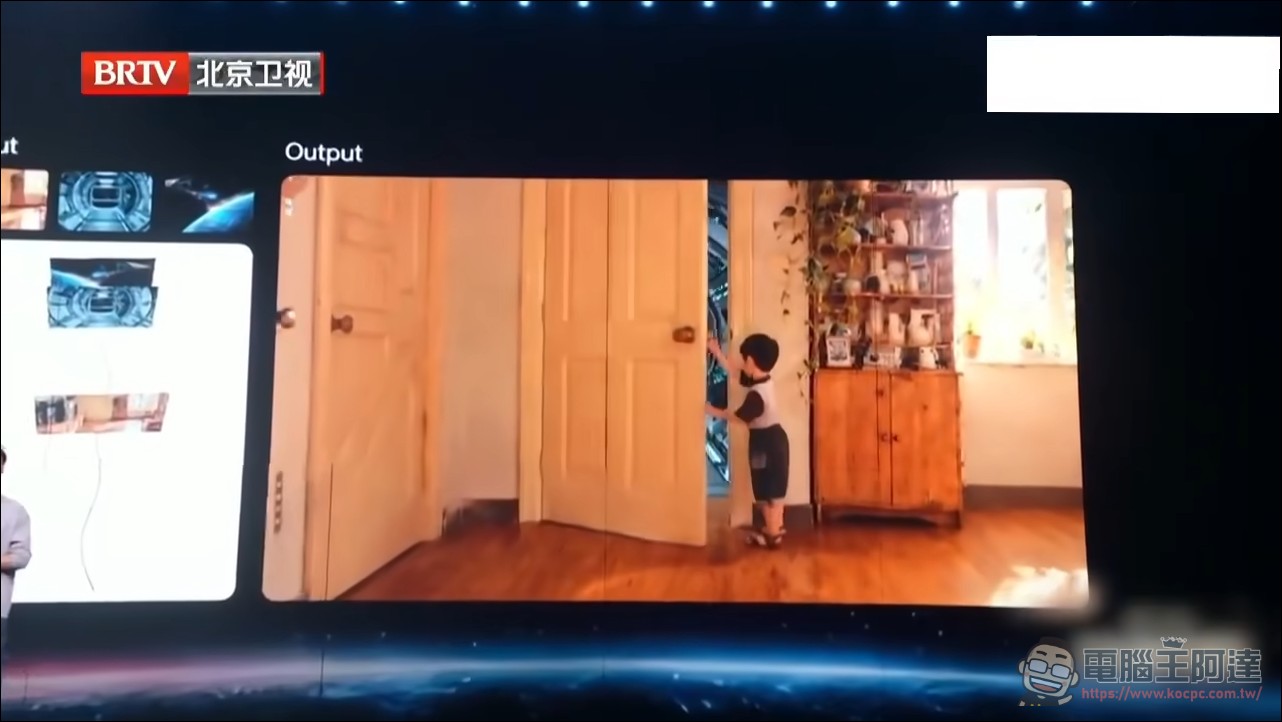
Next is the “Anywhere Door.” He says that as a child, what he wanted most was to open the door at home and roam the universe, and that in the world model, a person can decide what is in the world, where it is, and how things connect to one another. In the demo, memory and imagination each have their own coordinates, and the universe is placed next door to his hometown.
Training grounds for robots and autonomous driving
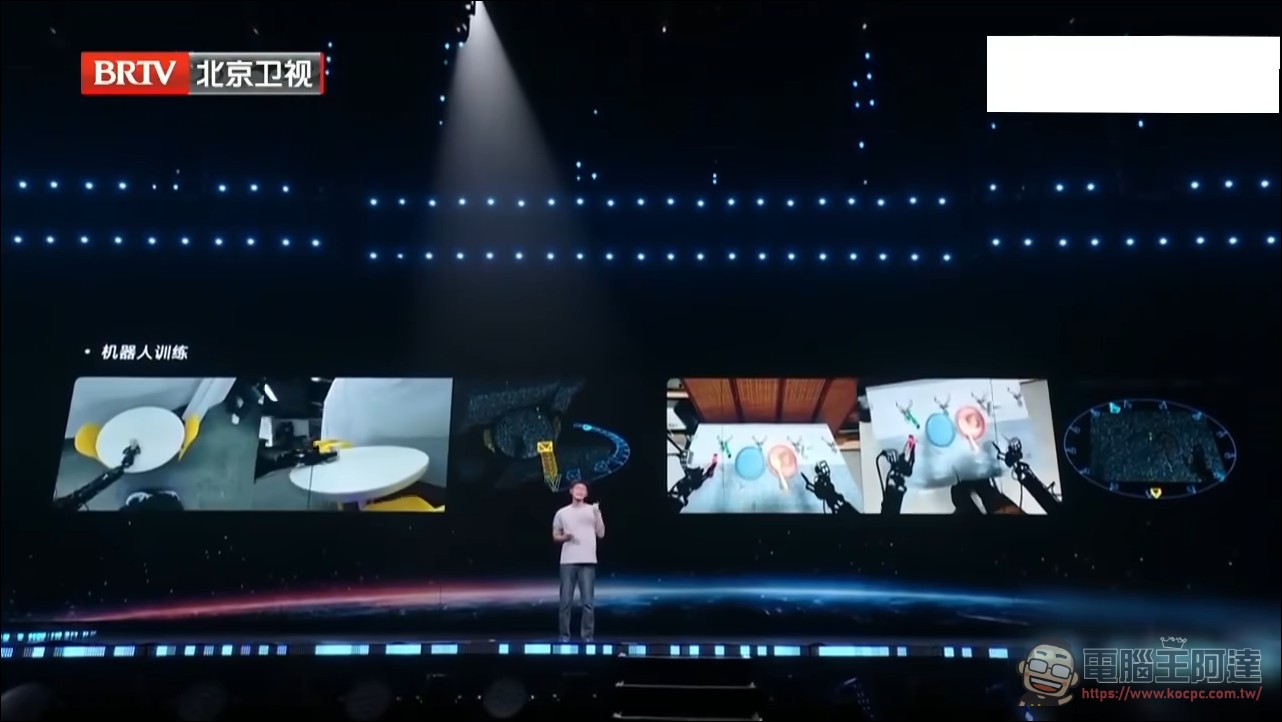
The latter half of the demo shifted toward industrial applications. He replaced the protagonist of the scene with a household robot: it can pick up cups and put away plates, but it’s best not to touch the figurines for now. The world model provides a sufficient training environment, letting the robot learn in the virtual world first before putting it into practice in the real world.
The same is true for autonomous driving. Sudden situations that are difficult to encounter in reality can be repeatedly simulated in the model—for example, stopping when seeing an elderly woman, avoiding an accident, and slowing down in the rain—so the vehicle can complete scenario training before it hits the road. He then mentioned that in the future it could also be used to simulate disaster rescue, physics experiments, and driving rehearsals; doctors could even put on Pico glasses to simulate complex surgeries.
The technical outline disclosed by Bloomberg in September
In fact, as early as September, Bloomberg was the first to report that ByteDance was developing a model for real-time spatial video generation, personally overseen by founder Zhang Yiming, with a launch as early as October. The report said he personally coordinated cross-departmental resources and concentrated AI compute on the project; the system is built on the existing video generation model Seedance and can be used to create interactive virtual worlds, with target scenarios including live streaming, short dramas, and games. A ByteDance spokesperson did not respond to Bloomberg’s request for comment at the time.
Bloomberg describes this set of models as a flywheel, with its own AI models and cloud computing power at one end and content platforms and Pico hardware at the other; Zhang Yiming hopes to mesh the two ends together. The report also benchmarks it against Google’s Genie; since Genie launched this year, users have been able to walk around in real-time rendered street-view scenes. Rumor has it that the world model alone consumes the largest data budget among all of ByteDance’s model directions, three to four times the amount of other subsidiaries.
The technical metrics mentioned in the report are an end-to-end latency of about 50 milliseconds and a generation frame rate of about 20 frames per second, with all visuals generated in the cloud. This figure has concrete significance for interactive experience: the interaction latency threshold for human visual perception is roughly between 50 and 100 milliseconds, and at 50 milliseconds, users can barely perceive any delay between the visuals and their actions. Remote rendering also reduces the computing burden on the headset, thereby lowering hardware costs. Traditional VR relies on pre-rendered content and local computing power, while real-time cloud generation is equivalent to moving computing power to servers, leaving the endpoint responsible only for display and motion capture.
To date, there is no official product, only research.
Although the launch events have all been held with great fanfare, ByteDance has not yet officially released any world model product. The latest update on the Seed official website is SeedRealtime on August 5, preceded in order by Seedance 2.5 on July 31, Seed STEM on July 23, Seed Audio 1.0 on July 20, and Seedream 5.0 Pro on July 8; there is no world model product name, page, or timeline. The only place where the official introduction mentions world models is the research directions list on the Seed team page.
Position on the global track
World models became a prominent field in 2026, but each player is entering from a different position. Google DeepMind is pursuing the Genie series; World Labs, founded by Fei-Fei Li, is taking the route of general-purpose world simulation and creator tools, with its Marble able to generate enterable 3D scenes from text or images. NVIDIA has connected Cosmos and Lyra 2.0 to the Isaac simulation platform to generate training data for robots and autonomous driving, a route closer to Physical AI.
Chinese companies, by contrast, tied their approaches to scenarios from the very start. Tencent open-sourced HY-World 2.0, focused on 3D assets that can be imported into Blender, Unity, and Unreal Engine. Alibaba launched Happy Oyster, split into a free-roaming mode and a director mode that allows intervention during generation, outputting audio and video streams. JD.com is betting on supply chain scenarios and a 100,000-card domestic compute cluster, aiming to close the loop between virtual simulation and physical execution. Upstream chipmakers are entering too: in September, AMD announced it would acquire World Labs in an all-stock deal worth $8.2 billion (about NT$266.5 billion).
ByteDance has chosen to position itself in content consumption. Rather than building a general-purpose platform, it connects models, computing power, Pico headsets, and the Douyin ecosystem into a single line aimed at interactive livestreaming, interactive short dramas, and immersive games. The advantage of this route is its existing content ecosystem and user scale; the limitation is that its scenarios lean toward virtual experiences, making it harder to directly enter real physical scenarios such as industrial, logistics, and robotics.
The parts not yet confirmed
ByteDance has still not officially confirmed whether the model demonstrated at Beautiful Wonder Night is the real-time spatial video model developed based on Seedance reported by Bloomberg, nor has it announced the product name, launch date, or detailed performance figures. The 50-millisecond latency and 20 frames per second in the report come from anonymous sources, with no technical paper or independent benchmark tests to support them, and the timeline itself has been described as still subject to change. The model has not yet been officially released, but it has already demonstrated capabilities including 3D scene generation, free exploration, real-time interaction, object editing, and cross-scene connectivity. ByteDance arranged its debut on the stage of its own gala rather than at a developer conference, sending a clear signal: it wants general audiences to see it first, and to discuss technical specifications later.
Source: KOCPC Chinese