


Longtime Apple fans probably know that Apple and NVIDIA had a falling out and stopped supporting NVIDIA graphics cards a decade ago. However, a developer recently spent a few weeks creating an open-source driver that lets an RTX 5060 run macOS 15 Sequoia with full acceleration on Intel Macs and Hackintoshes (booted via OpenCore): the desktop, Metal 3, applications, and games are all output by the NVIDIA card.
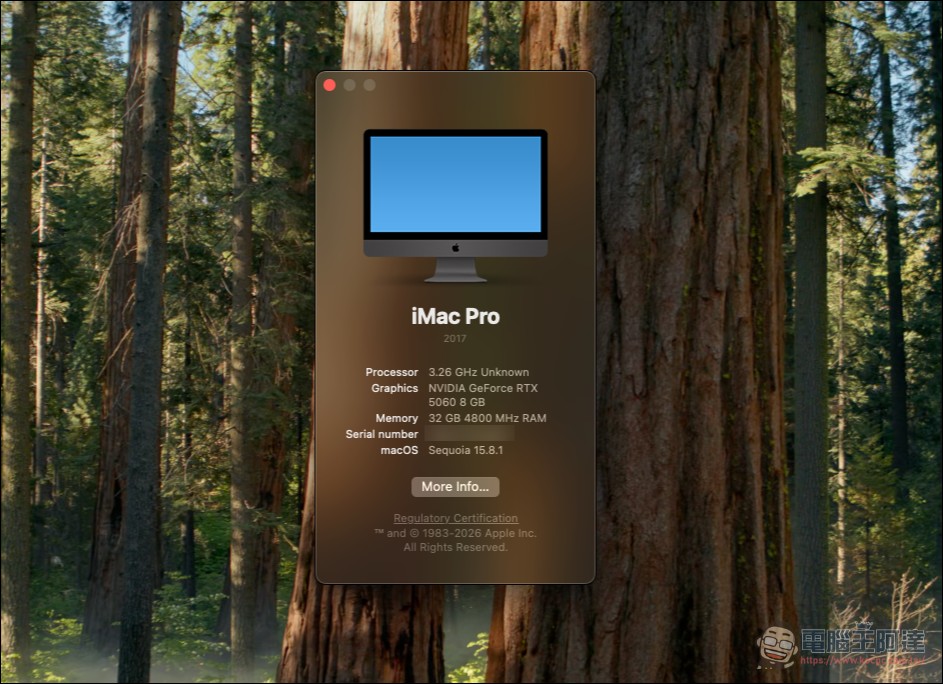
Limited to Intel and Hackintosh
However, there are a few key points to mention first: First, Apple Silicon does not support this driver at all; it is exclusive to x86_64 (This has nothing to do with the M-series external GPUs running AI that we talked about earlier.); Second, although the device table covers the entire GTX 16 to RTX 50 lineup and workstation cards, only the RTX 5060 has been verified on real hardware; third, the author himself posted on Reddit, “I can’t guarantee it will run on every machine; there have already been bug reports, so I’d recommend waiting and seeing.”
** Mac OS Nvidia Driver Out Now **
byu/null-moth inhackintosh
Let me also add some background: NVIDIA’s official support for macOS ended a decade ago. The last version of the macOS driver on the official download page was 387.10.10 from November 2020, corresponding to graphics cards from the Mojave era. After that, Apple’s M series switched to in-house GPUs, and NVIDIA cards were given a death sentence on the Mac.
null-moth’s progress actually started coming to light in late September. The September 25 development report already showed an RTX 5060 rendering an entire desktop on Sequoia 15.7, and a week later the source code was dropped, an astonishingly fast pace. The technical core of this driver is a three-layer relay architecture. The bottom layer consists of four kernel extensions (NVRM, NVAccel, NVRMFB, NVRMAGDC), porting NVIDIA’s own open-source GPU kernel modules to the macOS kernel, responsible for initializing the GPU firmware, managing memory and interrupts; the firmware file (GSP 610.57.04) is taken unchanged from NVIDIA. The middle layer ports Mesa’s NVK Vulkan driver to macOS as the compute backend. The top layer is a Metal plug-in, NVMTLDriver.bundle, which makes macOS apps think they are talking to a native Metal GPU. The development progress post breaks each layer down further: NVRM.kext is NVIDIA’s open-source GSP-RM kernel module ported to XNU, NVRMFB handles display output, and NVK together with the NAK compiler is responsible for compiling instructions for NVIDIA cards.
The official spec sheet lists support for Metal 3 (argument buffers tier 2, ray tracing, mesh shaders, MPS, MetalFX path), OpenGL (via Apple’s GL-on-Metal), OpenCL, Core Image, and Core ML. But the release notes are very conservative: the full behavior of RTX 5090, macOS 26, integrated/discrete GPU switching, DRM, and Firefox/Blender/Geekbench has not yet been qualified, so before seriously running games, check the qualification scope in the release notes. The spec sheet also reminds itself: the device list is broader than real-device validation, and being listed does not mean it will run.
On the AI application side, the official support list includes Core ML, Core Image, and MPS, so Apple ecosystem AI inference models “may have a chance” to run on Nvidia cards through a translation layer; however, the official documentation makes no mention of the CUDA ecosystem (PyTorch, etc.), so whether AI can be used remains an open question.
Moreover, this solution is a bypass, not a rewrite. It does not reconstruct Apple’s closed internal Metal implementation; instead, it translates the AIR bitcode of Metal shaders into SPIR-V in real time, then feeds that to NVK to compile into instructions Nvidia GPUs can execute. The translator is derived from the open-source project metal2vulkan. For app developers, the significance of this route is that they don’t need to change their programs or touch the system; once the driver is installed, they gain an extra “native” Metal graphics card. In principle, it seizes on the gap left behind when Apple compiles Metal shaders: the AIR intermediate bitcode, which is what makes translation possible. This also explains why the whole solution currently only applies to the x86_64 version of macOS 15; Apple Silicon’s closed architecture doesn’t even have that gap.
Foreign media describe this as a “parallel path”: rather than restoring official support, it bypasses restrictions and uses translation to fill the gap; the bigger problem is that Apple has announced macOS Tahoe will be the last version for Intel processors, and community projects like this are part of the wave of keeping Intel Macs alive.
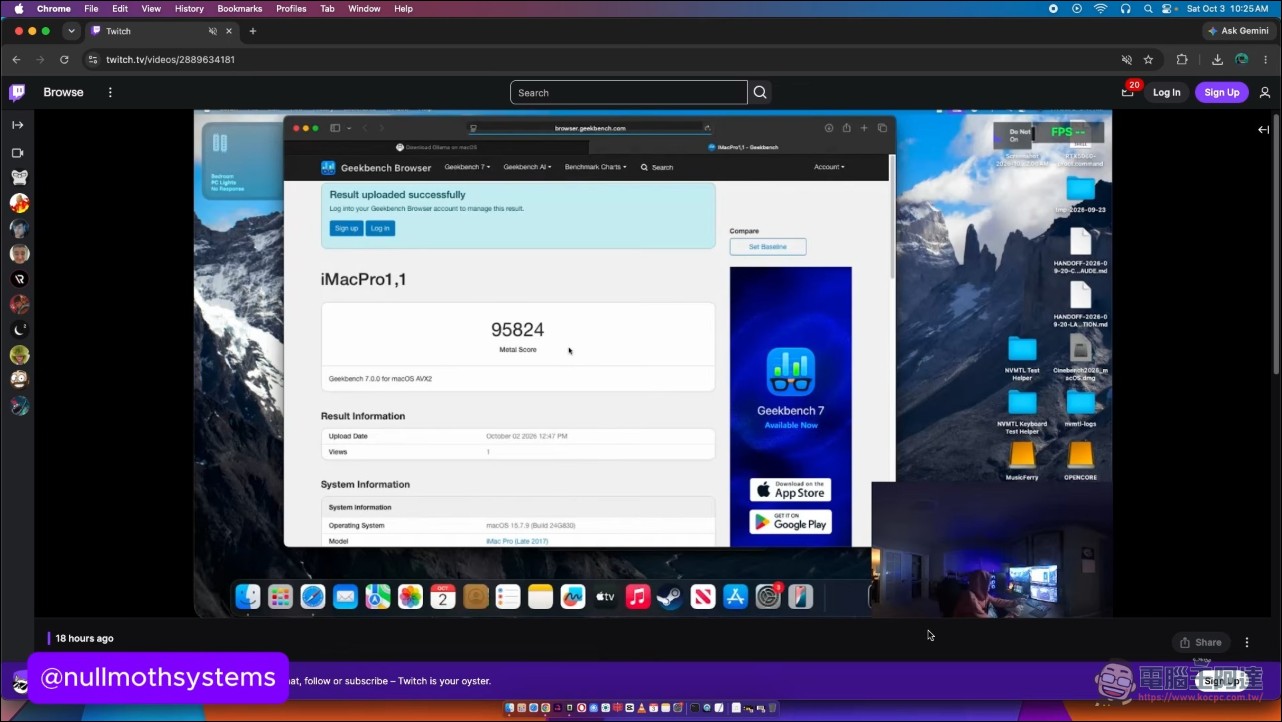
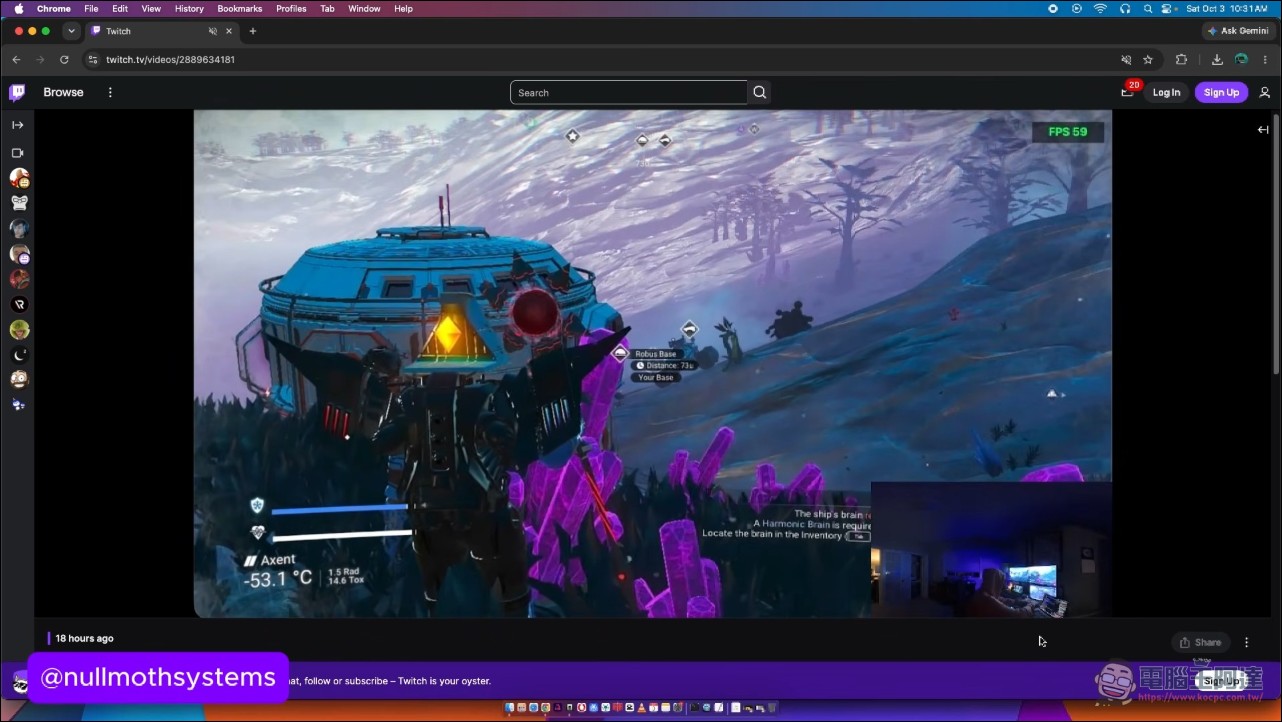
netizenHands-on test videoIn it, the RTX 5060 scored about 95,824 on Geekbench 7 GPU in macOS, runs No Man’s Sky at a playable 84 to 90 FPS, and touts CUDA, HEVC, and hardware ray tracing as available; earlier development logs showed the entire desktop—including WindowServer, Dock, and Finder—being rendered by the Nvidia card, and even hardware ray tracing. A YouTube feature described this as “the first time in decades.”
For the average Mac user, this breakthrough actually doesn’t mean much. First, it only supports Intel Macs or Hackintoshes, so it’s completely meaningless for users of today’s mainstream M-series processors; it’s mainly meant to keep old machines alive (Hackintosh users almost always install Windows for dual-booting too). Also, its installation barrier isn’t low either—old Intel Macs first have to use OpenCore to make them bootable and runnable.New version of OS HackintoshOnly then does the driver come into play. As for an official response from NVIDIA, there has still been none; after all, the driver was built using its own open-source modules, and even the firmware was left untouched, so legally it’s all clean open-source licensing. What Apple fans should be more concerned about, instead, is whether the M series, with the efforts of AI startups, can get external GPUs to run games and AI—that would be more practical.
Source: KOCPC Chinese